


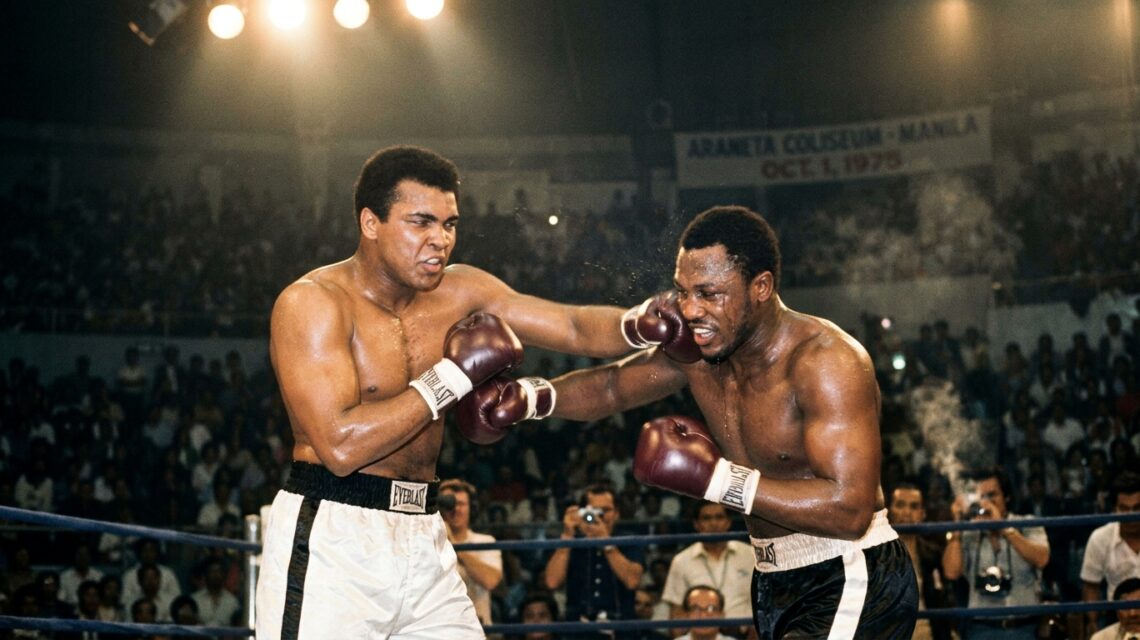
The Thrilla in Manila pushed two heavyweight legends to the edge of physical collapse. More than 50 years later, the most remarkable part of the fight is not who won, but how close both men came to being unable to continue.
By Marcio Tamer
Updated October 23, 2026
On October 1, 1975, Muhammad Ali defeated Joe Frazier in one of the most punishing heavyweight championship fights ever recorded. But the decisive moment came not from a knockout punch. It came from a trainer who refused to let his fighter absorb another three minutes of punishment.
Inside the sweltering Araneta Coliseum in Quezon City, part of metropolitan Manila, Ali and Frazier battled for 14 rounds in the final chapter of a rivalry that had already transformed boxing. Ali was 33, Frazier was 31, and both had endured years of physical punishment before entering the ring.
By the end, Frazier’s vision was severely compromised, Ali was barely able to celebrate, and veteran trainer Eddie Futch had made the decision that would determine the result.
Ali retained his world heavyweight championship by technical knockout, winning their three-fight series 2-1. Yet the victory revealed something that the official result could not capture: the extraordinary physical cost of a rivalry neither man had been willing to surrender.
Three Fights, Four Years and a Rivalry That Divided America
The Thrilla in Manila was not an isolated championship contest. It was the culmination of four years of competition, political controversy and increasingly personal hostility.
Their first encounter, on March 8, 1971, was promoted as the Fight of the Century. Both men entered Madison Square Garden as undefeated heavyweight champions with competing claims to boxing supremacy.
Frazier won by unanimous decision after 15 rounds, famously knocking Ali down with a left hook in the final round. It was Ali’s first professional defeat.
Their rematch on January 28, 1974, ended differently. Ali won a unanimous decision over 12 rounds, evening the series and making a third confrontation almost inevitable.
The trilogy unfolded as follows:
- 1971, New York: Frazier defeated Ali by unanimous decision after 15 rounds.
- 1974, New York: Ali defeated Frazier by unanimous decision after 12 rounds.
- 1975, Philippines: Ali defeated Frazier by technical knockout after 14 rounds.
Final record: Muhammad Ali 2 victories, Joe Frazier 1 victory.
The hostility between the fighters extended far beyond sporting competition. Ali’s opposition to the Vietnam War and his role in the civil rights era made him a cultural and political symbol. Frazier, meanwhile, resented being portrayed as an establishment figure despite his own experience of racial discrimination.
Ali intensified the bitterness with personal insults, including racist comparisons that Frazier found deeply offensive. The psychological warfare helped promote their fights but inflicted damage that lasted long after their boxing careers.
By 1975, their third encounter was no longer simply about determining the superior heavyweight. It had become an intensely personal struggle.
Why the Manila Fight Became an Ordeal of Extreme Heat
The final contest took place at the Araneta Coliseum, a major indoor arena in Quezon City. Promoter Don King helped bring the event to the Philippines, where the government of President Ferdinand Marcos supported its staging.
The fight was scheduled for the morning in the Philippines to accommodate international television coverage, including American audiences.
That decision had physical consequences.
The arena’s air conditioning struggled against the tropical conditions, spectators and powerful television lighting. The fighters competed in intense heat and humidity while performing an activity that demanded extraordinary cardiovascular endurance.
Accounts differ on the exact temperature. Some retrospective descriptions place conditions above 40°C (104°F), while Frazier later recalled even more extreme heat. These figures should be treated as reported estimates rather than independently verified ringside measurements.
What is not disputed is the impact of the conditions on both athletes. Heat made recovery between rounds more difficult, accelerated dehydration and intensified the exhaustion caused by repeated punches.
The arena had a reported crowd of approximately 25,000 spectators. Contemporary coverage also reported that the fight was transmitted to audiences across 70 countries.
How Frazier Nearly Turned the Fight Against Ali
Ali started strongly, using his reach, quick combinations and straight punches to control the opening exchanges. His objective was to keep Frazier at a distance and prevent the challenger from establishing his relentless inside attack.
Frazier’s approach was fundamentally different. He moved forward behind a bobbing defensive rhythm, targeting Ali’s body and head with powerful hooks.
By the middle rounds, the momentum had shifted.
Frazier’s pressure forced Ali into increasingly difficult exchanges along the ropes. His left hook, one of boxing’s most feared weapons, repeatedly threatened the champion.
Contemporary reports described Frazier’s strongest period as extending roughly from the fifth through the 11th rounds. Ali absorbed substantial punishment and appeared increasingly fatigued.
In the tenth round, Frazier landed a powerful left that visibly affected the champion. Ali’s extraordinary endurance was being tested by a fighter who seemed unwilling to retreat regardless of the punishment he received.
But Frazier was also paying a price.
His face began swelling under Ali’s accurate punches, and his ability to see incoming attacks deteriorated as the contest continued. The same aggressive style that allowed Frazier to pressure Ali also exposed him to repeated counterpunches.
The Injury That Made the Final Rounds Especially Dangerous
The fight changed dramatically in the 12th round.
Ali found renewed attacking energy and began landing combinations that interrupted Frazier’s forward movement. The challenger continued advancing, but his defensive reactions became less effective.
By the 13th round, Ali’s punches had caused serious swelling around Frazier’s eyes. A particularly powerful sequence sent Frazier’s mouthpiece flying.
The damage was especially dangerous because Frazier already had a significant preexisting vision problem.
Historical accounts describe impaired sight in one eye before the fight, compounded by swelling around the other during the contest. Sources differ in describing the precise medical history and which eye was affected, but they agree that Frazier’s ability to see Ali’s punches had become severely compromised.
This distinction matters. Frazier was not merely exhausted or losing on points. He was increasingly unable to defend himself against punches he could not reliably see.
In boxing, that creates a danger far greater than ordinary competitive disadvantage. A fighter who cannot anticipate incoming blows may continue absorbing direct impacts without being able to protect himself effectively.
Ali recognized the opening and increased his attack. During the 14th round, he landed repeated combinations against an opponent who remained upright but was no longer defending with the effectiveness he had shown earlier.
Eddie Futch’s Decision Stopped the Fight Before the 15th Round
When the bell ended the 14th round, Frazier returned to his corner determined to continue.
His trainer, Eddie Futch, saw a different reality. Frazier’s face was badly swollen, his vision was compromised, and the punishment had become increasingly one-sided.
Futch decided that his fighter would not return for the final round.
Frazier protested. He wanted another opportunity to defeat the man who had become his fiercest rival. But Futch refused to reverse his decision.
One widely reported version of the trainer’s final words was:
“It’s all over. No one will forget what you did here today.”
The intervention ended the fight. Because the bell for the 15th round had not sounded, the result was officially recorded as a technical knockout in the 14th.
There was no conventional knockout. Frazier had not been counted out, and he had not voluntarily surrendered. His corner withdrew him because continuing posed an unacceptable risk.
Contemporary reporting confirms that the stoppage came from Frazier’s corner, rather than from Ali knocking him unconscious.
Ali Won the Fight but Was Too Exhausted to Celebrate Normally
Across the ring, Ali had also reached the limits of his endurance.
When his corner realized that Frazier would not continue, Ali briefly rose in victory before ending up on the canvas, visibly drained by the contest.
Some retellings describe him as fainting. Contemporary eyewitness accounts establish that he lay on the canvas in exhaustion, but do not conclusively establish that he lost consciousness.
The distinction does little to diminish the extraordinary physical toll of the fight.
Ali later characterized the experience as the closest he had come to dying. The statement became one of the defining descriptions of the Thrilla in Manila, capturing how extreme the contest had felt even to a man who had fought some of the most formidable heavyweights in history.
Ali also acknowledged Frazier’s exceptional ability, describing him as the greatest fighter apart from himself.
Their rivalry had produced three contests, but Manila represented a different level of punishment. Both men had entered as elite competitors; both left with the visible effects of an extraordinary physical ordeal.
The Financial Stakes Were Enormous, but the Physical Cost Was Greater
The Thrilla in Manila was also a major commercial event.
According to TIME magazine’s contemporary reporting, Ali received approximately $4.5 million for the fight, while Frazier earned around $2 million.
These figures were nominal U.S. dollars in 1975, not adjusted for inflation.
Ali’s reported purse was more than twice Frazier’s, reflecting his status as the defending champion and one of the world’s most recognizable athletes.
The financial rewards, however, offered no protection against the damage sustained in the ring.
The bout illustrated the tension at the heart of professional boxing: the qualities that make a fight commercially spectacular, including sustained exchanges and extraordinary resistance, can also make it medically dangerous.
Futch’s decision became a defining example of a trainer placing an athlete’s immediate safety above the possibility of victory.
Did the Thrilla in Manila Permanently Damage Both Fighters?
The fight is frequently described as the moment Ali and Frazier left their athletic primes behind. There is evidence that it marked an important turning point, although attributing their later health problems to this single contest would be medically unjustified.
Ali continued boxing after Manila. He lost his heavyweight championship to Leon Spinks in February 1978, regained it later that year and continued fighting until 1981.
He was diagnosed with Parkinson’s disease in 1984. His later neurological condition cannot be conclusively attributed to the Manila fight alone. Researchers have examined associations between repeated head trauma and neurological disorders in boxers, but identifying the cause of an individual person’s disease requires greater caution.
Frazier also continued his career, facing George Foreman again in 1976 before retiring. He made a brief comeback in 1981.
Both fighters had accumulated years of demanding training, competitive bouts and repeated head impacts. Manila was among their most punishing experiences, but it was not their only exposure to physical risk.
Frazier died in 2011 at age 67. Ali died in 2016 at age 74.
Their final meeting remains a reminder that sporting greatness and physical vulnerability can exist simultaneously.
Why the Thrilla in Manila Remains One of Boxing’s Defining Fights
More than half a century later, the Thrilla in Manila occupies a distinctive place in heavyweight history.
Its significance is not based solely on the names involved. It combined a championship at stake, a deeply personal rivalry, dramatic changes in momentum, extreme environmental conditions and a final decision that challenged boxing’s traditional expectation that a fighter should never surrender.
Neither man was knocked down during the fight. Yet the contest ended because one competitor could no longer be allowed to continue safely.
The official result records Ali as the winner by technical knockout after 14 rounds. It cannot fully convey the suffering required to reach that outcome.
Futch’s intervention remains the most consequential act of the final moments. By refusing to send Frazier back into the ring, he ensured that the rivalry ended with both fighters alive to tell its story.
The Thrilla in Manila settled the competitive score between Muhammad Ali and Joe Frazier. It also left boxing with an enduring question: how much punishment should an athlete be permitted to endure in pursuit of victory?
+ Siga o Giro no Facebook
+ Siga o Giro no Instagram
Leia Mais:
One thought on “Muhammad Ali nearly collapsed, Joe Frazier could barely see: the 14 rounds that tade boxing history”
Comments are closed.