

The 2008 Wimbledon final lasted 4 hours and 48 minutes, featured two rain interruptions and four championship points, and ended with Rafael Nadal dethroning Roger Federer in one of tennis history’s most celebrated matches.
By Marcio Tamer
Updated October 22, 2026
On July 6, 2008, Rafael Nadal defeated Roger Federer in a Wimbledon final that lasted four hours and 48 minutes of playing time, stretched across nearly seven hours because of rain and finished in fading daylight on London’s Centre Court. The score, 6-4, 6-4, 6-7(5), 6-7(8), 9-7, told only part of the story.
Nadal, then 22, ended Federer’s streak of 65 consecutive grass-court victories, prevented the Swiss champion from winning a sixth straight Wimbledon title and became the first man since Björn Borg in 1980 to win Roland Garros and Wimbledon in the same season.
The extraordinary detail was how close Federer came to reversing the result. After losing the opening two sets, he saved two championship points in the fourth-set tiebreak and forced a deciding set. Ultimately, Nadal won just five more points than Federer across the entire match, 209 to 204.
The final would become a defining chapter in the Federer-Nadal rivalry, remembered not simply for its spectacular tennis but for the unusual circumstances surrounding its conclusion.
Why Federer Entered the Final With So Much at Stake
Federer arrived at Wimbledon as the world’s top-ranked player and the winner of five consecutive championships at the All England Club, from 2003 through 2007.
Another victory would have taken him beyond Borg’s five consecutive Wimbledon titles in the Open Era. It would also have given Federer his 13th Grand Slam singles championship, bringing him within one of Pete Sampras’s then-record total of 14.
Nadal presented an increasingly serious threat. He had lost the Wimbledon finals of 2006 and 2007 to Federer, but the gap between the two players on grass had narrowed.
Their 2007 championship match had already gone to five sets. By 2008, Nadal’s improved serving, court positioning and ability to redirect powerful shots were making him a more complete grass-court opponent.
There was also a psychological dimension. Just weeks earlier, Nadal had overwhelmed Federer 6-1, 6-3, 6-0 in the Roland Garros final. The result demonstrated his dominance on clay and raised questions about whether Federer could maintain his advantage on grass.
The Wimbledon final therefore represented something larger than another Grand Slam championship. Federer was defending an era of dominance, while Nadal was attempting to prove that his success could extend beyond clay.
How Nadal Built a Two-Set Lead Before the Rain Changed the Match
Nadal won the first set 6-4, exploiting Federer’s errors and protecting his own service games under pressure.
The second set was more revealing. Federer established a 4-1 advantage, seemingly recovering control, but Nadal won five consecutive games to take it 6-4.
That reversal placed the defending champion two sets behind, with little margin for further mistakes.
Federer then faced three consecutive break points at 3-3 in the third set. He escaped, winning five straight points to hold serve, and kept himself in contention.
With Federer leading 5-4, rain interrupted play. The delay lasted more than an hour and gave both players an opportunity to recover physically and mentally.
When play resumed, Federer took the third set in a tiebreak, 7-5.
The rain did not automatically transform the match, but it coincided with a decisive change in momentum. Federer served more effectively, played with greater conviction and began imposing his attacking game.
In later reflections on the final, Federer acknowledged that the interruption had helped him reset mentally after the difficult opening sets.
The Fourth-Set Tiebreak That Nearly Gave Nadal the Championship
The fourth set produced the sequence that elevated an already remarkable final into tennis folklore.
Neither player managed a service break, sending the set into another tiebreak. Nadal surged ahead 5-2, leaving him just two points from his first Wimbledon title.
But the Spaniard double-faulted and then made another error, allowing Federer to recover.
At 6-5, Federer earned a set point, but Nadal survived. At 7-6, Nadal had his first championship point, which Federer saved with a powerful serve.
Then came the most memorable exchange of the match.
Leading 8-7, Nadal had another championship point, this time on his own serve. Federer approached the net, and Nadal attempted to pass him. The Swiss responded with an exceptional backhand passing shot down the line, keeping his title defense alive.
Federer subsequently won the tiebreak 10-8, leveling the match at two sets apiece.
What had appeared likely to become a straight-sets victory for Nadal had turned into a five-set struggle.
The sequence illustrated the contrast between the rivals. Nadal repeatedly forced Federer into difficult defensive positions, while Federer continued finding attacking solutions under enormous pressure.
The Fifth Set Became a Race Against Darkness
By the deciding set, the match was approaching an unusual problem: Centre Court was running out of daylight.
Wimbledon did not yet have the retractable roof that would become operational in 2009. A second rain interruption, with the fifth set tied at 2-2, made the situation increasingly difficult.
Play resumed around 8:24 p.m. local time, leaving the competitors with limited daylight.
Both players continued holding serve as the score advanced beyond 6-6.
At 7-7, Federer faced another critical service game. Nadal created four break-point opportunities and converted the last when Federer sent a forehand long.
The Spaniard moved ahead 8-7 and earned the chance to serve for the championship.
At this point, the approaching darkness had become a serious concern for officials. According to a BBC retrospective featuring people involved in the match, officials had agreed that play would need to stop if the deciding set reached 8-8.
That meant Nadal’s next service game could determine whether the championship would end that night or continue the following day.
Nadal earned another championship point, his third of the match, but Federer saved it with an aggressive backhand return.
On the fourth championship point, Federer struck a forehand into the net.
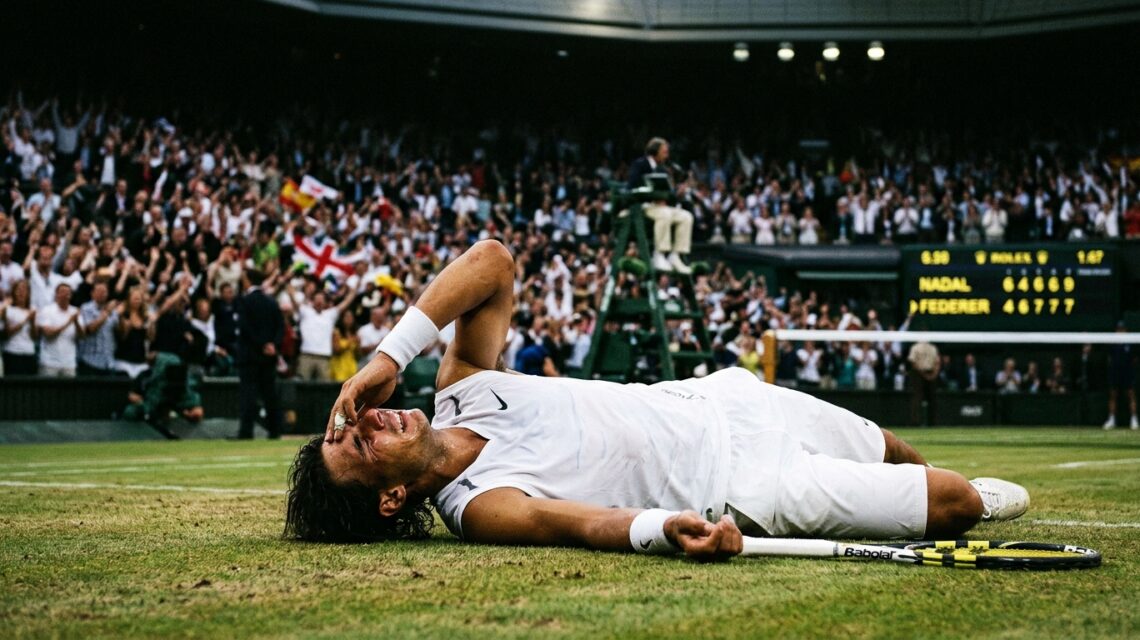
At approximately 9:16 p.m., Nadal collapsed onto the grass, having completed one of the most dramatic victories of his career.
The Numbers That Reveal How Close the Final Really Was
The final score suggests a dramatic contest, but the underlying statistics reveal just how narrow the difference between the players actually was.
Wimbledon 2008 Men’s Singles Final: Complete Score
| Set | Rafael Nadal | Roger Federer |
|---|---|---|
| First | 6 | 4 |
| Second | 6 | 4 |
| Third | 6 | 7 (7-5) |
| Fourth | 6 | 7 (10-8) |
| Fifth | 9 | 7 |
Champion: Rafael Nadal
Runner-up: Roger Federer
Date: July 6, 2008
Venue: Centre Court, All England Club, London
Playing time: 4 hours and 48 minutes
Total points played: 413
Points won by Nadal: 209 (50.6%)
Points won by Federer: 204 (49.4%)
Championship points needed by Nadal: 4
Rain interruptions: 2
Nadal won only five more points than Federer across 413 points played, an extraordinarily small margin considering the length and significance of the contest.
Another revealing statistic was Federer’s difficulty converting break points. He capitalized on only one of 13 opportunities against Nadal’s serve.
That figure helps explain why the Swiss player could produce extraordinary tennis, win two tiebreaks and remain competitive until the final moments without securing victory.
The match also established a Wimbledon final duration record at the time. However, that record no longer stands. In 2019, Novak Djokovic defeated Federer in a final lasting four hours and 57 minutes, nine minutes longer than the 2008 contest.
Why Nadal’s Victory Changed the Federer Rivalry
The result ended more than Federer’s run of Wimbledon championships.
His 65-match winning streak on grass was over, and Nadal had demonstrated that he could defeat the world’s leading grass-court player at the tournament most closely associated with his dominance.
It was also a landmark for Spanish tennis. Nadal became the first Spanish man to win the Wimbledon singles championship since Manuel Santana in 1966.
By completing the Roland Garros-Wimbledon double, he joined a select group of players capable of winning Grand Slam championships on two markedly different surfaces within the same season.
The victory did not immediately make Nadal world No. 1. Federer retained that ranking until August 2008, when Nadal finally overtook him.
Nor did the defeat end Federer’s Wimbledon achievements. He returned to win the championship in 2009 and ultimately accumulated eight men’s singles titles at the tournament.
What changed was the perception of their rivalry. Nadal was no longer simply Federer’s greatest obstacle on clay. He had become a genuine challenger on every major stage.
Why the 2008 Final Is Still Considered One of Tennis’s Greatest Matches
The final combined several elements that rarely appear together in one match: enormous historical stakes, a comeback from two sets down, championship points saved, dramatic changes in momentum, weather interruptions and a finish in near darkness.
Its reputation was reinforced by former champion John McEnroe, who described it at the time as the greatest match he had witnessed. That assessment remains an opinion, rather than an objective ranking, but it reflects the extraordinary reception the contest received.
There was also an enduring human dimension.
After the final point, Nadal embraced Federer at the net before climbing toward his family and team. He also greeted Spain’s Crown Prince Felipe and Princess Letizia, who were watching from the Royal Box.
Federer, meanwhile, was left confronting one of the most painful defeats of his career.
The match later became the subject of journalist L. Jon Wertheim’s book Strokes of Genius: Federer, Nadal, and the Greatest Match Ever Played, published in 2009.
Its lasting significance comes from a rare combination of sporting excellence and uncertainty. Nadal was two sets ahead but almost lost. Federer appeared beaten but forced a deciding set. Both were capable of winning until the closing moments.
And when the final point was played, with darkness descending on Centre Court, the difference between victory and defeat was only five points out of 413.
The image of Nadal lying on the grass, celebrating his first Wimbledon title, became one of the defining scenes of modern tennis.
+ Siga o Giro no Facebook
+ Siga o Giro no Instagram
Leia Mais: