

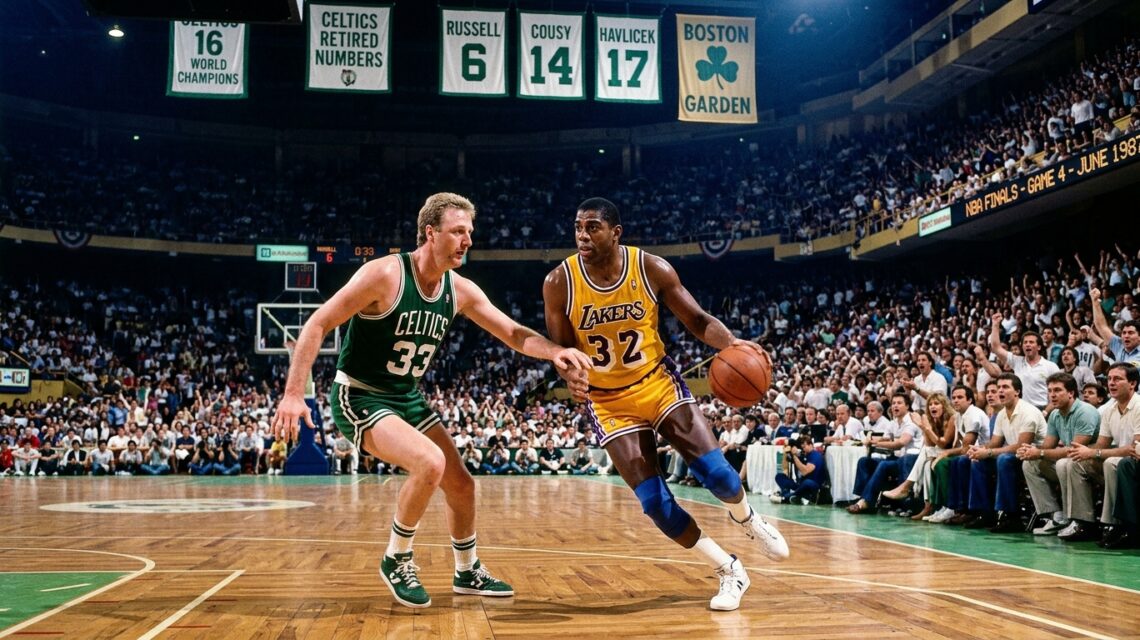
The Lakers and Celtics won eight of the NBA’s 10 championships during the 1980s, but the transformation began with a record-breaking college basketball game that introduced America to two very different superstars.
By Marcio Tamer
Updated October 23, 2026
On March 26, 1979, approximately 35.1 million Americans watched Michigan State defeat Indiana State in the NCAA men’s basketball championship game. The matchup featured two young players who would soon transform the professional game: Earvin “Magic” Johnson and Larry Bird.
Michigan State won 75-64, but the significance of the contest extended far beyond the final score. With a Nielsen television rating of 24.1, the championship remains the highest-rated college basketball game in American television history.
Within months, Johnson joined the Los Angeles Lakers and Bird began his NBA career with the Boston Celtics. Their arrival coincided with a period when the league desperately needed compelling stars, stronger television audiences and a new national identity.
Over the next decade, the Lakers and Celtics would win eight of the NBA’s 10 championships, meet three times in the Finals and help transform professional basketball into a major entertainment business.
The familiar claim that Magic and Bird “saved the NBA” simplifies a much larger transformation. Their rivalry, however, provided the league with something it had struggled to generate consistently: a compelling national story that audiences wanted to follow year after year.
The NBA was struggling before Magic Johnson and Larry Bird arrived
In the late 1970s, the NBA faced serious challenges involving television exposure, public perception and commercial appeal.
The league had extraordinary talent, including Kareem Abdul-Jabbar, Julius Erving, George Gervin and Moses Malone. Yet it struggled to turn those stars into the kind of national television attraction that professional football had become.
Drug-related controversies damaged the NBA’s reputation, while racial prejudice also shaped how some commentators, advertisers and viewers perceived a predominantly Black league.
Television scheduling illustrated the problem. CBS, the NBA’s national broadcast partner, sometimes aired important playoff games and even championship games on tape delay rather than broadcasting them live across the country.
In 1980, several NBA Finals games were shown on delayed broadcasts, including the deciding sixth game between the Lakers and Philadelphia 76ers.
That meant viewers in some markets could learn the result before seeing the championship decided on television.
The league’s problems were not simply a lack of talent or competitive basketball. They also involved marketing, broadcasting economics, scheduling and the challenge of turning individual stars into nationally recognizable personalities.
Magic and Bird arrived at precisely the moment when the NBA needed a stronger connection with American audiences.
A college championship drew 35 million viewers before either player entered the NBA
The rivalry’s commercial potential was established before either player became a professional.
Johnson led Michigan State with his extraordinary court vision, size and passing ability. At approximately 6 feet 9 inches tall, he possessed the height of a forward but the ball-handling and decision-making skills of an elite point guard.
Bird was the centerpiece of Indiana State, a relatively small basketball program that entered the 1979 national championship game undefeated.
The matchup offered television audiences a striking contrast.
Johnson was outgoing, charismatic and visibly comfortable with attention. Bird was reserved, intensely competitive and less interested in publicity.
Their playing styles were different, but both possessed an unusual ability to anticipate the movement of teammates and opponents.
Michigan State’s victory gave Johnson the national championship. Bird finished his college career without the title, but his individual brilliance had already made him one of the country’s most recognizable basketball prospects.
The television numbers revealed something more important for the NBA’s future.
An audience of approximately 35.1 million people had watched a basketball game built around two young personalities, a recognizable rivalry and a clear competitive storyline.
Professional basketball now had an opportunity to continue that story on a much larger stage.
Why Magic joined the Lakers while Bird became the face of Boston
The circumstances that placed Johnson and Bird on opposite sides of the NBA’s most famous rivalry were unusually favorable.
Boston had selected Bird with the sixth overall pick in the 1978 NBA Draft, even though he still had another college season to play. Under the rules then in effect, the Celtics could secure his rights before he completed his final year at Indiana State.
Bird joined Boston for the 1979-80 season.
Johnson entered the 1979 NBA Draft and was selected first overall by the Lakers, who held the pick through an earlier transaction involving the New Orleans Jazz.
The two rookies immediately became central figures in franchises with a long history of championship competition.
Boston had dominated much of the NBA’s early history, winning 11 championships between 1957 and 1969. Los Angeles had repeatedly challenged the Celtics but had never defeated Boston in an NBA Finals series.
The rivalry therefore existed long before Magic and Bird.
What changed in 1979 was the arrival of two players capable of giving that historic competition a new identity.
Bird helped transform a Celtics team that had won just 29 games in 1978-79 into a 61-win contender in his rookie season.
Johnson joined a Lakers team led by Kareem Abdul-Jabbar and immediately became part of a championship-caliber roster.
Their impact was visible almost immediately, although their first season produced different individual honors.
Bird won the 1979-80 NBA Rookie of the Year award. Johnson, meanwhile, helped the Lakers win the 1980 championship and was named Finals MVP.
Showtime basketball turned the Lakers into Hollywood’s favorite team
The Lakers’ identity during the 1980s became inseparable from the style known as Showtime.
Johnson was the ideal player to lead it.
His exceptional passing ability allowed Los Angeles to turn defensive rebounds and steals into immediate scoring opportunities. Fast breaks frequently ended with spectacular assists, powerful dunks and easy baskets before opposing defenses could organize.
The style combined speed, precision and entertainment.
Under coach Pat Riley, who became head coach during the 1981-82 season, the Lakers refined their transition offense while maintaining the half-court efficiency provided by Abdul-Jabbar.
James Worthy, Byron Scott, Michael Cooper and other important contributors helped build one of the decade’s most recognizable teams.
The Lakers also benefited from their location and ownership.
Jerry Buss, who purchased the franchise in 1979, emphasized entertainment and helped make games at the Forum in Inglewood major social events.
Celebrities attended courtside, the atmosphere became part of the attraction, and the Lakers developed an image closely associated with Southern California glamour.
Johnson’s personality fit the presentation perfectly.
His smile, enthusiasm and spectacular passing made him one of the NBA’s most marketable stars. But beneath the entertainment was an extraordinarily effective competitor who could control the pace of a game and influence virtually every possession.
The Lakers reached eight NBA Finals during the 1980s and won five championships.
Their success made Showtime more than a playing style. It became one of the defining brands of American professional sports.
Larry Bird built a different kind of dynasty in Boston
While Los Angeles embraced speed and spectacle, Boston developed a contrasting identity around Bird’s precision, toughness and competitive intensity.
Bird was not the fastest or most explosive athlete in the league. His greatness came from anticipation, shooting, passing, rebounding and an exceptional understanding of the game.
He could score from difficult positions, find teammates before defenders recognized an opening and influence games without relying on spectacular athleticism.
His confidence was equally famous.
Bird became known for verbal challenges and an ability to deliver under pressure, often making decisive plays after opponents knew exactly what he intended to do.
The Celtics surrounded him with outstanding talent.
Robert Parish arrived in 1980, while Kevin McHale joined the franchise through the same year’s draft. Together with Bird, they formed one of the greatest frontcourts in NBA history.
Dennis Johnson later became another essential contributor, bringing defensive intensity and championship experience to Boston’s backcourt.
Under coach K.C. Jones, the Celtics won championships in 1984 and 1986, adding to their 1981 title under Bill Fitch.
The contrast with Los Angeles was powerful but sometimes exaggerated.
Boston was not simply a slow, physical team, just as the Lakers were not merely an entertainment attraction. Both franchises combined extraordinary skill, intelligent passing, disciplined execution and elite defense.
Their different public images, however, made the rivalry especially attractive to television audiences.
Eight championships in 10 years: how the Lakers and Celtics dominated the 1980s
The scale of their dominance becomes clear when examining the NBA champions from 1980 through 1989.
| Season | NBA champion |
|---|---|
| 1980 | Los Angeles Lakers |
| 1981 | Boston Celtics |
| 1982 | Los Angeles Lakers |
| 1983 | Philadelphia 76ers |
| 1984 | Boston Celtics |
| 1985 | Los Angeles Lakers |
| 1986 | Boston Celtics |
| 1987 | Los Angeles Lakers |
| 1988 | Los Angeles Lakers |
| 1989 | Detroit Pistons |
The Lakers won five championships during the decade, while the Celtics won three.
Together, they captured 80% of the NBA titles available from 1980 through 1989.
Only two teams interrupted their dominance: the Philadelphia 76ers in 1983 and the Detroit Pistons in 1989.
The two franchises also appeared in every NBA Finals from 1980 through 1988, although they faced each other directly only three times.
This distinction is essential.
The Lakers and Celtics did not spend the entire decade meeting in the championship series. Instead, their sustained dominance created the expectation that their rivalry might determine the title almost every season.
Their three direct Finals matchups in 1984, 1985 and 1987 became the defining contests of the era.
The 1984 NBA Finals turned their rivalry into a national obsession
The first NBA Finals meeting between Magic and Bird took place in 1984.
Boston entered with the league’s best regular-season record at 62-20. Los Angeles had won 54 games and reached the Finals behind Johnson, Abdul-Jabbar and Worthy.
The series quickly became a dramatic confrontation.
In Game 2, Johnson’s late-game mistakes helped Boston escape with an overtime victory. The errors became a major talking point, intensifying the pressure surrounding the Lakers’ star.
Game 4 was particularly physical and controversial.
Boston won in overtime after a contest marked by hard fouls, confrontations and intense competition. The Celtics eventually forced a seventh game.
On June 12, 1984, Boston defeated Los Angeles 111-102 in Game 7, winning the championship four games to three.
Bird was named Finals MVP.
The series reinforced Boston’s historic advantage over the Lakers in championship meetings and deepened the personal stakes for both superstars.
For Johnson, the defeat was especially painful. Despite his individual success and previous championships, the mistakes against Boston became part of the public discussion about his ability to perform under maximum pressure.
He would have an opportunity to answer those criticisms one year later.
In 1985, the Lakers finally defeated Boston in the NBA Finals
The 1985 Finals began with one of the most humiliating defeats in Lakers championship history.
Boston overwhelmed Los Angeles 148-114 in Game 1, a contest remembered as the Memorial Day Massacre.
The result appeared to reinforce the Celtics’ psychological advantage.
But the Lakers responded.
Abdul-Jabbar, who had struggled in the opener, delivered a series of outstanding performances. Johnson controlled the offense, while Worthy and the rest of the roster helped Los Angeles exploit its speed and versatility.
The Lakers won the series four games to two.
The decisive victory came on June 9, 1985, when Los Angeles defeated Boston 111-100 at Boston Garden.
For the first time, the Lakers franchise had beaten the Celtics in an NBA Finals series.
That historical breakthrough mattered because Boston had defeated the Lakers in all eight of their previous Finals meetings.
Abdul-Jabbar earned Finals MVP honors, while Johnson gained a measure of redemption after the disappointment of 1984.
The victory also demonstrated that the Lakers were capable of defeating Boston in the Celtics’ own arena, removing one of the most enduring psychological barriers in the rivalry.
Magic Johnson’s famous baby hook helped decide the 1987 Finals
The third and final NBA Finals meeting between Magic and Bird occurred in 1987.
By then, both players had established themselves among the greatest in basketball history.
Bird had won three consecutive regular-season MVP awards from 1984 through 1986, an achievement that remains exceptionally rare.
Johnson won his first regular-season MVP award in 1987.
The Lakers entered the Finals with a 65-17 record, the best in the league. Boston had won 59 games but was dealing with injuries and the physical strain of repeated deep playoff runs.
Los Angeles won the first two games before Boston responded in Game 3.
The defining moment arrived in Game 4 at Boston Garden.
With the Lakers trailing 106-105 in the closing seconds, Johnson drove into the lane and released a running hook shot over Boston’s defense.
The shot, remembered as the baby hook, gave Los Angeles a 107-106 victory and a commanding 3-1 series lead.
The Lakers eventually won the championship in six games.
Johnson was named Finals MVP, completing one of the most successful individual seasons of his career.
The result gave Magic a 2-1 advantage over Bird in their direct NBA Finals meetings, mirroring the broader championship advantage Los Angeles held during the decade.
Their rivalry helped transform NBA television, but it was not the only reason
The commercial rise of the NBA during the 1980s is frequently attributed to Johnson and Bird.
Their contribution was substantial, but the league’s growth also depended on other developments.
Commissioner David Stern, who took office in 1984, expanded the NBA’s marketing strategy, strengthened its commercial partnerships and promoted individual players as international stars.
The arrival of Michael Jordan in 1984 added another transformative personality.
Nike’s marketing of Jordan, the increasing popularity of NBA highlights and improvements in national television distribution also helped basketball reach new audiences.
The NBA’s 1984 Finals averaged approximately 12.1 million viewers, while the 1987 championship series averaged roughly 15.9 million, according to historical television audience compilations.
The numbers reflected the growing national appeal of championship basketball, particularly when the Lakers and Celtics were involved.
But television growth cannot be assigned to one rivalry alone.
The Magic-Bird competition provided a powerful narrative, while Stern’s marketing approach, Jordan’s emergence and the league’s broader business strategy helped turn that attention into sustained commercial expansion.
The relationship between the two stars and the NBA’s growth was therefore important without being the sole explanation for the league’s transformation.
A famous commercial helped turn bitter rivals into genuine friends
For years, Johnson and Bird maintained a relationship defined primarily by competition.
They respected each other’s abilities but were not close friends.
That began changing during the filming of a Converse advertisement in 1985.
The commercial brought the two stars together in French Lick, Indiana, near Bird’s hometown.
During the visit, Johnson spent time with Bird and his family, including sharing a meal at Bird’s home.
The experience allowed both players to see each other outside the intense environment of professional competition.
Their relationship gradually developed into a friendship.
The change did not weaken their rivalry. Instead, it gave their competition a different dimension, built around mutual admiration and an understanding of the pressure each faced.
Both later acknowledged how closely they followed each other’s performances.
Bird wanted to know what Magic had accomplished the previous night. Magic paid similar attention to Bird’s statistics and results.
The competition extended beyond their direct meetings because each player measured his own success against the other’s achievements.
Magic’s HIV announcement in 1991 revealed how deeply the relationship had changed
On November 7, 1991, Johnson announced that he had tested positive for HIV and would retire from the Lakers.
The news shocked the sports world.
At the time, public understanding of HIV and AIDS was limited, and stigma surrounding the virus remained widespread.
Bird was among the people profoundly affected by the announcement.
He later described how difficult it was to imagine basketball without his longtime rival and friend.
The moment revealed how dramatically their relationship had changed since the hostile atmosphere of their early championship battles.
What had begun as a competition between two contrasting personalities had become a friendship grounded in shared experience.
Johnson’s announcement also gave him an important public role in HIV awareness and education.
His willingness to speak openly about his diagnosis challenged misconceptions and helped bring the subject into mainstream American sports discussion.
The 1992 Dream Team reunited Magic and Bird on the same side
Less than a year after Johnson’s announcement, Magic and Bird became teammates on one of the most famous basketball teams ever assembled.
The United States selected both players for the 1992 Olympic basketball team in Barcelona.
The roster included Michael Jordan, Charles Barkley, Karl Malone, John Stockton, Patrick Ewing, David Robinson, Scottie Pippen, Chris Mullin, Clyde Drexler and Christian Laettner.
Johnson and Bird served as co-captains.
The Dream Team dominated the tournament, winning the gold medal while defeating opponents by an average margin of approximately 43.8 points.
The Olympics also provided an extraordinary promotional platform for the NBA.
International audiences saw many of the league’s greatest stars competing together, accelerating global interest in American professional basketball.
For Magic and Bird, the experience represented a symbolic reversal.
After spending more than a decade trying to defeat each other, they were finally wearing the same uniform and pursuing the same championship.
Bird retired from the NBA after the Olympics, while Johnson later made a brief return to the Lakers during the 1995-96 season.
Who had the better career: Magic Johnson or Larry Bird?
Comparing the two players remains one of basketball’s most enduring debates.
Their career achievements illustrate why the discussion has never produced a universally accepted answer.
| Achievement | Magic Johnson | Larry Bird |
|---|---|---|
| NBA championships | 5 | 3 |
| Regular-season MVP awards | 3 | 3 |
| Finals MVP awards | 3 | 2 |
| NBA All-Star selections | 12 | 12 |
| Career points per game | 19.5 | 24.3 |
| Career assists per game | 11.2 | 6.3 |
| Career rebounds per game | 7.2 | 10.0 |
Johnson had the advantage in championships, Finals MVP awards and assists.
Bird was the more prolific scorer and rebounder, while also ranking among the greatest passing forwards in league history.
Both won three regular-season MVP awards and earned 12 All-Star selections.
Their statistical differences reflected their roles.
Johnson was a point guard who organized the Lakers’ offense and created opportunities for teammates. Bird was a versatile forward who combined elite shooting, rebounding and playmaking.
The debate also depends on how individual greatness is measured.
Championships favor Magic. Scoring and rebounding favor Bird. Their influence on the NBA’s development, however, cannot be reduced to a single statistical category.
Both were inducted into the Naismith Memorial Basketball Hall of Fame as individual players and were also members of the 1992 Dream Team, which was inducted as a team.
What the Magic-Bird era changed about professional basketball
The NBA that Magic Johnson and Larry Bird entered in 1979 was dramatically different from the league they left behind.
At the beginning of their careers, the NBA struggled to secure consistent live national television exposure for its most important games.
By the early 1990s, the league had become an increasingly powerful sports entertainment business with recognizable international stars, major sponsorships and growing global audiences.
The transformation continued after their playing careers, driven by Jordan, international expansion, new television agreements and successive generations of elite players.
But the foundation of the NBA’s modern superstar era was strengthened by the rivalry between Los Angeles and Boston.
Magic and Bird gave audiences a reason to care about games beyond their own local teams. Their contrasting personalities created a compelling narrative, while their extraordinary talent ensured that the basketball justified the attention.
Their competition also established a model that professional sports leagues continue to use: recognizable stars, historic franchises, contrasting identities and championship stakes combined into a story that extends across multiple seasons.
The most revealing number from their era remains eight championships in 10 years.
Between 1980 and 1989, the Lakers and Celtics dominated the NBA to an extent that few rival franchises have matched across an entire decade.
Yet the legacy reaches beyond those titles.
A rivalry that began before approximately 35 million television viewers in 1979 helped introduce professional basketball to an audience that would eventually extend around the world.
Magic Johnson and Larry Bird did not transform the NBA alone. They gave its transformation two unforgettable faces.
+ Siga o Giro no Facebook
+ Siga o Giro no Instagram
Leia Mais: