

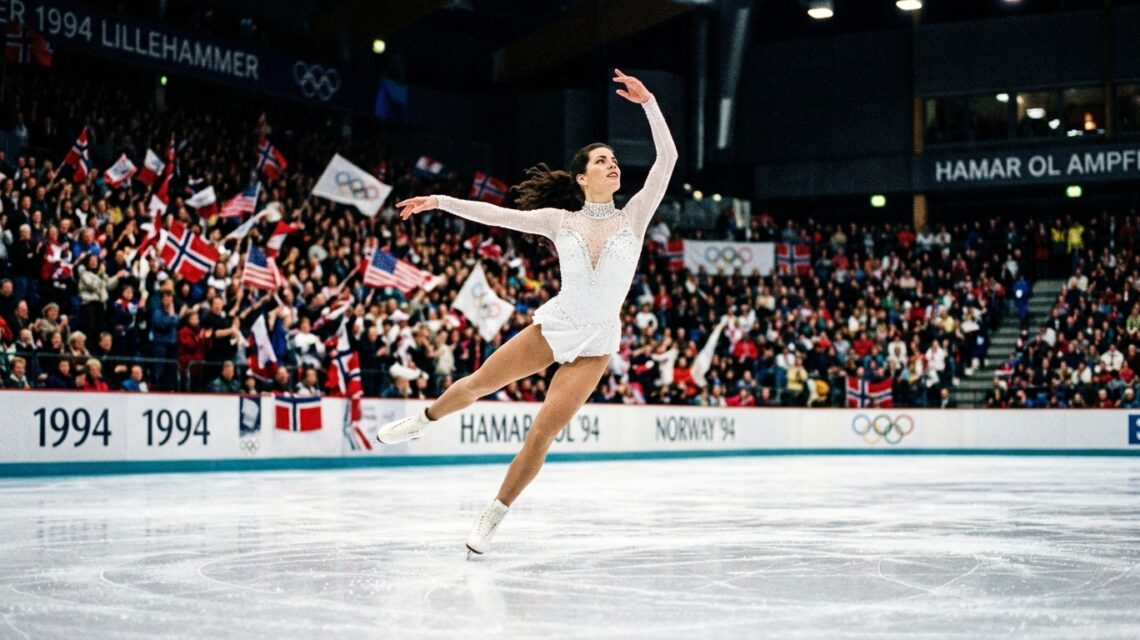
A metal baton, a conspiracy involving a rival skater’s inner circle and an extraordinary Olympic comeback turned the Lillehammer Winter Games into a television phenomenon. But the criminal investigation revealed a more complicated story than the rivalry portrayed in the headlines.
By Marcio Tamer
Updated October 24, 2026
On January 6, 1994, American figure skater Nancy Kerrigan was struck above her right knee with a metal baton after a practice session in Detroit. The attack left her injured, unable to compete at the U.S. Figure Skating Championships and facing the possibility of missing the Winter Olympics just seven weeks away.
The assailant was not a random attacker. He had been recruited through a conspiracy involving people closely connected to Kerrigan’s principal American rival, Tonya Harding.
Within weeks, the investigation would lead to criminal charges, expose a plot to eliminate an Olympic competitor and turn two elite athletes into the central figures of an international media spectacle.
The scandal reached its climax at the 1994 Winter Olympics in Lillehammer, Norway, where Kerrigan recovered to win a silver medal and Harding finished eighth after a troubled performance.
The women’s figure skating competition became one of the most-watched television events in American history. CBS estimated that approximately 126 million Americans watched at least part of its February 25 Olympic coverage, although that cumulative audience should not be confused with the number watching simultaneously.
The case ultimately ended with criminal convictions, Harding’s guilty plea for hindering the prosecution and a lifetime ban imposed by U.S. Figure Skating.
Yet one of the most important distinctions in the scandal is frequently lost: the criminal proceedings established Harding’s involvement in the cover-up after the attack, while her knowledge of the plot beforehand remained disputed.
The attack in Detroit was designed to eliminate an Olympic contender
Kerrigan was preparing for the U.S. Figure Skating Championships at Detroit’s Cobo Arena when the attack occurred.
As she walked through a corridor after practice, a man approached and struck her right leg with a collapsible baton before escaping.
The attacker was Shane Stant, who had traveled to Detroit as part of a plan to injure Kerrigan and prevent her from competing.
The blow landed above her knee, causing a painful injury but avoiding the catastrophic damage that might have ended her Olympic hopes.
Video footage captured immediately afterward showed Kerrigan on the floor, crying in pain and repeatedly asking why she had been attacked.
The images quickly became some of the most recognizable television footage of the 1990s.
Kerrigan had been considered a leading contender for the national championship and a place on the U.S. Olympic team. She had already won a bronze medal at the 1992 Winter Olympics in Albertville and was among America’s strongest medal prospects for Lillehammer.
The assault forced her to withdraw from the national championships.
Harding subsequently won the women’s singles title, placing her at the center of a story that was about to become much larger than figure skating.
Who planned the attack on Nancy Kerrigan?
Investigators traced the conspiracy to individuals connected to Harding’s personal and professional life.
The central figures included Jeff Gillooly, Harding’s former husband, and Shawn Eckardt, who had worked as her bodyguard.
Eckardt helped arrange the attack through associates, including Derrick Smith and Shane Stant.
The objective was to incapacitate Kerrigan and improve Harding’s competitive prospects ahead of the Olympics.
Stant carried out the assault, while Smith assisted in the operation.
The plan was poorly executed from the beginning. Investigators followed evidence linking the participants, and the case quickly attracted national attention.
Gillooly eventually cooperated with prosecutors and implicated Harding, claiming that she had known about the conspiracy before the assault.
Harding denied participating in the planning of the attack.
That disagreement became one of the central questions in the case.
The criminal investigation established that the assault was deliberate and connected to Harding’s associates. However, allegations that Harding had approved the attack in advance were not established by a criminal conviction against her.
The distinction matters because Harding’s eventual guilty plea concerned her conduct after the assault, not a conviction for ordering or carrying out the attack itself.
Why Nancy Kerrigan and Tonya Harding became symbols of two different Americas
The scandal attracted extraordinary attention partly because the two skaters were presented as cultural opposites.
Kerrigan grew up in Stoneham, Massachusetts, in a working-class family. Her father, Daniel Kerrigan, worked multiple jobs to help support her skating career.
Despite that background, sponsors and television coverage often presented her as an elegant, polished athlete whose appearance fit traditional expectations of women’s figure skating.
Harding grew up in Portland, Oregon, in a financially unstable household and faced significant personal difficulties during her childhood.
Her athletic identity was different.
She was known for powerful jumps, speed and technical ambition rather than the graceful image frequently promoted by figure skating’s commercial establishment.
In 1991, Harding became the first American woman to land a triple Axel in international competition, accomplishing the feat at Skate America.
The jump requires three and a half rotations in the air and remains among the most difficult elements in women’s figure skating.
Her achievement demonstrated extraordinary athletic ability at a time when relatively few women attempted the maneuver successfully.
But Harding’s relationship with the skating establishment was often contentious. She struggled with consistency, financial pressures and disputes involving her presentation and competitive results.
Media coverage amplified these contrasts into a simplified narrative of elegance against rebellion, privilege against hardship and innocence against ambition.
That framing overlooked a crucial fact: both women came from families that made significant financial sacrifices to support their careers.
The scandal was not a straightforward confrontation between a wealthy skater and a poor one. It was a criminal conspiracy involving people in one athlete’s circle, followed by a media spectacle that frequently reduced both women to stereotypes.
How Kerrigan reached the Olympics despite missing the national championships
The timing of the attack created an immediate problem for U.S. Figure Skating.
The national championships were an important part of the Olympic selection process, and Kerrigan could no longer compete.
Harding won the 1994 U.S. women’s title, while Michelle Kwan, then just 13 years old, finished second.
Ordinarily, the championship results would have played a major role in determining the Olympic team.
But Kerrigan’s previous international performances and the extraordinary circumstances of her injury led officials to grant her a place on the team.
Kwan was named an alternate.
The decision meant Kerrigan and Harding would both represent the United States in Lillehammer.
It also ensured that the scandal would accompany the American delegation to Norway.
Kerrigan spent the following weeks recovering from her injury and rebuilding her training routine.
The blow had caused serious pain and bruising, but it had not destroyed the structural integrity of her knee.
Her recovery allowed her to return to competitive skating in time for the Olympics.
Harding, meanwhile, traveled to Lillehammer under intense scrutiny as investigators continued examining the conspiracy.
The two athletes were no longer competing solely for Olympic medals. They were performing under the attention of journalists, television networks and millions of viewers following an unfolding criminal case.
The 1994 Olympics turned women’s figure skating into a television phenomenon
The Lillehammer Winter Olympics were already a major television event in the United States.
But the Kerrigan-Harding scandal generated interest far beyond the usual audience for figure skating.
CBS promoted its Olympic coverage extensively, and the women’s singles competition became one of the central attractions of the Games.
The February 25 broadcast of the women’s free skating competition produced an extraordinary television rating.
Historical Nielsen records commonly report a 48.5 household rating and a 64 share for the broadcast.
The figures describe different measurements.
A 48.5 rating means that approximately 48.5% of American television households were tuned to the broadcast on average. A 64 share means that roughly 64% of households actively watching television at the time were watching that coverage.
CBS also estimated that approximately 126 million Americans watched at least some portion of the broadcast.
That figure represented cumulative reach, not the average number of simultaneous viewers.
The distinction explains why the broadcast can be described as reaching an enormous audience without suggesting that 126 million people were watching at the same moment.
The television numbers were remarkable for a winter sports event.
They also demonstrated how the intersection of criminal investigation, celebrity culture and Olympic competition could attract an audience much larger than the sport’s traditional following.
What happened when Tonya Harding’s skate broke down in Lillehammer?
Harding entered the Olympic competition facing extraordinary pressure.
Her preparation had been disrupted by the investigation, media attention and questions about her future in the sport.
During the women’s free skating competition, she encountered a problem with her equipment.
Harding interrupted her performance after experiencing trouble with a broken skate lace.
She approached the judges, visibly distressed, and showed them the damaged lace while requesting permission to address the problem.
The judges allowed her to restart her program later.
The incident became one of the defining images of the Olympics, reinforcing the perception of a competitor overwhelmed by events both inside and outside the rink.
Harding ultimately finished eighth.
The result was a major disappointment for an athlete who had once demonstrated the technical ability to challenge the world’s best skaters.
But her performance was not simply the result of the broken lace.
Her competitive difficulties reflected a combination of technical inconsistency, disrupted preparation and the exceptional psychological pressures surrounding the scandal.
The equipment problem became the most memorable moment of her Olympic appearance because it unfolded before an enormous television audience already focused on her every movement.
Nancy Kerrigan won silver, but a 16-year-old Ukrainian took Olympic gold
Kerrigan delivered a strong Olympic performance despite having missed the national championships and undergone weeks of rehabilitation.
Her free skating program was technically controlled and elegantly presented, reinforcing her reputation as one of the world’s leading competitors.
But the gold medal went to Oksana Baiul of Ukraine.
Baiul was just 16 years old and competing in her first Winter Olympics.
Her victory gave independent Ukraine its first Winter Olympic gold medal.
Kerrigan finished second, earning silver, while China’s Chen Lu claimed bronze.
The result produced another controversy.
Some American viewers and commentators believed Kerrigan had performed more cleanly and deserved the gold medal.
Others argued that Baiul’s presentation, technical content and overall performance justified the judges’ decision under the scoring system used at the time.
Figure skating in 1994 was judged under the 6.0 system, which relied on ordinal placements rather than the detailed element-by-element scoring introduced years later.
The judging debate was separate from the criminal scandal, although the extraordinary attention surrounding Kerrigan inevitably intensified public reactions.
Kerrigan had achieved a remarkable recovery and earned her second Olympic medal.
Harding, who had entered the Games as a national champion, finished outside the medal positions.
The Olympic results settled the competition, but they did not settle the legal consequences of the attack.
What Tonya Harding admitted in court after the Olympics
In March 1994, Harding pleaded guilty to conspiracy to hinder prosecution.
The charge concerned her actions after the assault, including efforts to obstruct the investigation.
She was not convicted of physically attacking Kerrigan or of criminally conspiring to carry out the assault beforehand.
Harding received three years of probation, a $100,000 fine and an order to perform 500 hours of community service.
She was also required to contribute money toward investigative costs and establish a fund benefiting Special Olympics programs.
The guilty plea established criminal responsibility for obstructing the investigation.
It did not resolve every disputed allegation concerning what Harding knew before January 6.
Gillooly and other participants in the attack faced their own criminal consequences.
Their accounts of the conspiracy became essential to the investigation, but Harding continued to dispute claims that she had participated in planning the assault.
The legal outcome therefore differed from the simplified public narrative that portrayed her as having been convicted of ordering the attack.
That distinction remains important when evaluating the case more than three decades later.
Why U.S. Figure Skating banned Harding for life
The sporting consequences were more severe than Harding’s criminal sentence.
In June 1994, the United States Figure Skating Association, now known as U.S. Figure Skating, conducted disciplinary proceedings and imposed a lifetime ban.
The organization also stripped Harding of her 1994 U.S. national championship title.
Its findings went beyond the specific criminal offense to which Harding had pleaded guilty.
The association concluded that her conduct violated standards expected of members and that she had been involved in the events surrounding the assault.
Harding was barred from participating in association-sanctioned activities, including competition and coaching.
The ban effectively ended her career in elite American figure skating.
She later pursued other activities, including professional boxing, but never returned to Olympic-level skating.
Kerrigan continued performing professionally after the Olympics and became involved in television, skating shows and other public appearances.
The two women followed very different paths after Lillehammer, but the 1994 scandal remained attached to both of their public identities.
Did the scandal permanently change figure skating?
The attack did not fundamentally rewrite the technical rules of figure skating.
Its influence was primarily cultural, commercial and institutional.
The incident demonstrated the vulnerability of athletes during major competitions and highlighted the importance of security arrangements surrounding elite sporting events.
It also revealed the commercial power of scandal-driven television coverage.
Women’s figure skating had already produced major American stars, including Peggy Fleming, Dorothy Hamill and Kristi Yamaguchi.
But the Kerrigan-Harding case brought an entirely different type of attention to the sport.
Audiences followed police investigations, courtroom developments, personal relationships and television interviews alongside competition results.
The story became a prominent example of how sports coverage could merge with celebrity journalism and true-crime reporting.
It also raised questions about the treatment of female athletes.
Coverage frequently emphasized clothing, appearance, family background and personality, sometimes giving those subjects as much attention as athletic achievement.
Harding’s difficult upbringing became a recurring explanation for her public image, while Kerrigan was often presented through an idealized image of elegance and composure.
Those narratives helped attract viewers, but they also obscured the complexity of both athletes’ lives.
How the story continued long after the 1994 Winter Olympics
The scandal remained a subject of books, documentaries and films for decades.
ESPN revisited the case in its 2014 documentary The Price of Gold, part of the 30 for 30 series.
The documentary examined Harding’s career, the attack and the media environment surrounding the controversy.
In 2017, the film I, Tonya, starring Margot Robbie as Harding and Allison Janney as her mother, introduced the story to a new generation.
The film used a darkly comic style and conflicting character accounts to explore the uncertainty, abuse and public spectacle associated with Harding’s life.
Janney won the Academy Award for Best Supporting Actress for her performance.
The renewed attention encouraged another round of debate about Harding’s responsibility, Kerrigan’s experience and the way the media had portrayed the two women.
But the passage of time did not change the central established facts.
Kerrigan was deliberately attacked on January 6, 1994. Individuals connected to Harding organized the assault. Harding later pleaded guilty to helping obstruct the investigation, and U.S. Figure Skating imposed a lifetime ban.
The question of precisely what Harding knew before the attack remained contested.
The most extraordinary fact about the scandal was what happened after the attack
The assault was intended to remove Nancy Kerrigan from Olympic contention.
Instead, she recovered, competed in Lillehammer and won the silver medal.
Harding, whose associates had organized the attack, finished eighth and soon lost her national title and eligibility to compete in sanctioned figure skating events.
The scheme therefore failed to achieve its central sporting objective.
Its unintended consequences were enormous.
A competition that might otherwise have been remembered primarily for Oksana Baiul’s Olympic triumph became one of the most heavily watched and scrutinized events in Winter Games history.
The February 25 broadcast reached an estimated 126 million Americans at some point during the coverage, turning a women’s figure skating final into a national television event of extraordinary scale.
For Kerrigan, the Games represented an athletic comeback after a violent assault.
For Harding, they marked the final chapter of an elite skating career that had once included one of the most difficult jumps ever performed by an American woman.
For the sport, Lillehammer became a permanent reminder of how quickly competition can be overwhelmed by crime, publicity and public judgment.
The most revealing contrast is not the one that dominated tabloid coverage in 1994. It is the difference between the conspirators’ objective and the eventual outcome: the athlete targeted for elimination reached the Olympic podium, while the national champion connected to the scandal was banned from the sport.
+ Siga o Giro no Facebook
+ Siga o Giro no Instagram
Leia Mais: