

A team that had nearly been relegated in 2015 became English champion just one year later. Behind the greatest upset in Premier League history were a £1 million striker, an overlooked Algerian winger, a relentless French midfielder and a manager who had never won a top-flight league title.
By Marcio Tamer
Updated October 24, 2026
On May 2, 2016, Leicester City became Premier League champions without kicking a ball. More than 100 miles away, Chelsea had just held Tottenham Hotspur to a 2-2 draw at Stamford Bridge, making it mathematically impossible for Spurs to catch the unlikely league leaders.
At Jamie Vardy’s house in Leicester, players gathered around a television and erupted in celebration when the final whistle confirmed what had seemed impossible nine months earlier.
Leicester had started the 2015-16 season at odds of 5,000 to 1 to win the Premier League. They had narrowly escaped relegation the previous season, appointed a manager whose arrival had been widely questioned and assembled a squad with a fraction of the financial resources available to England’s biggest clubs.
Yet they finished with 81 points, 10 ahead of Arsenal, losing only three of their 38 league matches.
It was the first top-flight championship in Leicester City’s 132-year history.
The achievement became a defining example of sporting unpredictability. But the deeper story was not simply that a small club had beaten wealthy opponents. Leicester had built a team whose strengths fit together with extraordinary precision, then maintained a level of consistency that none of their more expensive rivals could match.
One year before winning the league, Leicester were facing relegation
The scale of Leicester’s transformation becomes clearer when examining where the club stood in the spring of 2015.
Having returned to the Premier League after winning the Championship in 2013-14, Leicester struggled through much of the following season.
On April 3, 2015, the team was bottom of the Premier League with just 19 points from 29 matches.
Relegation appeared increasingly likely.
Then came an extraordinary recovery.
Under manager Nigel Pearson, Leicester won seven of their final nine league games, collecting 22 points from a possible 27 and finishing 14th.
The turnaround preserved their Premier League status and demonstrated that the squad possessed qualities its earlier results had concealed.
But survival did not make Leicester a championship contender in the eyes of bookmakers or analysts.
The club’s immediate ambition remained modest: reach the conventional 40-point safety target and establish itself in the division.
When Pearson departed in June 2015, Leicester faced another period of uncertainty.
The appointment of Claudio Ranieri, announced in July, hardly reassured everyone.
The Italian had extensive managerial experience with clubs including Chelsea, Valencia, Juventus, Roma and Monaco, but he had never won a top-flight domestic league championship.
His most recent international assignment had ended disastrously, with Greece losing to the Faroe Islands during Euro 2016 qualifying.
Some commentators questioned whether Leicester had made the right decision.
Nine months later, Ranieri would be celebrating the most remarkable achievement of his managerial career.
What did Leicester’s 5,000-to-1 title odds actually mean?
The 5,000-to-1 figure became the defining number of Leicester’s championship season.
In fractional betting terms, odds of 5,000 to 1 meant that a successful £1 wager would return £5,000 in profit, plus the original stake.
A £10 winning bet would produce £50,000 in profit.
Those odds correspond to an implied probability of approximately 0.02%, or roughly one chance in 5,001, before accounting for bookmakers’ margins.
That does not mean Leicester’s actual mathematical chance of winning the league was precisely 0.02%.
Bookmaker odds reflect pricing decisions, customer behavior, profit margins and risk management, rather than a scientifically established probability of an outcome.
Nevertheless, the number captured the extreme skepticism surrounding Leicester’s prospects.
British bookmakers had offered similarly extravagant odds on unusual events and novelty propositions, making Leicester’s eventual championship particularly striking.
The comparison with the Loch Ness Monster became part of the story, although specific novelty odds varied by bookmaker and should not be treated as a universal statistical benchmark.
What matters is that Leicester were priced as an exceptionally unlikely champion in a competition historically dominated by clubs with far greater financial power.
And unlike a one-off cup upset, winning the Premier League required sustaining results across 38 matches.
Leicester built a title-winning team with players the biggest clubs had overlooked
Leicester’s success was not based on one expensive transfer window.
Much of the championship squad had been assembled over several seasons through recruitment from lower divisions, smaller European leagues and undervalued positions in the transfer market.
The club’s recruitment operation, including influential scout and recruitment executive Steve Walsh, identified players whose qualities suited a clear footballing approach.
Jamie Vardy had arrived from Fleetwood Town in 2012 for a fee reported at approximately £1 million, then a record for a non-league player.
Riyad Mahrez joined from French club Le Havre in January 2014 for a reported fee of around £400,000.
N’Golo Kanté arrived from Caen in the summer of 2015 for a fee commonly reported at approximately £5.6 million.
Kasper Schmeichel had joined from Leeds United in 2011, while Wes Morgan arrived from Nottingham Forest in 2012.
Other important players included Robert Huth, Danny Drinkwater, Marc Albrighton, Christian Fuchs and Shinji Okazaki.
These were not all unknown footballers, but few had the reputations or transfer valuations associated with established Premier League superstars.
Their combined effectiveness proved more valuable than their individual market profiles suggested.
The often-cited figure of roughly £30 million for Leicester’s team refers to estimates of the transfer fees used to assemble much of the championship-winning starting lineup, not the club’s complete wage bill, total operating expenditure or full squad market value.
That distinction is important when comparing Leicester with wealthier rivals.
The club was not operating without substantial professional resources. It had Premier League television income, wealthy ownership and an established recruitment structure.
But its football expenditure was still far below that of the biggest English clubs.
Jamie Vardy went from non-league football to a Premier League scoring record
Vardy’s career became one of the most recognizable symbols of Leicester’s title.
Before reaching the Premier League, he had played for Stocksbridge Park Steels, Halifax Town and Fleetwood Town.
His rise was unusually late compared with players developed in elite professional academies.
By the 2015-16 season, however, his pace, aggressive running and finishing ability made him an ideal striker for Leicester’s counterattacking system.
Vardy scored 24 Premier League goals during the championship campaign, finishing one behind Golden Boot winner Harry Kane.
His most extraordinary achievement came during the first half of the season.
On November 28, 2015, Vardy scored against Manchester United to become the first player to score in 11 consecutive Premier League appearances.
The goal broke Ruud van Nistelrooy’s previous record of 10 consecutive matches.
The streak was not simply an individual scoring achievement.
It demonstrated how Leicester repeatedly created high-quality attacking opportunities against teams that controlled possession but left space behind their defenses.
Vardy’s movement forced opponents to defend deeper than they preferred, changing the tactical balance of matches.
His speed also allowed Leicester to threaten without needing long periods of possession.
Riyad Mahrez turned a £400,000 transfer into one of the league’s best players
If Vardy supplied the goals, Mahrez provided much of Leicester’s creativity.
The Algerian winger combined close control, deceptive changes of direction and an ability to cut inside from the right flank onto his stronger left foot.
He scored 17 Premier League goals and contributed 11 assists during the 2015-16 campaign.
Those numbers were extraordinary for a player whose transfer fee had been relatively modest.
Mahrez’s technical quality also made Leicester more difficult to defend than a conventional counterattacking team.
Opponents could not focus exclusively on stopping Vardy’s runs.
Mahrez could slow the game, beat defenders individually, create shooting opportunities or deliver passes into dangerous areas.
His partnership with Vardy became one of the most effective attacking combinations in English football.
At the end of the season, Mahrez won the Professional Footballers’ Association Players’ Player of the Year award.
He became the first African player to receive the men’s award.
The recognition confirmed that Leicester’s success was not simply a collective defensive achievement. The team also possessed players capable of producing elite individual performances.
N’Golo Kanté gave Leicester a midfield advantage that money could not easily replicate
Kanté was perhaps the most important tactical addition made before the championship season.
Signed from Caen, the French midfielder brought exceptional mobility, defensive anticipation and ball-winning ability.
His role was fundamental to Leicester’s preferred approach.
When opponents had possession, Kanté covered large areas of the pitch, intercepted passes and disrupted attacking moves.
When Leicester recovered the ball, his quick decisions helped launch transitions before opposing defenses could reorganize.
Alongside Danny Drinkwater, he formed a midfield partnership that balanced defensive protection with efficient distribution.
Kanté’s impact was particularly valuable because Leicester frequently allowed opponents to have more possession.
A team that spends long periods without the ball needs players capable of recovering it without constantly exposing the defense.
Kanté provided exactly that.
His performances attracted attention across Europe, and Chelsea signed him after Leicester’s championship season.
He then helped Chelsea win the Premier League in 2016-17, becoming one of the rare players to win consecutive English league titles with different clubs.
That subsequent success reinforced how important his contribution had been to Leicester’s extraordinary campaign.
Claudio Ranieri changed less than expected and made Leicester stronger
Ranieri’s appointment initially appeared risky, but one of his most important decisions was to avoid unnecessarily dismantling what already worked.
Leicester had developed a direct, energetic style during their survival run under Pearson.
Rather than replacing that identity with a complex possession-based system, Ranieri refined it.
The team generally operated in a compact 4-4-2 formation.
Morgan and Huth provided physical strength in central defense, while Schmeichel offered reliable goalkeeping and distribution.
Kanté and Drinkwater protected the central areas.
Albrighton contributed defensive discipline and deliveries from wide positions, while Mahrez supplied individual creativity.
Up front, Vardy stretched defenses and Okazaki worked tirelessly to press opponents and create space.
The system was relatively simple, but its execution was exceptional.
Ranieri also developed a strong relationship with the squad through humor, encouragement and a willingness to keep expectations manageable.
His famous pizza promise became part of the season’s folklore.
The manager offered to reward the players with pizza after clean sheets, turning defensive discipline into a lighthearted team challenge.
The story was entertaining, but the underlying approach was serious.
Ranieri reduced unnecessary pressure, maintained tactical consistency and helped a group of players believe they could compete against opponents with much greater resources.
Leicester won the league without dominating possession
One of the most unusual aspects of Leicester’s championship was how little they depended on controlling the ball.
The team frequently surrendered possession to opponents, defended compactly and attacked quickly after winning it back.
This approach contrasted with the possession-heavy systems associated with many elite European clubs.
Leicester’s success depended on efficiency rather than territorial dominance.
Their defenders protected central spaces, midfielders recovered possession and attacking players exploited openings with minimal delay.
The strategy was especially effective against opponents who pushed their fullbacks forward or committed too many players to attacking positions.
Leicester could turn a defensive recovery into a goalscoring opportunity within seconds.
The team also became increasingly difficult to beat as the season progressed.
During the decisive final months, Leicester collected a series of narrow victories, often winning 1-0.
Those results reflected defensive organization, concentration and the ability to protect small leads.
The numbers show how successful the approach became.
The numbers behind Leicester’s 2015-16 Premier League title
| Statistic | Leicester City |
|---|---|
| Final position | 1st |
| Points | 81 |
| Matches played | 38 |
| Wins | 23 |
| Draws | 12 |
| Defeats | 3 |
| Goals scored | 68 |
| Goals conceded | 36 |
| Goal difference | +32 |
| Lead over Arsenal | 10 points |
| Preseason title odds | 5,000 to 1 |
Leicester lost only three league games all season.
That was fewer defeats than any other Premier League club in 2015-16.
Their 81-point total was not a Premier League record. Other champions have accumulated substantially more points.
But Leicester’s achievement was never primarily about setting a points record.
It was about producing championship-level consistency with a squad that had been expected to fight relegation.
Arsenal finished second with 71 points, while Tottenham finished third with 70.
Manchester City and Manchester United both ended the season with 66 points.
Chelsea, the defending champions, finished tenth with 50 points.
The final standings illustrated both Leicester’s remarkable performance and the unusual struggles of several established contenders.
Why the Premier League’s richest clubs failed to stop Leicester
Leicester’s championship cannot be explained solely by their own excellence.
The 2015-16 season also featured significant underperformance from several of England’s wealthiest clubs.
Chelsea endured a dramatic collapse after winning the previous championship.
José Mourinho left the club in December 2015, and the defending champions never mounted a serious title defense.
Manchester United struggled to produce consistent attacking football under Louis van Gaal.
Manchester City, despite possessing an expensive and talented squad, finished fourth.
Arsenal remained competitive but failed to capitalize on opportunities to take control of the title race.
Tottenham emerged as Leicester’s strongest challenger during the closing months, but ultimately fell short.
These developments created an unusually open competition.
However, describing Leicester’s victory as merely the result of other clubs failing would ignore the consistency required to exploit those circumstances.
The Foxes did not win because every rival collapsed simultaneously.
They won because they repeatedly took points while competitors dropped them.
Their record of 23 wins, 12 draws and just three defeats was the product of sustained performance over an entire season.
The victory over Manchester City changed how the title race was viewed
One of the most significant results came on February 6, 2016.
Leicester traveled to the Etihad Stadium to face Manchester City, a team widely expected to challenge for the championship.
The visitors won 3-1.
Huth scored twice, while Mahrez added another goal in a performance that exposed Manchester City’s defensive vulnerabilities.
The result was especially important because it came against one of the league’s most expensive squads.
Leicester were no longer simply collecting points against weaker opposition.
They were defeating major title contenders away from home.
The victory strengthened their position at the top of the table and forced analysts to reconsider whether their success could continue until May.
Another crucial moment came against Norwich City later that month.
With the match heading toward a goalless draw, substitute Leonardo Ulloa scored in the 89th minute to secure a 1-0 victory.
The goal illustrated a different side of Leicester’s title challenge.
The team could win through spectacular counterattacks, but it could also grind out difficult results when opponents restricted space.
That versatility became increasingly important as the pressure grew.
Tottenham’s draw at Chelsea made Leicester champions without playing
By the beginning of May, Leicester were on the verge of the title.
A 1-1 draw against Manchester United at Old Trafford on May 1 left them waiting for Tottenham’s result the following evening.
Spurs needed to beat Chelsea at Stamford Bridge to keep their mathematical hopes alive.
For much of the match, Tottenham appeared capable of doing so.
Harry Kane opened the scoring, and Son Heung-min doubled the lead before halftime.
But Chelsea responded.
Gary Cahill reduced the deficit, and Eden Hazard scored a spectacular equalizer in the closing stages.
The match finished 2-2.
With only two games remaining, Tottenham could no longer catch Leicester.
The title was confirmed on May 2, 2016.
Leicester’s players had gathered at Vardy’s home to watch the game together.
When the final whistle sounded, the room erupted.
Footage of the celebration spread around the world, capturing the disbelief and excitement of players who had begun the season expecting a relegation battle.
The city of Leicester celebrated as supporters filled streets, pubs and public spaces.
A club that had spent much of its history outside English football’s elite had become national champion.
How much money did Leicester earn from winning the Premier League?
The financial consequences of the championship were substantial.
Leicester received approximately £93 million in Premier League central payments for the 2015-16 season, according to the league’s published distribution figures.
That amount included broadcast-related distributions and merit payments, rather than a single cash prize awarded solely for finishing first.
The distinction matters because Premier League clubs receive significant central revenues regardless of their final position.
Leicester’s championship also secured qualification for the following season’s UEFA Champions League, creating additional commercial and broadcasting opportunities.
The club’s international profile expanded dramatically.
Merchandise demand increased, sponsorship interest grew and the Leicester City name became recognizable to football audiences far beyond England.
The achievement also raised the market value of several players.
Mahrez, Vardy and Kanté were no longer regarded as overlooked talents. They had become established Premier League stars.
But financial success created new challenges.
Wealthier clubs could offer higher salaries, larger transfer fees and more consistent opportunities to compete for major trophies.
Leicester’s championship made their players more desirable, increasing the difficulty of keeping the squad together.
The miracle did not create a permanent Premier League dynasty
Leicester’s title was extraordinary partly because it proved so difficult to repeat.
Kanté left for Chelsea during the summer of 2016.
The following Premier League season was far more challenging, and Leicester struggled to reproduce the consistency that had made them champions.
Ranieri was dismissed in February 2017, less than nine months after lifting the trophy.
The decision shocked many supporters, given his role in the club’s greatest achievement.
Leicester nevertheless reached the Champions League quarterfinals in 2016-17, losing to Atlético Madrid.
The club later enjoyed another major triumph by winning the FA Cup in 2021, defeating Chelsea 1-0 in the final.
But the Premier League title did not permanently transform Leicester into one of England’s dominant clubs.
In 2023, the Foxes were relegated from the Premier League, seven years after becoming champions.
They returned immediately by winning the 2023-24 Championship, only to suffer another Premier League relegation in 2025.
Those later setbacks reveal an important truth about the 2016 achievement.
Winning one extraordinary season did not eliminate the structural financial advantages enjoyed by England’s biggest clubs.
Leicester had overcome those differences temporarily through exceptional recruitment, tactical discipline and consistency.
Maintaining that advantage across multiple seasons proved much harder.
Why Leicester’s 5,000-to-1 triumph remains almost impossible to replicate
Football regularly produces surprising results.
Lower-division teams defeat elite opponents in cup competitions, underdogs win individual matches and heavily favored clubs occasionally collapse.
But Leicester’s championship required something much more difficult.
The team had to outperform wealthier opponents across 38 league games, manage injuries, withstand increasing pressure and continue winning after opponents adapted to their tactics.
Their success also required several unusual circumstances to align.
Vardy delivered the most productive league season of his career to that point.
Mahrez became one of England’s outstanding attacking players.
Kanté emerged as an elite midfielder.
Ranieri created a stable tactical system, while established title contenders experienced inconsistent campaigns.
Each factor mattered.
Remove one or two of them, and Leicester’s season might have ended very differently.
The championship therefore should not be interpreted as proof that money has little influence in football.
Financial resources remain strongly associated with the ability to recruit and retain elite players over time.
Leicester demonstrated something more specific: under exceptional circumstances, a club with a smaller budget can assemble a team capable of outperforming richer opponents across an entire league season.
The 5,000-to-1 odds became famous because they represented the enormous gap between expectations and reality.
The final table supplied the definitive evidence.
Leicester finished with 81 points, 10 more than Arsenal, and lost only three matches.
The club had started the campaign hoping to reach 40 points and avoid relegation. Instead, it more than doubled that safety target and became champion with two matches remaining.
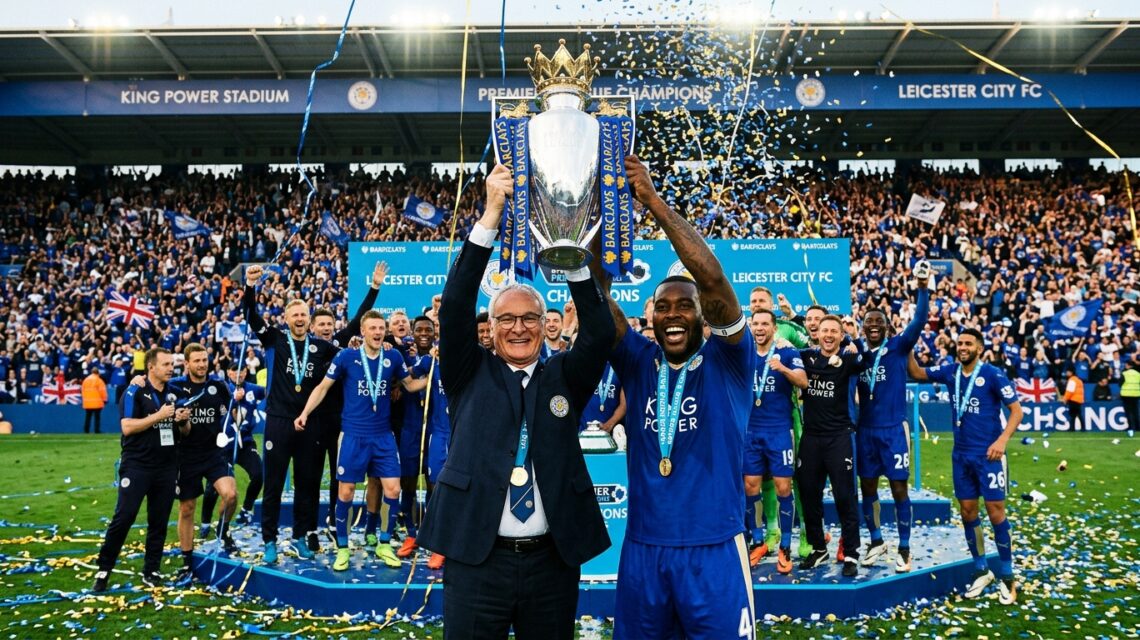
On May 7, 2016, captain Wes Morgan lifted the Premier League trophy at the King Power Stadium after Leicester’s 3-1 victory over Everton.
For a club founded in 1884, it was a moment 132 years in the making.
And for English football, it remains one of the clearest examples of how even a competition shaped by enormous financial differences can occasionally produce a result that almost nobody believed possible.
+ Siga o Giro no Facebook
+ Siga o Giro no Instagram
Leia Mais: