

Just 13 days after a humiliating exhibition defeat, the youngest team in the Olympic hockey tournament stunned the four-time defending champions. But the victory that became a Cold War legend did not actually win the gold medal.
By Marcio Tamer
Updated October 24, 2026
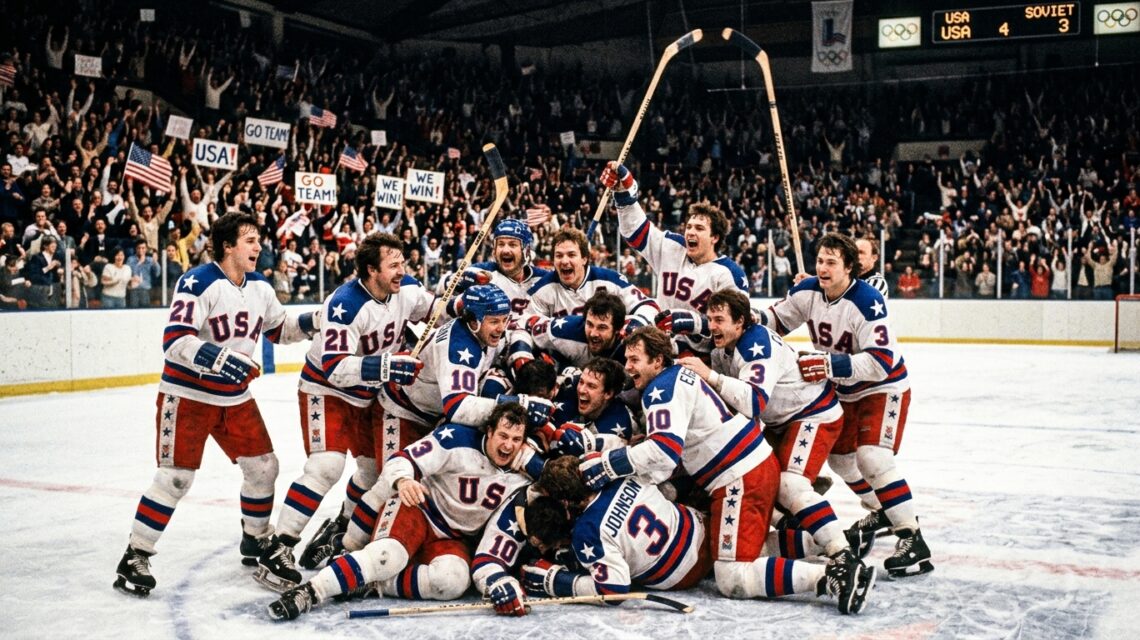
On February 22, 1980, a group of American college hockey players defeated the Soviet Union 4-3 at the Winter Olympics in Lake Placid, New York, producing one of the most extraordinary upsets in international sports history.
The Soviet team had won four consecutive Olympic gold medals, dominated international hockey for nearly two decades and entered the tournament with a roster featuring some of the most accomplished players in the world.
The Americans were different. Their team had an average age of approximately 21, consisted largely of college players and had been assembled by coach Herb Brooks specifically to challenge the Soviet system.
Thirteen days before their Olympic meeting, the Soviets had beaten the United States 10-3 in an exhibition game at Madison Square Garden.
Yet when the two teams met again, the Americans survived relentless Soviet pressure, scored twice in the third period and protected a one-goal lead through the final ten minutes.
The result became known as the Miracle on Ice.
But one detail is frequently misunderstood: the United States did not win the Olympic gold medal by beating the Soviet Union. The victory came during the final medal round, and the Americans still needed to defeat Finland two days later to become champions.
That distinction makes the achievement even more remarkable. After defeating the world’s dominant hockey team, the Americans still had to prove they could finish the job.
The Soviet Union had won four straight Olympic gold medals before arriving in Lake Placid
By 1980, the Soviet national hockey program had established a level of international dominance that few teams in any major sport had matched.
The Soviet Union won Olympic gold in 1964, 1968, 1972 and 1976.
Those championships were part of a broader period in which the Soviet team regularly defeated leading international opponents and accumulated world championship titles.
Its success was built on a sophisticated system of player development, tactical discipline and year-round preparation.
Unlike the American team, which relied heavily on college players, the Soviets featured athletes who trained and competed at an elite level throughout the year.
Officially, Soviet players were classified as amateurs under the Olympic eligibility rules of the period.
In practice, many were supported through state institutions, military organizations or other government-connected structures that allowed them to train as full-time athletes.
The arrangement gave the Soviet Union an enormous competitive advantage over countries whose Olympic teams were assembled from students and other amateur players.
The Soviet roster included legendary goaltender Vladislav Tretiak, captain Boris Mikhailov, forward Valeri Kharlamov and defenseman Viacheslav Fetisov.
Tretiak was already regarded as one of the finest goaltenders in hockey history.
The Soviet attack combined speed, coordinated movement and precise passing, allowing players to maintain possession while creating high-quality scoring opportunities.
Their system was particularly difficult for opponents accustomed to the more direct and physical style associated with North American hockey.
The Soviet team was not merely favored to win the 1980 tournament. It was widely considered the strongest national hockey program in the world.
Why the United States relied on college players instead of NHL stars
The 1980 Winter Olympics took place before professional NHL players were allowed to participate in the men’s Olympic hockey tournament.
That restriction shaped the American roster.
While the Soviet Union could field players who effectively trained and competed as full-time professionals, the United States relied largely on athletes from the college hockey system.
Many American players were still developing and had limited experience against elite international opponents.
The roster included Mike Eruzione, Jim Craig, Mark Johnson, Neal Broten, Dave Christian, Jack O’Callahan, Ken Morrow and other young players who would become permanently associated with the Miracle on Ice.
Several later played professionally in the NHL.
But in February 1980, they were not established professional stars.
Their coach, Herb Brooks, understood the challenge.
Brooks had built a successful college coaching career at the University of Minnesota, where he won NCAA championships in 1974, 1976 and 1979.
He knew that assembling the most individually talented American players would not necessarily produce a team capable of defeating the Soviet Union.
Instead, he focused on selecting athletes who could function within a demanding tactical system.
His roster combined players from different college programs, including universities with intense existing rivalries.
Brooks had to transform those competitors into a cohesive national team in a matter of months.
Herb Brooks built a team designed specifically to challenge Soviet hockey
Brooks believed that traditional North American hockey tactics would not be enough to defeat the Soviet Union.
The Soviets excelled at puck possession, coordinated passing and continuous movement.
Attempting to overpower them physically without matching their skating ability would likely leave the Americans chasing the game.
Brooks therefore developed a system that combined North American aggression with elements of European hockey.
His players were expected to skate relentlessly, move the puck quickly and maintain defensive discipline without sacrificing attacking opportunities.
Conditioning became a central part of preparation.
Brooks subjected the team to demanding training sessions intended to improve endurance and mental resilience.
One of the most famous episodes occurred after an exhibition game against Norway in 1979, when Brooks ordered repeated skating drills following a performance he considered unacceptable.
The exhausting session became known as the “Herbies.”
The story later gained widespread recognition through books and films about the team.
But Brooks’ approach involved more than physical punishment.
He studied the Soviet system, emphasized tactical flexibility and worked to develop a group capable of responding to the speed and movement of elite international opponents.
The Americans needed to remain competitive for all 60 minutes.
Against a Soviet team accustomed to overwhelming opponents, fatigue or a brief lapse in concentration could be decisive.
The Soviets beat the Americans 10-3 just 13 days before the Olympic upset
On February 9, 1980, the United States faced the Soviet Union in an exhibition game at Madison Square Garden in New York.
The result appeared to confirm the enormous gap between the teams.
The Soviets won 10-3.
For American observers, the defeat reinforced expectations that the United States would struggle against the tournament favorites.
For Brooks, the game exposed weaknesses but also provided information about the opponent his team would soon face again.
The exhibition was not part of the Olympic tournament, and its result did not determine medal standings.
Nevertheless, it became one of the most important pieces of context surrounding the Miracle on Ice.
The Americans had been comprehensively beaten by the same opponent they would face less than two weeks later.
A seven-goal defeat does not establish that a future victory is impossible, but it illustrated why the Soviet Union entered the Olympic meeting as such a strong favorite.
The challenge was not simply to improve.
The United States had to produce a dramatically different performance against a team that had recently dominated it.
The Cold War made the hockey game much bigger than an Olympic contest
The Miracle on Ice occurred during a period of intense political tension between the United States and the Soviet Union.
In December 1979, Soviet forces invaded Afghanistan.
The invasion prompted international condemnation and contributed to a deterioration in relations between Washington and Moscow.
President Jimmy Carter subsequently called for a boycott of the 1980 Summer Olympics in Moscow unless Soviet forces withdrew from Afghanistan.
The United States ultimately led a boycott of those Games.
Meanwhile, Americans were also confronting the Iran hostage crisis, which began in November 1979 when militants seized the U.S. Embassy in Tehran.
Economic uncertainty, inflation and declining confidence in national institutions contributed to the difficult political atmosphere.
Against that backdrop, an Olympic hockey game between American students and the Soviet national team acquired symbolic significance far beyond sport.
The matchup appeared to represent two competing political systems.
The Americans were portrayed as young amateurs pursuing an improbable dream.
The Soviets represented an established, state-supported athletic structure with extraordinary resources and experience.
That contrast made the game particularly compelling for American audiences.
However, the political symbolism should not obscure the sporting reality.
The Soviet players were elite athletes competing for their country, not direct representatives of Soviet military policy.
And the American victory did not alter the strategic balance of the Cold War.
Its importance was cultural and emotional: it offered a dramatic sporting moment at a time when many Americans were searching for reasons to feel optimistic.
The Americans reached the Soviet game after surviving a difficult opening round
The United States did not enter the Soviet matchup with an unbeaten record against elite opposition in its recent exhibitions.
But its Olympic results were impressive.
The Americans opened the tournament with a 2-2 draw against Sweden.
They then defeated Czechoslovakia 7-3, a result that demonstrated their ability to compete against one of Europe’s strongest hockey nations.
Further victories over Norway, Romania and West Germany secured their place in the medal round.
The Americans entered the decisive phase with growing confidence.
Their results also showed that the team had improved substantially from the group that suffered the 10-3 exhibition defeat against the Soviets.
The Soviet Union, meanwhile, advanced through its preliminary games with the authority expected of the defending champions.
The stage was set for a meeting between a team accustomed to winning major international championships and an American squad whose strongest performances had come at precisely the right time.
The Soviet Union led twice, but the Americans refused to fall behind for long
The game began on February 22 at the Olympic Fieldhouse in Lake Placid.
The Soviets immediately demonstrated their attacking quality.
Vladimir Krutov opened the scoring, giving the Soviet Union a 1-0 lead.
Buzz Schneider equalized for the United States, but Sergei Makarov restored the Soviet advantage.
The first period appeared to be heading toward a 2-1 Soviet lead.
Then came one of the most important moments of the game.
With the final seconds approaching, American forward Dave Christian sent a long shot toward Soviet goaltender Vladislav Tretiak.
Tretiak failed to control the rebound cleanly.
Mark Johnson reacted quickly, collected the loose puck and scored with one second remaining in the period.
The goal tied the game at 2-2.
It was a remarkable moment because Tretiak was considered one of the most reliable goaltenders in the world.
The Soviet team had dominated stretches of play, but the Americans entered the first intermission level.
The late goal also triggered a coaching decision that would become one of the most debated moments in Olympic hockey history.
The Soviet coach benched Vladislav Tretiak after the first period
Soviet coach Viktor Tikhonov replaced Tretiak with backup goaltender Vladimir Myshkin at the start of the second period.
The decision was extraordinary.
Tretiak was an established international superstar who had played a central role in Soviet hockey’s success.
Removing him after the Americans scored twice in the opening period surprised observers and later became a source of controversy.
Tikhonov believed the change was necessary, but many players and analysts questioned whether it disrupted the team’s confidence.
Tretiak himself later expressed disappointment about the decision.
However, the substitution cannot be treated as the sole reason the Soviet Union lost.
Myshkin played effectively for much of the remainder of the game, and the Soviet team continued generating scoring opportunities.
The Soviets outshot the Americans by a substantial margin.
The deeper problem was that the United States remained within striking distance despite spending long periods defending.
A game the Soviets might normally have controlled comfortably was still tied after 20 minutes.
The Soviet Union dominated the second period but led by only one goal
The second period reflected the imbalance in experience and attacking pressure between the teams.
The Soviet Union controlled much of the puck possession and repeatedly tested American goaltender Jim Craig.
Craig became one of the central figures in the game.
He faced a sustained series of shots and prevented the Soviets from turning their territorial advantage into a decisive lead.
Aleksandr Maltsev scored for the Soviet Union, putting the defending champions ahead 3-2.
The Americans struggled to generate the same volume of chances.
But their defensive organization and Craig’s goaltending kept the deficit at one goal.
That distinction became critical.
Against a team as strong as the Soviet Union, falling behind by several goals would have made a comeback extremely difficult.
Instead, the United States entered the third period needing only one goal to equalize.
The Americans had survived the most dangerous stretches of Soviet pressure.
Now they had 20 minutes to attempt something extraordinary.
Two American goals in the third period changed Olympic history
The decisive period began with the Soviet Union leading 3-2.
The Americans continued competing aggressively, looking for opportunities to turn defensive recoveries into attacks.
At 8:39 of the third period, Mark Johnson scored his second goal of the game.
The goal came during an American power play and tied the score at 3-3.
Suddenly, the Soviet Union’s advantage had disappeared.
Less than two minutes later, the Americans struck again.
At 10:00 of the third period, captain Mike Eruzione received the puck in the attacking zone and fired a shot past Myshkin.
The United States led 4-3.
It was the first time the Americans had been ahead in the game.
The arena erupted.
But there were still ten minutes remaining, an enormous amount of time against a Soviet team capable of creating scoring opportunities in rapid succession.
The Americans had achieved the seemingly impossible task of taking the lead.
They now faced the equally difficult challenge of protecting it.
Jim Craig and the American defense survived the final ten minutes
The Soviet Union intensified its attack after Eruzione’s goal.
The Americans were forced to defend under sustained pressure as the defending champions attempted to avoid a historic defeat.
Craig continued making important saves.
The American defenders blocked shots, challenged puck carriers and worked to prevent the Soviets from creating uncontested opportunities near the net.
Brooks’ emphasis on conditioning became especially valuable during the closing minutes.
His players needed enough energy to maintain defensive positioning despite the physical and emotional strain of the game.
The Soviets finished with 39 shots on goal compared with 16 for the United States.
That statistical imbalance illustrates how unusual the result was.
The Americans did not dominate possession or create more scoring opportunities.
They won because they converted their chances efficiently, received exceptional goaltending and maintained their defensive structure when the game was at its most demanding.
As the final seconds approached, the crowd began counting down.
Television commentator Al Michaels delivered the line that would become inseparable from the moment:
“Do you believe in miracles? Yes!”
The final buzzer sounded.
The United States had defeated the Soviet Union 4-3.
The numbers behind the Miracle on Ice
| Statistic | United States | Soviet Union |
|---|---|---|
| Final score | 4 | 3 |
| Shots on goal | 16 | 39 |
| First-period goals | 2 | 2 |
| Second-period goals | 0 | 1 |
| Third-period goals | 2 | 0 |
| Olympic gold medals in previous four Games | 0 | 4 |
| Result of February 9 exhibition | 3 | 10 |
The shot totals reveal how heavily the game favored the Soviet attack.
The Soviets generated more than twice as many shots as the Americans.
Craig’s performance was therefore essential to the result.
But the statistics also highlight American efficiency.
The United States scored four goals from 16 shots, while the Soviets managed three from 39.
That difference in finishing and goaltending proved decisive.
The result was not evidence that the Americans had suddenly become the more experienced or technically superior team.
It was evidence that they had produced the better performance in the moments that determined the outcome.
The Miracle on Ice was not actually the Olympic gold-medal game
One of the most persistent misconceptions about the Miracle on Ice is that the victory over the Soviet Union immediately secured the Olympic championship.
It did not.
The 1980 men’s Olympic hockey tournament used a medal-round format rather than a single-elimination bracket with a traditional championship final.
The United States and Soviet Union met during the medal round, with results contributing to the final standings.
After defeating the Soviets, the Americans still needed a favorable result against Finland.
That game took place on February 24, two days after the Miracle on Ice.
The Americans entered the final period trailing Finland 2-1.
The possibility of losing the gold medal remained very real.
But the United States scored three unanswered goals in the third period to win 4-2.
The victory secured the Olympic championship.
The Soviet Union ultimately finished with the silver medal, while Sweden won bronze.
The Americans had completed their extraordinary tournament with a final victory that was less famous than the Soviet upset but equally necessary.
Without defeating Finland, the Miracle on Ice would still have been historic.
It would not, however, have ended with the United States winning Olympic gold.
Al Michaels’ famous call was not heard live by most American television viewers
The Miracle on Ice became one of the most celebrated moments in American television sports history.
Yet another important detail is frequently overlooked.
The game was not broadcast live across most of the United States.
ABC aired it on tape delay during prime time, even though the contest had already concluded.
The network’s broadcast arrangement reflected the television practices of the period, when major sporting events were sometimes delayed to reach larger audiences during evening viewing hours.
Michaels’ commentary nevertheless became iconic.
His final call captured the emotional magnitude of an upset that many viewers had considered nearly impossible.
The recording was replayed countless times in subsequent years.
It became a defining example of how a brief moment of sports commentary can shape the public memory of an event.
The phrase also helped turn the victory into something larger than a hockey result.
For generations of American fans, the words became a symbol of unexpected achievement against overwhelming odds.
What happened to the players after the 1980 Olympics?
The Miracle on Ice changed the lives of the American players.
Several went on to successful professional careers.
Neal Broten became a long-serving NHL player and later won the Stanley Cup with the New Jersey Devils in 1995.
Ken Morrow joined the New York Islanders and won four consecutive Stanley Cups from 1980 through 1983.
Mark Johnson played professionally and later became a successful hockey coach.
Jim Craig became one of the most recognizable figures associated with the Olympic victory, while Eruzione remained closely identified with the winning goal.
Herb Brooks continued coaching, including later NHL assignments and another period with the U.S. Olympic team.
He died in a car accident in 2003 at age 66.
His influence on American hockey remained substantial.
The 1980 team was inducted into the United States Olympic Hall of Fame, and its victory continued to inspire generations of young players.
The story also entered popular culture through books, documentaries and the 2004 Disney film Miracle, starring Kurt Russell as Brooks.
The film introduced the event to audiences who had not been alive when the game took place.
Why the Soviet defeat was so shocking
The Soviet Union had not lost an Olympic hockey game since 1968.
Its international record, experienced roster and recent 10-3 victory over the Americans made it an overwhelming favorite.
The American team, meanwhile, was younger and had far less international experience.
The upset was extraordinary because it required the Americans to overcome several disadvantages simultaneously.
They faced a technically sophisticated opponent with superior experience, a long history of winning major tournaments and an established tactical system.
They were also heavily outshot during the game.
Their victory depended on exceptional goaltending, disciplined defending, efficient finishing and the ability to respond after falling behind.
It was not a case of the Soviet Union failing to take the contest seriously.
The Soviet players understood the importance of Olympic competition and had dominated much of the match.
But hockey is decided by goals, not reputation or shot totals.
On February 22, the Americans scored one more goal than the strongest team in international hockey.
The victory became a Cold War symbol, but its sporting legacy was even larger
The Miracle on Ice arrived at a moment when Americans were confronting serious international and domestic challenges.
The Soviet invasion of Afghanistan, the Iran hostage crisis and economic difficulties formed the political backdrop to the Olympic tournament.
The victory provided an emotional moment of national celebration.
But its lasting importance cannot be explained entirely by Cold War politics.
The game also demonstrated the value of team preparation, tactical adaptation and collective belief.
Brooks had assembled players who were not individually as accomplished as their Soviet opponents.
He created a system designed to maximize their strengths and reduce the impact of their disadvantages.
The Americans did not become Olympic champions through one lucky goal.
They survived a difficult tournament, defeated the defending champions and then recovered from a third-period deficit against Finland to secure gold.
The Soviet Union remained a major international hockey power after 1980, winning Olympic gold again in 1984 and 1988.
The American victory did not permanently end Soviet dominance.
Its significance was different.
For one extraordinary afternoon in Lake Placid, a team of young American players overcame an opponent that had spent years establishing itself as the standard of international hockey.
The final score was 4-3, but the statistical contrast was even more striking: 16 American shots against 39 Soviet attempts.
Two days later, the United States completed the story by defeating Finland 4-2 and winning Olympic gold.
That sequence, from a 10-3 exhibition defeat to a victory over the Soviet Union and finally an Olympic championship, is what made the Miracle on Ice one of the most enduring underdog stories in sports history.
+ Siga o Giro no Facebook
+ Siga o Giro no Instagram
Leia Mais: