

The undisputed heavyweight champion had destroyed nearly every opponent in his path. But on February 11, 1990, a grieving challenger used his reach, discipline and relentless combinations to produce one of the greatest upsets in sports history.
By Marcio Tamer
Updated October 24, 2026
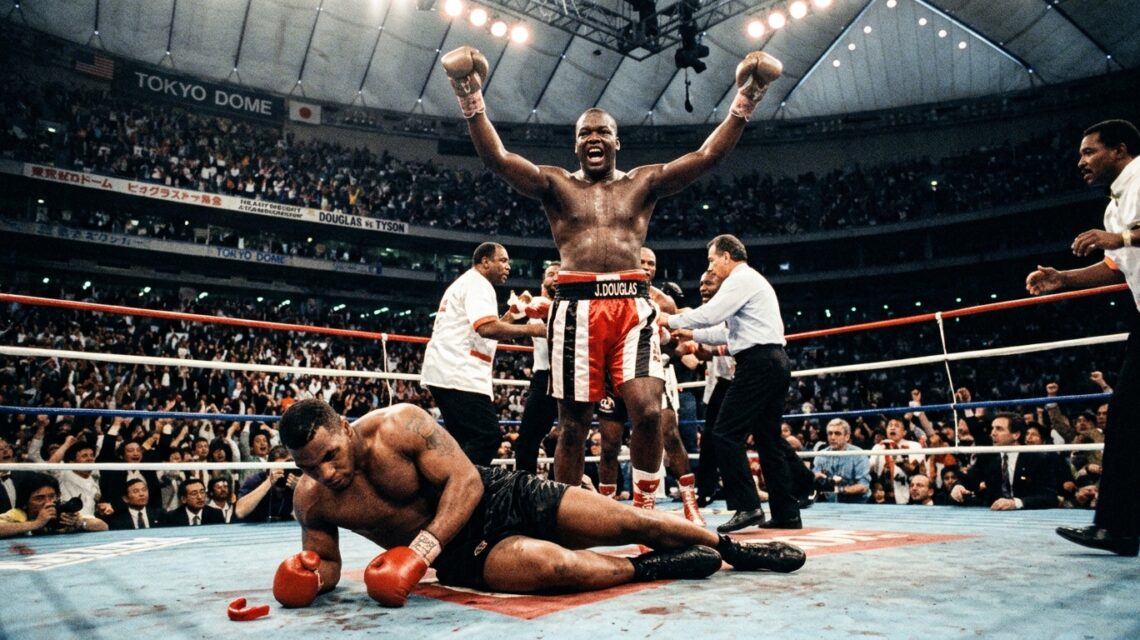
On February 11, 1990, James “Buster” Douglas knocked out Mike Tyson in the tenth round at the Tokyo Dome in Japan, ending the undefeated heavyweight champion’s reign in a result that stunned the boxing world.
Tyson entered the fight with 37 professional victories, including 33 by knockout, and no defeats. He held the World Boxing Association (WBA), World Boxing Council (WBC) and International Boxing Federation (IBF) heavyweight titles.
Douglas was considered such an unlikely winner that the Mirage casino in Las Vegas famously offered odds of 42 to 1 against him.
The challenger had lost his mother just 23 days before the fight. Tyson, meanwhile, was widely expected to dispatch Douglas and move toward a lucrative showdown with Evander Holyfield.
Instead, Douglas controlled long stretches of the contest with his jab, punished Tyson with combinations and survived a dramatic eighth-round knockdown before delivering the decisive blows in the tenth.
The victory was more than the first defeat of a feared champion. It exposed the limits of Tyson’s aura of invincibility and transformed Douglas, a fighter with a history of inconsistent performances, into the undisputed heavyweight champion of the world.
Mike Tyson had built one of boxing’s most intimidating undefeated records
By early 1990, Tyson was one of the most recognizable athletes in the world.
He had become the youngest heavyweight champion in boxing history in November 1986, when he stopped Trevor Berbick in the second round at just 20 years old.
Over the following years, Tyson unified the major heavyweight titles and established a reputation for explosive power, aggressive movement and devastating combinations.
His style was built around speed, head movement and the ability to close distance rapidly.
Although relatively short for a heavyweight at approximately 5 feet 10 inches, Tyson used his compact build and exceptional punching power to overwhelm taller opponents.
He frequently ended fights before opponents could establish a rhythm.
In June 1988, Tyson knocked out Michael Spinks in just 91 seconds, producing one of the most emphatic victories of his career.
The result strengthened the belief that no heavyweight could withstand his attacks.
By the time he arrived in Tokyo, Tyson had defeated every opponent he had faced professionally.
His record stood at 37-0, with 33 knockouts.
The championship belts, undefeated record and speed of his victories created an image of near-total dominance.
But that reputation also concealed changes occurring outside the ring.
Why Tyson’s preparation for the Douglas fight became a major concern
Tyson’s career had undergone significant changes in the years leading up to Tokyo.
His longtime trainer and mentor Cus D’Amato had died in 1985, before Tyson became heavyweight champion.
Kevin Rooney, who had helped develop Tyson’s technique and maintain his disciplined fighting style, was dismissed from the training team in 1988.
Tyson’s professional and personal life became increasingly turbulent.
His marriage to actress Robin Givens ended amid intense publicity, while changes in management and training arrangements created further instability.
By 1990, Tyson was working with a different team and facing questions about his preparation.
Accounts from people close to the fight later described a champion who had not approached Douglas with the same discipline associated with his earlier career.
However, the claim that Tyson lost simply because he failed to train properly is an incomplete explanation.
Douglas entered the ring with a clear tactical strategy and executed it with exceptional consistency.
Tyson’s preparation may have contributed to his performance, but it does not diminish the quality of the challenger’s victory.
The fight was decided by what happened inside the ring, not merely by the circumstances surrounding the champion.
Buster Douglas had already experienced defeat and disappointment before Tokyo
Douglas was not an unknown boxer, but he had never been regarded as one of the division’s dominant fighters.
Born in Columbus, Ohio, he came from a boxing family.
His father, William “Dynamite” Douglas, had been a professional fighter, and Buster grew up surrounded by the sport.
At 6 feet 4 inches, Douglas possessed substantial height and reach advantages over Tyson.
He also had a technically effective jab, solid punching ability and the capacity to box from distance.
But his career had been inconsistent.
In 1987, Douglas challenged Tony Tucker for the vacant IBF heavyweight title.
He performed well early in the fight but eventually lost by technical knockout in the tenth round.
The defeat reinforced doubts about his conditioning and ability to sustain pressure in major championship contests.
Douglas subsequently rebuilt his career with a series of victories.
He earned the opportunity to face Tyson, but few observers believed he could seriously threaten the undefeated champion.
His professional record before the bout was 29 wins, four losses and one draw, with one no-contest also appearing in some historical record listings.
The numbers reflected a capable heavyweight challenger, but not someone whose career achievements appeared comparable to Tyson’s.
That gap in reputation made the eventual result extraordinary.
Douglas lost his mother 23 days before the biggest fight of his life
On January 18, 1990, Douglas’s mother, Lula Pearl Douglas, died after suffering a stroke.
Her death came just over three weeks before the scheduled championship fight.
The loss devastated Douglas.
His mother had supported his boxing ambitions and believed he possessed the ability to become world champion.
Douglas later described her confidence in him as a major source of motivation.
He considered withdrawing from the fight but ultimately continued preparing.
The emotional circumstances became central to the story of his victory.
Yet reducing the outcome to grief or determination alone would overlook the technical and physical preparation required to defeat Tyson.
Douglas still needed to survive against one of the most dangerous punchers in heavyweight history.
He had to maintain his distance, withstand pressure and execute a disciplined strategy across multiple rounds.
His mother’s death gave the contest profound personal meaning, but his performance was the product of boxing skill as well as emotional resilience.
What did the 42-to-1 betting odds really mean?
The odds offered on Douglas became one of the most famous numbers in boxing history.
The Mirage casino in Las Vegas listed him as a 42-to-1 underdog.
In fractional betting terms, a successful $100 wager on Douglas at those odds would have generated $4,200 in profit, plus the original $100 stake.
The odds reflected the enormous gap between the fighters’ reputations.
Tyson was undefeated, held three major heavyweight belts and had defeated numerous established opponents with remarkable speed.
Douglas had suffered four professional defeats and had previously lost a heavyweight title opportunity.
The betting market therefore treated a Douglas victory as exceptionally unlikely.
However, 42-to-1 odds do not establish the exact mathematical probability that Douglas would lose.
Betting prices reflect bookmakers’ assessments, profit margins and customer behavior.
The figure is best understood as evidence of the overwhelming expectation that Tyson would win.
Some sportsbooks reportedly declined to offer a conventional betting market on the fight because Tyson was considered such a dominant favorite.
The Mirage’s price became the most widely cited measure of the upset’s magnitude.
Douglas used his jab to disrupt Tyson’s most dangerous weapon
From the opening rounds, Douglas fought with a discipline that surprised many observers.
He used his height and reach to keep Tyson at a distance.
His left jab repeatedly interrupted the champion’s forward movement and prevented Tyson from establishing the rhythm required for his explosive combinations.
Douglas also moved effectively around the ring, refusing to remain stationary in front of the shorter fighter.
When Tyson attempted to close the distance, Douglas answered with straight right hands and combinations.
The strategy was particularly effective because Tyson’s offense depended heavily on getting close enough to unleash powerful hooks and uppercuts.
Douglas forced him to cross dangerous territory before reaching punching range.
The challenger did not simply retreat.
He attacked consistently, landed meaningful punches and made Tyson work for every opportunity.
As the rounds progressed, Tyson’s face began to show visible damage.
His left eye became increasingly swollen, affecting his ability to see punches coming from that side.
The damage reflected the sustained success of Douglas’s jab and combinations.
For perhaps the first time in his professional career, Tyson was being comprehensively outboxed over an extended championship contest.
Tyson knocked Douglas down in round eight, creating the fight’s biggest controversy
Despite Douglas’s strong performance, Tyson remained dangerous.
Late in the eighth round, the champion landed a powerful right uppercut that sent Douglas to the canvas.
It was the most dramatic moment of the fight to that point.
Douglas remained down while referee Octavio Meyran administered the count.
He rose before the referee reached ten and was allowed to continue.
The knockdown later became controversial because Tyson’s representatives argued that Douglas had received a count longer than the standard ten seconds.
Video footage showed that Meyran’s count did not correspond precisely to ten seconds of elapsed clock time.
But boxing knockdown counts are administered by the referee, not determined solely by a television stopwatch.
The official count controls the action, and the referee has responsibility for deciding whether a fighter can continue.
Douglas rose during the count and demonstrated that he was able to resume fighting.
Tyson’s camp subsequently challenged the result, but the victory was ultimately upheld.
The controversy did not change the fact that Douglas survived the knockdown and continued fighting effectively.
Nor did it erase his dominance in many of the earlier rounds.
The eighth-round incident became part of the legend because it showed how close Tyson came to preserving his undefeated record despite being outboxed.
The tenth-round combination ended Tyson’s undefeated reign
By the tenth round, Tyson was visibly exhausted and badly swollen around the left eye.
Douglas continued applying pressure.
He landed a powerful right uppercut that rocked the champion.
Then came a rapid combination of punches that drove Tyson backward and sent him crashing to the canvas.
The sequence included a series of clean blows to the head, delivered against a fighter who could no longer defend effectively.
Tyson fell heavily.
As the referee counted, the champion searched for his mouthguard on the canvas and attempted to put it back into his mouth.
The image became one of the most recognizable moments in boxing history.
For years, Tyson had been the fighter standing over fallen opponents.
Now he was the one struggling to rise.
Meyran completed the count.
Douglas had won by knockout in the tenth round.
The official stoppage came at 1 minute and 23 seconds of the round.
The undefeated champion was defeated, and the challenger became the new undisputed heavyweight champion.
The numbers behind Tyson vs Douglas in Tokyo
| Statistic | Mike Tyson | Buster Douglas |
|---|---|---|
| Professional record entering fight | 37-0 | 29-4-1 |
| Knockout victories entering fight | 33 | 19 |
| Height | Approximately 5 ft 10 in | Approximately 6 ft 4 in |
| Championship status | Undisputed heavyweight champion | Challenger |
| Betting position | Overwhelming favorite | 42-to-1 underdog |
| Knockdowns scored | 1, in round eight | 1, in round ten |
| Final result | Lost by knockout | Won by knockout |
| Round of stoppage | 10 | 10 |
The statistics highlight the contrast between expectation and outcome.
Tyson entered the fight undefeated, with a knockout rate approaching 90%.
Douglas had a far less imposing record and had previously lost a major title fight.
But the challenger possessed a significant height advantage and used it effectively.
The difference was not simply physical.
Douglas fought with tactical discipline, maintained his concentration after being knocked down and continued attacking even when Tyson threatened to turn the fight around.
The final result demonstrated how a technically sound strategy could neutralize an opponent whose reputation had become almost as intimidating as his punches.
The boxing world initially struggled to accept the result
The immediate reaction to Douglas’s victory was disbelief.
Journalists, broadcasters and fans had expected Tyson to win comfortably.
Many had viewed the Tokyo bout as a relatively routine title defense before a possible fight against Evander Holyfield.
Instead, the heavyweight championship changed hands in one of the most unexpected results in boxing history.
Tyson’s representatives challenged the result, focusing on the eighth-round knockdown count.
The dispute created uncertainty about whether the championship outcome would be recognized without further controversy.
But the governing bodies ultimately accepted Douglas as champion.
The WBA, WBC and IBF titles passed to the challenger.
The result forced boxing observers to reassess Tyson’s position in the sport.
He remained a dangerous heavyweight with extraordinary power, but the idea that he was unbeatable had been permanently destroyed.
Douglas, meanwhile, experienced an immediate transformation in public status.
He had entered Tokyo as a widely dismissed challenger.
He left as the man who had defeated the most feared heavyweight champion of his generation.
Why Douglas’s victory was more than a lucky punch
The fight is sometimes remembered primarily for the final knockout.
That interpretation misses what made Douglas’s performance so exceptional.
He did not win through a single unexpected punch after being dominated for nine rounds.
He controlled significant portions of the contest.
His jab repeatedly landed, his combinations damaged Tyson and his movement prevented the champion from attacking with his usual effectiveness.
Douglas also recovered from a knockdown that could have ended the fight.
His victory therefore combined technical execution, physical endurance and mental resilience.
Tyson’s difficulties outside the ring may have affected his preparation, but they do not explain away the sustained success of Douglas’s tactics.
The challenger demonstrated that Tyson could be beaten by an opponent who refused to be intimidated, maintained distance and attacked consistently.
That lesson changed how future opponents approached the former champion.
Douglas lost the heavyweight title to Evander Holyfield eight months later
Douglas’s reign as undisputed heavyweight champion was brief.
On October 25, 1990, he defended his titles against Evander Holyfield in Las Vegas.
Holyfield had been preparing for a potential showdown with Tyson before the Tokyo upset changed the heavyweight landscape.
The fight against Douglas became his opportunity to win the championship.
Holyfield knocked Douglas out in the third round.
The result ended Douglas’s reign after just one successful championship fight, the victory over Tyson.
Douglas’s performance against Holyfield drew criticism, particularly regarding his conditioning and preparation.
He later stepped away from boxing before eventually returning to the sport.
His career never again reached the level of his performance in Tokyo.
But the brevity of his championship reign did not diminish the significance of the upset.
Many heavyweight champions have held titles for longer periods without producing a victory as historically memorable.
Douglas’s legacy became inseparable from the night he defeated Tyson.
Tyson’s defeat changed the course of his career
For Tyson, the loss marked the end of his first period of heavyweight dominance.
He continued boxing and remained one of the sport’s biggest attractions.
But the aura of invincibility that had defined his rise was gone.
Tyson later faced major personal and legal difficulties, including a 1992 rape conviction and imprisonment.
He returned to professional boxing in 1995 and regained heavyweight titles in 1996.
However, he never fully recovered the same dominance he had displayed during the late 1980s.
His later career included major fights against Holyfield and Lennox Lewis, as well as further controversies.
The Tokyo defeat became a dividing line in the story of his career.
Before Douglas, Tyson had appeared almost unstoppable.
After Douglas, opponents knew that he could be hurt, outboxed and knocked out.
The psychological effect was as important as the statistical change from 37-0 to 37-1.
Why the Tokyo upset remains one of boxing’s greatest shocks
Boxing history contains many unexpected championship results.
Underdogs have defeated established champions, aging fighters have produced remarkable comebacks and little-known challengers have seized titles against the odds.
But Douglas’s victory occupies a special place because of the gap between the fighters’ reputations.
Tyson was not merely a champion.
He was undefeated, held the major heavyweight belts and had established a record of devastating knockouts.
Douglas was a challenger whose previous career had not suggested that he could dominate the division’s most feared fighter.
The 42-to-1 odds captured that imbalance.
The circumstances surrounding Douglas’s mother’s death added emotional significance, while the eighth-round knockdown created extraordinary drama.
Then came the tenth-round knockout, an image that permanently changed how Tyson was remembered.
The result also exposed a fundamental truth about heavyweight boxing.
No matter how dominant a champion appears, a single opponent with the right preparation, tactics and determination can change everything.
The Tokyo Dome witnessed that possibility become reality.
On February 11, 1990, Buster Douglas did not simply defeat Mike Tyson.
He ended an undefeated reign, captured the undisputed heavyweight championship and produced a result that remains a benchmark for sporting upsets more than three decades later.
+ Siga o Giro no Facebook
+ Siga o Giro no Instagram
Leia Mais: