

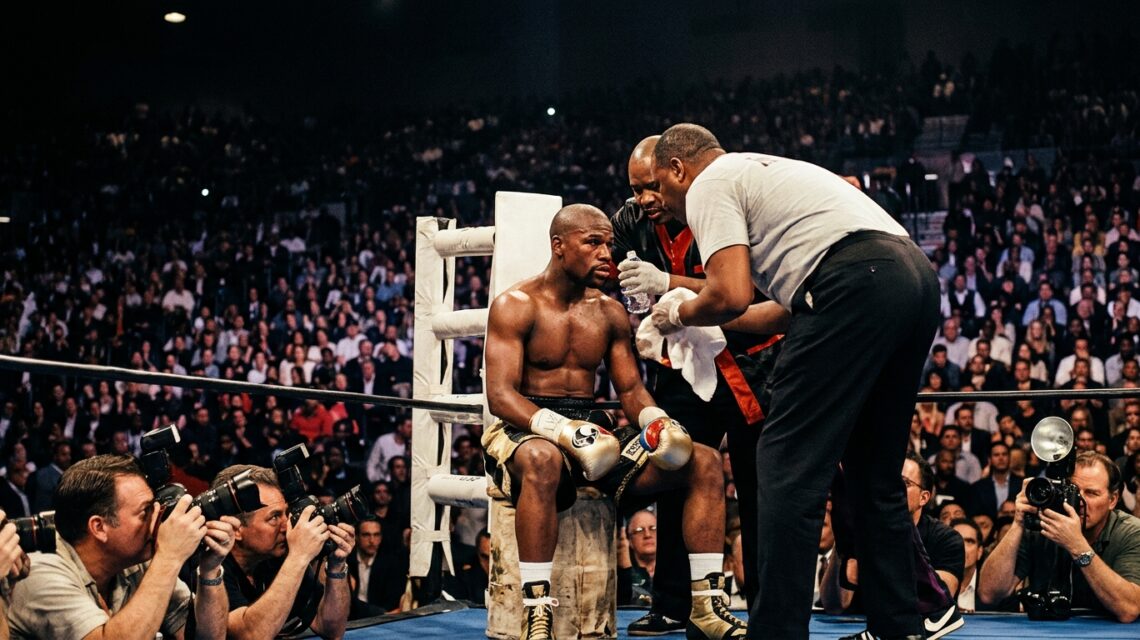
The undefeated champion walked away from Top Rank to pursue control over his own business. A year later, his fight with Oscar De La Hoya generated 2.48 million pay-per-view purchases, setting the stage for two nine-figure paydays.
By Marcio Tamer
Updated October 30, 2026
In April 2006, Floyd Mayweather Jr. paid $750,000 to terminate his promotional contract with Bob Arum’s Top Rank. He was an undefeated world champion, but he believed his earning potential was being limited by the traditional business structure of professional boxing.
The decision was expensive, risky and potentially transformative.
Mayweather was giving up the security of an established promoter to pursue something more valuable: a greater share of the money generated by his own fights.
Within a year, he had earned an estimated $25 million against Oscar De La Hoya. In 2015, his victory over Manny Pacquiao helped him earn approximately $300 million over a 12-month period. Two years later, his crossover fight with Conor McGregor delivered another estimated $275 million payday.
By October 2026, Forbes estimated Mayweather’s career earnings at approximately $1.08 billion.
The arithmetic makes his original decision extraordinary.
The $750,000 buyout amounted to less than 0.1% of the career earnings Forbes would eventually attribute to him.
But the story is not simply about a boxer who became rich after firing his promoter.
Mayweather helped change how the biggest stars in boxing negotiated with television networks, event promoters and commercial partners.
He also demonstrated that the person generating the audience could demand a much larger share of the business.
Why Mayweather wanted to leave Bob Arum and Top Rank
Mayweather turned professional after winning a bronze medal at the 1996 Atlanta Olympics.
He signed with Top Rank, the influential promotional company founded by Bob Arum.
The relationship was initially successful.
Mayweather won his first world title in 1998 by defeating Genaro Hernández.
He continued winning championships across multiple weight divisions while building an undefeated record.
His reputation rested on exceptional defensive technique, speed, accuracy and ring intelligence.
But his commercial status developed more slowly.
In the early 2000s, Mayweather was a highly respected fighter without the enormous pay-per-view audience enjoyed by boxing’s biggest mainstream attractions.
Forbes reported that he earned approximately $150,000 for his first world-title victory in 1998.
By the middle of the following decade, his purses had grown into the millions.
He earned approximately $3.2 million for his 2005 victory over Arturo Gatti.
Yet Mayweather believed his commercial potential was much greater.
He wanted the biggest fights and the financial rewards that came with them.
His relationship with Arum became increasingly strained over the direction of his career and the compensation he expected.
The decisive disagreement involved potential fights against Antonio Margarito and Oscar De La Hoya.
The $8 million Margarito offer helped expose the disagreement
In 2006, Top Rank offered Mayweather approximately $8 million to fight welterweight champion Antonio Margarito.
The proposal was substantial by the standards of the period.
But Mayweather and his advisers believed he could earn more by pursuing a fight against Oscar De La Hoya.
De La Hoya was already one of boxing’s biggest commercial attractions.
A fight between the two could generate far more public attention and pay-per-view sales than a conventional title defense.
The obstacle was their promotional relationships.
De La Hoya had founded Golden Boy Promotions after separating from Top Rank.
Arum and De La Hoya had a contentious business relationship.
Mayweather’s advisers were concerned that remaining with Top Rank could complicate negotiations.
Contemporary reporting from April 2006 confirms that the promotional dispute was central to Mayweather’s decision.
His adviser Leonard Ellerbe explained that Mayweather did not want Arum’s problems with De La Hoya to prevent the fight.
Mayweather’s representative Al Haymon also sought more favorable financial arrangements.
The disagreement was therefore about more than one rejected purse.
It concerned who would determine Mayweather’s future opponents, negotiate his opportunities and control the commercial structure of his biggest events.
How the $750,000 contract buyout changed his career
Mayweather’s contract contained an exit provision.
He could pay $750,000 to terminate the remaining agreement with Top Rank.
In April 2006, he exercised that option.
Sports Business Journal reported the transaction at the time, citing contemporary coverage from the Las Vegas Review-Journal.
The decision made Mayweather available to negotiate major fights outside Top Rank’s exclusive promotional control.
It did not instantly give him sole ownership of every commercial right associated with his future bouts.
Professional boxing events involve multiple parties, including fighters, promoters, broadcasters, venues, sponsors and regulators.
But leaving Top Rank allowed Mayweather to negotiate from a different position.
Instead of relying on a single established promoter to arrange his career, he could participate more directly in the promotion and financial structure of his fights.
That flexibility became increasingly valuable as his popularity grew.
Leonard Ellerbe later described the buyout as an exceptionally successful investment.
Forbes reported that Mayweather subsequently established Mayweather Promotions, creating a company that could participate in promoting his own events.
The financial model changed.
Mayweather was no longer simply negotiating what he would be paid to fight.
He was seeking a share of the business generated by the event itself.
Why being a promoter was more valuable than receiving a guaranteed purse
The traditional boxing model generally separates fighters from event promoters.
A promoter organizes the event, negotiates commercial agreements and assumes financial responsibilities.
The boxer receives compensation under a contract that may include a guaranteed purse and additional payments tied to revenue.
For established stars, those arrangements can be extremely lucrative.
But the promoter also participates in the financial upside.
Mayweather wanted to move closer to that side of the business.
Through Mayweather Promotions and his advisers, he became involved in arrangements covering event promotion, television distribution, ticket sales, sponsorships and other revenue streams.
That did not mean he personally collected every dollar.
Pay-per-view providers retained portions of sales revenue.
Broadcasters received compensation.
Venues, promoters, other fighters and event contractors also had financial interests.
The difference was that Mayweather could negotiate a larger economic participation than a fighter receiving only a conventional purse.
Forbes reported that Mayweather Promotions participated in his major events, receiving shares of revenue from pay-per-view sales, live gates, sponsorships, merchandise and international television.
The model required Mayweather to remain a major attraction.
Without sufficient audience demand, greater control would not automatically produce greater earnings.
His next major fight demonstrated why the risk could pay off.
The 2007 Oscar De La Hoya fight made Mayweather a pay-per-view superstar
On May 5, 2007, Mayweather faced Oscar De La Hoya at the MGM Grand Garden Arena in Las Vegas.
The fight was a major commercial event.
De La Hoya entered as the established pay-per-view attraction.
Mayweather was the undefeated challenger seeking a larger audience and a defining victory.
The promotion emphasized their contrasting personalities and styles.
De La Hoya was the familiar superstar.
Mayweather was the younger, outspoken fighter challenging his position.
The bout generated approximately 2.48 million pay-per-view purchases, a record at the time.
Mayweather won by split decision.
Forbes estimated that he earned approximately $25 million from the event.
De La Hoya reportedly earned even more, approximately $52 million.
That detail matters.
The fight did not immediately make Mayweather the biggest financial beneficiary of every boxing event.
De La Hoya still possessed enormous commercial power.
But the victory helped transfer that status.
Mayweather had defeated the established star while participating in one of the most successful pay-per-view events in boxing history.
The commercial possibilities were now much greater.
The transformation from Pretty Boy Floyd to Money Mayweather
Mayweather had previously been known as Pretty Boy Floyd.
The nickname reflected his defensive skill and his ability to avoid taking heavy punishment.
As his commercial ambitions expanded, he increasingly embraced the identity of Money Mayweather.
The change was more than a new nickname.
Mayweather made wealth, luxury and personal success central elements of his public image.
He displayed expensive cars, jewelry and large amounts of cash.
He spoke openly about his earnings.
He promoted himself as an undefeated fighter whose opponents could not solve his defensive style.
The persona attracted supporters who admired his skill and success.
It also attracted critics who disliked his displays of wealth and confrontational behavior.
Both groups could become paying customers.
Some viewers purchased his fights because they wanted to see him win.
Others paid because they hoped to witness his first defeat.
This was an important commercial insight.
A sporting event does not require every viewer to admire the central figure.
It requires enough people to care about the outcome.
Mayweather’s undefeated record made the proposition especially compelling.
Each fight offered the possibility that someone might finally beat him.
As his victories accumulated, that question became more valuable.
The public persona amplified an existing sporting advantage.
Mayweather was not merely advertising his fights.
He was turning his undefeated record into a recurring commercial attraction.
Mayweather’s 2013 Showtime agreement strengthened his negotiating position
In 2013, Mayweather signed a major multiyear agreement with Showtime after years of fighting on HBO.
The deal covered up to six fights over 30 months.
The arrangement was widely regarded as one of the richest television agreements in boxing.
It also reflected Mayweather’s position as an established commercial attraction.
Showtime was prepared to make a substantial commitment because his fights could generate enormous pay-per-view revenue.
The relationship helped support several of the most lucrative events of his career.
In September 2013, Mayweather defeated Canelo Álvarez in Las Vegas.
The fight generated approximately $150 million in domestic pay-per-view revenue, according to figures later cited by the broadcasters involved in Mayweather’s 2015 fight with Pacquiao.
Forbes estimated that Mayweather earned more than $70 million from the Canelo event.
The progression was striking.
His reported purse against Arturo Gatti in 2005 had been approximately $3.2 million.
Against De La Hoya in 2007, he earned around $25 million.
Against Canelo in 2013, his earnings exceeded $70 million.
His financial growth reflected more than larger guaranteed purses.
It reflected his increasing ability to negotiate around the total commercial value of an event.
The Pacquiao fight generated more than $500 million in worldwide revenue
The biggest commercial breakthrough came on May 2, 2015.
Mayweather faced Manny Pacquiao at the MGM Grand Garden Arena in Las Vegas.
The fight had been discussed for years.
Both men were among the most successful and recognizable boxers of their generation.
Their rivalry created enormous public anticipation.
The event was jointly distributed by HBO and Showtime and promoted by Mayweather Promotions and Top Rank.
The involvement of Top Rank was particularly notable.
Nine years after Mayweather had paid to leave Bob Arum’s company, the two organizations were cooperating on the richest fight in boxing history.
The financial results were unprecedented.
A joint announcement from Showtime, HBO and the promoters reported more than 4.4 million initial U.S. pay-per-view purchases.
The event generated more than $400 million in domestic pay-per-view revenue alone.
Worldwide gross receipts were expected to exceed $500 million after including ticket sales, international television, sponsorships, closed-circuit viewing and merchandise.
The Nevada State Athletic Commission reported an official live gate of $72,198,500.
That was more than three times the previous Nevada boxing gate record of approximately $20 million.
The numbers demonstrated the scale of Mayweather’s commercial influence.
He had become one of the few athletes capable of generating hundreds of millions of dollars from a single event.
How much did Mayweather actually earn against Pacquiao?
Mayweather defeated Pacquiao by unanimous decision after 12 rounds.
The bout lasted 36 minutes of scheduled fighting time, excluding breaks between rounds.
The financial outcome was even more remarkable.
Forbes later estimated that Mayweather earned approximately $240 million from the Pacquiao fight.
Other reports placed his total compensation closer to $250 million.
The exact final figure depends on which payments and adjustments are included.
Those estimates should not be confused with the event’s gross revenue.
The fight generated more than $400 million in domestic pay-per-view receipts and was expected to exceed $500 million in worldwide revenue.
That money did not all belong to Mayweather.
It was distributed among multiple commercial participants.
His earnings represented his negotiated share, including compensation tied to the event’s performance.
Forbes estimated that Mayweather earned $300 million during the 12-month period ending in June 2015.
Guinness World Records recognized that figure as the highest annual earnings recorded for a boxer at the time.
The achievement illustrated how far his financial position had changed since 2006.
He had paid $750,000 to leave a promoter.
Nine years later, a single fight was capable of generating personal earnings hundreds of times larger than that payment.
The McGregor fight produced another nine-figure payday
Mayweather’s next defining financial event came in August 2017.
He faced Conor McGregor, the UFC star making his professional boxing debut.
The matchup was unusual.
McGregor was an elite mixed martial artist but had never competed professionally as a boxer.
Mayweather was a retired, undefeated boxing champion returning for a crossover spectacle.
The event was marketed around the contrast between the two personalities and their different combat-sport backgrounds.
Mayweather won by technical knockout in the tenth round.
The victory extended his professional boxing record to 50-0.
Commercially, the fight was another enormous success.
Showtime confirmed approximately 4.3 million pay-per-view purchases in North America.
That made it the second-largest pay-per-view boxing event by purchases at the time, behind Mayweather-Pacquiao.
Showtime also reported that worldwide event revenue exceeded $600 million.
Forbes estimated Mayweather’s earnings from the McGregor fight at approximately $275 million.
The figure surpassed its estimate for his Pacquiao payday.
The two events together accounted for more than $500 million in estimated personal earnings.
That concentration of income demonstrates how different Mayweather’s business model had become from the conventional pattern of fighting several times annually for relatively fixed purses.
He could generate extraordinary earnings from a single event built around his name.
Why Mayweather’s fights generated billions without making every dollar his income
One of the most common misunderstandings about Mayweather’s career concerns the difference between event revenue and personal earnings.
Forbes reported in 2018 that his final 15 major fights, beginning with De La Hoya in 2007, had generated approximately $1.7 billion in pay-per-view revenue.
Those events attracted nearly 23 million paying customers.
That was revenue generated by the events, not money paid directly to Mayweather.
The total included payments from viewers to distributors and broadcasters.
The commercial proceeds were divided according to contractual arrangements.
Mayweather’s share was substantial because of his negotiating position and his involvement through Mayweather Promotions.
But it was not 100%.
Similarly, the $500 million-plus generated by the Pacquiao event and the $600 million-plus associated with McGregor should not be added directly to Mayweather’s personal income.
Those figures describe event economics.
His reported $240 million and $275 million paydays are estimates of personal compensation.
The distinction is essential for understanding how his business operated.
Mayweather became exceptionally wealthy not because he owned every dollar generated by boxing fans.
He became wealthy because he secured a larger share of the commercial value associated with his fights.
Did Mayweather eliminate boxing promoters?
Mayweather’s business model is sometimes described as eliminating promoters entirely.
That is inaccurate.
He established his own promotional company and became more directly involved in the business of his events.
But his fights continued to require partnerships with broadcasters, distributors, venues and other promoters.
The Pacquiao fight, for example, involved both Mayweather Promotions and Top Rank.
The McGregor event required cooperation among boxing and mixed martial arts organizations, television distributors and other commercial participants.
Mayweather did not remove every intermediary.
He changed his position within the system.
Instead of depending entirely on an outside promoter to negotiate his opportunities, he became a participant in the promotional business.
That gave him greater bargaining power and access to additional revenue.
The model was particularly effective because Mayweather had an exceptional competitive record and an audience willing to pay premium prices to watch him.
Not every boxer could reproduce the arrangement.
A fighter without a major audience might assume substantial financial risk by attempting to promote events independently.
Mayweather’s strategy worked because his commercial leverage increased alongside his sporting success.
Mayweather’s financial rise in numbers
| Milestone | Reported figure |
|---|---|
| Top Rank contract buyout, 2006 | $750,000 |
| Reported Margarito offer, 2006 | $8 million |
| Mayweather earnings vs. De La Hoya, 2007 | Approximately $25 million |
| De La Hoya fight PPV purchases | 2.48 million |
| Mayweather earnings vs. Canelo, 2013 | More than $70 million |
| Canelo fight domestic PPV revenue | Approximately $150 million |
| Pacquiao fight, 2015, initial U.S. PPV purchases | More than 4.4 million |
| Pacquiao fight domestic PPV revenue | More than $400 million |
| Pacquiao fight official live gate | $72.2 million |
| Pacquiao fight worldwide gross receipts | More than $500 million expected |
| Mayweather earnings vs. Pacquiao | Approximately $240 million |
| Forbes estimate of 2015 annual earnings | $300 million |
| McGregor fight, 2017, North American PPV purchases | 4.3 million |
| McGregor fight worldwide event revenue | More than $600 million |
| Mayweather earnings vs. McGregor | Approximately $275 million |
| PPV revenue from his final 15 major fights | Approximately $1.7 billion |
| Forbes estimated career earnings, October 2026 | $1.08 billion |
| Professional boxing record | 50 wins, 0 losses |
The figures show why the $750,000 payment became one of the most consequential business decisions in modern boxing.
Mayweather did not simply negotiate higher purses.
He moved into a position where his compensation could grow with the total value of the event.
That distinction became decisive as pay-per-view audiences reached millions of households.
Was Mayweather the first boxer to control his own business?
Mayweather was not the first athlete to challenge traditional promotional arrangements.
Boxers had long negotiated directly with promoters, established business partnerships and sought greater control over their careers.
Oscar De La Hoya founded Golden Boy Promotions in 2002.
Other major fighters had also participated in promotional ventures before Mayweather’s departure from Top Rank.
What made Mayweather’s case exceptional was the combination of his undefeated record, his commercial persona and the extraordinary financial success of his biggest events.
He demonstrated how a fighter could use personal drawing power to negotiate a larger share of revenue.
His model also helped make financial transparency and promotional independence more prominent subjects in discussions about boxing.
But it did not create a universal solution.
The economics of boxing remain highly dependent on an athlete’s popularity, negotiating power and access to major television distribution.
For Mayweather, the model produced historic earnings.
For less established fighters, the risks and opportunities can be very different.
The $750,000 decision mattered because Mayweather changed what he was selling
The most revealing part of Mayweather’s financial story is not the amount he eventually earned.
It is the change in what he controlled.
Before leaving Top Rank, Mayweather was primarily a fighter receiving compensation for his performances.
After the buyout, he increasingly positioned himself as both the sporting attraction and a participant in the business built around that attraction.
His undefeated record became a commercial asset.
His public persona helped generate demand.
His promotional company gave him a larger role in negotiating how that demand was monetized.
The result was a career that Forbes valued at approximately $1.08 billion in earnings by October 2026.
That figure does not mean Mayweather has a verified personal net worth of $1.08 billion.
Career earnings and net worth are different measures.
Earnings represent money received before relevant expenses, taxes and other financial obligations.
Net worth measures assets minus liabilities.
The distinction matters because public estimates of Mayweather’s personal fortune have varied considerably.
But his commercial achievements are not in serious doubt.
He participated in some of the highest-grossing boxing events ever staged.
He earned nine-figure sums from individual fights.
And he showed that an elite athlete with exceptional audience demand could negotiate a far larger role in the business of professional sport.
The original $750,000 payment was not a guarantee of future wealth.
It was the price Mayweather paid for the opportunity to negotiate on his own terms.
The billion-dollar career that followed showed just how valuable that opportunity could become.
+ Siga o Giro no Facebook
+ Siga o Giro no Instagram
Leia Mais: