


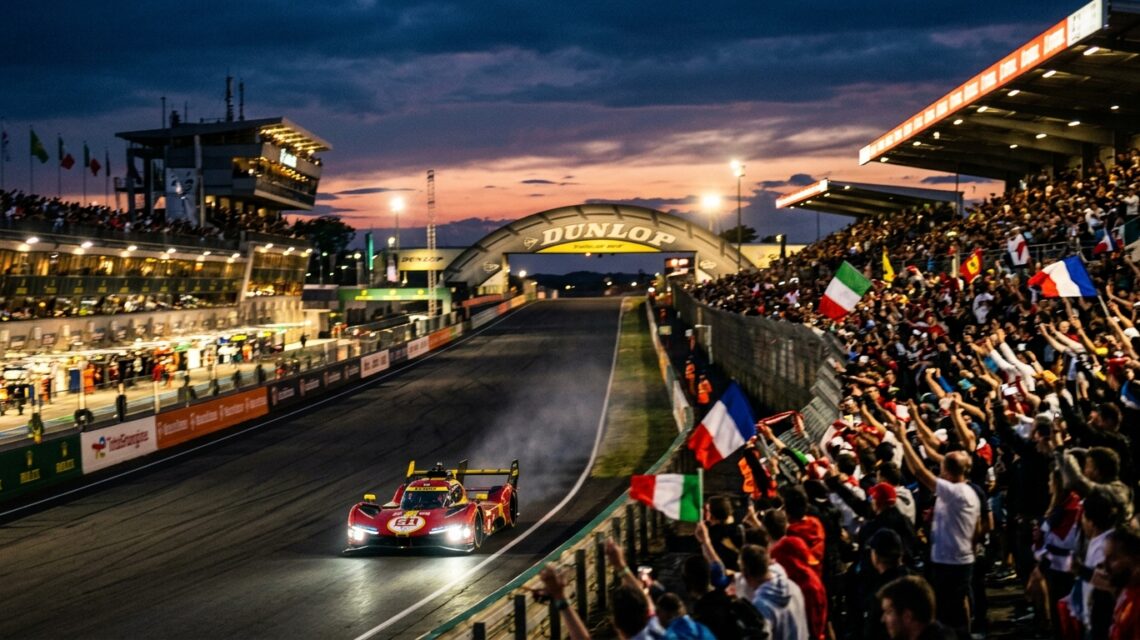
Audi and Porsche left the expensive LMP1 era, leaving Toyota with little factory opposition. A regulatory agreement between Europe and the United States created two routes into endurance racing’s top class, bringing new manufacturers, three consecutive Ferrari victories and Toyota’s dramatic 2026 comeback.
By Marcio Tamer
Updated November 3, 2026
On June 14, 2026, Toyota won the 24 Hours of Le Mans for the first time in four years.
Its No. 7 prototype, driven by Mike Conway, Kamui Kobayashi and Nyck de Vries, completed 381 laps and covered 5,190.33 kilometers.
After 24 hours of racing, the gap to the second-placed BMW was just 10.913 seconds.
Around the circuit, organizers recorded 350,105 spectators, a new attendance record for the event.
The result represented a remarkable transformation for a branch of motorsport that had faced a serious manufacturer crisis less than a decade earlier.
In 2016, Audi announced its withdrawal from the top class of endurance racing.
Porsche followed in 2017.
Both manufacturers had invested heavily in sophisticated hybrid prototypes under the LMP1 regulations.
Their departures left Toyota as the only major factory manufacturer competing in the category’s final years.
The FIA World Endurance Championship needed a new approach.
Instead of creating another unrestricted technological contest, regulators developed a system allowing manufacturers to compete using two different types of prototype.
Le Mans Hypercar, known as LMH, offered greater design freedom.
Le Mans Daytona h, or LMDh, offered a more standardized and potentially less expensive route.
The two categories could compete for overall victories under a common performance-balancing framework.
The arrangement helped bring Ferrari, Porsche, Cadillac, BMW, Alpine and other manufacturers into the top class.
It also created a new commercial proposition: manufacturers could compete at Le Mans and, with suitable programs, in major American endurance races using cars developed around compatible regulations.
The revival was not a guarantee of profitability.
But it restored something the championship had been losing: a broad field of major automotive manufacturers willing to compete for overall victories.
Why the LMP1 era became too expensive to sustain
The World Endurance Championship was revived in 2012.
Its premier category, LMP1, became a showcase for advanced prototype technology.
Audi, Porsche and Toyota developed extremely sophisticated racing cars.
Their programs combined powerful combustion engines with hybrid energy-recovery systems.
The technology was impressive.
It also required enormous investment.
Manufacturers developed specialized powertrains, aerodynamic packages, energy-management systems and complex electronics.
The competition rewarded technical innovation.
But it also created escalating costs.
Leading factory programs were widely reported to cost well into nine figures annually.
Exact budgets were not publicly disclosed in a consistent format.
That makes it difficult to establish a definitive cost for each manufacturer.
Nevertheless, the direction of travel was clear.
The top category had become increasingly expensive.
The commercial benefits of competing were harder to justify when only a small number of manufacturers could afford the technology.
The system was vulnerable to corporate decisions made far beyond the racetrack.
That vulnerability became apparent when Audi and Porsche withdrew.
Audi’s exit exposed the weakness of the business model
Audi had been one of the defining manufacturers in modern endurance racing.
Its Le Mans program began in 1999.
The company went on to achieve 13 overall victories at the race.
Its cars helped establish diesel technology and later hybrid systems as major features of endurance competition.
But in October 2016, Audi announced that it would end its LMP1 program after the season.
The company said it would redirect its motorsport focus toward Formula E.
The decision came amid Volkswagen Group’s wider strategic changes following the diesel emissions scandal.
The scandal increased pressure on the group’s finances and accelerated its emphasis on electrification.
It would be too simplistic to attribute Audi’s withdrawal solely to the emissions crisis.
Corporate strategy, technology priorities and the cost of maintaining a factory endurance program all mattered.
But the timing demonstrated how vulnerable LMP1 had become.
A major manufacturer could decide that the investment no longer supported its business objectives.
The championship had limited alternatives.
Porsche’s withdrawal left Toyota almost alone
Porsche returned to the top class of endurance racing in 2014.
Its 919 Hybrid became one of the most successful prototypes of the modern era.
The manufacturer won Le Mans in 2015, 2016 and 2017.
It also secured multiple world championship titles.
But in July 2017, Porsche announced that it would leave LMP1 at the end of the season.
Like Audi, Porsche redirected resources toward Formula E.
The decision removed another major factory competitor.
Toyota remained committed to endurance racing.
But the championship’s top category had lost much of its competitive depth.
Private teams continued to participate.
Yet the financial and technical gap between Toyota and many independent entrants was substantial.
That created a problem for the championship’s commercial appeal.
A competition dominated by one major factory manufacturer could still produce exciting races.
But it offered fewer direct battles between globally recognized automotive brands.
For manufacturers considering entry, the cost of developing a competitive car remained a major obstacle.
The FIA and the Automobile Club de l’Ouest needed a new regulatory structure.
The first solution was Le Mans Hypercar
The FIA and ACO developed the Le Mans Hypercar regulations to replace LMP1.
The new category debuted in the 2021 World Endurance Championship.
LMH was designed to reduce costs while allowing manufacturers to retain technical freedom.
The regulations imposed limits on power, weight and aerodynamic performance.
Manufacturers could develop their own chassis and powertrain configurations.
Hybrid systems were permitted but not universally required.
The framework also allowed different technical approaches to compete within the same performance window.
Toyota was an early participant.
Its GR010 Hybrid became the first major benchmark of the new era.
The manufacturer won Le Mans in 2021 and 2022.
But LMH alone did not solve every commercial problem.
Developing a bespoke prototype still required substantial resources.
The championship needed a way to attract manufacturers that wanted a less expensive route into top-level endurance racing.
That opportunity emerged through cooperation with the American sanctioning body IMSA.
The decisive breakthrough was regulatory convergence
In January 2020, the FIA, ACO and IMSA announced plans to align their top-level endurance regulations.
The goal was to allow cars built under different technical frameworks to compete against one another.
The agreement was developed further during 2020 and 2021.
In July 2021, the organizations confirmed key technical principles.
LMH cars would be eligible to compete in IMSA’s top category from 2023, subject to the applicable requirements.
LMDh cars would also be eligible for the World Endurance Championship’s Hypercar class.
The arrangement did not create one identical car formula.
It created two technical pathways with common performance targets.
That distinction was crucial.
Manufacturers could select the approach that best matched their engineering capabilities, marketing goals and budgets.
A company seeking maximum design freedom could choose LMH.
A manufacturer wanting to reduce development complexity could choose LMDh.
Both could compete for overall victories at Le Mans.
The convergence also increased the potential value of a racing program.
A manufacturer could develop a car for competition on both sides of the Atlantic.
That made the investment easier to justify.
How LMH and LMDh differ
The two regulations share a common competitive objective.
But they use different technical structures.
| Feature | LMH | LMDh |
|---|---|---|
| Full name | Le Mans Hypercar | Le Mans Daytona h |
| WEC introduction | 2021 | 2023 |
| Chassis | Manufacturer-developed or commissioned | Based on approved chassis suppliers |
| Hybrid system | Optional under the regulations | Standardized rear-axle hybrid system |
| Engine | Manufacturer-selected | Manufacturer-selected |
| Aerodynamics | Greater design freedom within performance limits | Manufacturer styling within prescribed architecture |
| Cost-control approach | Performance limits and technical restrictions | Standardized components and approved suppliers |
| Eligible for WEC Hypercar | Yes | Yes |
| Eligible for IMSA GTP | Yes, subject to requirements | Yes |
LMDh uses chassis from four approved suppliers: Dallara, Ligier, Multimatic and Oreca.
Manufacturers select their own combustion engines.
They also develop bodywork reflecting their brand identity.
But the cars use a common hybrid system.
That reduces the need for each manufacturer to design every major component independently.
LMH allows more freedom.
Ferrari’s 499P and Toyota’s prototype are examples of the approach.
The system accommodates different engineering philosophies.
But neither route guarantees competitive success.
The cars must still be developed, operated and optimized.
Why the new regulations attracted luxury manufacturers
The new framework changed the financial calculation for automotive companies.
A manufacturer considering a Le Mans program no longer faced the same technical environment that had characterized the final years of LMP1.
The regulations offered clearer performance limits.
They reduced the incentive to pursue unlimited technological development.
They also created a broader competitive platform.
For luxury and performance-car brands, endurance racing provides a powerful marketing opportunity.
Le Mans is associated with reliability, engineering excellence and prestige.
A victory can support a manufacturer’s sporting identity.
It can also reinforce the appeal of road cars.
Ferrari’s return to the top class demonstrated that value.
Porsche’s participation reflected its historic connection to endurance racing.
Cadillac used the category to support its international performance image.
BMW and Alpine also saw opportunities to strengthen their motorsport identities.
The new regulations made participation more attractive.
But they did not eliminate the cost of competing.
A top-level endurance program still requires substantial investment in personnel, engineering, testing and logistics.
Ferrari’s 2023 victory became the symbol of the revival
Ferrari returned to the top class of endurance racing in 2023.
The company had not competed for overall Le Mans victories with a factory prototype since the early 1970s.
Its new 499P was developed under the LMH regulations.
The car combined a combustion engine with hybrid technology.
The return carried enormous historical significance.
Ferrari had won Le Mans outright nine times before 2023.
Its last overall victory had come in 1965.
At the centenary edition of the race, Ferrari defeated Toyota to claim its tenth overall victory.
The winning No. 51 car was driven by Alessandro Pier Guidi, James Calado and Antonio Giovinazzi.
The result ended a 58-year wait for another Ferrari overall victory.
It also delivered exactly the kind of manufacturer rivalry that the new regulations were intended to encourage.
The centenary attracted 325,000 spectators.
That was a record for the event at the time.
The figure covered attendance across the race week.
It was not a count of 325,000 people simultaneously watching from the grandstands.
The distinction matters when interpreting motorsport attendance figures.
Ferrari won three consecutive Le Mans races
Ferrari’s 2023 victory was not an isolated result.
The manufacturer won again in 2024.
Its No. 50 car, driven by Antonio Fuoco, Miguel Molina and Nicklas Nielsen, claimed the overall victory.
In 2025, Ferrari completed a third consecutive win.
The No. 83 AF Corse entry, driven by Robert Kubica, Yifei Ye and Philip Hanson, finished first.
That victory was particularly significant because the winning car was entered by AF Corse rather than the two main factory entries.
Ferrari’s 499P had won every Le Mans race it entered from 2023 through 2025.
The manufacturer also secured the 2025 World Endurance Championship manufacturers’ and drivers’ titles.
The results demonstrated the competitiveness of the LMH concept.
But they also showed that performance balancing does not produce identical outcomes.
Ferrari developed a highly effective car and racing operation.
Its success depended on engineering, strategy, reliability and driver performance.
The regulations created the conditions for competition.
They did not determine the winner.
Toyota ended Ferrari’s streak in 2026
The 2026 Le Mans race provided another demonstration of the category’s competitive depth.
Toyota arrived seeking its first overall victory since 2022.
Ferrari had won the previous three editions.
BMW, Cadillac, Alpine and other manufacturers also competed in the top class.
The race produced 48 changes of the lead.
Toyota’s No. 7 car ultimately won.
Mike Conway, Kamui Kobayashi and Nyck de Vries completed 381 laps.
The winning car covered 5,190.33 kilometers.
BMW finished second, just 10.913 seconds behind.
The gap was the fourth-smallest winning margin in Le Mans history.
After 24 hours, the leading cars were separated by less than 11 seconds.
That result illustrated the competitive potential of the Hypercar era.
The category had moved beyond the period when Toyota was the only major factory manufacturer in the top class.
Multiple brands were capable of challenging for major results.
Le Mans attendance reached 350,105 in 2026
The revival has also been visible in attendance.
Official figures from the Automobile Club de l’Ouest show a sustained increase in recent years.
<box gap={2}>
<text weight=”medium” size=”sm”>24 Hours of Le Mans attendance</text>
<Chart content={{“chartType”:”bar”,”meta”:{“footer”:”Source: Automobile Club de l’Ouest. Attendance figures cover the event, not simultaneous spectators.”,”description”:”Attendance rose from 325,000 in 2023 to 350,105 in 2026.”},”xKey”:”year”,”series”:[{“dataKey”:”attendance”,”label”:”Spectators”,”valueFormat”:”integer”}],”yAxisMin”:300000,”data”:[{“year”:”2023″,”attendance”:325000},{“year”:”2024″,”attendance”:329000},{“year”:”2025″,”attendance”:332000},{“year”:”2026″,”attendance”:350105}]}}/>
</box>
Attendance increased from 325,000 in 2023 to 329,000 in 2024.
It reached 332,000 in 2025.
In 2026, the figure rose to 350,105.
That represented an increase of approximately 7.7% over three years.
The numbers demonstrate growing public interest.
They do not, by themselves, establish the profitability of the event or the championship.
Attendance is only one component of the business.
Revenue also depends on ticket prices, hospitality, sponsorship, broadcasting and other commercial arrangements.
Operating costs must be considered before profitability can be assessed.
The ACO has not published a comprehensive set of comparable annual figures demonstrating that the Hypercar era is the most profitable period in endurance racing history.
The attendance growth is confirmed.
The claim of record profitability is not.
The 2026 grid shows both the success and the limits of the manufacturer boom
The World Endurance Championship’s 2026 entry list included 14 manufacturers across its two main categories.
The Hypercar class featured eight manufacturers.
They were Toyota, Ferrari, BMW, Cadillac, Alpine, Aston Martin, Peugeot and Genesis.
The wider championship also included brands competing in the LMGT3 category.
That distinction is important.
A manufacturer participating in LMGT3 is not necessarily competing for overall Le Mans victory.
Porsche, for example, remained represented in the championship’s GT category in 2026.
But its factory Hypercar program was absent from the full-season WEC grid.
Lamborghini had also withdrawn from the top category.
The changes demonstrate that manufacturer participation remains cyclical.
Companies enter and leave motorsport programs based on financial priorities, technical strategy and commercial objectives.
The new regulations have made endurance racing more attractive.
They have not eliminated the risk of manufacturers withdrawing.
Porsche’s departure shows why cost control still matters
Porsche returned to the top class in 2023 with the 963 LMDh prototype.
The program was operated in partnership with Team Penske.
The car competed in both the World Endurance Championship and IMSA.
It achieved major victories and championship success.
But Porsche announced that it would end its factory WEC Hypercar program after the 2025 season.
The manufacturer continued its involvement in IMSA and other categories.
The decision demonstrated that the new regulations do not guarantee permanent manufacturer participation.
Even a company with Porsche’s endurance racing heritage must evaluate the cost and commercial value of its programs.
The LMDh framework reduces certain development burdens.
But it does not make racing inexpensive.
Manufacturers still face substantial costs for engineering, operations and personnel.
The business case must be reassessed as corporate priorities change.
That is one reason the category’s long-term stability cannot be measured solely by the number of manufacturers on a single season’s entry list.
Balance of Performance makes different cars competitive, but remains controversial
The Hypercar class uses Balance of Performance, commonly called BoP.
The system adjusts technical parameters to bring different cars into a common performance range.
Those adjustments can include minimum weight, power and energy allocation.
The objective is to prevent one technical architecture from enjoying an overwhelming structural advantage.
That is particularly important when LMH and LMDh cars compete together.
The cars use different chassis and powertrain approaches.
Without performance balancing, one regulation set might prove inherently superior.
BoP is therefore central to the convergence model.
But it is also controversial.
Manufacturers invest heavily in engineering.
They want superior design and execution to produce competitive advantages.
When regulators adjust performance parameters, teams may argue that their development work is being penalized.
The system also depends on complex data analysis.
It cannot guarantee that every car will perform identically at every circuit.
Track characteristics, tire management, strategy and reliability still influence results.
BoP creates a common competitive window.
It does not eliminate differences between teams.
The 70% cost-reduction claim is not supported by comparable public data
The new regulations were designed to reduce costs compared with the most expensive LMP1 programs.
That objective is well documented.
But claims that development spending fell by exactly 70% across the category require caution.
Manufacturers do not publish complete program budgets in a standardized format.
An LMH project may have different costs from an LMDh program.
Factory operations may also differ substantially from customer-team arrangements.
Some manufacturers develop their own engines and chassis.
Others rely more heavily on approved suppliers.
Testing programs, staffing levels and logistics can vary.
Without comparable audited budgets, it is not possible to establish a reliable category-wide percentage reduction.
The FIA and ACO have documented technical measures intended to reduce expenditure.
Those include power limits, weight targets, aerodynamic restrictions and standardized components for LMDh.
The direction of the policy is clear.
The precise financial savings depend on the manufacturer and program.
A universal 70% figure should not be presented as established fact.
The convergence model also strengthened American endurance racing
The regulatory agreement was important because it connected two major endurance racing markets.
The World Endurance Championship includes Le Mans and other international events.
IMSA’s WeatherTech SportsCar Championship features major American races, including the Rolex 24 at Daytona and the Twelve Hours of Sebring.
Before convergence, manufacturers often faced different technical requirements when competing in the two championships.
That increased the cost of participating in both.
The LMH and LMDh framework created a more compatible structure.
A manufacturer could develop a car with the potential to compete in both series.
That increased the commercial value of the investment.
Cadillac and Porsche were among the manufacturers that embraced the transatlantic opportunity.
BMW also developed an LMDh program.
The arrangement allowed manufacturers to reach audiences in Europe and North America through related racing platforms.
It was not a complete merger of the championships.
The FIA WEC and IMSA retained separate sporting structures, calendars and regulations in other areas.
But the technical convergence created a shared top-level competition.
That was a major institutional achievement.
The next expansion is already planned for 2027
The manufacturer revival is continuing.
Ford has announced plans to return to the top class of endurance racing in 2027.
McLaren is also preparing a Hypercar program for the same year.
Both brands have significant motorsport histories.
Their participation would add further prestige to the category.
But announced programs should be distinguished from completed race entries.
Manufacturers may change schedules or technical plans.
The 2027 grid will only be confirmed through official entry lists and competition participation.
The current trend nevertheless demonstrates the attractiveness of the regulations.
Manufacturers see Le Mans and the wider endurance championship as valuable platforms for engineering and brand promotion.
The opportunity to compete under a more predictable technical framework has strengthened that appeal.
The Hypercar era in numbers
| Milestone | Figure |
|---|---|
| Audi announces LMP1 withdrawal | 2016 |
| Porsche announces LMP1 withdrawal | 2017 |
| FIA, ACO and IMSA announce convergence plans | 2020 |
| LMH competition begins | 2021 |
| LMDh competition begins | 2023 |
| Ferrari returns to top-level endurance racing | 2023 |
| Ferrari Le Mans victories under Hypercar rules | 2023, 2024, 2025 |
| Ferrari WEC manufacturers’ title | 2025 |
| Toyota Le Mans victory | 2026 |
| Toyota’s total Le Mans victories through 2026 | 6 |
| Winning margin at Le Mans 2026 | 10.913 seconds |
| Lead changes at Le Mans 2026 | 48 |
| Winning distance at Le Mans 2026 | 5,190.33 km |
| Le Mans attendance in 2023 | 325,000 |
| Le Mans attendance in 2024 | 329,000 |
| Le Mans attendance in 2025 | 332,000 |
| Le Mans attendance in 2026 | 350,105 |
| Manufacturers across WEC categories in 2026 | 14 |
| Hypercar manufacturers in 2026 | 8 |
| Ford and McLaren Hypercar programs | Planned for 2027 |
The figures demonstrate a substantial recovery.
The championship moved from a period of limited factory competition to a category featuring multiple major manufacturers.
Le Mans attendance increased.
The race produced close competition between different technical concepts.
But the numbers also reveal the limits of the revival.
Manufacturer participation can change.
Cost savings are difficult to quantify precisely.
And public attendance figures do not establish overall profitability.
The real achievement was making different engineering strategies commercially viable
The Hypercar era did not succeed by eliminating technical competition.
It succeeded by changing the conditions under which manufacturers could participate.
The old LMP1 model rewarded extraordinary engineering investment.
But it became difficult to sustain when major manufacturers withdrew.
The new framework established common performance targets while preserving different routes into the category.
LMH allowed manufacturers to pursue bespoke designs.
LMDh offered a more standardized architecture.
Balance of Performance made the two approaches eligible to compete for the same overall victories.
The agreement also connected European and American endurance racing.
That increased the potential commercial return from a single development program.
The results have been visible on the track.
Ferrari returned and won Le Mans three consecutive times.
Toyota reclaimed victory in 2026.
BMW finished less than 11 seconds behind after 24 hours.
And more than 350,000 spectators attended the event.
Those outcomes do not prove that endurance racing has become financially risk-free.
They demonstrate something more specific.
The FIA, ACO and IMSA created a regulatory structure attractive enough to bring major manufacturers back into a championship that had been losing them.
The greatest achievement of the Hypercar era was not simply reducing costs.
It was making top-level endurance racing a viable strategic choice for more automotive companies.
That is what transformed the competition.
+ Siga o Giro no Facebook
+ Siga o Giro no Instagram
Leia Mais: