
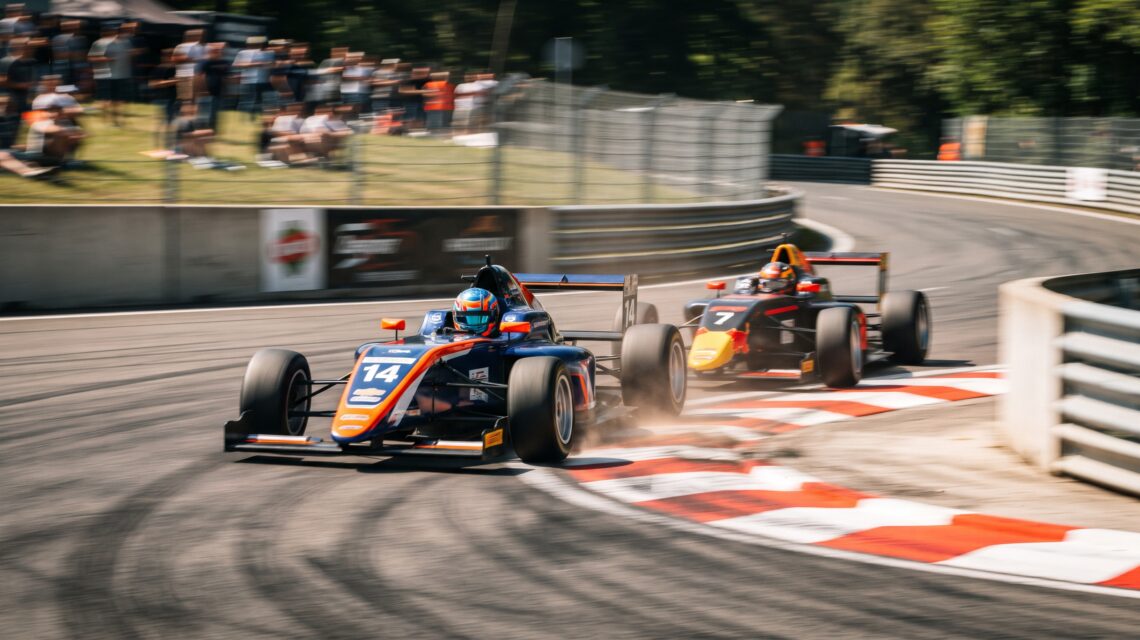
Both American racing schools offer paddle-shifted single-seaters and access to arrive-and-drive championships, but their training schedules, competition licensing requirements and financial commitments differ considerably.
By Marcio Tamer
Updated November 18, 2026
An aspiring racing driver can spend $4,999 on two days of open-wheel instruction at the Lucas Oil School of Racing, or pay an additional $2,000 for an accelerated program that provides eligibility for a full Sports Car Club of America (SCCA) competition license.
At Skip Barber Racing School, the traditional beginner progression consists of a three-day introductory course followed by a two-day advanced program. Students drive a Mygale Formula 4 car equipped with a 160-horsepower turbocharged engine, carbon-fiber monocoque and six-speed paddle-shift transmission.
Both schools offer opportunities to progress into actual wheel-to-wheel competition without purchasing a race car. However, Lucas Oil’s BasicPlus program challenges the assumption that aspiring drivers must complete five days of commercial racing-school instruction before qualifying for a full competition license.
The decision between the two schools ultimately depends on whether the driver prioritizes introductory tuition, Formula 4 experience, licensing efficiency or participation in a particular championship.
How much do Skip Barber and Lucas Oil racing schools cost?
Lucas Oil publishes course-specific prices for its two-day Basic and BasicPlus programs. Its calendar also reveals an upcoming increase affecting selected 2027 dates.
Skip Barber’s current Formula Car calendar confirms program availability, but its publicly accessible information does not consistently display direct enrollment prices. A reseller advertisement provides a separate pricing reference for its three-day program at Virginia International Raceway.
| Program | Duration | Published price |
|---|---|---|
| Lucas Oil Basic, selected 2026 dates | 2 days | $4,999 |
| Lucas Oil BasicPlus, selected 2026 dates | 2 days | $6,999 |
| Lucas Oil Basic, selected 2027 dates | 2 days | $5,499 |
| Lucas Oil BasicPlus, selected 2027 dates | 2 days | $7,499 |
| Skip Barber Formula Car, VIR reseller voucher | 3 days | $9,190 |
| Skip Barber Advanced Racing School | 2 days | Request current quotation |
Lucas Oil figures come from its published booking calendar. The $9,190 Skip Barber figure is a reported third-party voucher price, not a verified direct enrollment rate.
Lucas Oil’s calendar lists December 14–15, 2026, at Circuit Florida and January 25–26, 2027, at Sebring’s modified course among the dates carrying its lower tuition rates.
Selected programs beginning in February 2027 cost $500 more, representing approximately a 10% increase for Basic and a 7.1% increase for BasicPlus.
Skip Barber has also announced a limited-time promotion allowing customers to secure 2026 pricing for selected 2027 programs. Drivers considering either school should compare the exact dates, circuits and enrollment conditions rather than rely on historical tuition estimates.
The $2,000 upgrade that changes the competition licensing process
The most significant difference between Lucas Oil’s Basic and BasicPlus schools is not their duration. Both take two days, but they provide different competition licensing outcomes.
Successful graduates of the standard Basic program qualify for the school’s own Formula Car Series competition license. They also receive eligibility for an SCCA Novice Permit with one regional-event credit, subject to applicable requirements.
Under SCCA’s accredited-school framework, that leaves two successful regional race weekends to complete before upgrading to a full competition license.
Lucas Oil’s BasicPlus program offers an accelerated, small-group curriculum that can satisfy the on-track requirements for a full SCCA competition license.
Skip Barber offers two-event credit and full-license accreditation pathways, with the latter associated with its advanced racing-school progression.
| Licensing consideration | Lucas Oil Basic | Lucas Oil BasicPlus | Skip Barber |
|---|---|---|---|
| Entry course duration | 2 days | 2 days | 3 days |
| Novice Permit route | One event credited | Full-license pathway | Two-event credit pathway |
| Additional regional weekends under the novice route | 2 | Not required under full-license recommendation | 1 |
| Advanced school route | Available | Accelerated within the program | Separate 2-day advanced course |
The distinction matters because additional race weekends require more than entry fees. Drivers may need access to a compliant race car, supporting equipment, transportation and mechanical assistance.
Paying $2,000 more for BasicPlus could therefore make financial sense for someone specifically pursuing an SCCA license. However, an accelerated school is not necessarily the best educational choice for every inexperienced driver.
Graduation also does not automatically issue a competition license. Applicants must satisfy SCCA’s administrative, medical and eligibility requirements and obtain the appropriate recommendation from their instructors.
Mygale Formula 4 vs. Ray formula cars
Skip Barber and Lucas Oil use different open-wheel platforms, giving students distinct experiences behind the wheel.
Skip Barber’s official Formula Car specifications identify its vehicle as a Mygale FIA Formula 4 chassis with a homologated carbon-fiber monocoque. The car uses a turbocharged 1.6-liter Ford EcoBoost engine producing 160 horsepower.
Lucas Oil’s formula-car platform is based on the purpose-built Ray GR-RSC, designed for driver development and racing-school use.
| Vehicle characteristic | Skip Barber | Lucas Oil |
|---|---|---|
| Formula platform | Mygale Formula 4 | Ray GR-RSC |
| Chassis architecture | Carbon-fiber monocoque | Tubular-frame design |
| Transmission control | Paddle shifters | Paddle shifters |
| Training emphasis | Formula 4 vehicle dynamics and racecraft | Fundamental vehicle control and racecraft |
| Competition environment | Skip Barber Formula Race Series | Lucas Oil Formula Car Race Series |
Skip Barber’s winged Formula 4 platform gives aspiring drivers exposure to a car developed around the technical characteristics of contemporary junior single-seater racing.
Lucas Oil’s approach emphasizes repeatable driving fundamentals, including braking, corner entry, positioning and smooth control inputs.
However, describing one platform as exclusively dependent on aerodynamic grip and the other as purely mechanical oversimplifies the physics involved. Every race car depends on tire grip, weight transfer and vehicle setup, regardless of its aerodynamic configuration.
The exact tire specification and vehicle configuration should be confirmed with the school before enrolling.
Do you need manual-transmission experience?
One of the most important corrections to older comparisons between the two racing schools concerns their transmissions.
Skip Barber’s current Mygale Formula Car uses a SADEV six-speed sequential gearbox operated through steering-wheel-mounted paddles. Lucas Oil also uses paddle-shift gear selection and explicitly states that previous clutch experience is not necessary for its Basic program.
Consequently, paddle shifting is no longer a feature that uniquely distinguishes Lucas Oil from Skip Barber’s Formula 4 experience.
Skip Barber’s general enrollment guidance still recommends basic proficiency with manual transmissions, although it does not require previous racing experience for its introductory programs.
That recommendation may reflect the different vehicles and programs operated by the school. Drivers unfamiliar with manual gearboxes should ask specifically about clutch operation, standing starts and the requirements of their selected Formula Car course.
Paddle shifters reduce the complexity of changing gears, but they do not eliminate the need to learn correct shift timing, braking technique and vehicle control.
Does Lucas Oil provide more driving time in two days?
Lucas Oil advertises five hours of on-track activity during its two-day Basic Racing School, which consists of two eight-hour instructional days.
That provides a more useful benchmark than the number of days alone. Racing schools also spend time on classroom instruction, equipment fitting, safety briefings, technical explanations and driver feedback.
Skip Barber’s three-day curriculum uses a progressive structure that introduces basic car control before moving toward repeated lapping and racecraft exercises. Its historical course descriptions include competition flags, drafting, passing, practice starts and restarts.
The additional day can give participants more time to absorb instruction and review their performance between sessions.
Lucas Oil claims that its shorter format delivers more driving time than competing three-day schools. However, equivalent current seat-time measurements for Skip Barber’s Formula Car program were not available to independently establish that comparison.
Prospective students should request actual scheduled driving minutes per participant, including how interruptions, mechanical problems and adverse weather affect the program.
Which school offers better access to famous racetracks?
Both organizations operate across multiple American racing circuits, making the selected venue another important part of the decision.
Skip Barber’s late-2026 Formula Car calendar includes Virginia International Raceway, Laguna Seca, Sonoma Raceway and Circuit of the Americas. However, not every location offers every course level.
Its published November 23–25 three-day Formula Car school takes place at Circuit of the Americas, while earlier Laguna Seca listings feature shorter programs and advanced coaching.
Lucas Oil’s 2026 school calendar includes Sebring, Mid-Ohio, Virginia International Raceway, NCM Motorsports Park and Circuit Florida.
Sebring is particularly relevant for drivers interested in a winter training trip, with additional Basic and BasicPlus schools advertised for early 2027.
A driver whose primary ambition is experiencing the Corkscrew at Laguna Seca or the fast corners of Virginia International Raceway may reasonably prioritize the circuit. Someone pursuing a competition license may instead choose the venue offering the most suitable course and favorable travel arrangements.
Before purchasing flights, confirm the precise circuit configuration. A full road course and a shortened layout can provide significantly different driving experiences.
What happens after graduating from racing school?
Both organizations operate arrive-and-drive championships that allow drivers to compete using school-supplied race cars and professional support.
Skip Barber’s 2026 Formula Race Series calendar features eight events, including Sebring, Circuit of the Americas, Road America, Sonoma and multiple configurations of Virginia International Raceway.
The championship uses a fleet of standardized Formula Cars, with chassis assigned to drivers at the beginning of each race weekend. Coaching and performance development form part of the competition experience.
Lucas Oil also operates its own Formula Car Race Series, providing a progression from initial instruction into competitive single-seater racing.
Successful graduates of its Basic school can qualify for the school’s series competition license without first completing the entire SCCA novice-to-full-license process.
This creates an important distinction: obtaining eligibility for a particular commercial racing series is not necessarily the same as acquiring a competition license accepted across other championships.
Drivers should evaluate the series they eventually want to enter before selecting their introductory course.
How expensive is arrive-and-drive racing after graduation?
A relatively affordable racing-school course does not necessarily lead to an affordable championship season.
Historical Skip Barber registration documents for its 2024 Formula Race Series listed individual race events at $24,500 and a discounted seven-event season at $160,000.
The package included race entries, use of a standardized Mygale Formula 4 car, professional coaching, performance analysis and hospitality.
These figures illustrate the scale of the financial commitment involved in structured single-seater competition. They are historical prices, not confirmed quotations for the 2026 or 2027 championships.
Lucas Oil promotes its series as a cost-conscious development route, but current comparable season pricing was not independently established.
Before comparing championships, request written quotations covering the same number of races, practice sessions and coaching hours. Testing days, tires, travel, accommodation and damage liability can materially change the final budget.
Why crash-damage liability can matter more than tuition
Racing schools provide the cars, but students may remain financially responsible for damage caused during their participation.
Historical Skip Barber Formula 4 enrollment documents illustrate how substantial that exposure can become.
One published registration offered two optional damage-liability reduction packages:
| Historical protection option | Daily charge | Maximum liability per incident |
|---|---|---|
| Option A | $350 | $10,000 |
| Option B | $550 | $5,000 |
| No reduction purchased | $0 | Up to the vehicle’s replacement value |
Under those historical terms, selecting Option B for a three-day school would add $1,650 to the tuition while reducing the stated liability to $5,000 per incident.
Lucas Oil advertises an included limited-damage-liability policy for its programs. However, included protection should not be interpreted as zero financial responsibility.
The current policy limits, exclusions and treatment of multiple incidents must be established before enrollment.
Neither school should be evaluated solely on its advertised tuition without considering the applicable damage agreement. Historical liability-reduction prices are useful illustrations, but they cannot substitute for the actual contract covering a future booking.
Which racing school should you choose?
Choose Skip Barber if your priority is training in a contemporary Formula 4 car, experiencing a particular circuit or following a progressive curriculum before entering its Formula Race Series. Its carbon-monocoque Mygale platform is particularly relevant to drivers interested in modern junior formula racing.
Choose Lucas Oil Basic if you want a shorter introductory program with transparent tuition and a direct pathway into its own race series. Its advertised five hours of track activity and two-day format can make travel planning easier.
Consider Lucas Oil BasicPlus if your primary objective is full SCCA competition license eligibility. The additional $2,000 at selected dates may reduce the need for separate licensing-related race weekends, provided you successfully meet the required driving standards.
Before paying a deposit, obtain written confirmation of cockpit fit, safety equipment, actual driving time, licensing recommendations and crash-damage liability.
The best comparison is not simply the price of two days against three days. It is the complete cost of progressing from a first experience in a single-seater to the type of racing you ultimately intend to pursue.
+ Siga o Giro no Facebook
+ Siga o Giro no Instagram
Leia Mais: