

By Marcio Tamer
Updated November 25, 2026
The platform and pinpoint serve stances can both produce powerful, effective tennis serves, but they influence how players generate momentum, rotate their bodies, and prepare for the next shot. The platform keeps the feet separated during the loading phase, while the pinpoint brings the back foot forward before takeoff.
For adult recreational players, the best stance is not necessarily the one that looks more explosive. It is the one that produces a repeatable toss, comfortable loading, reliable contact, and the right movement after landing. Research involving expert players has found measurable differences between the two techniques, including a trade-off between serve speed and forward movement.
What actually changes between platform and pinpoint?
The primary difference is how the lower body organizes itself before the racket accelerates toward the ball. Platform servers keep their feet separated during the preparation phase, allowing them to load and rotate over a wider base. Pinpoint servers move the rear foot toward the front foot as the toss rises, creating a narrower launching position.
Neither stance eliminates the need for leg drive, trunk rotation, shoulder movement, or coordinated racket acceleration. The feet influence how these elements are organized, but they do not independently determine serve speed.
| Serve mechanic | Platform stance | Pinpoint stance |
|---|---|---|
| Foot position | Feet remain separated through loading | Rear foot moves forward during preparation |
| Base of support | Wider base | Narrower base before takeoff |
| Main coaching focus | Loading, balance and rotation | Timing, coordination and forward momentum |
| Common adjustment | Weight transfer and leg drive | Synchronizing foot slide with toss |
| Potential advantage | Stable preparation and easier movement sequencing | More dynamic loading and potentially higher ball speed |
| Common recreational problem | Incomplete leg drive or excessive stiffness | Rushing the toss or losing balance during the slide |
The important distinction is that platform does not mean staying grounded, and pinpoint does not automatically mean jumping farther into the court. Both techniques can involve explosive takeoff, and both require control of the body before and after contact.
Why platform can help players struggling with serve consistency
The platform stance removes the back-foot movement from the serving sequence. That can make it easier for some recreational players to identify problems with their toss, body rotation, knee bend, or timing because they are managing fewer moving parts.
A player whose toss changes direction every time the back foot slides may benefit from temporarily keeping the feet separated. This creates a simpler preparation sequence that a coach can observe and adjust. However, platform is not a universal solution for double faults or toss inconsistency. A poorly timed toss, excessive wrist movement, or premature racket preparation can remain problematic regardless of stance.
The platform also gives players room to work on loading the legs without feeling forced to bring both feet together. For adults who have limited hip mobility, struggle with balance, or find the pinpoint movement uncomfortable, keeping a wider base may be a more natural starting point.
Does pinpoint really produce a faster serve?
The strongest evidence supporting pinpoint comes from a 2012 study published in the Journal of Sports Sciences. Caroline Martin and her colleagues tested 15 expert players performing serve-and-volley actions with both foot-up and foot-back techniques.
The results favored pinpoint for ball speed. The foot-up technique produced significantly faster serves, while the foot-back technique produced a shorter measured running interval toward the net. The researchers also observed greater trunk and racket-arm angular momentum before impact with foot-up, suggesting that the two techniques organize rotational movement differently.
The finding is important because it shows that the stance can influence performance, but it does not establish that recreational players will gain a specific number of miles per hour by switching. The participants were experienced players capable of performing both techniques, and the experiment measured a controlled task rather than the results of a long-term coaching program.
The hidden trade-off between serve speed and the first step
A faster serve is not the only outcome that matters, especially for players who want to serve and volley, attack the next ball, or recover quickly after landing.
In the Martin study, foot-back players completed the measured movement toward the net faster, despite producing slower average ball speeds. This suggests that the movement pattern used to generate the serve can also influence how efficiently a player transitions into the next action.
That distinction matters in recreational tennis. A player who gains a little pace but lands off balance may struggle to defend the return. Another player who serves slightly slower but arrives in a better position may perform more effectively in a match.
The 2023 systematic scoping review by Johanna Lambrich and Thomas Muehlbauer reinforces the need for caution. It identified five studies comparing foot-up and foot-back serve stances, with findings that varied depending on the participants, measurement methods, and outcomes. Some biomechanical results favored foot-up, particularly for vertical force, but the available evidence does not establish one stance as universally superior.
How coaches should teach the platform stance
A platform progression generally starts by establishing the player’s foot alignment, comfortable loading position, and repeatable toss. The feet stay separated during preparation while the player learns to coordinate knee flexion, trunk rotation, and upward racket acceleration.
The goal is not to freeze the lower body. Players still transfer weight, rotate, extend their legs, and leave the ground when appropriate. A coach should look for a smooth loading sequence rather than an exaggerated squat or a rigid stance.
Once the toss and contact point become more predictable, the player can add power without changing several mechanics simultaneously. This makes it easier to identify whether a new problem comes from the toss, timing, racket path, or body position.
How to test pinpoint without rushing the serve
Pinpoint requires the back foot to move at the right moment without disrupting the toss or prematurely opening the hips and shoulders. The slide should be controlled and comfortable, not an aggressive stomp that changes the player’s head position or balance.
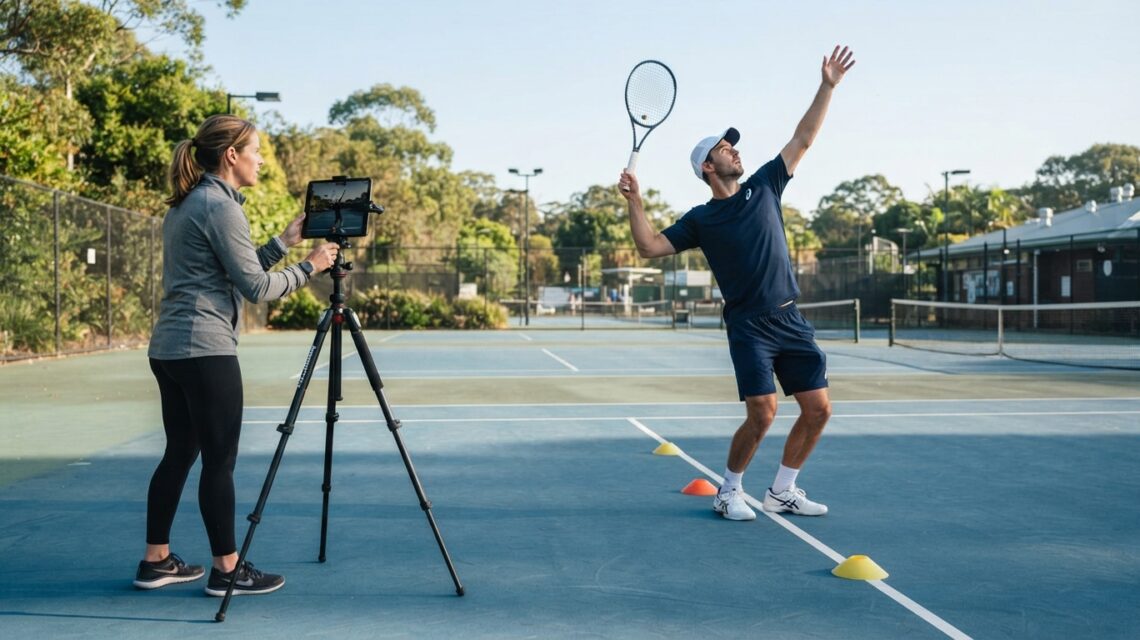
Coaches can use video from the side to examine when the rear foot moves, how the player reaches the trophy position, and whether the legs continue loading after the feet come closer together. A common mistake is bringing the feet together too early and losing the rhythm needed for a coordinated leg drive.
The player should also monitor foot faults. Under tennis rules, the server must avoid touching the baseline or the court inside it with either foot during the serving motion before striking the ball. A pinpoint slide does not automatically cause a foot fault, but it adds movement that must remain controlled and legal.
Which serve stance should adult players choose?
| If your main problem is… | Start by testing… |
|---|---|
| Toss inconsistency | Platform |
| Rushing the serving motion | Platform |
| Difficulty coordinating the back-foot slide | Platform |
| Comfortable serve mechanics but limited explosive loading | Pinpoint |
| Wanting to compare ball speed | Both, with consistent targets |
| Serve-and-volley movement | Both, including the first step after landing |
Adult clinic players should avoid changing stances solely because a professional uses a different technique. The more useful comparison is to record a short series of serves using each stance, then evaluate target accuracy, double faults, comfort, ball speed if available, and recovery position.
A stance change is worthwhile when it solves a measurable problem without creating another. The serve does not end at contact: its effectiveness also depends on where the player lands, how quickly they regain balance, and whether they are prepared for the return.
+ Siga o Giro no Facebook
+ Siga o Giro no Instagram
Leia Mais: