


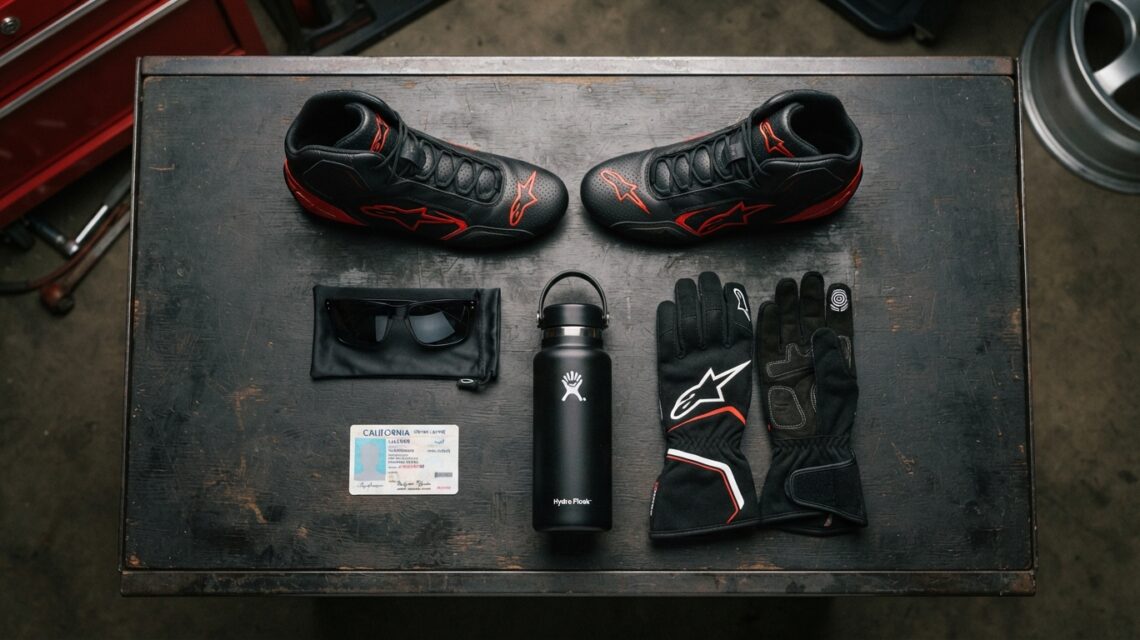
Factory-backed driving schools provide the cars and instruction, but arriving without the correct identification or footwear can prevent participation. Official Porsche and BMW policies also reveal why helmets, long pants and track insurance should never be assumed to follow universal rules.
By Marcio Tamer
Updated November 13, 2026
A first-time performance driving school participant does not need to arrive with a racing suit, an expensive helmet or a trunk full of mechanical equipment.
At Porsche Track Experience and BMW Performance Driving School, the vehicles are supplied by the manufacturers, eliminating the need to prepare a personal car for track use.
But one missing item can still ruin an expensive day: a valid driver’s license.
Porsche requires participants in its US Track Experience courses to be at least 21 years old and present a valid license at check-in. BMW’s regular driving schools accept licensed drivers from age 18.
Both manufacturers also recommend comfortable, closed-toe footwear that allows precise pedal control.
The surprising difference is what they do not require.
Porsche explicitly allows shorts at its Track Experience courses and supplies helmets. BMW also allows shorts and states that helmets are not required for its standard Performance Driving School programs.
That means a checklist treating racing shoes, long pants and personal helmets as universal requirements would be misleading.
The better approach is to separate mandatory documents and clothing rules from optional items that improve comfort throughout the day.
The complete first driving school packing checklist
The following checklist is designed for beginners attending a manufacturer-backed driving school where the car is provided.
Essential items
- Valid driver’s license: Bring your current physical license unless the school explicitly confirms that another form of identification is accepted.
- Booking confirmation: Save the confirmation email, course date, location and check-in instructions. A printed backup is useful but not universally mandatory.
- Closed-toe driving shoes: Choose comfortable sneakers or driving shoes with relatively thin, flexible soles.
- Comfortable clothing: Wear clothes that allow unrestricted movement and comply with the specific school’s dress code.
- Prescription glasses or contact lenses: Bring any vision correction you need for safe driving.
- Required waivers: Complete electronic forms in advance when available and bring any documents requested in your confirmation.
Recommended comfort items
- Reusable water bottle: Check whether the school permits personal bottles in its facilities or provides refreshments.
- Sunscreen and lip balm: Useful for outdoor paddocks and sunny circuits.
- Sunglasses: Choose lenses that work comfortably with your helmet, if one is used.
- Light jacket or extra layer: Useful when mornings are cool or windy.
- Small bag: Keep personal belongings together while rotating between driving exercises.
- Medication you normally require: Keep essential personal medication accessible and follow any relevant medical guidance.
- Phone and charging cable: Useful for directions, registration details and emergencies, but not for use while driving.
- Snack: Optional, particularly if meals are not included or you have specific dietary needs.
The essential category is about meeting participation requirements. The recommended category is about comfort, convenience and avoiding unnecessary distractions.
Why your driver’s license is more important than expensive driving gear
A driving school can provide a high-performance car worth tens or hundreds of thousands of dollars, but it cannot waive basic eligibility requirements simply because the course has already been paid for.
Porsche’s official Track Experience terms require participants at Barber Motorsports Park and Laguna Seca to be at least 21 years old and hold a current, valid driver’s license.
The license must be presented at check-in.
BMW Performance Driving School requires participants in its regular programs to be at least 18 years old, with a valid license presented when they arrive.
BMW operates separate teen-focused courses with different eligibility requirements.
The distinction matters when someone purchases a driving school experience as a gift.
An 18-year-old licensed driver may qualify for BMW M School but not for Porsche’s standard US Track Experience.
Likewise, a participant with an expired license should not assume the school will make an exception.
Porsche’s Experience Center guidance specifically instructs drivers to bring their physical license, making it sensible to carry the original card rather than rely solely on a photograph.
A digital booking confirmation is generally convenient, but the driver’s license is a different matter.
What shoes should you wear to a performance driving school?
Footwear is one of the few items that can directly affect how comfortably and precisely a beginner operates a performance car.
Modern sports cars often have closely spaced pedals and responsive braking systems.
Bulky footwear can make it harder to judge pedal pressure or move cleanly between the accelerator and brake.
Porsche recommends soft-soled shoes, including driving shoes or tennis shoes, and prohibits open-toe footwear and high heels at its Track Experience courses.
BMW recommends comfortable, closed-toe shoes and explicitly notes that thin soles are best.
That does not mean beginners must purchase professional racing boots.
A comfortable pair of narrow, flat sneakers is usually sufficient for an introductory program.
The most useful characteristics are a secure fit, a sole that bends naturally and enough pedal feedback to distinguish accelerator and brake inputs.
Heavy hiking boots, loose slip-on shoes and thick platform sneakers are less suitable.
Open-toe sandals and flip-flops should be left at home.
A first-time driver is generally better served by familiar, comfortable footwear than by brand-new racing shoes that have never been worn.
Are long pants mandatory at Porsche and BMW driving schools?
No. At least not at the standard US programs covered by the manufacturers’ published guidance.
This is an important distinction because many traditional track-day organizations require long pants.
Porsche Track Experience states that shorts are allowed.
BMW Performance Driving School also permits T-shirts, jeans and shorts.
Both emphasize comfortable clothing appropriate for the weather.
That makes long pants a personal choice rather than a universal requirement.
Lightweight trousers can be useful for sun protection and comfort, particularly during cooler mornings.
Shorts may be more comfortable during hot-weather courses.
The important point is to follow the dress code for the exact program booked.
An advanced racing school, an independent HPDE organizer or a competitive motorsport event may impose different clothing requirements.
A participant should not transfer the rules from one school to another without checking.
Do you need to bring your own helmet?
The answer depends on the program.
Porsche Track Experience provides helmets for participants at Barber Motorsports Park and Laguna Seca.
Students who prefer their own helmet may bring one, but Porsche requires it to meet Snell 2020 or newer standards.
The school does not require racing suits for its regular Track Experience courses.
BMW’s official Performance Driving School FAQs state that helmets are not required for its standard programs.
That is a significant difference from the assumption that every driving school requires full motorsport safety equipment.
The requirements of an independent track-day event may be stricter.
A beginner should therefore avoid purchasing an expensive helmet before confirming whether one is necessary.
For Porsche participants, the school-provided helmet is the straightforward option.
Anyone considering bringing a personal helmet should verify its certification, condition and compatibility with the school’s requirements.
What should you know about sunglasses and vision correction?
Clear vision is essential when driving on a circuit.
Drivers who normally wear prescription glasses or contact lenses should bring them.
Sunglasses can help reduce glare, especially at open-air circuits in California, Alabama or South Carolina.
However, heavily tinted lenses may be less suitable in cloudy weather or changing light.
Polarized sunglasses are not automatically the best choice for every car because some polarized lenses can interfere with the visibility of digital displays or head-up displays.
The more practical recommendation is to use eyewear that provides clear visibility and fits comfortably.
If the school requires a helmet, glasses should not create painful pressure points inside it.
Participants who use prescription glasses may want to check helmet fit before their first driving session.
Why hydration matters even when you are not racing
A driving school day can involve several hours of activity.
Participants may alternate between classroom sessions, standing in the paddock and driving exercises that demand sustained concentration.
At warmer locations, particularly BMW’s Thermal facility in California, heat can become a significant comfort and safety consideration.
Dehydration can contribute to fatigue, headaches and reduced concentration.
Bringing a reusable water bottle is sensible, although participants should check the school’s facilities and whether refreshments are already provided.
Hydration should begin before the first session rather than after symptoms of thirst become uncomfortable.
It is also sensible to avoid arriving after excessive alcohol consumption or a night of inadequate sleep.
Performance driving requires quick decisions and sustained attention.
The goal is not athletic endurance for its own sake. It is remaining alert enough to follow instructions and respond appropriately throughout the course.
What should you pack for sun, wind and changing weather?
A driving school may include substantial time outdoors.
Laguna Seca can experience cool coastal mornings, fog and changing afternoon conditions.
Barber Motorsports Park in Alabama can be warm and humid, depending on the season.
BMW’s Thermal facility operates in a desert environment where summer temperatures can be particularly demanding.
Sunscreen, lip balm and a lightweight jacket are therefore practical additions.
The correct clothing depends on the venue and forecast.
BMW’s California school even adjusts its summer schedule, with earlier start times during part of the year.
According to the manufacturer’s FAQ, Thermal classes may begin at 6 a.m. between June 1 and September 13, rather than following the standard daytime schedule.
That makes reading the confirmation email essential.
A participant who assumes every school begins at 8 a.m. could miss a significant portion of the program.
Should you bring snacks, medication or motion-sickness remedies?
Most beginners do not need a large supply of food or specialized medical equipment.
However, a long day can be more comfortable when participants plan around their individual needs.
Anyone who relies on prescribed medication should bring what they need for the day and follow their clinician’s instructions.
Participants prone to motion sickness may want to plan ahead.
Porsche’s Experience Center guidance notes that some driving exercises involve significant forces and vehicle rotation, which can trigger symptoms in susceptible participants.
Medication should not be taken casually before high-performance driving because some products can cause drowsiness or impair reaction time.
Drivers should check potential side effects and seek appropriate professional advice before using any medication that might affect alertness.
Snacks may be useful for participants with specific dietary requirements.
But the booking confirmation should be checked first because some courses include meals and refreshments.
Why bringing a camera or GoPro can create problems
Many first-time participants want to record their experience.
That is understandable, especially when driving a Porsche 911 or BMW M car for the first time.
However, recording policies vary.
Porsche Track Experience explicitly prohibits recording devices inside or attached to the exterior of its vehicles.
Its published restrictions include smartphones, handheld cameras, GoPros, dashboard cameras and wearable recording devices.
That means a participant should not arrive expecting to mount a personal action camera on the windshield.
The restriction applies even if the equipment appears securely attached.
Other driving schools may offer different policies or official photo and video services.
Before bringing recording equipment, ask what is permitted.
A phone remains useful for directions and booking details, but it should be stored securely during driving sessions.
Does the school provide insurance and cover vehicle damage?
Providing the vehicle does not mean the participant has zero financial risk.
This is one of the most important details to check before arriving.
Porsche Track Experience states that participants at Barber Motorsports Park and Laguna Seca may be personally responsible for up to $25,000 in vehicle damage per occurrence.
For introductory courses, Porsche offers an optional damage-limitation waiver costing $200 per day.
Purchasing the waiver reduces the stated damage exposure to $5,000.
That is a meaningful reduction, but it does not eliminate the driver’s potential financial responsibility.
BMW participants should review the liability and damage terms attached to their particular booking.
The presence of a manufacturer-owned fleet should not be interpreted as automatic comprehensive insurance with no deductible or excess.
A participant should understand the agreement before the first session, not after an incident.
What should you leave at home?
A manufacturer-backed driving school does not require the equipment normally associated with preparing a personal car for an HPDE event.
There is generally no need to bring a torque wrench, spare brake pads, tire-pressure gauge or mechanical tool kit when the school supplies and maintains its vehicles.
A personal racing helmet may also be unnecessary, depending on the program.
Avoid bringing loose items that could move around inside a car during braking or cornering.
Large bags, unsecured electronics and bulky accessories are better left in a designated storage area or personal vehicle.
Drivers should also avoid wearing clothing or footwear that interferes with pedal operation or seat-belt positioning.
Alcohol and other substances that impair driving ability are incompatible with participation.
The best preparation is usually simpler than beginners imagine: arrive rested, properly dressed and ready to follow the instructors.
What should you do the night before your first driving school?
The final preparation should focus on eliminating preventable problems.
Check the confirmation email for the venue address, arrival time, course name and any documents that must be completed in advance.
Verify that your driver’s license is current.
Set out comfortable clothing and suitable shoes.
Review the weather forecast and pack any necessary layers.
Confirm transportation and parking arrangements.
If the school requires a waiver or other paperwork, complete it before arriving when possible.
Participants should also review cancellation and rescheduling policies.
Porsche and BMW apply different terms, and missing a scheduled course can have financial consequences.
Getting adequate sleep is more useful than studying advanced racing techniques late into the night.
A beginner is attending to learn, not to demonstrate professional-level performance.
What should you check when you arrive?
At check-in, present your identification and follow the registration instructions.
If a helmet is required, take time to confirm that it fits correctly.
Ask where personal belongings should be stored.
Listen carefully during the safety briefing, especially when instructors explain flags, passing rules, radio communication and emergency procedures.
Do not assume that experience with ordinary road driving automatically translates into track-driving knowledge.
A circuit introduces unfamiliar braking zones, corner sequences and vehicle behavior.
If an instruction is unclear, ask before entering the car.
Professional driving schools are designed to teach those skills in a controlled environment.
The participant’s responsibility is to arrive prepared and follow the program.
What is the most important item on the checklist?
For a beginner attending Porsche Track Experience or BMW Performance Driving School, the most important items are a valid driver’s license, suitable closed-toe shoes and the correct booking information.
Everything else depends on the specific program.
Porsche supplies helmets for its Track Experience courses, while BMW states that helmets are not required for its standard schools.
Both allow shorts.
Neither requires a beginner to purchase professional racing shoes simply to attend an introductory course.
The more serious risks involve arriving without valid identification, missing an early check-in time, misunderstanding the damage agreement or assuming that equipment rules are identical across schools.
A first driving school should be about learning how a performance car behaves, not discovering at the registration desk that an avoidable mistake has put the day at risk.
+ Siga o Giro no Facebook
+ Siga o Giro no Instagram
Leia Mais: