

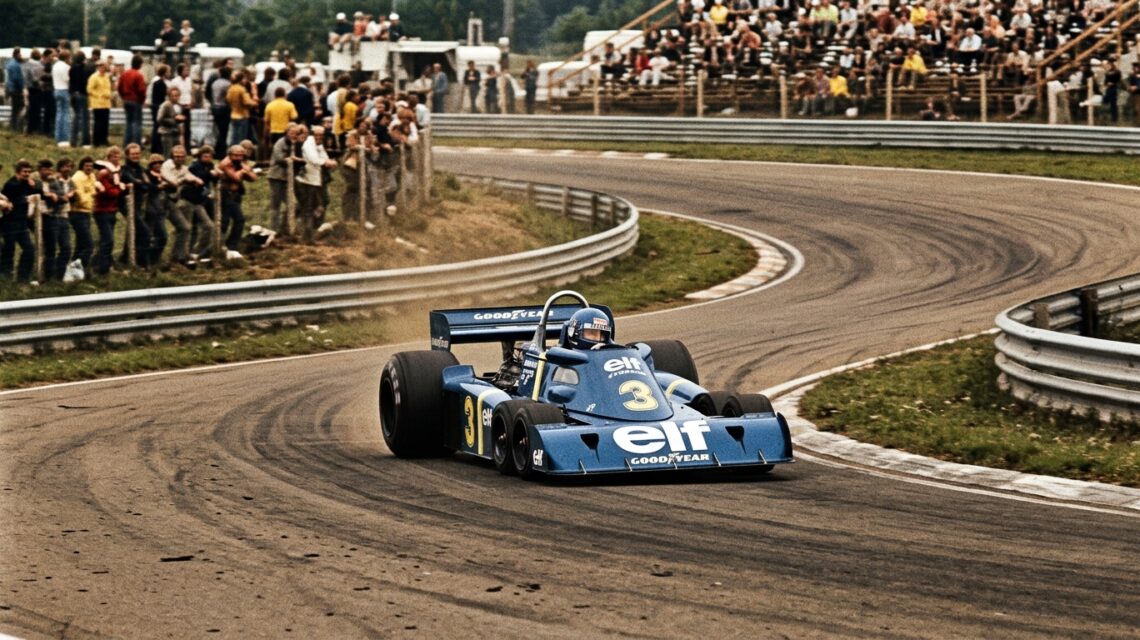
Derek Gardner’s radical P34 used four 10-inch front wheels to reduce aerodynamic drag and improve braking. The design delivered a historic one-two finish, but Goodyear’s struggle to develop its unique tires turned an engineering breakthrough into a two-season experiment.
By Marcio Tamer
Updated October 29, 2026
On June 13, 1976, a Formula 1 car with six wheels crossed the finish line first at the Swedish Grand Prix. Jody Scheckter had won at Anderstorp in the Tyrrell P34, a machine equipped with four tiny front wheels and two conventional rear wheels. His teammate Patrick Depailler finished second, completing one of the most extraordinary one-two victories in the sport’s history.
The result was more than a publicity triumph. It proved that a radical engineering concept, initially regarded with skepticism, could defeat conventional Formula 1 cars in a World Championship race.
But the P34’s greatest strength would eventually become its biggest weakness.
Its four front wheels depended on specially manufactured 10-inch Goodyear tires. As the American manufacturer improved the conventional tires used by other teams, development of Tyrrell’s unique front tires failed to keep pace.
The car became increasingly difficult to balance. By the end of 1977, the six-wheel experiment was over.
The Tyrrell P34 remains the only six-wheeled Formula 1 car to win a World Championship Grand Prix. Its story is not simply about an unusual design that disappeared. It is about a genuine competitive advantage that became impossible to sustain without the technology needed to support it.
Why Derek Gardner believed six wheels could make a Formula 1 car faster
During the mid-1970s, Formula 1 engineers were searching for ways to improve aerodynamic efficiency.
Many teams used the same Ford-Cosworth DFV engine and Hewland gearbox, making aerodynamic development an important opportunity to gain an advantage.
Tyrrell’s chief designer, Derek Gardner, identified a problem with conventional front wheels.
Large exposed tires disturbed the airflow around the car and contributed to aerodynamic drag.
Reducing their size could help the car travel faster, particularly on straights.
But simply installing two smaller front wheels would introduce another problem: the reduced tire dimensions could compromise braking performance and front-end grip.
Gardner’s solution was to replace the conventional pair of front wheels with four smaller ones.
The additional wheels would help compensate for the smaller individual tires, while the reduced wheel diameter would allow the front assembly to sit largely behind the front wing.
The design promised a combination of lower aerodynamic drag, effective braking and improved cornering performance.
It was an unconventional answer to a legitimate engineering problem.
Gardner did not add two wheels merely to make the car look different. He was attempting to improve the relationship between aerodynamic efficiency and mechanical performance.
The project received the designation P34, short for Project 34.
Four 10-inch wheels created an aerodynamic advantage
The most recognizable feature of the P34 was its front-wheel arrangement.
Instead of two conventional front wheels, the car used four wheels with 10-inch rims.
These wheels were significantly smaller than the standard Formula 1 front wheels of the period.
The original design positioned them largely behind the front wing, reducing their exposure to the airflow.
The intended benefit was lower aerodynamic drag.
With less resistance, the car could potentially achieve higher speeds without requiring additional engine power.
But the design also offered mechanical advantages.
Four front tires provided multiple contact patches through which the car could transmit braking and cornering forces to the road.
The P34 also had four front disc brakes rather than the usual two.
This arrangement offered potential benefits in braking performance and brake-pad wear.
However, it would be inaccurate to assume that four front tires automatically produced twice the grip of two conventional tires.
Tire performance depends on load, compound, temperature, construction and the relationship between vertical force and available traction.
Gardner’s objective was to obtain the necessary front-end performance while reducing the aerodynamic penalty of conventional wheels.
The idea was technically sophisticated, but its success depended on several components working together.
The tires were among the most important.
The six-wheel steering system made the P34 unusually complex
The P34 required more than an extra pair of wheels.
Its steering and suspension systems had to accommodate two separate front axles.
The front pair of wheels was connected directly to the steering mechanism.
The second pair was steered through a linkage arrangement designed to coordinate its movement with the first.
Each front wheel also required its own suspension and braking components.
The result was a compact but mechanically complicated front assembly.
The additional parts increased weight and created new maintenance challenges.
Braking was particularly difficult to manage.
If one pair of front wheels locked before the other, the car’s behavior could change significantly.
The system also had to cope with the high rotational speeds of the small wheels and the heat generated by the compact brakes.
Gardner later described how the tires could deform dramatically under load.
The team experimented with ways to improve braking stability, cooling and tire behavior.
The P34 therefore represented a trade-off.
Its unusual layout offered aerodynamic and mechanical opportunities, but it introduced complexity that conventional four-wheel cars did not face.
The challenge was to ensure that the benefits outweighed those disadvantages.
In 1976, the evidence suggested that they could.
Goodyear had to manufacture tires that no other Formula 1 team needed
Before the P34 could race, Tyrrell needed a manufacturer willing to produce its unusual front tires.
Goodyear agreed to develop the required 10-inch rubber.
That cooperation was essential.
The tires were not ordinary road-car components adapted for racing. They had to withstand the extreme loads, temperatures and speeds of Formula 1 competition.
Gardner had originally considered even smaller wheels.
According to his later recollections, he initially preferred a diameter of nine inches before agreeing with Goodyear on ten.
The manufacturer produced the specialized tires, allowing Tyrrell to proceed with testing.
But this arrangement created a structural vulnerability.
Every other Goodyear-equipped Formula 1 team used conventional tire sizes.
Tyrrell alone depended on the unusual 10-inch fronts.
As long as Goodyear continued improving those tires, the P34 could remain competitive.
If development slowed, however, Tyrrell would have no straightforward alternative.
That dependency would become decisive in the car’s second season.
The P34 debuted in Spain in 1976 and immediately showed competitive speed
Tyrrell revealed the P34 in 1975, but the car did not make its World Championship debut until the Spanish Grand Prix on May 2, 1976.
Patrick Depailler drove the new six-wheeler at Jarama.
His teammate Jody Scheckter continued using the conventional Tyrrell 007.
The contrast offered an immediate comparison between the team’s established design and its radical successor.
Depailler qualified third.
Scheckter, driving the four-wheel car, qualified fourteenth.
The P34 had demonstrated genuine speed before completing its first championship race.
Depailler’s race ended with braking problems, highlighting one of the technical challenges associated with the design.
But the qualifying result encouraged the team.
At the Belgian Grand Prix, Scheckter drove the P34 to fourth place.
The next race, Monaco, produced an even stronger result.
Scheckter finished second, while Depailler took third.
Two six-wheeled Tyrrells had reached the podium at one of Formula 1’s most demanding circuits.
The P34 was no longer an engineering curiosity.
It was a serious contender.
Scheckter and Depailler delivered a historic one-two finish in Sweden
The breakthrough came at the Swedish Grand Prix on June 13, 1976.
The race took place at Anderstorp, a circuit known for its unusual layout and demanding corners.
Scheckter qualified on pole position in the P34.
Depailler started fourth.
Mario Andretti initially led the race in his Lotus, but his challenge ended after mechanical trouble.
Scheckter took control.
Depailler followed him home.
The result was a Tyrrell one-two finish, with Scheckter first and Depailler second.
It remains the only World Championship Grand Prix victory achieved by a six-wheeled Formula 1 car.
The achievement was especially significant because it occurred just weeks after the P34’s competitive debut.
Tyrrell had introduced a completely unconventional front-wheel configuration and turned it into a race-winning design during its first season.
The victory also showed that the concept was not dependent on a single fortunate qualifying lap.
The car could maintain competitive performance over a full Grand Prix distance.
The P34 had achieved what its designer hoped: a genuine performance advantage from an unconventional engineering solution.
The 1976 season proved the car was more than a one-race experiment
The Swedish victory was the high point of the P34’s career, but it was not its only successful result.
Scheckter and Depailler regularly scored points and reached the podium during the season.
Scheckter finished third in the Drivers’ Championship.
Depailler finished fourth.
Tyrrell placed third in the Constructors’ Championship, behind Ferrari and McLaren.
That result demonstrated the team’s competitiveness across the season.
The P34 was not a failed concept that happened to win one unusual race.
It was part of a successful championship campaign.
Nevertheless, the drivers had different opinions about the car.
Depailler generally responded positively to its handling characteristics.
Scheckter was more skeptical, particularly about the braking system and its behavior on uneven surfaces.
He later expressed doubts about the concept despite winning its only Grand Prix.
Those contrasting assessments reveal an important distinction.
A car can produce competitive results while remaining difficult to drive or develop.
The P34 had achieved success, but its engineering problems had not disappeared.
Why the six-wheel design became slower in 1977
The decisive problem emerged as tire development progressed.
During 1976, Goodyear continued improving the conventional tires used by Formula 1 teams.
Those developments benefited the rear tires fitted to the P34.
But the unique 10-inch front tires did not receive equivalent development.
The result was a growing performance imbalance.
The rear of the car benefited from newer tire technology, while the front increasingly depended on older specifications.
Gardner later explained that the small front tires were effectively being left behind as Goodyear concentrated on supplying the rest of the championship.
The P34’s original advantage depended partly on strong front-end performance.
As that advantage diminished, the car became harder to balance.
The problem was not simply that six wheels were inherently slower than four.
The specialized tires were no longer progressing at the same rate as the conventional alternatives.
For a design that depended on those tires, the consequences were severe.
The car’s aerodynamic concept remained interesting, but its overall performance deteriorated.
Tyrrell tried to fix the problem but sacrificed part of the original advantage
For 1977, Tyrrell introduced a revised version of the P34.
The team experimented with changes to the bodywork, cooling systems and front suspension.
The front track was widened in an effort to recover grip.
But moving the small front wheels farther into the airflow weakened one of the original design’s principal advantages.
The P34 had been conceived partly to reduce aerodynamic drag by hiding its front wheels behind the front wing.
Widening the front assembly compromised that objective.
The revised bodywork also introduced weight and packaging challenges.
Tyrrell experimented with different solutions, including lighter materials, but the car never recovered its 1976 competitiveness.
Scheckter had left the team to join Walter Wolf Racing.
Ronnie Peterson replaced him alongside Depailler.
The new driver pairing struggled to reproduce the previous season’s results.
Depailler finished tenth in the 1977 Drivers’ Championship.
Peterson finished fourteenth.
The contrast with 1976 was dramatic.
A car that had delivered a Grand Prix victory and helped Tyrrell finish third among constructors had become increasingly difficult to develop.
Goodyear did not simply abandon Tyrrell, but the special tires fell behind
The P34’s decline is often summarized as Goodyear abandoning the project.
That description captures part of the story but oversimplifies the manufacturer’s position.
Goodyear was supplying tires to numerous Formula 1 teams.
The company faced considerable pressure to develop conventional front and rear tires that could benefit a much larger group of customers.
Only Tyrrell needed the specialized 10-inch fronts.
Developing those tires required separate engineering and testing resources.
Gardner later acknowledged the difficulty Goodyear faced in meeting the demands of the championship.
The problem was not necessarily a sudden refusal to supply Tyrrell.
It was the widening gap between the development of conventional tires and the unique front tires required by the P34.
As that gap increased, Tyrrell lost the performance balance on which the six-wheel concept depended.
The distinction matters because it changes the interpretation of the project.
The P34 did not fail simply because its unusual design was fundamentally flawed.
It failed to remain competitive within the technological and commercial conditions of Formula 1 at the time.
Its success required sustained development of components that no other team needed.
That support became increasingly difficult to justify.
Tyrrell abandoned six wheels after 1977 and returned to a conventional car
By the end of the 1977 season, Tyrrell had decided to abandon the six-wheel configuration.
Gardner had left the team.
His replacement, Maurice Philippe, developed the Tyrrell 008 for 1978.
The new car used four conventional wheels.
That decision ended the P34’s World Championship career after two seasons.
Its final record included one Grand Prix victory, multiple podium finishes and a third-place Constructors’ Championship result in 1976.
The P34 had achieved more than many conventional Formula 1 designs.
But the engineering advantages that made it competitive had become too difficult to maintain.
The decision also marked the end of Tyrrell’s attempt to challenge the standard four-wheel configuration.
The team returned to a more conventional technical direction.
Formula 1 later banned six-wheeled cars, but the rule did not cause the P34’s retirement
The Tyrrell P34 was not immediately banned when the team abandoned it.
The car disappeared because Tyrrell could no longer justify continuing the project.
Other constructors subsequently explored six-wheel concepts.
March developed an experimental design with four rear wheels.
Williams also tested a six-wheel configuration using four driven rear wheels.
Ferrari experimented with an unusual arrangement involving paired rear wheels.
These projects demonstrated that Formula 1 engineers continued to investigate alternatives to the conventional four-wheel layout.
However, none of those designs won a World Championship Grand Prix.
Regulatory changes in the early 1980s eventually restricted Formula 1 cars to four wheels.
The restrictions ended the possibility of introducing another six-wheeled Formula 1 car under the championship’s technical regulations.
But the chronology is important.
The P34 was retired before the six-wheel concept was prohibited.
Its competitive decline came first.
The regulatory restriction followed later.
That distinction prevents a common misunderstanding: the FIA did not force Tyrrell to abandon a winning six-wheel car immediately after its Swedish Grand Prix triumph.
The project ended because its performance advantage had eroded.
The P34 later became competitive again with improved tires
One of the most revealing developments in the P34’s history occurred long after its original Formula 1 career.
Restored examples returned to competition in historic racing.
With specially manufactured modern tires, the six-wheel Tyrrell demonstrated that its underlying design still had considerable potential.
Historic racer Martin Stretton achieved notable success driving a P34 equipped with Avon tires.
The improved rubber helped address the front-end performance limitations that had troubled the car during its final championship season.
The results do not prove that Tyrrell would have won more Formula 1 races in 1977 with different tires.
Historic racing involves different competitors, regulations, circuits and operating conditions.
Direct comparisons are therefore impossible.
But the later performances support the argument that tire development was central to the original car’s decline.
The P34’s unconventional configuration was not automatically uncompetitive.
Its performance depended on having suitable tires at both ends of the car.
That was precisely what Tyrrell had struggled to obtain.
Tyrrell P34: The numbers behind Formula 1’s six-wheel experiment
| Specification | Tyrrell P34 |
|---|---|
| Designer | Derek Gardner |
| Team | Tyrrell Racing Organisation |
| First public presentation | 1975 |
| World Championship debut | 1976 Spanish Grand Prix |
| Racing seasons | 1976 and 1977 |
| Total wheels | Six |
| Front wheels | Four |
| Rear wheels | Two |
| Front wheel diameter | 10 inches |
| Tire supplier | Goodyear |
| Engine | Ford-Cosworth DFV V8 |
| Engine displacement | Approximately 3.0 liters |
| Grand Prix victories | One |
| Historic victory | 1976 Swedish Grand Prix |
| Winning driver | Jody Scheckter |
| Second-place finisher | Patrick Depailler |
| Tyrrell’s 1976 Constructors’ Championship position | Third |
| Final championship season | 1977 |
| Successor | Four-wheel Tyrrell 008 |
The figures illustrate why the P34 remains such an unusual chapter in Formula 1 history.
Its six-wheel configuration was not merely a design study.
It raced against the best teams in the championship, won a Grand Prix and helped Tyrrell finish among the leading constructors.
Yet its competitive life lasted only two seasons.
The P34 changed how Formula 1 viewed unconventional engineering
The Tyrrell P34 remains one of the clearest examples of the experimental freedom that characterized Formula 1 during the 1970s.
Its designer identified a genuine aerodynamic problem and developed an unconventional solution.
The car required specialized tires, complicated steering mechanisms and additional suspension components.
Those choices created new engineering challenges.
But they also produced a competitive machine.
The Swedish Grand Prix victory demonstrated that six wheels could work in Formula 1.
The following season demonstrated how quickly an innovative design could lose its advantage when supporting technology failed to develop at the same pace.
The P34’s legacy is therefore more complicated than the story of a strange car that briefly won a race.
It was a successful experiment constrained by the technological and commercial realities of its time.
Derek Gardner had found a way to make six wheels competitive.
What Tyrrell could not secure was the sustained tire development needed to keep them competitive.
Nearly half a century after its only victory, the P34 remains a reminder that revolutionary engineering depends not only on the brilliance of an idea but also on the resources required to make that idea work.
+ Siga o Giro no Facebook
+ Siga o Giro no Instagram
Leia Mais: