


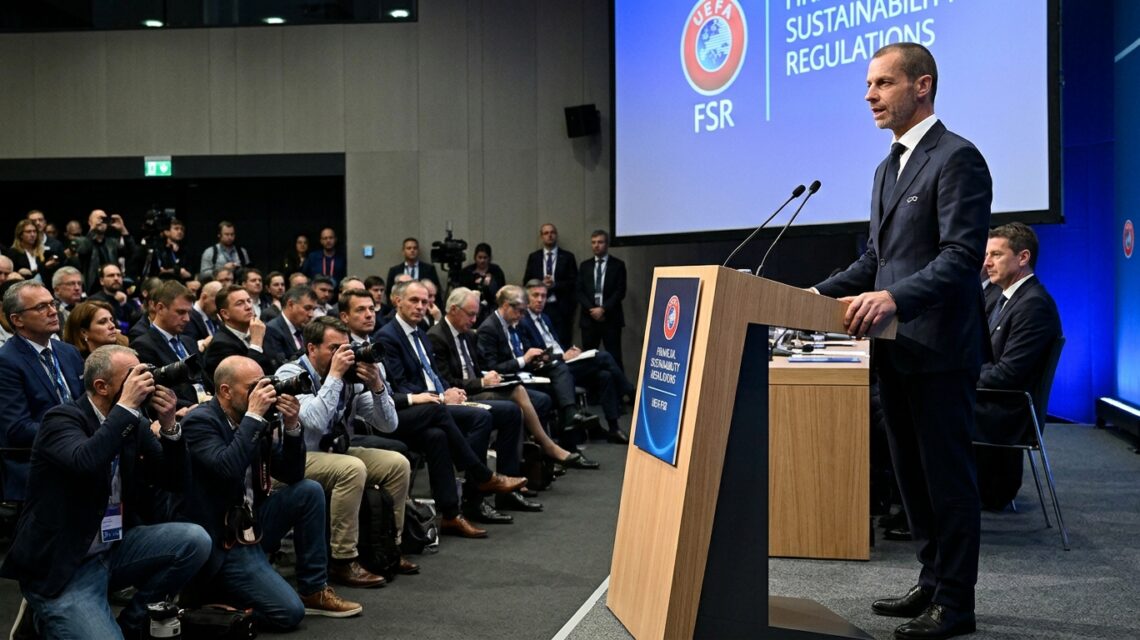
Europe’s new financial rules reached full force in 2025/26, with Chelsea, Newcastle and seven other clubs punished for exceeding the squad-cost threshold. But the regulation is not a conventional salary cap, and its accounting formula contains an important exception for transfer profits.
By Marcio Tamer
Updated November 6, 2026
UEFA’s attempt to control football spending moved from regulation to enforcement in June 2026, when nine clubs were sanctioned for exceeding the new 70% squad-cost limit.
Strasbourg received a €25 million fine, including €12 million conditional on future compliance. Aston Villa was fined €22.5 million, of which €15 million was conditional.
Fenerbahçe received a €7 million fine, while Fiorentina, Chelsea, Newcastle United, Nottingham Forest, AEK Athens and Nice also faced penalties.
Strasbourg and Aston Villa were additionally subjected to restrictions on registering new players for UEFA competitions in the 2026/27 season.
The decisions demonstrated that UEFA’s squad cost rule had become more than a financial reporting requirement.
But the rule is often misunderstood.
It does not prohibit a club from spending more than 70% of its revenue on salaries alone. Nor does it impose the same spending limit in euros on every team.
Instead, UEFA measures the combined cost of players, relevant coaching personnel, transfers and intermediaries against a specially defined revenue base.
A wealthy club can therefore spend considerably more than a smaller competitor while remaining compliant.
The regulation is designed primarily to control costs relative to income, not to equalize spending across European football.
What exactly is UEFA’s 70% squad-cost rule?
The squad cost rule forms part of UEFA’s Club Licensing and Financial Sustainability Regulations, approved in 2022.
Its purpose is to prevent clubs participating in UEFA competitions from committing an excessive share of their financial resources to their playing squads.
The basic principle is straightforward:
Squad-cost ratio = eligible squad costs ÷ eligible revenue and transfer-related results.
A club must keep that ratio at or below 70%.
The costs include player and relevant coaching compensation, accounting charges associated with player registrations, and agent or intermediary fees.
The revenue calculation includes eligible operating income and transfer-related results, subject to UEFA’s detailed accounting adjustments.
The rule therefore captures costs that a salary-only limit would miss.
A club might offer moderate wages but spend heavily on transfer fees. Another might avoid large transfer payments but commit enormous sums to salaries.
Both forms of expenditure can affect the squad-cost ratio.
The regulation examines their combined financial burden.
Why the limit fell from 90% to 70%
UEFA introduced the new framework gradually to give clubs time to adjust existing contracts and financial plans.
The transition took place over three seasons.
| Season | Maximum squad-cost ratio |
|---|---|
| 2023/24 | 90% |
| 2024/25 | 80% |
| 2025/26 onward | 70% |
The permanent threshold began in the 2025/26 season.
That did not mean clubs were expected to cut every player’s salary by 30%.
The calculation is a ratio, so compliance can improve through several different changes.
A club might reduce wages, lower transfer amortization, earn more eligible revenue or generate qualifying transfer profits.
It could also use a combination of those measures.
The gradual implementation mattered because football contracts often last several years.
A club cannot necessarily eliminate an expensive wage commitment simply because a financial regulation changes.
The transition gave teams time to manage those obligations before the full threshold applied.
Why this is not a salary cap
The difference becomes clearer through a hypothetical example.
Suppose Club A has €500 million in eligible revenue and transfer-related results.
At a 70% ratio, its maximum eligible squad costs would be €350 million.
Club B has a comparable revenue base of €100 million.
Its corresponding limit would be €70 million.
Both clubs face the same percentage.
But Club A can spend five times as much in absolute terms.
This is why the rule should not be confused with the salary caps used in some American professional sports leagues.
UEFA has not established a single maximum payroll for every Champions League participant.
It has established a financial ratio.
The distinction also limits claims that the rule will automatically produce competitive equality.
Large clubs with stronger broadcasting, sponsorship and matchday revenues retain a substantial spending advantage.
The regulation may reduce the risk of unsustainable spending without eliminating the financial gap between clubs.
How UEFA calculates the cost of a transfer
Transfer accounting is one of the most important parts of the system.
When a club purchases a player’s registration, the fee is generally spread across the relevant accounting period rather than charged entirely in the year of purchase.
This is known as amortization.
Consider a hypothetical €60 million transfer with a five-year accounting life.
The club would ordinarily recognize €12 million in annual amortization, before considering other costs or adjustments.
If the player also earns €8 million annually, those two items alone would contribute €20 million to the relevant annual cost calculation.
Agent fees and other eligible charges may increase the total.
This explains why a club’s reported transfer spending and its squad-cost ratio can look very different.
A €60 million signing does not necessarily produce a €60 million squad-cost charge in the first year.
But the accounting treatment does not make the transfer free.
The club still has contractual payment obligations and a continuing cost over future reporting periods.
Why longer contracts are not an unlimited loophole
Longer contracts can spread transfer amortization across more accounting periods, reducing the annual charge.
That made contract length a significant issue as clubs searched for ways to manage UEFA’s financial rules.
But the idea that clubs can indefinitely extend contracts to make expensive transfers disappear from the calculation is misleading.
UEFA introduced restrictions on the amortization period for newly acquired player registrations.
Under the relevant financial rules, the maximum period is generally five years for new registrations, even when a player’s contract lasts longer.
That limits the ability to reduce annual accounting charges simply by offering unusually long contracts.
The restriction does not erase the economic consequences of transfer spending.
It changes how those costs are recognized for regulatory purposes.
Clubs must also account for wages, intermediary payments and other relevant expenses.
The overall ratio is therefore more complicated than dividing a transfer fee by the number of years on a player’s contract.
Why selling academy players can improve the ratio
Player sales affect the denominator of the squad-cost calculation.
When a club sells a player, the accounting profit depends on the transfer proceeds and the remaining book value of the player’s registration.
Academy-developed players often have little or no capitalized acquisition cost.
Selling one can therefore produce a substantial accounting profit.
For example, a hypothetical academy player sold for €30 million may generate a profit close to that amount before applicable transaction costs and other adjustments.
A player purchased for €40 million and sold for €30 million would produce a different accounting result, depending on the registration’s remaining book value.
That distinction helps explain why clubs may value academy sales as a financial management tool.
But the effect on UEFA’s squad-cost rule is not simply a one-for-one increase in the current year’s spending allowance.
The calculation uses specific reporting periods and adjustments.
Under UEFA’s 2026 regulations, transfer-related results are generally measured over 36 months and prorated to a 12-month basis, while most operating revenue and squad costs use a 12-month period.
That design reduces the ability of a single transfer transaction to distort the ratio for one season.
UEFA changed the detailed formula again in 2026
The permanent 70% limit remained in place, but UEFA updated the underlying accounting rules.
Under Article 93 of the 2026 regulations, the squad-cost numerator includes employee benefit expenses for relevant personnel, amortization of player registration costs, loan-related income and expenses, and relevant intermediary costs.
The denominator includes adjusted operating revenue, net profits or losses on player disposals, impairment of registration costs, and other transfer-related income or expenses.
The placement and treatment of certain accounting items differ from earlier editions.
That matters because an apparently simple 70% rule depends on technical definitions.
Clubs cannot accurately calculate compliance merely by dividing their published wage bill by total turnover.
The relevant financial statements may contain items that UEFA excludes, adjusts or treats over different reporting periods.
The official regulatory calculation is therefore more precise than a conventional wage-to-revenue ratio.
Which clubs were fined in June 2026?
On June 30, UEFA’s Club Financial Control Body announced penalties against nine clubs that had exceeded the 70% limit for calendar year 2025.
The decisions included the following amounts.
| Club | Announced fine | Conditional portion |
|---|---|---|
| Strasbourg | €25m | €12m |
| Aston Villa | €22.5m | €15m |
| Fenerbahçe | €7m | None stated |
| Fiorentina | €6m | None stated |
| Chelsea | €3m | €2m |
| Newcastle United | €3m | None stated |
| Nottingham Forest | €2.5m | None stated |
| AEK Athens | €0.5m | None stated |
| Nice | €0.45m | None stated |
The total announced fines amounted to €69.95 million, including €29 million in conditional amounts.
Those totals should not be confused with cash immediately payable in every case.
Conditional fines depend on whether the clubs satisfy specified future requirements.
UEFA also imposed additional registration restrictions on Strasbourg and Aston Villa because their breaches were considered significant.
The decisions provided the first major demonstration of how the permanent threshold would be enforced across prominent European clubs.
Why Aston Villa and Strasbourg faced more than fines
UEFA’s sanctions are not limited to a fixed penalty for exceeding 70%.
The financial disciplinary measure depends on the size of the breach and whether the club has violated the rule previously.
Repeat breaches can produce more severe consequences.
A significant breach can also trigger sporting measures.
In June 2026, UEFA imposed restrictions on Strasbourg and Aston Villa concerning the registration of new players on List A for European competitions in 2026/27.
Those restrictions can affect squad planning.
A club may have money available to sign a player but face limitations on registering that player for UEFA matches.
That is a different consequence from a fine.
It can influence recruitment decisions and the management of European competition squads.
However, it would be inaccurate to say that every breach automatically results in a transfer ban, points deduction or exclusion from the Champions League.
The applicable sanction depends on the regulatory framework, the nature of the breach and the disciplinary decision.
Some clubs exceeded 70% without receiving the same punishment
UEFA’s June announcement also identified Bologna and Napoli as clubs whose squad-cost ratios exceeded 70%.
Yet the governing body did not impose the same penalties on them.
UEFA explained that their deviations were fully mitigated by football earnings surpluses under provisions contained in the regulations.
That detail is especially important.
The 70% threshold is a central rule, but UEFA’s enforcement framework includes defined mitigating factors.
A club’s wider financial position can affect the outcome.
The distinction does not make the limit meaningless.
It shows that compliance assessment is governed by more than one isolated number.
The official regulations determine how exceptions and mitigating circumstances apply.
Clubs cannot simply declare themselves exempt because they believe their finances are healthy.
Financial Fair Play did not disappear entirely
UEFA’s 2022 reforms replaced the previous regulatory framework, but they did not eliminate all the principles associated with Financial Fair Play.
The new system contains three central pillars: solvency, stability and cost control.
Solvency rules address overdue payments.
Stability requirements examine a club’s football earnings over multiple reporting periods.
Cost control introduces the squad-cost ratio.
These tests address different financial risks.
A club may comply with the 70% squad-cost limit but still breach the football earnings rule.
Another may meet the earnings requirements but have overdue payments.
The regulations are therefore designed to operate together.
UEFA’s June 2026 decisions illustrated that distinction.
Newcastle United and Nice were among clubs assessed under more than one part of the framework.
The governing body also imposed separate sanctions for breaches of the football earnings rule.
Those penalties should not be added to the squad-cost fines without explaining which regulation each sanction concerns.
Why owner investment cannot automatically solve the problem
Wealthy owners can provide clubs with additional capital.
But an owner transferring money into a club is not necessarily equivalent to generating eligible operating revenue.
UEFA’s squad-cost calculation is based on defined revenue categories and transfer-related results.
Capital injections are treated differently from ordinary commercial income.
The regulations also contain fair-value provisions intended to prevent clubs from artificially increasing revenue through transactions with related parties.
For example, a sponsorship agreement involving a company connected to a club’s ownership may be subject to scrutiny.
UEFA can assess whether the transaction reflects fair market value.
That does not mean every owner-related sponsorship is prohibited.
It means clubs cannot assume that any amount written into a commercial contract will automatically be accepted for financial monitoring.
The rule is intended to connect spending capacity more closely to genuine economic activity.
Does the 70% limit reduce transfer inflation?
The rule can constrain spending by clubs whose squad costs are already high relative to their eligible income.
Those clubs may need to reduce wage commitments, reconsider transfer fees or increase revenue before making additional signings.
But there is not enough evidence to conclude that the regulation has already reduced transfer inflation across European football as a whole.
Transfer prices depend on multiple factors, including player quality, contract length, competitive demand and the financial resources of potential buyers.
The 70% limit also permits larger clubs to spend more in absolute terms.
A club generating €800 million in eligible revenue has far greater spending capacity than one generating €150 million.
Both may comply with the same ratio.
The regulation is therefore better understood as a sustainability measure than as a mechanism for equalizing the transfer market.
Its effectiveness will depend on enforcement, accounting standards and the behavior of clubs over several seasons.
What happens next for clubs already sanctioned?
The next stage involves monitoring whether clubs reduce their squad-cost ratios and comply with any conditions attached to their penalties.
Aston Villa, Strasbourg and Chelsea face particular attention because portions of their announced fines were conditional.
The clubs must also account for any restrictions or settlement obligations affecting European competition registration.
UEFA’s Club Financial Control Body will continue reviewing financial information under the applicable reporting timetable.
The 2026 regulations remain in force, including the permanent 70% squad-cost threshold.
Future decisions will show whether the rule changes clubs’ financial behavior or produces repeated sanctions against the same organizations.
The first major enforcement round has already established that the limit carries consequences.
The more difficult question is whether those consequences will persuade clubs to change how they build and finance their squads.
+ Siga o Giro no Facebook
+ Siga o Giro no Instagram
Leia Mais: