

Live-pigeon shooting, balloon races and firefighting competitions appeared alongside genuine Olympic sports such as tug-of-war and obstacle swimming, but the chaotic 1900 World’s Fair left a century of confusion over which events actually counted.
By Marcio Tamer
Updated October 29, 2026
More than 300 pigeons were reportedly killed during a shooting competition associated with the 1900 Paris Olympic Games. Belgian marksman Léon de Lunden won the main contest after shooting 21 birds, in an event that would be almost unimaginable at a modern international sporting championship.
Yet one of the most surprising details is that de Lunden did not win an officially recognized Olympic gold medal.
The live-pigeon competition was part of the sprawling sporting program organized during the Paris World’s Fair. Although it has become one of the most famous stories from the early Olympics, specialist historical records classify it as a non-medal event.
That distinction reveals something extraordinary about the first decades of the modern Olympic movement.
Between 1900 and 1920, athletes genuinely won Olympic medals in tug-of-war, standing jumps and obstacle swimming. Meanwhile, balloon races, firefighting competitions and other unusual activities took place alongside the Games without necessarily becoming official Olympic championships.
The result was a sporting landscape where the difference between an Olympic event, an exhibition and a recreational contest was often difficult to establish.
More than a century later, historians are still separating the recognized medal competitions from the extraordinary spectacles that surrounded them.
Why the 1900 Olympics became a six-month sporting experiment
The second modern Olympic Games took place in Paris in 1900, just four years after the inaugural edition in Athens.
But the event looked nothing like the modern Olympics.
Instead of organizing a clearly defined international championship, French authorities incorporated sporting competitions into the Exposition Universelle, a massive World’s Fair celebrating technology, industry, culture and national achievement.
The sporting program extended from May to October.
Competitions were held at different venues, under different regulations and with different forms of recognition.
There was no conventional Olympic opening ceremony or closing ceremony.
Some athletes received medals or trophies. Others received cash prizes, plaques or certificates. Many competitors did not even realize they were participating in events that would later be recognized as Olympic competitions.
The International Olympic Committee had limited influence over the organization.
Local committees and World’s Fair authorities controlled much of the program, producing an enormous mixture of sporting disciplines, technical demonstrations and recreational activities.
This created a historical problem.
Not every competition held during the exposition was an Olympic event, even when it involved international participants and awarded prizes.
The distinction matters because many of the strangest activities associated with Paris 1900 were never officially recognized as Olympic medal sports.
Live-pigeon shooting killed hundreds of birds, but the champion did not win Olympic gold
The live-pigeon shooting competition took place at the Bois de Boulogne in Paris between June 25 and 27, 1900.
The main event attracted 52 competitors representing eight countries.
The rules were simple.
Live pigeons were released in front of the shooters, who attempted to kill them with shotguns. Competitors were eliminated after missing two birds.
Belgian shooter Léon de Lunden won after successfully shooting 21 pigeons.
French competitor Maurice Faure finished second with 20, while American Crittenden Robinson and Australian Donald Mackintosh tied for third with 18.
Historical accounts estimate that more than 300 birds were killed during the competition.
The event has often been described as the only occasion when live animals were deliberately killed as targets during a competition associated with the modern Olympics.
However, Olympedia classifies live-pigeon shooting as a non-medal event.
De Lunden received prize money, but his victory is not included in official Olympic gold-medal records.
This distinction is frequently lost in articles about unusual Olympic sports.
The competition happened during the 1900 Paris sporting festival, but that does not automatically make it an official Olympic championship.
The episode remains historically significant because it illustrates how different sporting customs were at the beginning of the twentieth century.
Why shooting live pigeons disappeared from the Olympic landscape
Live-bird shooting was already practiced in Europe before the 1900 Paris exposition.
It was not invented specifically for the Olympics.
The activity reflected a period when shooting sports had not yet fully standardized their equipment, targets and competition formats.
As organized shooting developed, clay targets became the established alternative to live birds.
Clay-target shooting allowed competitors to demonstrate accuracy and reaction speed without killing animals during the event.
A recognized Olympic trap-shooting competition using inanimate targets was also held in Paris in 1900.
That means two very different types of shooting competition existed within the broader sporting festival.
One involved live pigeons and is classified as non-medal.
The other involved artificial targets and belongs to the official Olympic record.
It is often claimed that the live-pigeon competition was immediately banned by the IOC following widespread public outrage.
The available historical evidence does not establish such a specific immediate decision.
What is confirmed is that live-pigeon shooting did not become a recurring recognized Olympic medal event.
Its disappearance reflected the broader evolution of shooting sports and changing attitudes toward animal welfare.
Tug-of-war awarded real Olympic gold medals from 1900 to 1920
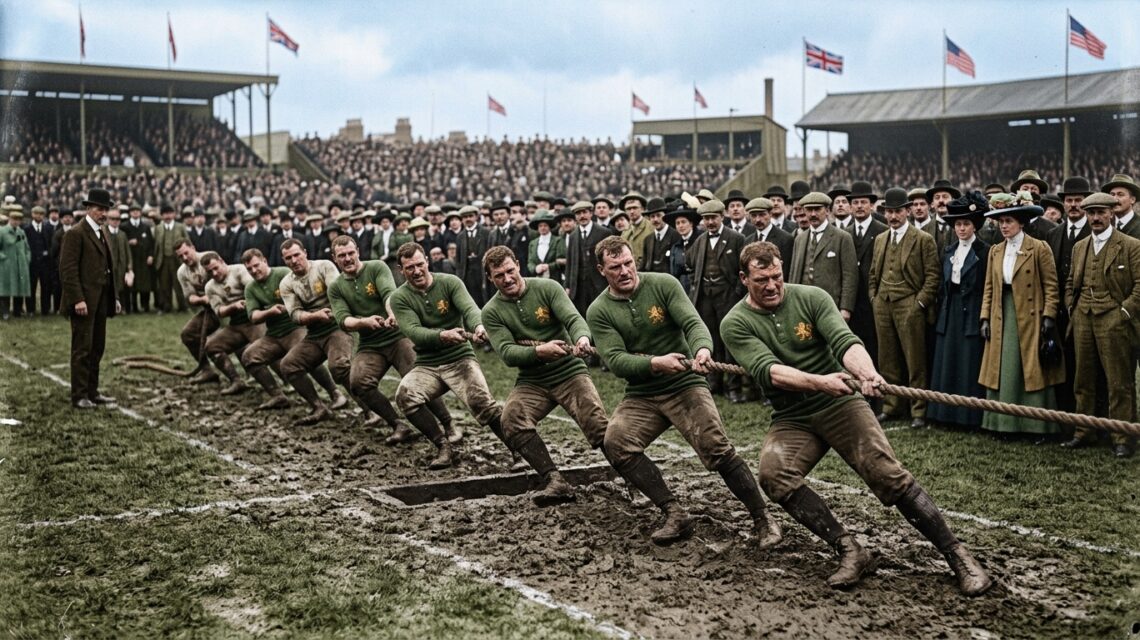
Unlike live-pigeon shooting, tug-of-war was a genuine Olympic medal sport.
It appeared at the 1900 Paris Games and remained on the program through Antwerp in 1920.
The event was classified within athletics during its Olympic years.
Teams competed by pulling opposite ends of a rope, attempting to drag their opponents across a designated line.
Success depended on strength, balance, technique and coordination.
The sport was particularly popular among police forces and athletic clubs.
British police teams became some of the most successful competitors.
At the 1920 Antwerp Olympics, Great Britain won the final Olympic tug-of-war gold medal.
The British team included several members of the London police and won all six of its pulls during the competition.
The sport disappeared from the Olympic program after 1920.
Its removal did not erase its history.
Tug-of-war champions remain legitimate Olympic medalists, and their results are included in the historical record.
The discipline also produced one of the most unusual equipment controversies in Olympic history.
Police boots caused an international dispute at the 1908 London Olympics
At the 1908 London Olympics, the United States faced a British tug-of-war team composed of Liverpool police officers.
The Americans were defeated and protested the footwear worn by their opponents.
The Liverpool officers competed in heavy police boots with metal-rimmed soles.
American officials argued that the boots gave the British team an unfair advantage.
The British maintained that the officers were wearing ordinary police footwear rather than equipment specially modified for the competition.
Officials rejected the American protest.
The United States withdrew from the event.
Liverpool continued through the competition and eventually won silver, losing the final to the City of London Police.
The controversy revealed how inconsistent early Olympic equipment regulations could be.
A dispute over ordinary police boots became an international sporting confrontation.
Today, tug-of-war competitions have detailed technical regulations covering footwear, surfaces, rope handling and team composition.
In 1908, those standards were less settled, allowing disagreements over equipment to become major controversies.
Ray Ewry won eight Olympic gold medals without taking a running step
One of the most successful athletes of the early Olympics built his career around events that no longer exist.
American jumper Ray Ewry specialized in standing jumps.
Unlike modern long jumpers and high jumpers, competitors were not allowed to take a running approach.
They had to generate their jumping power from a stationary position.
The Olympic program included standing high jump, standing long jump and standing triple jump.
Ewry dominated these disciplines.
He won three gold medals at Paris 1900, three more at St. Louis 1904 and another two at London 1908.
His total of eight officially recognized Olympic gold medals made him one of the greatest individual champions of the early Games.
His achievements were especially remarkable because he had suffered from polio as a child and experienced serious weakness in his legs.
Through physical training, he rebuilt his strength and developed exceptional jumping ability.
Ewry also won two titles at the 1906 Intercalated Games in Athens.
Those victories are not included in the IOC’s standard Olympic medal count.
Consequently, some historical sources describe him as a ten-time champion, while official Olympic records credit him with eight gold medals.
The distinction demonstrates how historical recognition can differ between competitions that were celebrated at the time and events included in today’s official Olympic statistics.
Standing jumps disappeared after the 1912 Stockholm Olympics
Standing jumps remained part of the Olympic athletics program until 1912.
The standing high jump and standing long jump were contested for the final time at the Stockholm Games.
The standing triple jump had disappeared earlier, after 1904.
Their removal reflected the gradual standardization of international athletics.
Running jumps became the dominant competitive disciplines, combining speed, explosive power and technical skill.
Standing jumps required exceptional athletic ability, but they attracted less sustained international support as the Olympic program evolved.
Their disappearance was not evidence that they were merely exhibition events.
They had been legitimate Olympic championships.
The athletes who won them retained their medals and historical records.
Ewry’s achievements remain among the clearest examples of how Olympic greatness can survive even after an entire discipline disappears.
Swimmers had to climb over boats and dive underneath them in Paris
The 1900 Paris Games included an official 200-meter obstacle swimming competition.
The event took place in the River Seine rather than a modern swimming pool.
Competitors had to negotiate three obstacles during the race.
They first climbed over a pole, then scrambled across a row of boats before swimming underneath another row of boats.
The event combined swimming speed with agility and obstacle navigation.
British swimmer Fred Lane won the gold medal in 2 minutes, 38.4 seconds.
Austria’s Otto Wahle finished second, while Britain’s Peter Kemp took bronze.
The competition was held only once in Olympic history.
Unlike ballooning and live-pigeon shooting, obstacle swimming is recognized as an official Olympic medal event.
Its results remain part of the historical Olympic record.
The event illustrates how experimental early aquatic competitions could be.
Modern Olympic swimming takes place in carefully regulated pools with standardized distances, lanes and equipment.
In Paris, competitors raced through a river while climbing over and diving beneath boats.
The difference reveals how dramatically the sport evolved during the following century.
Underwater swimming also awarded Olympic medals in 1900
Another unusual recognized Olympic event was underwater swimming.
Instead of racing over a conventional distance, athletes earned points based on how far they traveled underwater and how long they remained submerged.
The competition also took place in the Seine.
French swimmer Charles Devendeville won the gold medal.
André Six, also representing France, finished second.
Denmark’s Peder Lykkeberg won bronze.
The format created an unusual challenge for spectators.
Unlike conventional swimming, where the leader is visible throughout the race, much of the action took place beneath the surface.
The event also involved breath-holding and prolonged underwater exertion, activities that require careful safety precautions.
Underwater swimming never returned to the Olympic program.
Its brief appearance demonstrates the wide range of athletic abilities that early organizers considered suitable for international competition.
Balloon races took place during the 1900 Games, but they were not official Olympic events
Ballooning was one of the most visually impressive activities associated with the Paris World’s Fair.
Competitors used balloons to demonstrate navigation, endurance and technical skill.
The program included contests measuring distance traveled, flight duration and altitude.
Some flights lasted many hours and covered considerable distances.
Other competitions focused on technical tasks such as inflating balloons.
Olympedia records 26 ballooning events associated with the 1900 exposition.
However, these competitions are classified as non-medal events.
Their winners are not recognized as Olympic champions.
One particularly unusual competition involved balloon inflation.
French participant Maurice Mallet won the event and received a silver plaque valued at 200 francs.
That prize was awarded by the organizers of the competition.
It was not an official Olympic silver medal.
The distinction matters because ballooning frequently appears in lists of discontinued Olympic sports.
Although it was part of the sporting festival surrounding Paris 1900, it did not belong to the recognized Olympic medal program.
Firefighting competitions were held alongside the Olympics
Firefighting was another activity included in the 1900 World’s Fair sporting program.
Teams demonstrated their ability to operate firefighting equipment and perform rescue-related maneuvers.
The competitions attracted crews from different countries.
British teams included firefighters from Windsor, Lydd, Bournemouth and Worthing.
These events reflected the broader purpose of the World’s Fair.
The exposition was not exclusively about sport.
It also celebrated technology, industry, public services and professional skills.
Firefighting competitions allowed teams to demonstrate practical techniques and equipment.
Some participants received prizes.
But the contests are classified as non-medal events by Olympic historians.
They were not official Olympic championships.
Their inclusion shows how the early sporting festival blurred the boundaries between athletic competition and technical demonstration.
Cannon shooting is often described as an Olympic sport, but it did not award recognized gold medals
Some popular accounts of unusual Olympic sports include cannon shooting or artillery competitions.
Military-themed shooting activities were part of the broader sporting environment associated with the 1900 Paris exposition.
However, there is no reliable basis for claiming that cannon shooting awarded officially recognized Olympic gold medals.
The recognized shooting program at Paris 1900 included rifle, pistol and trap events.
Cannon shooting is not included among those official medal competitions.
The wider shooting program was complicated.
It contained contests for military personnel, shooting clubs and professional competitors.
Some events offered substantial prize money.
Others had restricted eligibility requirements.
Because these activities took place during the same exposition, later accounts sometimes confused them with official Olympic championships.
The distinction is essential.
An activity could be held during the World’s Fair without being recognized as an Olympic medal event.
That is why cannon shooting should not be presented as a former official Olympic discipline without stronger historical evidence.
Which unusual Olympic events actually awarded gold medals?
The difference between official Olympic competitions and non-medal events becomes clearer when the historical records are compared.
| Event | Year or period | Olympic medal status | Historical detail |
|---|---|---|---|
| Live-pigeon shooting | Paris 1900 | Non-medal | Léon de Lunden won after shooting 21 birds |
| Tug-of-war | 1900–1920 | Official medal event | Great Britain won the final Olympic title |
| Standing high jump | 1900–1912 | Official medal event | Ray Ewry won three Olympic titles |
| Standing long jump | 1900–1912 | Official medal event | Ray Ewry dominated the discipline |
| Standing triple jump | 1900–1904 | Official medal event | Ray Ewry won both Olympic editions |
| Obstacle swimming | Paris 1900 | Official medal event | Fred Lane won the 200-meter race |
| Underwater swimming | Paris 1900 | Official medal event | Charles Devendeville won gold |
| Ballooning | Paris 1900 | Non-medal | Events included distance, duration and balloon inflation |
| Firefighting | Paris 1900 | Non-medal | Crews demonstrated firefighting and rescue skills |
| Cannon shooting | Paris 1900 exposition | Not a recognized Olympic medal event | Military-themed contests belonged to the wider program |
The table reveals why early Olympic history is frequently misunderstood.
Some activities that seem absurd today were genuine Olympic championships.
Others were exhibitions or competitions held during the same international festival.
The fact that an event took place in Paris in 1900 does not automatically mean it awarded Olympic medals.
Why the IOC gradually removed unusual sports from the program
The early Olympic Games were organized under conditions very different from those of the modern movement.
The International Olympic Committee had limited administrative authority.
Host cities and local committees exercised considerable influence over the program.
Eligibility requirements varied.
Competition formats were inconsistent.
The distinction between amateur and professional athletes was frequently disputed.
As the Games expanded, international sports federations became more important.
They developed standardized rules, technical requirements and qualification systems.
The IOC gradually established clearer criteria for including sports and disciplines in the Olympic program.
Some events disappeared because they lacked broad international participation.
Others were replaced by disciplines with more established competitive structures.
Some simply fell out of favor.
This transformation did not occur through a single decision immediately after 1900 or 1920.
It was a gradual process extending across decades.
The modern Olympic program is therefore not a permanent collection of traditional sports.
It is the result of more than a century of changes in international participation, regulation and sporting culture.
The strangest early Olympic contests reveal how the modern Games were created
The unusual competitions associated with Paris 1900 are often presented as evidence that the early Olympics were chaotic or absurd.
There is truth in that description.
The Games were poorly separated from the World’s Fair, the sporting program was inconsistent, and the distinction between official championships and exhibitions was frequently unclear.
But the period also produced genuine athletic achievements.
Ray Ewry won eight recognized Olympic gold medals in standing jumps.
Fred Lane became an Olympic champion in obstacle swimming.
Tug-of-war teams competed for medals over two decades.
Meanwhile, balloonists, firefighters and live-pigeon shooters participated in contests that belonged to the wider international exhibition rather than the recognized Olympic medal program.
The most important lesson is that unusual does not necessarily mean unofficial, and taking place during the Olympics does not necessarily mean awarding an Olympic medal.
That distinction separates the documented history of the early Games from the myths that have accumulated around them.
It also reveals how much the Olympic movement has changed.
What began as a loosely organized collection of international competitions gradually became a global sporting institution with standardized rules, defined medal events and increasingly detailed athlete protections.
The strange contests of 1900 are not merely curiosities from a distant past.
They are evidence of the experimentation, confusion and institutional development that helped shape the Olympics as they exist today.
+ Siga o Giro no Facebook
+ Siga o Giro no Instagram
Leia Mais: