

Alojzy Ehrlich and Farkas Paneth turned the opening rally of a World Championship match into an extraordinary endurance contest. The episode helped trigger reforms in 1937, and its legacy survives in the modern rule that rewards a receiver after 13 successful returns.
By Marcio Tamer
Updated October 29, 2026
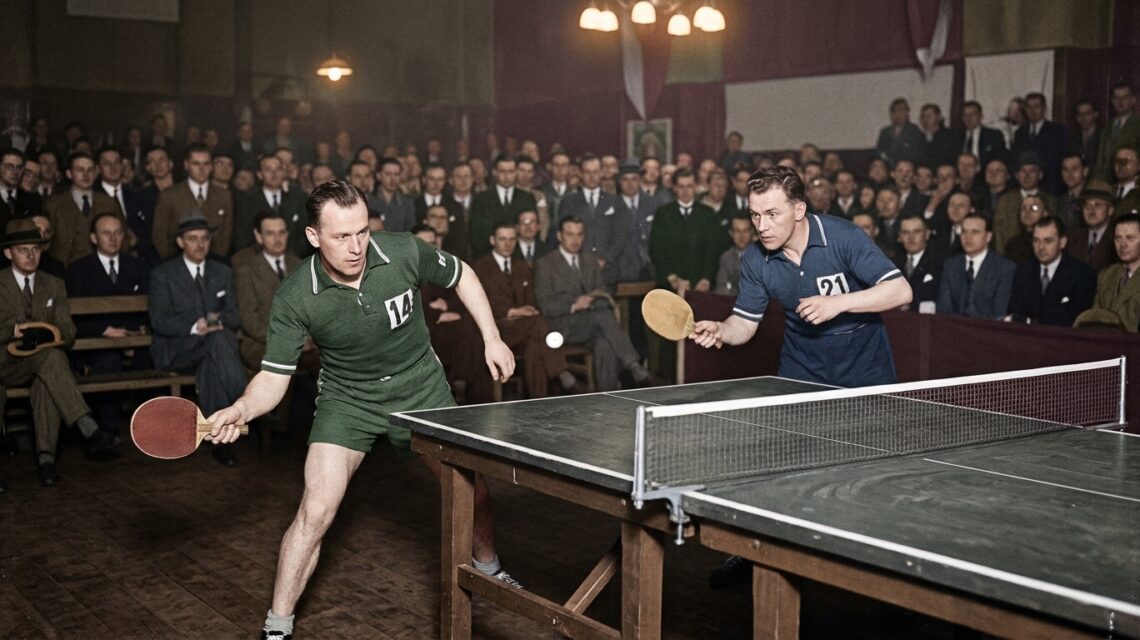
In March 1936, a table tennis match at the World Championships in Prague began with a rally that reportedly lasted two hours and 12 minutes. Poland’s Alojzy Ehrlich and Romania’s Farkas Paneth exchanged shot after shot without either player conceding the opening point.
By the time the rally ended, the ball had reportedly crossed the net more than 12,000 times. Spectators had watched an extraordinary demonstration of defensive persistence, while officials confronted a problem that threatened the viability of competitive table tennis.
The most remarkable detail was the score.
After more than two hours of play, the winner had earned just one point.
The episode became one of the defining moments in the sport’s early history. In 1937, the International Table Tennis Federation introduced measures designed to encourage attacking play, including a lower net and time limits.
Ninety years later, the ITTF still identifies the Prague rally as a landmark in the development of modern table tennis.
But the story contains more than an extraordinary duration. Historical accounts describe chess games, food breaks, an exhausted umpire and officials attempting to negotiate an end to a rally that neither player wanted to abandon.
Some of those colorful details are difficult to verify independently, but the central event is firmly established in the sport’s historical record.
Why a single point could last more than two hours in 1936
The 1936 World Table Tennis Championships began in Prague, Czechoslovakia, on March 12.
It was the tenth edition of the tournament, which had first been held in London in 1926.
The sport was still developing its international identity.
Equipment, tactics and playing conditions differed significantly from those of modern table tennis.
The early decades were dominated by hardbat rackets, which generally used wooden blades covered with pimpled rubber rather than the sponge-based surfaces that later transformed attacking play.
These rackets could produce spin, but they did not offer the same combination of speed and rotation associated with modern sponge-rubber equipment.
Defensive techniques were particularly effective.
Players could return the ball repeatedly with controlled, low-risk strokes, often using backspin to make aggressive attacks more difficult.
The strategy was straightforward.
Rather than attempting to win a point quickly, a player could wait for the opponent to make a mistake.
When two defensive specialists faced each other, however, neither necessarily wanted to take the initiative.
That was the situation confronting Ehrlich and Paneth in Prague.
Both were accomplished competitors who understood the advantages of patient, defensive play.
Neither was willing to surrender the first point through an unnecessary attacking error.
The result was a rally that exposed a fundamental weakness in the rules.
There was no effective mechanism to prevent a single exchange from continuing indefinitely.
Ehrlich and Paneth turned the opening point into a battle of endurance
The extraordinary rally occurred during the opening men’s team fixture between Poland and Romania.
Alojzy Ehrlich, widely known as Alex Ehrlich, represented Poland.
Farkas Paneth represented Romania.
Both players adopted an extremely cautious approach.
Instead of attempting decisive attacking shots, they repeatedly returned the ball, preserving the rally and waiting for the other player to make a mistake.
Minutes passed.
Then the first hour.
Still, neither player had scored.
The contest became less about conventional point construction and more about patience, concentration and physical endurance.
According to a historical account published by Table Tennis England, the players continued exchanging defensive shots while tournament officials attempted to find a solution.
The story became increasingly extraordinary as the rally continued.
Ehrlich reportedly arranged to play chess with a teammate while maintaining the exchange.
He called out his chess moves without interrupting his returns.
The same account describes him preparing food and drinking coffee during the prolonged point.
These details illustrate how controlled and repetitive the rally had become.
The players were not exchanging the kind of high-speed attacking strokes associated with modern table tennis.
They were maintaining a defensive pattern that allowed the ball to remain in play for an extraordinary length of time.
Officials reportedly held a meeting beside the table while the rally continued
The situation became so unusual that tournament officials attempted to intervene.
According to Table Tennis England’s archival account, the ITTF called a meeting of delegates to discuss the problem.
There was an immediate complication.
Ehrlich was also the Polish delegate.
Because he was still playing, the meeting reportedly moved to the courtside.
Officials suggested declaring the match a draw.
Both players refused.
Another proposal was to allow the rally to continue for five more minutes.
Paneth was reportedly willing to accept that arrangement.
Ehrlich was not.
He believed that prolonging the contest would benefit him and his team.
The exchange continued.
The episode demonstrated that the players were not simply trapped in an accidental marathon.
Their tactics were rational under the rules available at the time.
Neither player had an obligation to attack.
Neither faced a time penalty for prolonging the point.
As long as both could keep returning the ball, the rally could continue.
The officials’ difficulty was therefore structural.
They could ask the players to stop, but the existing rules offered no straightforward way to force a quicker resolution.
How the two-hour rally finally ended
The most widely reported duration of the opening rally is two hours and 12 minutes.
That figure appears in the ITTF’s official historical material and in accounts published by national table tennis organizations.
However, the exact duration is not completely uniform across historical sources.
A scholarly review presented at the 2019 ITTF Sports Science Congress notes that published estimates range from approximately one hour and 58 minutes to two hours and 15 minutes.
The accepted figure of two hours and 12 minutes is therefore best understood as the standard historical account rather than a measurement supported by modern electronic timing records.
The number of strokes is similarly uncertain.
Some accounts estimate more than 12,000 exchanges across the net, while others provide lower figures.
What is beyond serious dispute is that the opening point lasted roughly two hours.
According to Table Tennis England’s archival account, Ehrlich eventually changed the direction of his shot.
After repeatedly playing toward Paneth’s forehand, he sent the ball to his opponent’s backhand.
Paneth failed to return it.
Ehrlich had finally won the opening point.
The score was 1-0.
The rally had lasted longer than many complete sporting events.
The Prague tournament had another match that lasted approximately seven hours
The Ehrlich-Paneth rally was not an isolated example of the problems facing table tennis in the 1930s.
The same World Championships featured another extraordinary contest involving France’s Michel Haguenauer and Romania’s Marin Goldberger.
Historical accounts describe their match continuing for approximately seven hours before officials intervened.
The contest became another example of how defensive tactics could make tournament scheduling almost impossible.
A single match could occupy a table for much of the day.
Other players were forced to wait.
Organizers struggled to maintain the timetable.
Spectators faced long periods without decisive action.
The consequences extended beyond the two competitors.
A championship involving multiple teams and individual events depended on matches finishing within a reasonably predictable period.
If one rally could last two hours and one match could continue for seven, the entire tournament schedule became vulnerable.
The 1936 championships made that problem impossible to ignore.
What the ITTF changed in 1937
The International Table Tennis Federation responded with reforms intended to encourage more attacking play.
According to the ITTF’s official historical timeline, three significant changes followed the 1936 championships.
The net was lowered from 6.75 inches to six inches, equivalent to approximately 15.24 centimeters.
A time limit of 20 minutes was introduced for each game.
Finger spin was prohibited.
Each measure addressed a different aspect of the sport.
Lowering the net made attacking shots easier to execute because players had less height to clear.
Time restrictions reduced the possibility of games continuing without limit.
Prohibiting finger spin addressed a technique that could create difficult and unpredictable ball behavior during service.
Together, the changes reflected a deliberate effort to shift the sport away from excessively defensive play.
The objective was not to eliminate defense.
Defensive technique remained a legitimate and important part of table tennis.
The goal was to prevent players from exploiting the absence of time restrictions to prolong competition indefinitely.
The reforms marked a significant step toward the faster, more structured sport that developed in later decades.
The modern expedite system goes further than the original time limit
The most direct modern safeguard against excessively slow play is the expedite system.
It is governed by Section 2.15 of the ITTF’s Laws of Table Tennis.
The system normally comes into operation after 10 minutes of play in a game, provided fewer than 18 points have been scored.
It can also be introduced earlier if both players or pairs request it.
Once the system begins, the serving order changes so that players alternate service after every point.
The most important provision concerns the receiver.
If the receiving player makes 13 correct returns during a rally, the receiver automatically wins the point.
This changes the tactical incentives.
Under normal rules, a server can continue exchanging defensive shots for as long as both players keep the ball in play.
Under the expedite system, the server must win the rally before the receiver completes 13 successful returns.
The receiver no longer needs to force an attacking error to win.
Simply returning the ball successfully enough times becomes sufficient.
That gives the server a strong reason to attack rather than maintain an endless defensive exchange.
The rule does not automatically award a point to the server after 13 shots.
It does the opposite.
It rewards the receiver for surviving the required number of returns.
Once introduced, the expedite system remains in force until the end of the match.
Why the 10-minute rule does not apply to every game
The modern expedite system contains an important exception.
If at least 18 points have already been scored in a game, the system is not introduced.
That distinction prevents the rule from unnecessarily interrupting games that are already progressing toward completion.
For example, if a game reaches 9-9 before the 10-minute mark, the expedite system will not be activated solely because the time limit is reached.
But if the score is 4-4 after 10 minutes, the rule can be introduced.
The umpire interrupts play if necessary and applies the revised service and rally procedures.
This mechanism is designed to address slow progress rather than punish ordinary tactical exchanges.
A long rally is not automatically illegal.
Players can still use defensive techniques, vary spin and construct points patiently.
The difference is that the rules provide a mechanism to prevent prolonged defensive play from dominating an entire game.
The modern system is therefore more sophisticated than a simple maximum time limit.
It changes the incentives that determine how players approach each rally.
Why the 1936 rally could not happen under today’s rules
The contrast between the 1936 match and modern table tennis is dramatic.
In Prague, Ehrlich and Paneth could continue returning the ball without an effective time-based mechanism forcing a change.
Under today’s rules, the situation would develop differently.
If the opening point continued until the 10-minute threshold, the umpire would interrupt play to introduce the expedite system.
The rally would then be replayed under the revised procedure.
From that point onward, the receiver could win by making 13 correct returns.
The server would need to end the rally before that threshold.
The incentive to maintain a purely defensive exchange would disappear.
That does not guarantee every modern rally will be short.
But it prevents a player from using the same strategy indefinitely without facing a tactical consequence.
The rules are designed to preserve both competitive fairness and a workable match duration.
The Prague marathon demonstrated why that balance was necessary.
The two-hour point also exposed the limits of early table tennis equipment
The 1936 rally occurred during what historians commonly describe as the classic hardbat era.
The equipment encouraged a different balance between attack and defense.
Modern table tennis rackets typically use rubber surfaces backed by sponge.
Those materials can generate substantial speed and spin.
Players can produce aggressive topspin attacks that make passive defensive returns more difficult.
The widespread adoption of sponge-based racket technology accelerated after the Second World War.
It contributed to major changes in playing styles and international competition.
But the transformation was not caused solely by equipment.
Rule changes also played a significant role.
Lower nets, time restrictions and the later development of the expedite system all encouraged a more attacking approach.
The sport evolved through the interaction of technology, tactics and regulation.
The Prague rally belongs to the period before those developments had fully reshaped competitive play.
It shows what could happen when defensive equipment, conservative tactics and permissive rules combined.
The historical record is clear about the event, but not every detail is equally certain
The two-hour rally is widely recognized as one of the longest exchanges in table tennis history.
The ITTF confirms that the opening point between Ehrlich and Paneth lasted two hours and 12 minutes.
Table Tennis England has published a detailed account based on historical material.
However, some popular retellings include details that cannot be verified with the same confidence.
The exact number of shots varies between accounts.
Descriptions of the players’ physical condition also differ.
Stories about chess, food and officials negotiating beside the table come from retrospective narratives rather than a complete modern audiovisual record.
A 2019 academic study of defensive play in table tennis identified multiple published estimates for the rally’s duration.
That does not undermine the central story.
It means the precise chronology and some of the most colorful anecdotes should be attributed rather than presented as independently established facts.
The historical significance does not depend on whether the rally lasted exactly 132 minutes or a few minutes less.
Its importance lies in the fact that a single point consumed approximately two hours and exposed a serious weakness in the sport’s competitive structure.
The 1936 rally changed table tennis because it revealed a problem the rules could not solve
The match between Ehrlich and Paneth has endured in sporting history because it represents an unusual conflict between competitive strategy and the interests of the sport itself.
Neither player needed to break the rules to create the extraordinary situation.
Both could simply continue using defensive tactics.
The rules allowed it.
The problem was that a strategy that made sense for individual competitors could make the broader competition almost impossible to organize.
The ITTF’s response in 1937 showed that governing bodies could not rely solely on athletes voluntarily choosing entertaining or efficient styles of play.
Rules had to create incentives that supported the structure of the competition.
The lower net encouraged attacking shots.
Time limits restricted excessively prolonged games.
The modern expedite system eventually provided a direct mechanism to end defensive stalemates.
The two-hour rally remains a remarkable example of sporting endurance.
But its greater significance is institutional.
It demonstrated that a competition can become dysfunctional even when every participant follows the rules.
The solution was not to demand that players behave differently.
It was to change the rules that made the behavior possible.
+ Siga o Giro no Facebook
+ Siga o Giro no Instagram
Leia Mais: