


The merger ended a bidding war for players, created the championship that became the Super Bowl and established a unified football business. But the NFL’s most important financial advantage, collective television rights, actually began five years earlier.
By Marcio Tamer
Updated October 31, 2026
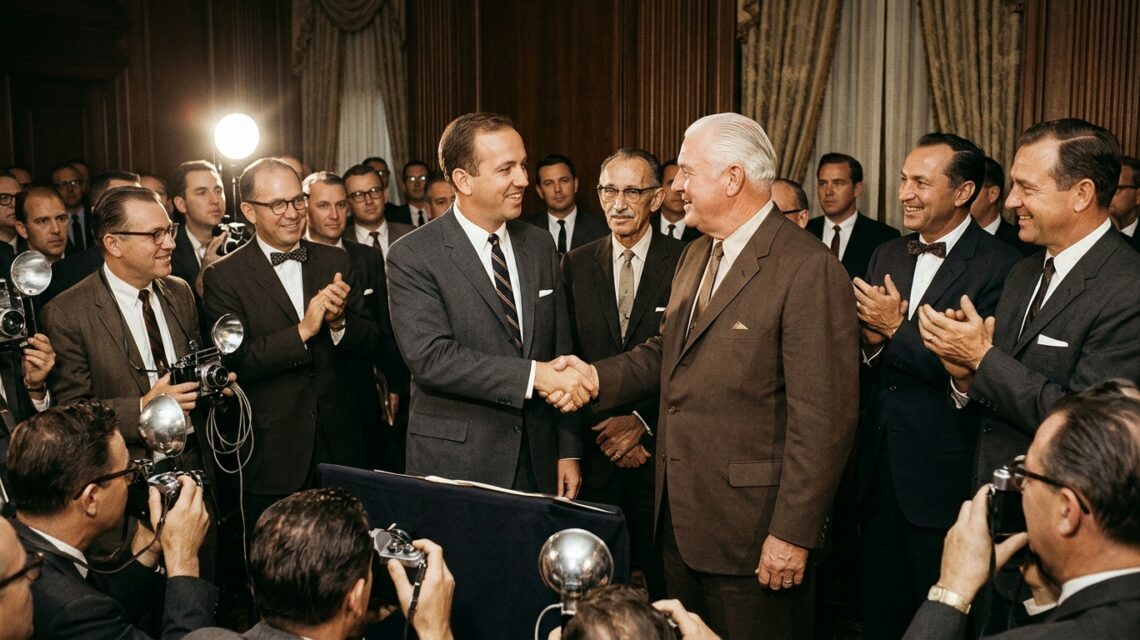
On June 8, 1966, the National Football League and its rival American Football League announced an agreement that would permanently change the economics of American professional sports.
The two organizations had spent six years competing for players, television audiences and access to major American markets. Their rivalry had driven up salaries and forced owners to reconsider the financial future of professional football.
The agreement ended the prospect of an indefinite bidding war.
It also created a championship game between the leagues, established a timetable for their integration and paved the way for a unified competition beginning in 1970.
Six months after the merger announcement, CBS and NBC agreed to pay $9.5 million for four years of rights to the new championship game.
That competition became the Super Bowl.
Sixty years later, the NFL’s major television and streaming agreements for the 2023 through 2033 seasons are valued at approximately $110 billion.
And in 2025, the league distributed a record $14.5 billion in shared revenue among its 32 franchises, according to financial analysis published by S&P Global Market Intelligence in September 2026.
The transformation was extraordinary.
But one detail changes the traditional account of how it happened.
The NFL did not invent collective television rights when it merged with the AFL in 1966. Congress had already authorized that business model in 1961.
The real breakthrough came from combining centralized broadcasting, revenue sharing, a unified national competition and a championship game that would eventually become one of the world’s most valuable television events.
Why the AFL challenged the NFL in 1960
The NFL was already an established professional sports organization when the American Football League began operating in 1960.
Founded in 1920, the NFL had survived decades of financial instability, franchise relocations and competition from other football leagues.
By the late 1950s, television was changing its prospects.
The 1958 NFL Championship Game between the Baltimore Colts and New York Giants became a landmark broadcast.
The game attracted a reported television audience of approximately 45 million people.
Its dramatic overtime finish helped demonstrate that professional football could become a major national television attraction.
Investors recognized the opportunity.
But the NFL was reluctant to expand quickly enough to accommodate every interested ownership group.
One of the frustrated investors was Lamar Hunt.
Hunt wanted an NFL franchise in Dallas but could not secure one on acceptable terms.
Instead of abandoning the idea, he helped organize a competing league.
The AFL began play in 1960 with eight franchises.
Its founding markets included Dallas, Houston, Denver, Los Angeles, Oakland, Buffalo, Boston and New York.
The new competition challenged the NFL’s established position.
It also introduced a different commercial dynamic.
The NFL could no longer assume that it was the only realistic destination for the best professional football players.
The AFL forced the NFL to compete for college stars
The AFL’s most immediate impact was on player recruitment.
Both leagues wanted access to the same elite college athletes.
That created competing offers and pushed salaries upward.
The situation was especially expensive because teams could spend considerable time and money negotiating with players who might ultimately sign with a rival organization.
The AFL also needed recognizable stars to attract television audiences.
Its owners understood that credibility on the field was essential to commercial survival.
The competition reached a new level in 1965.
The New York Jets signed quarterback Joe Namath after his college career at Alabama.
His reported three-year, $427,000 contract was extraordinary for the period.
The signing demonstrated that the AFL could attract major talent rather than simply employ players overlooked by the older league.
The following year, the bidding war intensified.
According to the Pro Football Hall of Fame, the two leagues spent a combined $7 million signing their 1966 draft selections.
That figure was significant because it represented money committed to incoming players before they had established themselves professionally.
The competing drafts created uncertainty and duplicated recruitment expenses.
Owners in both leagues had strong incentives to end the escalation.
But the AFL had also become financially and competitively strong enough that the NFL could no longer dismiss it.
A negotiated merger increasingly looked more attractive than continued competition.
Television had already become football’s most important commercial opportunity
The merger was not simply a response to rising player salaries.
Television was becoming the central business opportunity in professional football.
In the early 1960s, major American networks were willing to pay substantial amounts for exclusive access to live sports.
Football was especially attractive.
Its weekly schedule created appointment viewing.
The games were well suited to national broadcasts.
And television allowed teams to reach audiences far beyond their stadiums.
The NFL and AFL both recognized that broadcasting revenue could transform their finances.
But the two leagues were not starting from the same position.
The NFL had an established national audience and major network relationships.
The AFL needed television exposure to build credibility.
In 1964, the AFL signed a five-year, $36 million agreement with NBC, beginning with the 1965 season.
That represented an average of $7.2 million annually.
The contract gave the younger league financial resources and national visibility.
The NFL had already negotiated a larger arrangement with CBS.
In 1964, CBS agreed to pay approximately $14.1 million annually for NFL regular-season rights.
By the end of 1965, CBS had committed $18.8 million annually for the NFL’s 1966 and 1967 regular seasons, with an option for 1968.
The numbers showed that both leagues had become valuable television properties.
They also demonstrated why broadcasters would play such an important role in the eventual merger.
The 1961 Sports Broadcasting Act created the legal foundation
One of the most important developments occurred before the merger.
In 1961, President John F. Kennedy signed the Sports Broadcasting Act into law.
The legislation created a limited exemption from federal antitrust restrictions for certain collective sales of television rights by professional sports leagues.
Before the law, agreements allowing teams to combine their television rights could face legal challenges under antitrust rules.
The central concern was that independently owned clubs might be restricting competition by selling broadcasting rights together.
The Sports Broadcasting Act addressed that issue.
It allowed qualifying professional sports leagues to sell the sponsored television rights of their member clubs as a package.
The law covered professional football, baseball, basketball and hockey.
For the NFL, the implications were enormous.
Instead of each franchise negotiating separately with broadcasters, the league could offer networks a coordinated package of games.
That made the product more attractive to national television companies.
It also created the foundation for sharing broadcasting income among franchises.
The legislation did not authorize every conceivable broadcasting arrangement.
Its original scope concerned sponsored telecasts, and later legal disputes examined how the exemption applied to different technologies and distribution models.
But it provided the legal basis for the centralized television business that would become fundamental to the NFL’s finances.
The key point is chronological: collective television rights were legally protected in 1961, five years before the AFL-NFL merger.
The merger expanded and consolidated the business built on that foundation.
Lamar Hunt and Tex Schramm helped negotiate the 1966 agreement
By 1966, leaders in both leagues recognized the growing costs of their rivalry.
Secret discussions began between Lamar Hunt, owner of the AFL’s Kansas City Chiefs, and Tex Schramm, president and general manager of the NFL’s Dallas Cowboys.
Their involvement was significant.
Hunt had helped create the AFL because he could not obtain an NFL franchise.
Schramm represented one of the older league’s most important organizations.
Both understood the financial value of reducing competition between the leagues.
The discussions eventually produced a comprehensive agreement.
On June 8, 1966, NFL Commissioner Pete Rozelle announced the merger.
The plan included several major provisions.
All existing franchises would be retained.
The leagues would continue operating separate regular-season schedules through 1969.
They would begin holding a joint championship game after the 1966 season.
A common player draft would begin in 1967.
Full integration would take effect in 1970.
Rozelle would become commissioner of the combined organization.
The agreement was designed to end the bidding war while preserving the investments made by existing franchise owners.
It also provided a framework for a larger national competition.
Congress approved the merger but imposed protections for college and high school football
The merger raised antitrust concerns.
Combining the NFL and AFL would eliminate direct competition between the two major professional football leagues.
That could affect player negotiations, franchise markets and broadcasting arrangements.
The owners therefore needed congressional approval.
Congress amended the Sports Broadcasting Act in 1966 to provide a specific antitrust exemption for the merger.
The legislation was approved in October.
But the exemption came with conditions.
Lawmakers were concerned about the potential impact of professional football broadcasts on college and high school games.
The law therefore included restrictions on certain Friday-night and Saturday professional football telecasts during the traditional school football season.
The protections were intended to preserve attendance and interest in amateur football.
The arrangement reflected an important political compromise.
Congress allowed the professional leagues to combine, but it sought to limit the potential damage to other levels of the sport.
The legal structure helped make the merger possible.
It also demonstrated that the NFL’s commercial expansion depended partly on government decisions.
The league’s later financial success was not produced by market competition alone.
It also benefited from carefully defined legal exemptions that allowed collective broadcasting arrangements and the consolidation of competing organizations.
The first Super Bowl was a product of the merger
The merger agreement called for a championship game between the winners of the NFL and AFL.
The first contest was played on January 15, 1967.
The Green Bay Packers defeated the Kansas City Chiefs 35-10 at the Los Angeles Memorial Coliseum.
The event was officially called the AFL-NFL World Championship Game.
The name Super Bowl became associated with the competition soon afterward.
Lamar Hunt is widely credited with popularizing the term.
The game was commercially unusual because two major television networks broadcast it.
CBS held the NFL’s broadcasting rights.
NBC had the AFL’s rights.
Both networks televised the inaugural championship.
The arrangement reflected the fact that the leagues had not yet completed their integration.
It also gave the new event an unusually broad national platform.
In December 1966, the rights to four championship games were sold to CBS and NBC for $9.5 million.
That was a major commitment at the time.
The championship would eventually become much more than a sporting final.
It developed into a national television event with enormous advertising demand.
Its audience extended beyond dedicated football fans.
Halftime entertainment, advertising campaigns and cultural traditions became part of the product.
The Super Bowl helped turn the NFL into a recurring centerpiece of American television.
The 1970 merger created the AFC and NFC
The agreement announced in 1966 did not immediately create the modern NFL structure.
The two leagues continued operating separately for several seasons.
The full integration took effect in 1970.
The combined competition organized its teams into two conferences.
The American Football Conference incorporated the former AFL franchises along with three established NFL teams.
The National Football Conference contained the remaining NFL franchises.
The new structure preserved elements of the former rivalry while creating a single championship system.
The Super Bowl became the final contest between the conference champions.
The unified league also gained greater control over scheduling, commercial rights and national branding.
That integration made the NFL a more coherent television property.
Broadcasters could purchase packages associated with a single league rather than negotiate around two competing organizations.
The former AFL-NFL rivalry became an internal conference competition.
The merger did not eliminate every difference among teams or markets.
But it created a unified structure that could be marketed nationally.
That was essential to the league’s later expansion.
Monday Night Football turned regular-season games into national television events
The next major television innovation arrived in 1970.
The NFL reached an agreement with ABC to broadcast games on Monday nights.
The program became known as Monday Night Football.
Its significance was commercial as well as cultural.
Professional football had traditionally been concentrated on Sundays.
A nationally televised Monday-night game created an additional premium broadcasting window.
It also transformed an ordinary regular-season contest into a weekly television event.
The format included extensive pregame coverage, recognizable commentators and a presentation designed for a broad national audience.
The success of Monday Night Football demonstrated that the NFL could create valuable television products beyond the Super Bowl.
The league was no longer selling only games.
It was selling scheduled national events with predictable audiences.
That helped increase the value of future broadcasting contracts.
The strategy would later expand into Sunday Night Football, Thursday Night Football and special holiday games.
Each additional package created another commercial opportunity.
The NFL’s media business became increasingly sophisticated.
Why equal national TV revenue helped smaller-market franchises
The NFL’s revenue-sharing system became one of its most important competitive advantages.
Major national television income is distributed equally among the league’s franchises.
That means a small-market team can receive the same basic national media distribution as a franchise in a much larger metropolitan area.
The Green Bay Packers provide a particularly useful example.
Green Bay is a far smaller market than New York, Los Angeles or Chicago.
But the Packers receive an equal share of major national league revenue.
That arrangement reduces the financial gap between clubs based solely on local market size.
It also supports the league’s broader competitive structure.
A team does not need to operate in one of America’s largest cities to receive substantial national broadcasting income.
However, the system does not make every franchise financially identical.
Teams still differ in local sponsorships, stadium revenue, premium seating, commercial partnerships and operating costs.
Some organizations generate significantly more local income than others.
Equal national media distributions therefore reduce financial inequality.
They do not eliminate it.
The league also uses other mechanisms to support competitive balance, including the player draft, salary cap and collective bargaining arrangements.
Revenue sharing is one part of a larger system.
It does not guarantee that every team will win championships at the same rate.
Nor does it guarantee that every franchise will be profitable in every season.
The NFL’s television contracts grew from millions to nearly $110 billion
The long-term financial impact of the merger becomes clearer when television contracts are compared across generations.
In 1966, CBS and NBC paid a combined $9.5 million for four years of championship-game rights.
In 1970, the newly unified NFL began a national Monday-night package with ABC.
Television income continued rising throughout the following decades.
A federal appeals court later documented the scale of that growth in litigation involving the United States Football League.
The court noted that NFL clubs received approximately $186 million from television contracts covering 1970 through 1973.
The total increased to approximately $268 million for 1974 through 1977.
For 1978 through 1981, it reached approximately $646 million.
The five-year contracts covering 1982 through 1986 were worth approximately $2.1 billion.
Those figures demonstrated how rapidly national television became the foundation of the league’s business.
The next major transformation involved cable television.
ESPN and other subscription broadcasters expanded the market for sports rights.
Later, digital streaming platforms created additional competition.
In 2021, the NFL announced a new series of long-term media agreements covering the 2023 through 2033 seasons.
The deals involved CBS, FOX, NBC, ESPN/ABC and Amazon.
Industry analysis valued the agreements at approximately $110 billion.
The league had moved from a business dependent on a handful of traditional broadcasters to a national and international media property distributed across television and streaming platforms.
How much money does the NFL make in 2026?
The NFL’s financial scale is enormous, but revenue figures must be interpreted carefully.
S&P Global Market Intelligence reported in September 2026 that league-wide shared revenue reached approximately $14.5 billion in 2025.
That amount included national media rights, sponsorships, royalties from league-related businesses and shared ticket income.
Divided among 32 teams, it represented more than $450 million in shared revenue per franchise.
The figure does not represent total NFL revenue.
Teams also generate local income from stadium operations, sponsorships and other commercial activities.
S&P Global reported that overall NFL revenue had surpassed $23 billion in the 2024-25 period.
The distinction matters.
Shared revenue is money distributed through the league’s central arrangements.
Total revenue includes additional income generated by franchises.
Operating profit is a separate measure.
A league generating more than $23 billion in annual revenue is not necessarily earning that amount as profit.
Player salaries, stadium costs, staff, travel, administration and other expenses must be deducted.
Claims that every NFL franchise operates profitably or that the league earns tens of billions in annual operating profit are not supported by the revenue figures alone.
The league’s commercial strength is undeniable.
But accurate financial reporting requires separating sales, distributions, operating income and net profit.
The NFL’s financial transformation in numbers
| Milestone | Figure |
|---|---|
| AFL begins play | 1960 |
| Sports Broadcasting Act becomes law | 1961 |
| AFL television agreement with NBC | $36 million over five years |
| NFL annual CBS regular-season rights, 1964-65 | $14.1 million |
| Combined spending on 1966 draft signings | Approximately $7 million |
| AFL-NFL merger announcement | June 8, 1966 |
| Congressional merger exemption | October 1966 |
| First AFL-NFL championship game | January 15, 1967 |
| Initial four-year championship TV agreement | $9.5 million |
| Full AFL-NFL integration | 1970 |
| Monday Night Football begins | 1970 |
| NFL TV revenue, 1970-73 | Approximately $186 million |
| NFL TV revenue, 1982-86 | Approximately $2.1 billion |
| Major NFL media agreements, 2023-33 | Approximately $110 billion |
| League-wide shared revenue in 2025 | Approximately $14.5 billion |
| Shared revenue per franchise in 2025 | More than $450 million |
| Overall NFL revenue, 2024-25 period | More than $23 billion |
The figures reveal the scale of the commercial transformation.
In the 1960s, the leagues were competing for players and network contracts worth millions.
By the 1980s, television agreements had reached billions.
By the 2020s, the NFL was negotiating media contracts valued at nearly $110 billion.
The growth did not happen because of the merger alone.
It required decades of audience expansion, new broadcasting technologies, stronger national branding and the increasing commercial value of live sports.
But the merger helped create the unified structure that allowed the league to pursue those opportunities.
Why the NFL’s business model is sometimes called socialism for billionaires
The phrase “socialism for billionaires” is often used to describe the NFL’s financial structure.
It refers to the combination of privately owned franchises and substantial revenue sharing.
Owners compete on the field while participating in a collective commercial system.
The league negotiates major national media contracts.
The resulting income is distributed among the teams.
This reduces the dependence of individual franchises on their local television markets.
The arrangement is unusual when compared with businesses that compete independently for customers and advertising revenue.
But it is not socialism in the conventional political or economic sense.
NFL franchises remain privately owned businesses, with the Green Bay Packers as a distinctive publicly owned exception.
Owners retain substantial control over their organizations.
Teams compete for players, coaches, sponsors and fans.
The revenue-sharing model is a collective business arrangement designed to strengthen the value of the league as a whole.
Its logic is straightforward.
A sports league needs credible opponents.
If a small number of wealthy teams dominate financially to the point that other franchises cannot compete, the entertainment product may become less attractive.
Sharing national revenue helps maintain a broader base of financially viable competitors.
That can increase the value of the league’s television rights.
The model therefore aligns collective financial stability with the interests of individual franchise owners.
The merger did not create perfect competitive balance
Revenue sharing has helped the NFL maintain a competitive structure in which teams from relatively small markets can win championships.
The Green Bay Packers, Kansas City Chiefs and Pittsburgh Steelers have all achieved major success despite operating outside America’s largest metropolitan markets.
But the league has also experienced long periods of dominance by individual teams.
The New England Patriots won six Super Bowls with Tom Brady and Bill Belichick.
The Kansas City Chiefs later established another highly successful period.
Competitive balance does not mean that every team wins equally often.
It means that the financial system gives more franchises a realistic opportunity to compete.
The NFL’s salary cap, draft structure and revenue sharing all contribute to that objective.
Coaching, player development, injuries, management and organizational decisions still determine results.
The merger also did not eliminate every financial risk.
Franchise profitability can vary.
Stadium financing arrangements differ.
Local market conditions remain important.
The NFL’s collective model has created enormous financial strength, but it has not removed uncertainty from professional sports.
The Super Bowl became the league’s most valuable advertising showcase
The Super Bowl developed into the NFL’s most recognizable commercial product.
Its importance extends beyond the championship itself.
The game attracts viewers who do not regularly follow football.
It generates extensive media coverage.
Advertisers pay premium prices for access to its audience.
The halftime show has become a major entertainment event.
The Super Bowl also creates commercial opportunities for host cities, broadcasters, sponsors and digital platforms.
Its value depends partly on scarcity.
There is only one Super Bowl each season.
That makes it a distinctive national event.
The NFL has also preserved a relatively short regular season compared with other major American sports.
Each game therefore carries considerable competitive importance.
The combination of limited supply and large audiences has strengthened the league’s negotiating position.
Broadcasters know that live NFL games attract viewers at a scale that is increasingly difficult to reproduce with scripted entertainment.
That has become especially valuable as television audiences fragment across streaming services and digital platforms.
The Super Bowl is the most visible example of the strategy.
But the same economic logic applies to the league’s regular-season television packages.
The NFL’s next challenge is maintaining its television dominance in the streaming era
The NFL’s current media agreements run through the 2033 season, although some contracts contain provisions allowing the league to reconsider terms earlier.
Industry analysis published in September 2026 noted that the league could exercise certain media-rights options after the 2029 season.
That creates a potential opportunity to renegotiate agreements if the market changes.
Streaming services have become increasingly important.
Amazon holds the rights to Thursday Night Football.
Netflix has entered the NFL market through Christmas games.
YouTube distributes NFL Sunday Ticket.
Traditional broadcasters remain central to the league’s strategy, but digital platforms are now major participants.
The NFL is also expanding its international schedule.
S&P Global reported that nine overseas games were scheduled for 2026.
Those developments show how far the business has moved beyond its original television model.
The league that once depended on CBS and NBC now sells premium live content across multiple technologies and markets.
The basic commercial principle, however, remains familiar.
The NFL creates a nationally valuable product.
It negotiates major distribution agreements.
And it shares substantial portions of the resulting revenue among its franchises.
That structure traces its legal foundation to 1961 and its unified competitive organization to the 1966 merger.
The 1966 agreement mattered because it turned rivals into business partners
The AFL-NFL merger is often described as the moment professional football became a financial empire.
That interpretation captures its importance but oversimplifies the history.
Professional football was already growing rapidly before 1966.
The 1958 NFL Championship Game had demonstrated its television appeal.
The 1961 Sports Broadcasting Act had provided the legal foundation for collective media rights.
The AFL had secured a major NBC contract in 1964.
The NFL had negotiated lucrative agreements with CBS.
The merger did not create those developments.
It brought them together.
It ended a costly competition for players.
It preserved existing franchises.
It established a common draft.
It created a championship game between the leagues.
And it paved the way for a unified national competition in 1970.
The financial consequences continued unfolding for decades.
Television contracts grew from millions to billions.
The Super Bowl became a cultural institution.
National revenue sharing helped support franchises in markets of very different sizes.
And by 2026, the NFL had become a sports business generating more than $23 billion in annual revenue.
The decisive insight was that rival teams could create more commercial value by cooperating on the sale of the league’s television product than by negotiating every broadcasting opportunity independently.
The 1966 merger gave that business model a unified national stage.
The nearly $110 billion in modern media agreements shows how valuable that stage eventually became.
+ Siga o Giro no Facebook
+ Siga o Giro no Instagram
Leia Mais: