

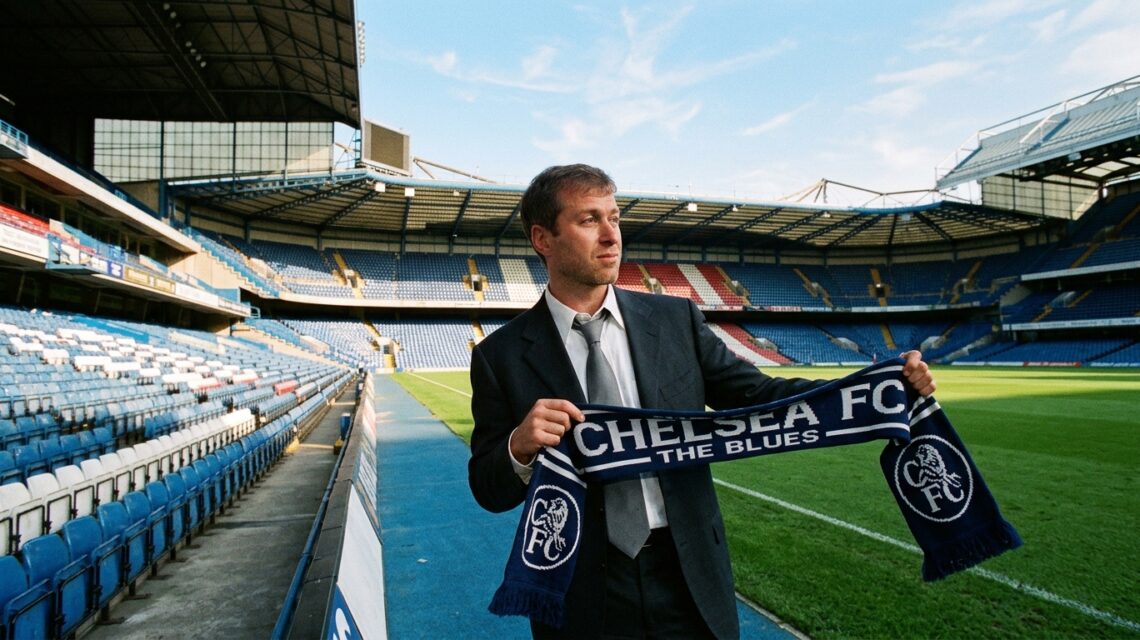
The Russian billionaire took control of a heavily indebted club and transformed it into a title contender. Within a year, Chelsea’s wage bill had reached £115 million and its losses approached £88 million, revealing a new model of football ownership.
By Marcio Tamer
Updated October 31, 2026
On July 1, 2003, Roman Abramovich agreed to buy Chelsea in a transaction valued at approximately £140 million, including around £80 million of existing debt.
The purchase changed the Premier League almost immediately.
During the 2003-04 season, Chelsea committed approximately £175 million to new players, according to financial reporting published after the takeover. The club’s annual wage bill rose to roughly £115 million, about £38 million more than Manchester United’s.
Yet Chelsea recorded a loss of £87.8 million.
That contrast explains why the takeover became one of the defining financial events in modern football.
Abramovich was not simply buying an established business and trying to increase its profits. He was providing private capital to accelerate Chelsea’s sporting development, allowing the club to spend far beyond what its existing football income could support.
The results arrived quickly.
Chelsea finished second in the Premier League in 2003-04. José Mourinho became manager the following summer, and the club won consecutive league titles in 2004-05 and 2005-06.
But the wider financial effects were more complicated than a straightforward explosion in spending across English football.
Deloitte found that, excluding Chelsea, the combined wage bill of the other 19 Premier League clubs actually fell by 1% in 2003-04.
Abramovich had transformed the market, but other clubs initially reacted by limiting their exposure rather than trying to match his spending.
Why Chelsea needed a buyer in 2003
Chelsea were not a minor club before Abramovich arrived.
They had won the FA Cup in 1997 and 2000, the League Cup in 1998 and the UEFA Cup Winners’ Cup in 1998.
Their squad included established international players, and Stamford Bridge was already a major London football venue.
But success had come with considerable financial pressure.
Under chairman Ken Bates, Chelsea had invested in stadium redevelopment, facilities and the playing squad.
The wider Chelsea Village business included hotels and other commercial operations associated with the stadium complex.
The investments contributed to substantial borrowing.
By the summer of 2003, Chelsea’s debts were widely reported at approximately £80 million.
The club had also struggled to produce sustainable profits.
That made the arrival of a wealthy buyer particularly important.
However, the frequently repeated claim that Chelsea were definitely days away from entering administration is stronger than the publicly established evidence.
The financial pressure was serious, and a takeover reduced the risks associated with the club’s debt.
But financial vulnerability should not be confused with a confirmed insolvency filing.
Abramovich acquired a club with significant assets, a valuable London location, a talented squad and a growing international profile.
He also acquired substantial financial obligations.
What Abramovich actually paid for Chelsea
The £140 million purchase price is often misunderstood.
It was not simply a £140 million cash payment to Ken Bates.
Contemporary reporting described approximately £60 million for the acquisition of the club’s parent company, Chelsea Village, together with the assumption of roughly £80 million in debt.
Bates personally received around £17.5 million for his shareholding.
Abramovich initially acquired a controlling stake and moved to secure the remaining shares.
The distinction matters because buying shares and assuming debt are different financial commitments.
The share purchase transferred ownership.
The debt obligations represented liabilities that the new owner needed to address.
The transaction nevertheless gave Abramovich control over one of English football’s most recognizable clubs.
His financial resources were substantially greater than those available to Chelsea’s previous ownership.
That created an immediate opportunity.
Instead of spending several seasons gradually increasing revenue before investing heavily in players, Chelsea could accelerate its development with funding from its owner.
The club’s financial limitations changed almost overnight.
Its sporting ambitions followed.
The summer of 2003 transformed Chelsea’s squad
Chelsea entered the 2003 transfer window with a level of purchasing power that surprised established rivals.
The club signed a succession of international players.
Damien Duff arrived from Blackburn Rovers.
Joe Cole and Glen Johnson joined from West Ham United.
Wayne Bridge moved from Southampton.
Juan Sebastián Verón arrived from Manchester United.
Claude Makélélé joined from Real Madrid.
Hernán Crespo was recruited from Inter Milan.
Adrian Mutu also arrived from Parma.
The signings covered almost every area of the team.
Chelsea were not attempting to solve one tactical problem.
They were rebuilding the squad at exceptional speed.
Makélélé became particularly important.
His defensive midfield role helped provide balance to a team filled with attacking talent.
Duff added pace and creativity.
Cole offered technical ability and versatility.
Crespo and Mutu strengthened the forward line, although neither ultimately became the long-term success Chelsea had hoped for.
The strategy was expensive and imperfect.
Not every signing justified its cost.
But the overall effect was unmistakable.
Chelsea had become a serious competitor for players who might previously have expected to join Manchester United, Arsenal, Real Madrid or another established European power.
Did Chelsea really outspend the other 19 Premier League clubs combined?
Abramovich’s first transfer window generated extraordinary headlines.
Chelsea spent more than £100 million during the summer of 2003, with commonly reported totals above £120 million.
Across the entire 2003-04 financial season, the club’s transfer commitments reached approximately £175 million.
That broader figure includes activity beyond the initial summer window.
The distinction matters because the two amounts are sometimes combined in historical accounts.
It is also important to distinguish gross transfer spending from net spending.
Gross spending measures the total cost of incoming players.
Net spending subtracts money received from player sales.
Chelsea’s net expenditure was exceptionally high because the club was not relying on major departures to finance its acquisitions.
But the claim that Chelsea’s summer spending exceeded the combined expenditure of every other Premier League club requires a consistent comparison of the same transfer window and accounting method.
The stronger, better-supported conclusion is that Chelsea became the dominant individual spender in English football.
Deloitte’s financial analysis confirmed that the club’s spending helped reverse a decline in the English transfer market.
In 2003-04, gross transfer spending by English clubs exceeded £400 million.
Chelsea played a major role in that increase.
The wage bill revealed the real financial revolution
Transfer fees attracted the most attention, but wages were equally important.
A transfer fee is generally accounted for over the length of a player’s contract.
Salaries create recurring obligations.
A club that signs several expensive players must continue paying them even if results deteriorate.
Chelsea’s wage bill increased dramatically after Abramovich’s arrival.
For the 2003-04 financial year, it reached approximately £115 million.
That compared with roughly £54.5 million the previous year.
The increase was more than £60 million in a single season.
Manchester United, then the Premier League’s leading commercial powerhouse, spent approximately £77 million on wages.
Chelsea therefore spent around £38 million more.
The difference was extraordinary because Manchester United generated substantially greater revenue.
According to Deloitte, Manchester United’s turnover was approximately £172 million in 2003-04.
Chelsea’s was approximately £144 million.
Chelsea had a smaller revenue base but a much larger wage bill.
The gap was possible because Abramovich was willing to finance the difference.
That was the central change in the club’s business model.
The other 19 clubs initially reduced their combined wage spending
One of the most surprising findings from the period challenges the idea that Abramovich immediately forced every Premier League club into a spending war.
Deloitte reported that the Premier League’s total wage bill increased by approximately 7% in 2003-04.
That was the lowest annual growth rate recorded since the competition began in 1992.
When Chelsea’s spending was excluded, the combined wage bill of the other 19 clubs actually fell by approximately 1%.
The result was unusual.
Chelsea had increased its wages dramatically.
But its rivals had not collectively followed at the same pace.
Some clubs recognized that matching Abramovich’s resources would be financially dangerous.
Others were already attempting to control costs after years of rapid wage inflation.
The finding reveals a more complicated market response.
Chelsea created a new spending benchmark.
But the rest of the league did not immediately adopt the same model.
The club’s financial advantage was partly the result of other owners deciding that the competition was too expensive to imitate.
That helped Chelsea establish a substantial short-term advantage.
Chelsea lost nearly £88 million in Abramovich’s first full season
The financial consequences became clear when Chelsea published its accounts.
For the 2003-04 season, the club reported a loss of approximately £87.8 million.
It was described at the time as a record loss for a British football club.
The figure demonstrated the scale of the owner’s financial commitment.
Chelsea had increased its revenue.
It had improved its squad.
It had become more competitive.
But the cost of that transformation substantially exceeded the income generated by ordinary football operations.
The following season was even more expensive.
Chelsea reported a loss of approximately £140 million for 2004-05.
The club had won the Premier League under Mourinho, but the sporting success did not immediately produce financial self-sufficiency.
By the end of 2005-06, Chelsea’s cumulative losses during Abramovich’s ownership had reached approximately £308 million.
The losses were not evidence that the club had failed to achieve its owner’s sporting objectives.
They showed that those objectives were being pursued through substantial owner funding.
Chelsea could tolerate financial results that would have created severe problems for clubs without similar backing.
Mourinho turned the spending into Premier League titles
Claudio Ranieri managed Chelsea during Abramovich’s first season.
The club finished second in the Premier League and reached the Champions League semifinals.
Those results demonstrated immediate progress.
But Abramovich wanted more.
In June 2004, Chelsea appointed José Mourinho, who had just won the Champions League with Porto.
The club continued investing.
Didier Drogba joined from Marseille.
Ricardo Carvalho and Paulo Ferreira arrived from Porto.
Arjen Robben joined from PSV Eindhoven.
Petr Čech, whose transfer had been arranged earlier, also became part of the team.
The new signings strengthened a squad that already contained Frank Lampard, John Terry, Makélélé and other established players.
Mourinho created a disciplined defensive structure.
Chelsea conceded only 15 goals during the 2004-05 Premier League season.
They finished with 95 points and won the title.
It was the club’s first English league championship since 1955.
Chelsea retained the title in 2005-06.
The achievement ended the period in which Manchester United and Arsenal had dominated the Premier League title race.
Abramovich’s financial investment had helped create a genuine third force.
But the titles also depended on recruitment, coaching and the development of players already at the club.
Money accelerated the transformation.
It did not eliminate the need for sporting competence.
Chelsea’s spending changed the market for elite players
Abramovich’s arrival altered the bargaining position of clubs and agents.
Before 2003, Manchester United and Arsenal had major advantages in English football.
Their commercial revenues, sporting success and established reputations made them attractive destinations for elite players.
Chelsea’s new wealth challenged that hierarchy.
The club could offer competitive salaries and substantial transfer fees.
It could also move quickly in negotiations.
That increased competition for certain players.
Selling clubs gained another wealthy potential buyer.
Agents gained additional leverage.
Chelsea’s willingness to pay large fees helped establish new expectations in parts of the market.
But it would be inaccurate to attribute every subsequent increase in football transfer prices to Abramovich.
Transfer inflation was already influenced by television revenue, international commercialization, player mobility and the Bosman ruling.
Other wealthy clubs had also spent heavily before 2003.
Real Madrid’s Galácticos strategy, for example, predated Abramovich’s Chelsea takeover.
The distinctive feature of Chelsea’s approach was the scale of private-owner funding relative to the club’s existing revenue.
Abramovich demonstrated that a wealthy individual could rapidly change the competitive position of an established club.
That became an influential model for later investors.
The takeover helped popularize the owner-funded superclub model
Chelsea were not the first football club to benefit from a wealthy owner.
Private investment had influenced professional football for decades.
But Abramovich’s takeover became a particularly visible example of how concentrated wealth could transform a club’s competitive position.
The results were rapid.
Chelsea moved from financial pressure in 2003 to consecutive Premier League titles in 2005 and 2006.
The club also became a regular Champions League contender.
Other investors recognized the potential.
In 2008, the Abu Dhabi United Group acquired Manchester City.
In 2011, Qatar Sports Investments acquired Paris Saint-Germain.
Those transactions involved different ownership structures and political circumstances.
Abramovich was a private billionaire investor.
Manchester City’s later ownership was linked to Abu Dhabi.
Paris Saint-Germain’s ownership was linked to Qatar.
They should not be treated as identical models.
But the common feature was access to substantial capital beyond ordinary club operating revenue.
Chelsea had demonstrated that such funding could accelerate sporting transformation.
The later acquisitions expanded that approach across European football.
Did Abramovich’s Chelsea takeover cause Financial Fair Play?
The emergence of owner-funded clubs became an important part of the debate that preceded UEFA’s Financial Fair Play regulations.
But Chelsea’s takeover was not the sole cause of those rules.
UEFA was concerned about wider financial problems across European football.
These included rising wages, transfer spending, accumulated losses and unpaid debts.
In 2009, UEFA approved the Financial Fair Play concept.
The formal regulations were adopted in May 2010.
The initial framework was introduced gradually, with break-even assessments beginning later.
UEFA’s stated objective was to improve the financial sustainability of European clubs.
The rules sought to limit persistent losses and encourage spending based on football-related revenue.
Chelsea’s spending was relevant to that debate because it illustrated the impact of large owner subsidies.
But other clubs had also accumulated significant debts and losses.
The regulations emerged from a broader concern about the financial health of European football.
There is another important detail.
By 2009, Abramovich was reportedly supportive of financial reforms that would encourage clubs to reduce their dependence on wealthy owners.
Chelsea had already benefited from years of extraordinary investment.
That gave the club an established squad, stronger commercial operations and a larger international profile.
Financial restrictions could therefore affect new challengers differently from clubs that had already completed their initial expansion.
The relationship between owner funding and regulation became one of European football’s central economic debates.
The Abramovich takeover in numbers
| Financial or sporting milestone | Figure |
|---|---|
| Chelsea takeover announced | July 1, 2003 |
| Approximate total transaction value | £140 million |
| Estimated share acquisition component | £60 million |
| Existing debt included in the transaction | Approximately £80 million |
| Chelsea’s 2003-04 transfer commitments | Approximately £175 million |
| Chelsea’s 2003-04 wage bill | Approximately £115 million |
| Manchester United’s 2003-04 wage bill | Approximately £77 million |
| Chelsea’s 2003-04 revenue | Approximately £144 million |
| Manchester United’s 2003-04 revenue | Approximately £172 million |
| Chelsea’s 2003-04 loss | £87.8 million |
| Chelsea’s 2004-05 loss | Approximately £140 million |
| Other 19 Premier League clubs’ combined wage growth in 2003-04 | -1% |
| Chelsea’s first Premier League title under Abramovich | 2004-05 |
| Consecutive Premier League titles | 2004-05 and 2005-06 |
| Chelsea’s first Champions League title | 2012 |
The figures explain why the takeover became a turning point.
Chelsea were generating less revenue than Manchester United.
Yet they were spending substantially more on wages.
They were also absorbing losses on a scale that ordinary football income could not support.
The club’s new competitive advantage came from the owner’s willingness to provide capital.
That changed the relationship between revenue and sporting ambition.
Abramovich’s funding did not make Chelsea immediately profitable
The early Abramovich era is sometimes presented as an investment that quickly paid for itself.
That interpretation confuses sporting success with financial profit.
Chelsea won major trophies.
Its international reputation grew.
Its commercial opportunities expanded.
But the club continued recording large financial losses.
The owner provided funding through loans and capital contributions.
Those arrangements allowed Chelsea to operate despite losses that exceeded the financial capacity of many competitors.
Over time, the club developed stronger sponsorship income and commercial operations.
But the early model depended heavily on Abramovich’s financial support.
The distinction is important because football clubs can be successful on the field while losing money.
A championship does not automatically produce enough revenue to cover expensive transfers and wages.
Chelsea’s experience demonstrated that a wealthy owner could prioritize sporting achievement over short-term profitability.
That approach was transformative.
It was also difficult for other clubs to imitate without comparable financial resources.
The 2022 sale revealed the scale of Abramovich’s investment
Abramovich’s ownership ended in 2022.
Following Russia’s invasion of Ukraine, the United Kingdom imposed sanctions on him.
Chelsea were subsequently sold to a consortium led by Todd Boehly and Clearlake Capital.
The transaction valued the club at approximately £2.5 billion, with additional commitments to investment in the club.
The sale demonstrated how much Chelsea’s commercial and sporting position had changed since 2003.
The club had become a global football brand.
It had won multiple Premier League titles.
It had also won the Champions League in 2012 and 2021.
But the increase in the club’s sale value should not be treated as a straightforward personal profit for Abramovich.
The 2022 transaction occurred under sanctions-related restrictions.
The proceeds were subject to special arrangements and were not freely available to him.
Chelsea’s ownership history therefore cannot be reduced to a simple calculation of purchase price versus sale price.
The sporting transformation was clear.
The financial return to Abramovich was more complicated.
The real legacy was a new relationship between private wealth and sporting success
Before Abramovich arrived, Chelsea were a competitive club with serious financial pressures.
They had a talented squad and a valuable London location.
But they lacked the resources to consistently challenge the Premier League’s strongest teams.
The takeover changed that.
Abramovich provided capital that allowed Chelsea to recruit elite players, pay exceptional wages and tolerate substantial operating losses.
The club became a title contender almost immediately.
Within two seasons, it had won the Premier League.
Within a decade, it had won the Champions League.
The wider consequences were significant.
Chelsea’s spending increased competition for elite players.
It demonstrated the power of private-owner funding.
It influenced how other investors evaluated football clubs.
And it became part of the debate over financial regulation.
But the most revealing statistic is not the £140 million acquisition price or the £175 million spent on players in the first season.
It is the contrast between Chelsea’s finances and those of its competitors.
In 2003-04, Chelsea’s wage bill rose to approximately £115 million.
The combined wage bill of the other 19 Premier League clubs fell by 1%.
That was the clearest evidence of the new financial order.
Chelsea were no longer operating within the same spending constraints as most of their rivals.
Abramovich had introduced a model in which private wealth could rapidly overcome the limitations of a club’s existing revenue.
The transformation changed Chelsea.
It also changed the way football owners, competitors and regulators thought about the economics of winning.
+ Siga o Giro no Facebook
+ Siga o Giro no Instagram
Leia Mais: