
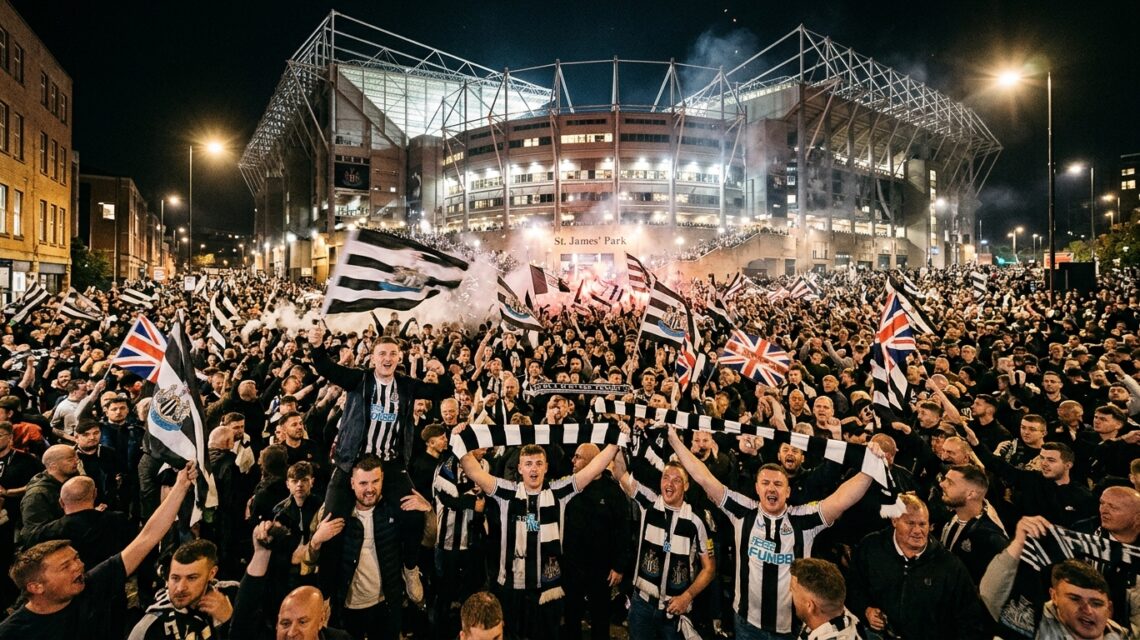
The PIF-led acquisition ended Mike Ashley’s ownership in 2021 after disputes over Saudi state control and television piracy. Five years later, Newcastle have won a trophy and returned to the Champions League, while questions about ownership, financial regulation and the club’s underlying profitability remain.
By Marcio Tamer
Updated November 3, 2026
On October 7, 2021, a consortium led by Saudi Arabia’s Public Investment Fund completed the acquisition of Newcastle United in a deal widely reported at £305 million.
The transaction ended Mike Ashley’s 14-year ownership of the English club and concluded a takeover process that had been stalled for approximately 18 months.
The consortium’s ownership was initially divided between the PIF, with 80%, Amanda Staveley’s PCP Capital Partners, with 10%, and the Reuben family’s RB Sports & Media, with 10%.
But the most important part of the deal was not the purchase price.
It was a legal assurance that allowed the Premier League to approve a transaction involving one of the world’s largest sovereign wealth funds.
The league announced that it had received legally binding assurances that the Kingdom of Saudi Arabia would not control Newcastle United.
Those assurances resolved the ownership dispute for the purposes of the Premier League’s approval process.
They did not eliminate the wider controversy.
In 2023, court documents in the United States described the PIF as an instrumentality of the Saudi state and its governor, Yasir Al-Rumayyan, as a government minister.
The documents prompted renewed questions about the relationship between the fund, the Saudi government and Newcastle.
Meanwhile, the club’s sporting and financial position changed dramatically.
Newcastle qualified for the Champions League in 2023, won the Carabao Cup in 2025 and returned to Europe’s leading club competition for the 2025–26 season.
Revenue reached £335.3 million in the financial year ending June 2025.
The club also reported a £34.7 million profit.
But that result included a £133.2 million accounting gain from the reorganization of property holdings and the corporate structure.
The figure demonstrates why the Newcastle story cannot be explained simply as a wealthy owner buying a football club and making it profitable.
The takeover transformed the institution.
The legal and financial questions surrounding that transformation have proved more complicated.
Why Mike Ashley wanted to sell Newcastle United
Mike Ashley acquired Newcastle United in 2007.
The Sports Direct founder initially received an enthusiastic welcome from some supporters.
But his relationship with the fanbase deteriorated over time.
Supporters criticized the club’s recruitment policies, commercial strategy and perceived lack of ambition.
Newcastle were relegated from the Premier League in 2009.
They returned immediately.
The club was relegated again in 2016 before winning promotion the following season.
Although Newcastle remained a major institution with a passionate fanbase and a large stadium, supporters believed the ownership had failed to develop its potential.
St. James’ Park remained one of English football’s most recognizable grounds.
But the club struggled to establish itself as a consistent challenger for European qualification.
Ashley repeatedly considered selling.
The proposed Saudi-backed acquisition emerged publicly in 2020.
For Newcastle supporters seeking a change of ownership, the consortium appeared to offer a dramatic break from the previous era.
The PIF possessed financial resources far beyond those of a conventional private investor.
But completing the deal required approval from the Premier League.
That proved far more difficult than expected.
The £305 million transaction involved three investors
The takeover consortium was led by the Public Investment Fund.
The PIF is Saudi Arabia’s sovereign wealth fund.
It invests in domestic and international businesses as part of the kingdom’s economic development strategy.
The other initial investors were PCP Capital Partners, associated with Amanda Staveley, and RB Sports & Media, linked to the Reuben family.
The reported ownership structure was straightforward.
| Investor | Initial stake |
|---|---|
| Saudi Public Investment Fund | 80% |
| PCP Capital Partners | 10% |
| RB Sports & Media | 10% |
| Total | 100% |
The transaction was widely valued at approximately £305 million.
The club’s official announcement confirmed that the consortium acquired 100% of Newcastle United Limited and Newcastle United Football Club Limited from St. James Holdings Limited.
It did not publish a detailed breakdown of the consideration paid by each investor.
The £305 million figure is therefore best described as the widely reported transaction value rather than a complete public accounting of the deal’s financial terms.
The acquisition also did not mean that the PIF’s entire asset base became available for Newcastle’s transfer spending.
The fund’s resources and the football club’s permitted expenditure were different matters.
Premier League and UEFA financial regulations continued to apply.
Why the Premier League delayed the takeover
The central legal dispute concerned control.
Under the Premier League’s ownership rules, the league needed to identify which individuals and entities would control Newcastle after the transaction.
That determination mattered because the relevant owners and directors were subject to the league’s suitability assessment.
The PIF was the proposed majority shareholder.
But the fund’s relationship with the Saudi state raised a difficult question.
Could the PIF be treated as a separate investor for the purposes of Newcastle’s ownership?
Or would the Saudi government itself be considered an entity capable of controlling the club?
The distinction was not merely theoretical.
Saudi Crown Prince Mohammed bin Salman chairs the PIF.
The fund is part of the kingdom’s state investment structure.
The Premier League sought clarity about which entities would exercise control over Newcastle.
In September 2020, the league publicly disputed Newcastle’s suggestion that the takeover had already been rejected.
It explained that the disagreement concerned the identification of entities that would control the club.
The league also stated that independent arbitration had been offered as a route to resolving the dispute.
The proposed acquisition remained unresolved.
The original consortium withdrew in July 2020
The takeover process had already become prolonged by the summer of 2020.
In July, the consortium announced that it was withdrawing its bid.
It cited the length of the process and the uncertainty surrounding the transaction.
That appeared to end the proposed sale.
But the underlying disagreements continued.
Newcastle and Mike Ashley’s holding company challenged aspects of the Premier League’s handling of the takeover.
Legal proceedings and arbitration became part of the dispute.
Supporters continued campaigning for the sale to proceed.
The situation remained unresolved for more than a year.
The transaction was eventually revived in October 2021.
The timing coincided with developments involving Saudi Arabia’s restrictions on the Qatari broadcaster beIN Sports and the wider dispute over television piracy.
Those issues had become deeply entangled with the takeover controversy.
The beIN Sports dispute was about more than television subscriptions
One of the most politically sensitive obstacles involved broadcasting rights.
beIN Sports, based in Qatar, held valuable rights to Premier League matches across the Middle East and North Africa.
But Saudi Arabia had blocked the broadcaster’s services during a wider diplomatic dispute with Qatar.
The conflict began in 2017, when Saudi Arabia and several regional allies imposed a blockade on Qatar.
During that period, a pirate broadcaster known as beoutQ distributed sports content without authorization.
The operation became a major source of controversy.
The Premier League and other rights holders accused the piracy network of violating their intellectual property.
A World Trade Organization dispute also examined Saudi Arabia’s response to piracy complaints.
In 2020, a WTO panel found that Saudi Arabia had failed to provide adequate criminal procedures and penalties against certain forms of piracy.
The findings concerned intellectual-property enforcement.
They did not constitute a ruling on whether Newcastle’s takeover should be approved.
But the broadcasting dispute created an obvious commercial conflict.
The Premier League depended on the value of its international media rights.
A major rights holder was simultaneously involved in a dispute concerning the country associated with the proposed Newcastle buyer.
The issue added political and commercial pressure to an already complicated transaction.
The diplomatic thaw helped remove a major obstacle
Saudi Arabia and Qatar began restoring relations in early 2021.
The Al-Ula declaration marked an important step toward ending the regional diplomatic crisis.
But the broadcasting dispute was not immediately resolved.
Saudi Arabia’s restrictions on beIN Sports remained an issue.
In October 2021, reports emerged that the kingdom would lift its ban on the broadcaster.
That development occurred shortly before the Newcastle takeover was approved.
The timing was significant.
It removed an important source of tension between Saudi Arabia, beIN Sports and the Premier League.
However, it would be too simplistic to say that the broadcasting settlement alone caused the takeover to be approved.
The Premier League’s official announcement identified the resolution of the ownership-control dispute and the receipt of legally binding assurances as the decisive basis for its decision.
The piracy dispute was part of the wider geopolitical background.
The legal assurances addressed the league’s formal ownership test.
Both developments helped create the conditions in which the transaction could proceed.
What the Premier League actually approved in October 2021
On October 7, 2021, the Premier League announced that the ownership dispute had been settled.
The league, Newcastle United and St. James Holdings Limited agreed to end their legal disagreement.
The takeover then passed the Owners’ and Directors’ Test.
The league stated that it had received legally binding assurances that Saudi Arabia would not control the club.
That wording was carefully chosen.
The assurance concerned the Kingdom of Saudi Arabia.
It did not state that the PIF was unrelated to the Saudi state in every legal or institutional sense.
The distinction became central to later controversy.
The Premier League had accepted a particular legal framework for determining control.
The public was not given the complete text of the assurances.
That limited outside scrutiny of their precise scope.
The decision nevertheless allowed the acquisition to proceed.
The PIF became Newcastle’s majority shareholder.
Yasir Al-Rumayyan, the fund’s governor, became the club’s non-executive chairman.
Amanda Staveley and the Reuben family also joined the new ownership structure.
The 2023 court documents reopened the state-control debate
In February 2023, documents filed in litigation in the United States created fresh controversy.
The proceedings concerned the PIF’s involvement in LIV Golf and its dispute with the PGA Tour.
The fund argued that it should receive sovereign immunity protections.
In the court documents, the PIF was described as a sovereign instrumentality of Saudi Arabia.
Yasir Al-Rumayyan was described as a sitting minister of the Saudi government.
Those descriptions appeared difficult to reconcile with the public understanding of the assurances that had enabled Newcastle’s takeover.
Human rights organization Amnesty International urged the Premier League to reconsider the approval.
The controversy centered on whether the PIF could be treated as separate from the Saudi state for football ownership purposes while claiming state-related legal protections in another jurisdiction.
But the two legal questions were not identical.
Sovereign immunity concerns the legal status and protections of a state or state-linked entity in litigation.
The Premier League’s ownership test concerned which entities would control a football club.
A sovereign wealth fund can have a state-related legal identity while operating through separate corporate governance arrangements.
The 2023 documents therefore raised serious questions.
They did not automatically prove that the 2021 assurances had been breached.
The Premier League acknowledged the limits of its oversight
In November 2021, Premier League chief executive Richard Masters defended the takeover approval.
He said the league was satisfied with the assurances it had received.
He also indicated that the league could take action if evidence emerged that the Saudi state was controlling Newcastle.
But his comments revealed a practical limitation.
When asked whether the league would necessarily know if the Saudi Crown Prince issued instructions to Newcastle’s directors, Masters acknowledged that it might not.
That admission highlighted the difficulty of monitoring control within complex ownership structures.
A legal assurance can establish obligations.
But enforcing those obligations may require evidence of conduct that is not publicly visible.
In March 2023, Masters was questioned by British lawmakers about whether the Premier League was reconsidering Newcastle’s ownership.
He declined to disclose whether an investigation was underway.
The episode demonstrated that the takeover’s legal settlement had not ended public scrutiny.
The ownership structure remained politically sensitive.
The takeover was also criticized as sportswashing
Human rights organizations criticized the acquisition because of Saudi Arabia’s human rights record.
Amnesty International argued that the kingdom was using major sporting investments to improve its international reputation.
Critics pointed to restrictions on political freedoms, the treatment of dissidents and the killing of journalist Jamal Khashoggi in 2018.
Saudi authorities have rejected allegations that their sporting investments are intended to conceal human rights abuses.
The PIF has presented its investments as part of a broader strategy to diversify the Saudi economy and develop international commercial partnerships.
Newcastle supporters responded in different ways.
Many welcomed the end of Mike Ashley’s ownership and the prospect of substantial investment.
Others expressed concern about the political implications.
The debate illustrated a broader problem facing international sport.
A football club can be both a local community institution and an asset within a sovereign investment strategy.
The interests of supporters, investors, regulators and human rights organizations do not necessarily align.
That tension has remained part of Newcastle’s identity since the takeover.
Eddie Howe changed Newcastle’s sporting direction
The new owners inherited a team struggling near the bottom of the Premier League.
Newcastle had failed to win any of their first seven league matches in the 2021–22 season.
Steve Bruce left the club shortly after the takeover.
Eddie Howe was appointed manager in November 2021.
His immediate task was survival.
Newcastle strengthened the squad during the January 2022 transfer window.
The club signed players including Kieran Trippier, Bruno Guimarães, Dan Burn, Chris Wood and Matt Targett.
The recruitment combined experience with players capable of improving the team’s long-term performance.
Newcastle recovered dramatically.
They finished 11th in the Premier League.
The following season brought a much larger breakthrough.
Howe guided the team to fourth place in 2022–23.
That secured qualification for the Champions League for the first time in two decades.
The improvement was rapid.
But it was not simply the result of purchasing established global superstars.
The club combined targeted recruitment, tactical organization and investment in its wider football operations.
Newcastle’s transfer spending remained subject to financial rules
The PIF’s enormous financial resources created expectations that Newcastle could spend without meaningful limits.
That was never the regulatory reality.
Premier League clubs were subject to Profitability and Sustainability Rules.
The framework restricted losses over a rolling assessment period, subject to permitted adjustments.
The rules were intended to prevent clubs from funding unlimited football expenditure through owner contributions.
UEFA also imposed financial regulations on clubs participating in European competitions.
Those requirements affected Newcastle’s recruitment strategy.
The club could invest heavily.
But it needed to manage transfer fees, wages and accounting costs.
A player purchased for a large fee does not usually create the full accounting expense in the year of acquisition.
Transfer fees are generally amortized over the length of the player’s contract, subject to applicable rules.
That means spending decisions can create costs across multiple seasons.
Newcastle therefore had to consider both immediate cash requirements and future accounting obligations.
The PIF’s wealth did not remove those constraints.
Bruno Guimarães and Alexander Isak became symbols of the new recruitment strategy
Newcastle’s early transfer business focused on players who could improve the team while retaining long-term value.
Bruno Guimarães arrived from Lyon in January 2022.
The Brazilian midfielder became central to Howe’s tactical system.
Alexander Isak joined from Real Sociedad in August 2022.
The Swedish striker developed into one of the Premier League’s most effective forwards.
Sven Botman, signed from Lille, strengthened the defense.
The club also recruited experienced players to improve squad depth.
The approach reflected the need to build a competitive team without relying entirely on expensive short-term signings.
But the strategy involved substantial financial risk.
Large transfer fees increased the club’s amortization expenses.
Higher wages created recurring obligations.
Newcastle needed commercial revenue growth to support those commitments.
The challenge was not simply identifying talented players.
It was creating a financial structure capable of sustaining the squad over several seasons.
The 2025 Carabao Cup ended a 70-year domestic trophy drought
Newcastle’s most significant sporting achievement under the new ownership came in March 2025.
The club defeated Liverpool 2–1 in the Carabao Cup final at Wembley.
Dan Burn and Alexander Isak scored for Newcastle.
The victory delivered the club’s first major domestic trophy since the 1955 FA Cup.
It also ended a long period of frustration for supporters.
Newcastle had reached the Carabao Cup final in 2023 but lost to Manchester United.
The 2025 victory marked a major step in the club’s development.
The team also finished fifth in the Premier League during the 2024–25 season.
That secured qualification for the 2025–26 Champions League.
The results demonstrated that the ownership change had produced tangible sporting progress.
Newcastle had moved from a relegation battle to competing for trophies and European qualification.
But the club’s financial accounts revealed a more complicated picture.
Newcastle’s revenue rose to £335.3 million in 2024–25
In March 2026, Newcastle published its financial results for the year ending June 2025.
Revenue reached £335.3 million.
That represented an increase of approximately £15 million from the previous year.
The club had generated £320.3 million in 2023–24.
Commercial revenue increased by 44%.
The growth reflected improvements in sponsorship, retail operations and other commercial activities.
The club also benefited from investments in its matchday experience.
The St. James’ STACK fan zone and changes to retail operations formed part of the wider commercial strategy.
The increase was notable because Newcastle did not participate in European competition during the 2024–25 accounting period.
That meant the club had to offset the loss of Champions League-related income.
The growth in commercial revenue helped achieve that.
But the reported profit was heavily influenced by a transaction outside ordinary football operations.
The £133.2 million property gain changed the profit calculation
Newcastle reported a profit after tax of £34.7 million for 2024–25.
At first glance, that appeared to demonstrate that the club had become profitable.
But the accounts included a £133.2 million gain on disposal arising from the reorganization of property holdings and the group structure.
The transaction was connected to preparations for future infrastructure investment.
The club stated that the accounting treatment followed the applicable FRS 102 rules.
It also disclosed that the figure would be slightly adjusted in the following financial year after a Premier League fair-market-value process.
The gain was larger than the club’s reported profit.
That distinction is essential.
If the £133.2 million gain is removed from the £34.7 million reported profit, the result becomes approximately £98.5 million in losses.
That is a simplified calculation.
It does not represent an official alternative profit figure because other accounting and tax effects may also need adjustment.
But it demonstrates the scale of the exceptional transaction.
The headline profit did not arise solely from ticket sales, broadcasting, sponsorship and ordinary football operations.
A major non-recurring accounting gain played a decisive role.
The financial transformation in numbers
| Indicator | Figure |
|---|---|
| Takeover completed | October 7, 2021 |
| Reported acquisition value | £305m |
| PIF initial ownership | 80% |
| PCP Capital Partners initial ownership | 10% |
| RB Sports & Media initial ownership | 10% |
| Premier League approval | October 2021 |
| First Champions League qualification under new owners | 2023 |
| Carabao Cup victory | 2025 |
| Newcastle revenue, 2022–23 | £250.3m |
| Newcastle revenue, 2023–24 | £320.3m |
| Newcastle revenue, 2024–25 | £335.3m |
| Commercial revenue growth, 2024–25 | 44% |
| Reported profit after tax, 2024–25 | £34.7m |
| Exceptional property and restructuring gain | £133.2m |
| Simplified result excluding that gain | Approximately £98.5m loss |
| Net assets at June 2025 | £333.0m |
| Average employees, 2024–25 | 614 |
Sources: Newcastle United official financial announcements and statutory accounts filed with Companies House.
The figures show a club that has grown substantially since the takeover.
Revenue increased.
Commercial operations expanded.
The team returned to European competition and won a domestic trophy.
But the accounts also demonstrate that financial sustainability remains a complex challenge.
Newcastle’s ownership structure has changed since 2021
The original consortium’s 80-10-10 ownership split is a historical description of the 2021 transaction.
It should not be presented as the current structure without qualification.
Amanda Staveley and her husband, Mehrdad Ghodoussi, left Newcastle’s ownership group in 2024.
The PIF and Reuben family remained the principal investors.
The club’s current corporate information identifies the ownership group as led by the PIF and RB Sports & Media.
That change matters because the consortium’s structure was central to the original legal and regulatory approval.
Ownership percentages and governance arrangements can evolve after an acquisition.
A historical ownership table does not necessarily describe the current distribution of shares or influence.
The club’s published corporate information and Companies House filings provide the appropriate basis for tracking those changes.
Why Newcastle is not automatically the world’s richest football club
The PIF’s enormous asset base led to widespread claims that Newcastle had become the richest football club in the world.
That description is misleading without qualification.
The PIF manages assets worth hundreds of billions of dollars.
But those assets belong to the sovereign wealth fund.
They are not the same as Newcastle United’s revenue, cash reserves or enterprise value.
A club’s financial strength depends on multiple factors.
Revenue matters.
So do operating costs, debt, cash flow, commercial agreements and financial regulations.
Newcastle’s annual revenue remains substantially below that of Europe’s largest clubs.
Real Madrid, Manchester City, Bayern Munich and other major institutions generate far greater annual income.
The PIF’s wealth gives Newcastle access to a powerful shareholder.
It does not automatically make Newcastle the highest-revenue or most valuable football club.
Nor does it permit unlimited spending.
That distinction is central to understanding the takeover’s financial consequences.
The takeover’s legal and financial legacy remains unsettled
Newcastle’s 2021 acquisition was one of the most politically sensitive ownership transactions in Premier League history.
It involved a sovereign wealth fund, a prolonged regulatory dispute, international broadcasting tensions and public scrutiny of Saudi Arabia’s human rights record.
The Premier League approved the deal after receiving legally binding assurances concerning state control.
Those assurances resolved the immediate ownership dispute.
But later U.S. court filings demonstrated that the relationship between the PIF and the Saudi state could be described differently in other legal contexts.
The club’s financial development has followed a similarly complicated path.
Revenue has increased substantially.
The team has returned to the Champions League.
It has won a major domestic trophy.
But the latest reported profit depended heavily on a £133.2 million accounting gain.
The most important question is therefore no longer whether the PIF had enough money to buy Newcastle.
The fund clearly did.
The harder questions concern how the club is governed, how financial regulations shape its investment strategy and whether its growing commercial business can support sustained success without exceptional transactions.
Five years after the £305 million takeover, Newcastle United is a transformed football institution.
The legal assurances that enabled the sale and the financial rules that constrain its spending remain central to understanding what that transformation means.
+ Siga o Giro no Facebook
+ Siga o Giro no Instagram
Leia Mais: