

The PIF’s 2024 partnerships put Saudi branding on both men’s and women’s world rankings. But Riyadh’s $15 million-plus WTA Finals deal ended early, while a separate agreement gave Saudi Arabia something more valuable: a future place among the ATP’s biggest tournaments.
By Marcio Tamer
Updated November 6, 2026
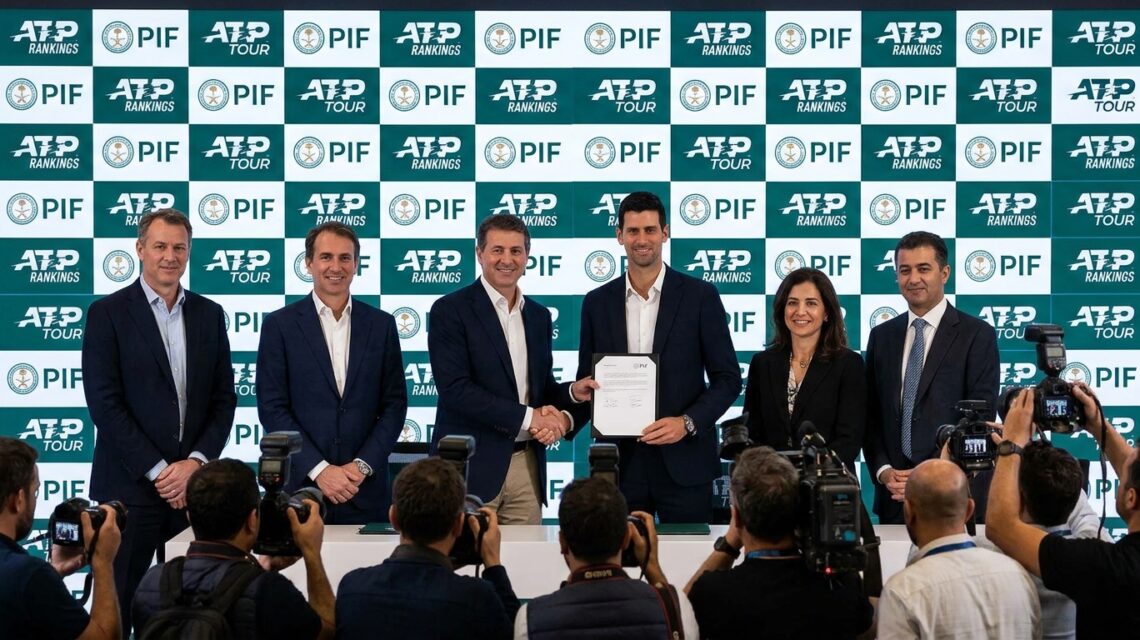
In February 2024, Saudi Arabia’s Public Investment Fund secured one of the most visible sponsorship positions in professional tennis: its name would appear on the official ATP world rankings.
Three months later, the fund signed a comparable agreement with the Women’s Tennis Association.
The partnerships placed the Saudi sovereign wealth fund alongside the world’s leading players throughout the season, not merely during tournaments held in Saudi Arabia.
The PIF also became associated with major events in Indian Wells, Miami, Madrid and Beijing.
Riyadh separately secured the WTA Finals for 2024 through 2026, promising record prize money and giving Saudi Arabia a prominent position in women’s professional sport.
But the arrangement changed before the original hosting term expired.
In July 2026, the WTA announced that the season-ending championship would leave Riyadh after just two editions. The 2026 tournament was moved to Indian Wells, California, and Charlotte subsequently secured the Finals from 2027 through 2029.
Meanwhile, Saudi Arabia was preparing for a different expansion.
In October 2025, the ATP announced an agreement with PIF-owned SURJ Sports Investment to establish a tenth Masters 1000 tournament in the kingdom, potentially beginning in 2028.
The contrast reveals how Saudi Arabia’s tennis strategy evolved.
The country initially purchased visibility through sponsorships and hosting agreements. It then secured a route into the permanent structure of the men’s elite tournament calendar.
Yet its experience with the WTA Finals demonstrated that substantial financial commitments do not guarantee long-term control of an event.
What did the PIF actually buy from the ATP and WTA?
The ATP announced its partnership with the Public Investment Fund on February 28, 2024.
The agreement made the PIF the official naming partner of the men’s rankings and a commercial partner of several leading tournaments.
The WTA announced its corresponding partnership on May 20.
That agreement made the fund the first naming partner of the women’s rankings.
The resulting names, PIF ATP Rankings and PIF WTA Rankings, placed Saudi branding on one of the sport’s most frequently referenced products.
Rankings appear in tournament coverage, player profiles, qualification discussions and year-end awards.
For a sponsor, that visibility extends far beyond advertising at individual events.
But naming rights do not mean ownership.
The ATP and WTA retained responsibility for their respective ranking systems and competition structures. The PIF did not acquire the authority to award ranking points, determine player positions or govern the Grand Slam tournaments.
The commercial terms of the sponsorship agreements were not publicly disclosed.
Consequently, claims that the fund paid a specific multibillion-dollar amount for the ATP and WTA partnerships are not supported by the available contracts or official announcements.
Why ranking sponsorship was an unusually powerful commercial move
Traditional tennis sponsorships are often tied to individual tournaments.
A company may sponsor a stadium, a court, a scoreboard or a particular event.
Those arrangements provide visibility during a defined period.
The rankings are different.
They form part of the sport’s continuous narrative.
Every week, players move up or down based on their results. Rankings influence tournament entry, seeding and qualification for major competitions.
By attaching its name to both ranking systems, the PIF gained recurring exposure across the men’s and women’s professional tours.
The arrangement also allowed the fund to associate its brand with the sport’s leading athletes without negotiating individual endorsement agreements with every player.
That was commercially efficient.
But the distinction between sponsorship and governance remains essential. A player’s ranking position is determined by the applicable sporting rules, not by the ranking sponsor.
How Saudi Arabia extended its presence across major tournaments
The ATP partnership included sponsorship activity at Indian Wells, Miami, Madrid, Beijing and the ATP Finals, as well as the Next Gen ATP Finals in Jeddah.
The WTA agreement expanded the fund’s association with leading women’s events, including combined tournaments that host both men’s and women’s competitions.
This approach gave the PIF a presence in several of tennis’s most important markets.
Indian Wells and Miami are major American events. Madrid is a prominent European tournament, while Beijing provides exposure in Asia.
The strategy therefore extended well beyond bringing players to Saudi Arabia.
It positioned the fund within existing tournaments that already attracted global audiences.
The sponsorships were also connected to initiatives promoting young-player development and participation.
The ATP cited its Baseline program, which provides financial support to eligible lower-ranked players, among the initiatives associated with the wider partnership.
The public announcements did not establish that PIF sponsorship alone funded the entire program or solved the economic difficulties faced by lower-ranked professionals.
Riyadh’s WTA Finals deal promised record prize money
On April 4, 2024, the WTA announced that Riyadh would host its season-ending Finals for three years.
The agreement was reached with the Saudi Tennis Federation.
That distinction matters because the hosting contract was separate from the PIF’s rankings sponsorship, even though Saudi organizations were involved in both.
The WTA Finals feature the season’s leading eight singles players and eight doubles teams.
The event is one of the most prestigious competitions outside the four Grand Slams.
Riyadh’s financial offer was substantial.
The WTA announced a $15.25 million prize pool for 2024, compared with approximately $9 million in 2023.
That represented an increase of roughly 69% in a single year.
The agreement also provided for further increases in 2025 and 2026.
For the WTA, the deal offered an opportunity to raise player compensation and develop the commercial profile of its flagship event.
For Saudi Arabia, it delivered an internationally recognized women’s sporting championship.
The prize money produced two historic paydays
The financial impact was particularly visible in the singles champions’ earnings.
Coco Gauff won the 2024 WTA Finals in Riyadh, defeating Zheng Qinwen in the final.
She earned approximately $4.81 million, a record payout for a women’s tennis tournament at the time.
In 2025, Elena Rybakina won the event without losing a match.
Her total earnings reached approximately $5.24 million, according to contemporary tournament records, establishing another benchmark.
The WTA later described her payout as approximately $5.5 million in its 2026 promotional material, so figures should be attributed to the relevant published prize-money accounting rather than treated as interchangeable.
These were extraordinary individual payments.
But the tournament’s total prize pool should not be confused with the champion’s earnings.
The full allocation covered singles and doubles competitors, including participation and performance-related payments.
Nor did the increased prize money establish that the event was profitable for its organizers.
A host can fund exceptionally large purses as part of a broader tourism or promotional strategy without recovering the entire expenditure through ticket sales and broadcasting revenue.
Why the WTA Finals left Saudi Arabia before the contract expired
The original agreement covered 2024, 2025 and 2026.
But on July 1, 2026, the WTA announced that the final edition would not take place in Riyadh.
The WTA said it had requested a change of venue and that the Saudi Tennis Federation had accepted the proposal.
The parties mutually agreed to end the hosting arrangement.
The 2026 WTA Finals were moved to the Indian Wells Tennis Garden in California, scheduled for November 8–15.
That decision was significant because it reversed one of Saudi Arabia’s most prominent tennis commitments.
The WTA did not publicly provide a complete financial explanation for the early departure.
It would therefore be inaccurate to attribute the move solely to political opposition, poor ticket sales or a particular financial dispute.
The confirmed outcome is narrower: both organizations agreed to end the hosting arrangement one year earlier than originally planned.
The PIF’s separate WTA rankings sponsorship did not automatically end with the Riyadh hosting deal.
The WTA chose Charlotte for 2027–2029
The next development came on September 16, 2026.
The WTA announced that Charlotte, North Carolina, would host the Finals for three years beginning in 2027.
The event will take place at Spectrum Center, with additional activities planned nearby.
The arrangement marked a different approach to tournament management.
WTA chair Valerie Camillo said the organization intended to exercise greater control over event operations, revenue and expenses.
The move followed financial concerns surrounding the WTA’s transition away from Riyadh.
Reuters reported that internal projections cited by another publication had raised questions about potential operating losses and cash-flow pressure.
Camillo described 2026 as a transitional year and said the WTA had a path toward more sustainable financial performance beginning in 2027.
Those projections were not equivalent to audited financial results.
They nevertheless highlighted a central trade-off.
Riyadh’s hosting arrangement offered unusually large prize money, but replacing that arrangement required the WTA to reassess how its premier event would be financed.
Saudi Arabia secured something bigger on the men’s tour
While the WTA Finals were preparing to leave Riyadh, the ATP was pursuing a major expansion involving Saudi capital.
On October 23, 2025, the ATP and SURJ Sports Investment, a PIF-owned company, announced plans for a new Masters 1000 tournament in Saudi Arabia.
The event could begin as early as 2028.
It would become the tenth ATP Masters 1000 tournament, joining the nine existing events.
That was a major structural development.
The Masters 1000 category sits immediately below the Grand Slams in the men’s annual tournament hierarchy, alongside the season-ending ATP Finals as one of the sport’s most commercially significant levels.
The new event would be the first expansion of the Masters 1000 category since its introduction in 1990.
Unlike a sponsorship arrangement, the agreement involved creating an additional top-tier tournament.
The ATP also announced that the new event would join the existing Masters 1000 tournaments and the ATP as a shareholder in ATP Media, the tour’s international broadcasting and media business.
That provided a more direct connection to the commercial infrastructure of men’s professional tennis.
Why a Masters 1000 tournament matters more than an exhibition
A Masters 1000 tournament is part of the official ATP Tour.
Players compete for ranking points, prize money and titles that contribute to their professional records.
Its results influence rankings and qualification for other events.
An exhibition operates differently.
It may feature famous players and substantial payments, but its results do not count toward official ATP rankings.
That distinction makes the proposed Saudi Masters tournament strategically important.
It would place Saudi Arabia within the official competitive calendar rather than relying solely on special events or sponsorships.
The tournament could also create long-term opportunities involving broadcasting, hospitality, tourism and commercial partnerships.
However, its launch was announced as beginning as early as 2028, not as an event already held.
The final commercial outcome will depend on implementation, scheduling and the tournament’s ability to attract players and audiences.
The Six Kings Slam demonstrated Saudi Arabia’s spending power
Saudi Arabia also entered tennis through high-profile exhibitions.
The Six Kings Slam debuted in Riyadh in October 2024.
Its inaugural field included Novak Djokovic, Rafael Nadal, Carlos Alcaraz and Jannik Sinner.
Each participant was guaranteed $1.5 million.
The champion received an additional $4.5 million, bringing the winner’s total to $6 million.
Sinner won the 2024 edition.
He returned in 2025 and defeated Alcaraz again, earning another $6 million.
The figures exceeded the winner’s prize at any individual Grand Slam tournament at that time.
For comparison, the 2025 US Open singles champions received $5 million each.
But the Six Kings Slam was not an ATP-sanctioned ranking event.
Its payments should not be included in official ATP prize-money statistics as though they were regular tour winnings.
The exhibition demonstrated Saudi Arabia’s ability to attract leading players through guaranteed compensation.
It did not establish a new Grand Slam or Masters tournament.
The sponsorships and exhibitions served different purposes
Saudi Arabia’s tennis strategy operated through several distinct channels.
The PIF’s ATP and WTA partnerships provided worldwide brand exposure.
The Riyadh WTA Finals agreement brought an established elite competition to the kingdom.
The Six Kings Slam attracted famous players through unusually large exhibition payments.
The proposed Masters 1000 tournament would integrate Saudi Arabia into the official men’s calendar.
Each mechanism offered a different form of influence.
Sponsorship provided visibility.
Hosting created opportunities for tourism and international events.
Exhibitions delivered attention without the constraints of a regular tour tournament.
A Masters 1000 license would provide a more enduring competitive position.
Treating all these arrangements as one transaction obscures the way the strategy developed.
It also risks exaggerating the fund’s control over professional tennis.
The financial terms remain largely undisclosed
Despite the prominence of Saudi investment, the exact value of the ATP and WTA sponsorship contracts has not been made public.
The PIF and the tours announced multiyear partnerships but did not disclose comprehensive payment schedules.
The WTA confirmed the Riyadh Finals prize pool, but that is not the same as the total hosting fee.
Similarly, the Six Kings Slam’s player payments do not reveal the event’s full operating costs or commercial returns.
The proposed Masters 1000 agreement includes a major new tournament and participation in ATP Media, but the publicly available announcements do not provide a complete valuation of the transaction.
As a result, there is no reliable basis for adding these commitments together and presenting a precise multibillion-dollar total for Saudi Arabia’s tennis investments.
The scale of the strategy is clear.
Its exact financial cost is not.
Why the deals generated political controversy
Saudi Arabia’s expansion into international sport has attracted criticism from human-rights organizations.
Critics argue that major sporting investments can improve the kingdom’s international image while drawing attention away from restrictions on political expression and concerns about women’s rights and LGBTQ rights.
The term sportswashing is often used to describe that concern.
Saudi officials reject the characterization and present their investments as part of a wider economic diversification and sports-development strategy.
The WTA’s decision to stage its Finals in Riyadh prompted particular debate.
Former champions Chris Evert and Martina Navratilova publicly opposed the arrangement, citing human-rights concerns.
Other figures, including Billie Jean King, argued that engagement could help create opportunities for women and girls.
Those positions reflect a genuine disagreement about the consequences of international sporting partnerships.
The commercial benefits of hosting an event do not resolve the underlying human-rights questions.
Equally, the existence of political controversy does not by itself establish that a particular sponsorship or hosting agreement violated sporting regulations.
Both dimensions need to be assessed separately.
What the PIF agreements changed, and what they did not
| Arrangement | Confirmed development | What it does not mean |
|---|---|---|
| ATP partnership | Announced February 28, 2024 | PIF did not purchase the ATP |
| WTA partnership | Announced May 20, 2024 | PIF did not acquire control of women’s rankings |
| Ranking naming rights | PIF branding on ATP and WTA rankings | Sponsor does not determine ranking points |
| Major tournament sponsorships | Indian Wells, Miami, Madrid and Beijing among partnered events | PIF does not own all those tournaments |
| Riyadh WTA Finals | Hosted in 2024 and 2025 | Original 2024–2026 hosting term was not completed |
| 2024 WTA Finals prize pool | $15.25 million | Not a single player’s payout |
| Six Kings Slam | $6 million total for the winner | Exhibition results earn no ATP ranking points |
| Saudi Masters 1000 | Announced in October 2025 | Event has not yet debuted |
| Targeted Masters launch | As early as 2028 | Start date remains dependent on implementation |
The table illustrates why the distinction between commercial rights and sporting authority matters.
Saudi Arabia gained significant visibility and hosting opportunities.
It also secured a route into the ATP’s top tournament category.
But the ATP, WTA and Grand Slam organizers remained separate institutions with their own responsibilities.
The next test comes after Riyadh’s WTA exit
As of November 6, 2026, the WTA Finals are about to begin in Indian Wells.
The event is scheduled for November 8–15.
Charlotte will take over from 2027 through 2029.
Saudi Arabia’s most prominent women’s tournament hosting agreement has therefore ended, although its wider commercial relationship with the WTA remains a separate matter.
On the men’s side, attention is shifting toward the proposed Masters 1000 tournament.
The ATP has announced that the event could begin in 2028.
That project will test whether Saudi investment can establish a durable position within the official calendar.
It will also raise practical questions about scheduling, player workload and the commercial relationship between existing tournaments and a new Masters event.
The original 2024 sponsorship agreements placed Saudi Arabia’s name on the rankings.
The 2025 Masters announcement went further by offering the kingdom a future tournament within the sport’s established competitive hierarchy.
The early end of the Riyadh WTA Finals shows that not every Saudi-backed initiative will remain in place.
The proposed Masters tournament shows that the country’s influence is still evolving.
The central question is no longer simply how much Saudi Arabia is willing to spend on tennis.
It is which parts of that investment will become lasting features of the sport.
+ Siga o Giro no Facebook
+ Siga o Giro no Instagram
Leia Mais: