
By Marcio Tamer
Updated November 24, 2026
Ask any bareboat charter skipper what causes the highest heart rate of a sailing vacation, and the answer is rarely a squall at sea. It is backing a 44-foot yacht into a narrow, crosswind slip while onlookers watch from the dock.
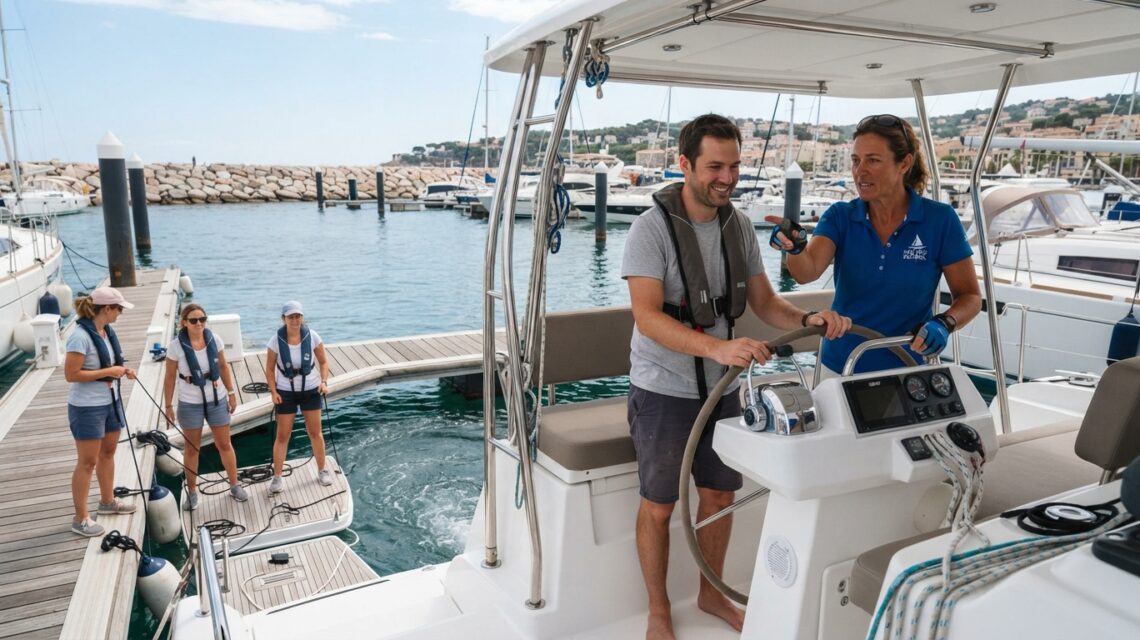
The American Sailing Association’s ASA 118 Docking Endorsement is designed to bridge that confidence gap through concentrated practice in close-quarters maneuvering. Because schools offer docking training on different vessel types, including monohulls and catamarans, choosing the right platform can determine how directly the skills transfer to your next charter.
Single-screw monohull vs. twin-engine catamaran docking
| Feature | Single-screw monohull | Twin-engine cruising catamaran |
|---|---|---|
| Propulsion | One propeller and usually one rudder | Two widely separated engines and propellers |
| Primary turning control | Rudder, prop wash, momentum and propeller effects | Differential engine power, gear selection and rudders |
| Reverse behavior | Prop walk may move the stern sideways; reverse steering response varies | Independent reverse and forward thrust can help rotate the boat |
| Wind sensitivity | Depends on hull, keel, rig, freeboard and conditions | Often substantial windage from beam and cabin structure |
| Docking challenge | Managing prop walk, momentum and limited steering authority at low speed | Coordinating engines, judging wide beam and managing wind drift |
| Spring-line techniques | Pivoting, stopping and maneuvering with bow and stern springs | Controlling movement, holding position and managing stern-to approaches |
| Training focus | Prop walk, prop wash, rudder authority, reverse control and line-assisted maneuvering | Differential thrust, engine coordination, windage and catamaran docking geometry |
| Best suited for | Monohull owners, coastal cruisers and monohull charter skippers | Cruising-cat owners and sailors preparing for catamaran charters |
The core docking principles are shared, but the way each boat responds to throttle, reverse, rudder, wind and lines can be very different. Learning those differences is the point of choosing your training platform carefully.
Mastering the single-screw monohull
A single-engine keelboat does not steer like a car, particularly when moving astern. The skipper must understand how the propeller, rudder, hull, momentum and environmental forces interact before attempting to force the boat into a slip.
Prop walk becomes a tool rather than a surprise. When a propeller rotates in reverse, its transverse thrust can push the stern toward one side. The direction and strength of this effect depend on propeller rotation, hull geometry, shaft angle and boat configuration. Rather than treating prop walk as an obstacle, instructors teach students to anticipate it and use it when planning an approach or departure.
Rudder authority depends on water flow. At very low speeds, the rudder may have limited effectiveness. A brief application of forward power can direct prop wash across the rudder, creating steering response before the boat builds significant forward momentum. The timing and throttle input matter because too much power can turn a controlled maneuver into an unwanted acceleration.
Spring lines can move a boat when the engine cannot. Docking clinics teach students how to use bow and stern spring lines to control movement, pivot around a secured point and reposition a vessel when space is limited. Proper line placement, cleat selection and crew coordination can make the difference between a controlled maneuver and an uncomfortable struggle against wind or dock geometry.
These skills are particularly valuable on conventional cruising monohulls, where the skipper may not have the immediate rotational control available from twin engines.
Mastering the twin-engine catamaran
Stepping aboard a twin-engine catamaran introduces a different set of advantages and challenges. Instead of relying primarily on rudder response and propeller behavior, the skipper can use the separation between the two engines to create turning forces.
Differential thrust changes the way the boat rotates. Applying forward power to one engine and reverse power to the other can help turn the catamaran within a confined area. The distance between the propellers creates leverage, allowing the skipper to rotate the vessel without relying exclusively on forward movement and rudder angle.
However, this is not a universal tank-steering formula. Engine response, propeller configuration, rudder position, wind, current and hull design all influence the maneuver. Some situations still require rudder input, and the best control technique depends on the specific vessel.
Windage is a major consideration. Cruising catamarans often have wide beams, large cabin structures and significant exposed surface area above the water. That area can act like a sail when the boat is moving slowly or sitting in neutral, allowing wind to push the vessel away from the intended path.
Students learn to assess wind direction, plan approaches, manage momentum, coordinate crew and avoid committing to a maneuver that cannot be completed safely. In a stern-to marina, the boat’s width and the available turning space can be just as important as engine power.
Med-mooring requires planning rather than brute force. Backing toward a dock while preparing to secure the bow to anchors or mooring lines requires crew communication, controlled speed and an understanding of the available space. Catamarans can offer excellent maneuverability with twin engines, but their beam, windage and stern configuration introduce challenges that cannot be solved simply by pulling both throttles in opposite directions.
Which ASA 118 platform should you book?
Choose the monohull if:
- You own or plan to charter single-engine sailing yachts.
- You want to understand prop walk, rudder authority and prop wash in greater detail.
- You regularly sail club keelboats, coastal cruisers or conventional monohulls.
- You want to develop confidence with spring lines, reversing and momentum management.
- Your next bareboat charter will be a cruising catamaran.
- You expect to maneuver a 40- to 48-foot twin-engine yacht in crowded marinas.
- You want practical experience with differential thrust and twin-engine control.
- Your sailing plans include stern-to docking, Mediterranean mooring and managing a wide vessel in crosswinds.
If you are unsure what type of boat you will sail in the future, monohull training is a useful foundation. However, it should not be considered a substitute for hands-on practice on a twin-engine catamaran before chartering one for the first time.
ASA 118 prerequisites, duration and cost
The official ASA 118 standards list no formal certification prerequisites. The course covers docking and maneuvering fundamentals, boat forces, engine and steering controls, prop walk, prop wash, rudder authority, spring lines, wind and current, safety and maneuvering differences between monohulls and twin-screw catamarans.
That does not mean every school accepts complete beginners with no practical experience. Some instructors expect previous experience handling an auxiliary-powered sailboat, and schools may require ASA 103 or equivalent skills. ASA 103 is commonly recommended as a foundation, but local school requirements can differ.
Training duration also varies. Some schools offer a one-day clinic, while others use two or three days to provide more repetitions, additional boat types or more extensive practical training.
A verified example from Swain Sailing lists a one-day ASA 118 course from 10 a.m. to 4 p.m., with tuition of $450 per person on a monohull and $550 on a catamaran, including the text and certification fee. This is a specific school’s pricing, not a national average.
Before booking, ask which boat you will use, how many students will be aboard, how much time each student spends at the helm and whether the course includes stern-to docking and catamaran-specific exercises if those skills are your priority.
The most important thing to verify before paying
Confirm that the school is actually teaching ASA 118 on the boat you want to learn to handle. A course advertised as a docking endorsement may use different vessel sizes, propulsion systems and teaching formats.
If you are preparing for a catamaran charter, ask whether the training boat has twin inboard engines with saildrives or shaft drives, how the instructor teaches differential thrust and whether you will practice maneuvering in realistic marina conditions.
For monohull sailors, ask about propeller configuration, reverse behavior, spring-line exercises, backing practice and controlled turns in confined spaces.
The endorsement provides a foundation, but the vessel you train on determines which handling habits you develop most directly. For a first charter, practicing on the same general type of boat you intend to skipper is usually the most useful way to turn classroom knowledge into confidence at the dock.
Final decision
ASA 118 on a single-screw monohull is the logical choice for sailors who want to understand conventional propulsion behavior, prop walk, rudder control and spring-line maneuvering. A twin-engine catamaran course is the better match for skippers preparing to charter multihulls and who need to practice differential thrust, wide-beam maneuvering and catamaran-specific docking situations.
Neither platform is universally harder. The right choice depends on the boat you intend to sail, the conditions you expect to encounter and the skills you still need to develop before your next charter.
+ Siga o Giro no Facebook
+ Siga o Giro no Instagram
Leia Mais: