

One-handed and two-handed backhands use different movement patterns, but research does not establish a universal injury advantage or a fixed timeline for changing strokes. For adult players, the real test is whether a new technique survives unpredictable rallies and match pressure.
By Marcio Tamer
Updated November 21, 2026
Adult tennis players considering a switch from a one-handed to a two-handed backhand have a new reason to question the conventional advice. A study published in March 2026 found that backhand technique was not independently associated with elbow or lower-back symptoms among the players examined.
That finding complicates the familiar argument that changing to two hands is automatically the safer option. It also raises a practical question for adults booking intensive tennis camps: should they spend three days rebuilding a stroke they have used for years, or improve its existing mechanics?
The answer depends on the problem being solved. A short clinic can help a player discover a better grip, contact position or preparation pattern. Replacing an established backhand requires a broader training process, particularly when the goal is to use the new technique reliably during competitive matches.
One-handed vs. two-handed backhand: What actually changes?
A 2015 scientific review examined 61 studies directly relevant to backhand mechanics and identified meaningful differences in how the two strokes generate racket speed.
Two-handed backhands rely more heavily on trunk rotation and coordination between both arms. One-handed backhands depend more on the movement of individual upper-limb segments, making their timing and spacing demands different.
| Coaching factor | One-handed backhand | Two-handed backhand |
|---|---|---|
| Common grip arrangement | Eastern backhand for topspin | Continental or related dominant-hand grip, with supporting top hand |
| Contact position | Generally farther in front | Generally closer to the body |
| Power generation | Greater contribution from upper-limb movement | Greater contribution from trunk rotation |
| High bouncing balls | Often requires more precise spacing and adjustment | Two-handed support can help manage high contact |
| Wide defensive balls | Greater reach with one hand | Players often release the top hand to defend or slice |
| Return of serve | Compact block or slice is useful | Compact two-handed returns are common |
| Main coaching challenge | Early preparation and contact spacing | Coordinating trunk rotation and both arms |
These are tendencies, not absolute rules. Individual technique, grip, strength, mobility and experience influence how each player performs.
A two-handed backhand does not guarantee a better return of serve, just as a one-handed backhand does not automatically produce superior slice or greater tactical variety.
Why a three-day camp cannot guarantee a successful backhand switch
Changing backhand styles involves more than adding or removing a hand from the racket. The player must adapt preparation, footwork, contact location, rotation and the timing of acceleration through the ball.
A three-day camp can introduce those changes and provide immediate technical feedback. However, performing a stroke successfully during predictable feeding drills is different from reproducing it against an opponent who varies speed, spin, depth and direction.
A review published in the Journal of Science and Medicine in Sport warns that excessive reliance on repetitive hitting without realistic playing situations may limit learning. The researchers emphasize the value of variable practice and feedback that helps players develop their own movement solutions.
This challenges the idea that a fixed number of ball-machine repetitions is enough to establish a reliable new stroke.
Neither a universal 1,000-repetition requirement nor a guaranteed six-to-eight-week transition period is supported by the research reviewed. Some adults may adapt quickly in controlled drills but need considerably longer before trusting the stroke in competition.
How coaches rebuild a one-handed backhand into a two-hander
The first challenge for a former one-handed player is learning to coordinate the non-dominant arm rather than simply placing a second hand on the handle.
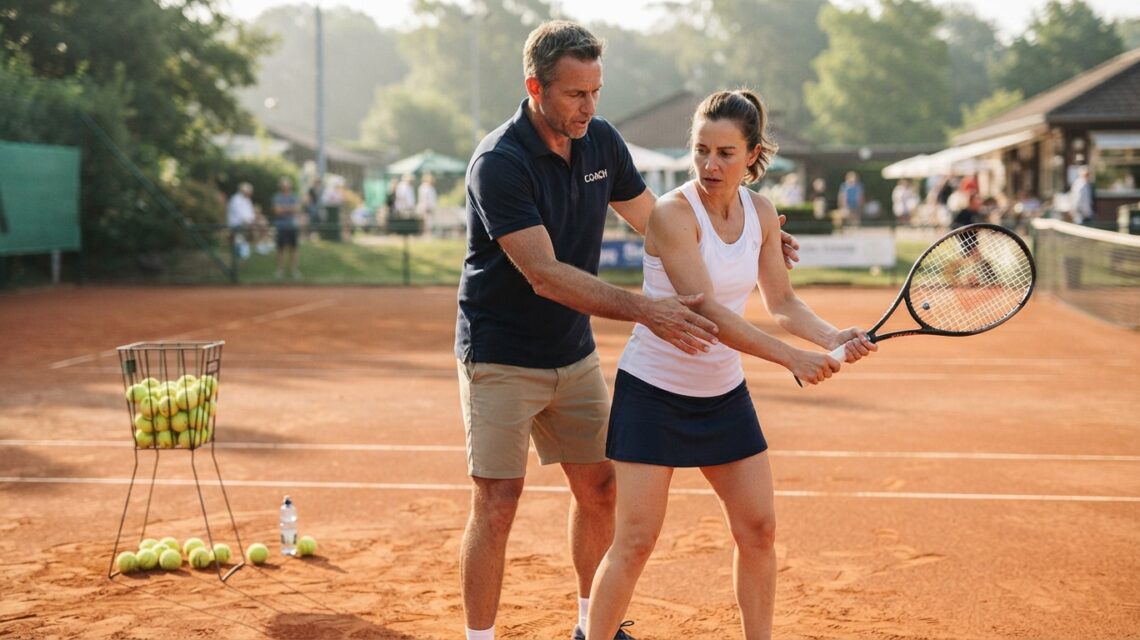
For a right-handed player, a coach may use left-handed forehand drills to help develop the supporting arm’s role. Short-court rallies, drop feeds and controlled crosscourt hitting then introduce the movement pattern with manageable timing demands.
Spacing also changes. A player accustomed to extending the hitting arm well in front of the body may stand too far from the ball when attempting a two-handed stroke.
Coaches can use video analysis to identify whether the player is reaching excessively, making contact too late or rotating the trunk inefficiently. These observations are more useful than prescribing a universal contact-point difference measured in inches.
Once the basic movement becomes repeatable, the player should progress to variable feeds, moving rallies and return-of-serve drills. Keeping a functional one-handed slice provides an additional defensive option rather than forcing every backhand into the new two-handed pattern.
What changes when switching from two hands to one?
Moving from a two-handed to a one-handed topspin backhand requires a different coordination pattern and often places greater demands on early preparation and contact positioning.
Coaches commonly begin by establishing an appropriate grip, using a clear shoulder turn and positioning the player to meet the ball in front of the body. Controlled feeds help the player understand how to accelerate the racket without relying on the supporting hand through contact.
The non-dominant arm still plays an important role during preparation and balance. Removing it from the handle does not mean eliminating its contribution to the stroke.
The transition becomes more demanding when balls arrive high, deep or unexpectedly fast. For that reason, coaches should introduce movement and variable feeds before judging whether the technique is suitable for the player.
There is no reliable evidence that adults must already possess a strong slice backhand before learning a one-handed topspin stroke. Slice proficiency can nevertheless provide a useful foundation for racket control and defensive play.
Does switching to two hands reduce tennis elbow?
A March 2026 cross-sectional study examined the relationship between backhand technique, dominant-arm elbow pain and lower-back pain.
Among participants reporting elbow symptoms, 64.7% described pain around the lateral epicondyle, the region commonly associated with tennis elbow. However, the researchers found that backhand technique was not independently associated with elbow or lower-back symptoms.
This does not prove that stroke mechanics are irrelevant. Earlier sports medicine research has identified technical factors and loading patterns that may contribute to elbow problems, particularly in recreational players using a one-handed backhand.
The distinction is that a player’s injury risk cannot be reduced to the number of hands on the racket.
Training volume, previous injuries, physical conditioning, technique and equipment may all influence symptoms. Players experiencing persistent elbow, wrist or shoulder pain should seek assessment from an appropriately qualified healthcare professional rather than assume that changing backhands will resolve the problem.
Which adult tennis clinic should you book?
The best clinic depends on whether the player wants to improve an existing stroke or develop an entirely new movement pattern.
| Player’s goal | Suitable training format | Main priority |
|---|---|---|
| Fix inconsistent contact | Technical private or small-group clinic | Video assessment, preparation and spacing |
| Improve backhand returns | Return-of-serve clinic | Compact preparation and variable serve speeds |
| Test a different backhand style | Technical clinic with individualized coaching | Grip, movement coordination and controlled feeds |
| Make a new stroke reliable | Ongoing coaching plus supervised match play | Variable practice and competitive transfer |
| Address pain during backhands | Medical assessment before intensive training | Identify and manage the cause of symptoms |
A technical clinic should not consist exclusively of repetitive basket feeds. Controlled repetition is useful for introducing unfamiliar movements, but players also need progressively less predictable situations.
A 2015 study of tennis anticipation training found that random practice improved certain retention and transfer measures compared with blocked practice. Although that experiment concerned anticipation rather than backhand reconstruction, it reinforces the importance of testing skills beyond the exact conditions in which they were learned.
For adults with an upcoming league match, improving the current stroke may be more practical than immediately replacing it. An off-season period provides greater flexibility to experiment without needing the new technique to perform under competitive pressure straight away.
What should happen after the camp?
A useful camp should end with a clear diagnosis and a manageable follow-up plan. Players should know which technical change they are practicing, how to recognize a successful repetition and when to introduce more demanding situations.
One possible progression is to begin with controlled feeds, move into variable crosscourt rallies, introduce serve returns and directional targets, then test the stroke in practice sets. The sequence should advance according to performance rather than a fixed calendar.
Video recorded at the beginning and end of a camp can help document visible changes. However, immediate improvement in a lesson is not proof of long-term learning.
A better measure is whether the player can reproduce the stroke after time away from practice, against unfamiliar opponents and when the ball arrives outside the preferred hitting zone.
For adults deciding between one-handed and two-handed backhand clinics, that distinction matters more than the number of balls struck over a weekend.
+ Siga o Giro no Facebook
+ Siga o Giro no Instagram
Leia Mais: