

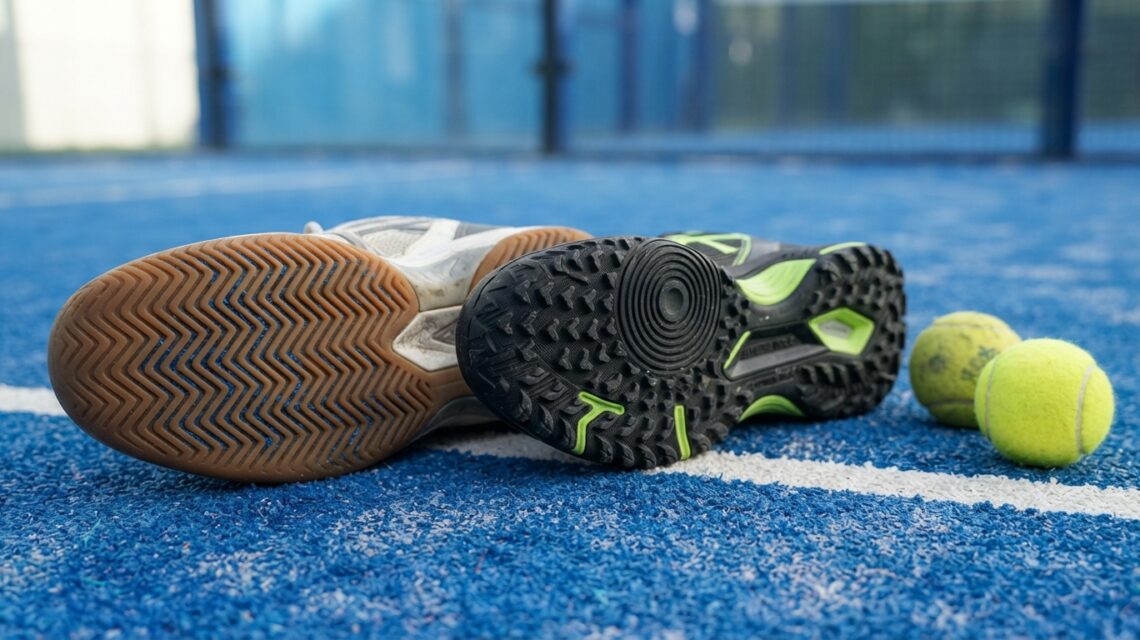
The right tread depends on how much sand sits in the artificial grass, how the court is maintained and how much grip you prefer. Here is what the three main outsole designs really offer.
By Marcio Tamer
Updated November 27, 2026
Choosing padel shoes by brand or appearance can be a costly mistake. The outsole determines how the shoe interacts with the artificial grass and silica sand, influencing grip, sliding, braking and the ability to change direction.
Three tread designs dominate the market: deep herringbone, omni dots and mixed or hybrid patterns. Each offers a different balance between traction and movement. But the common buying advice that modern Mondo courts automatically require a special hybrid sole is too simplistic.
The most important factor is not the name printed on the shoe box. It is the actual surface beneath your feet. A well-maintained sand-filled artificial-grass court can behave differently from a worn court with uneven sand distribution, even if both use similar turf.
Herringbone vs. omni vs. hybrid: What is the difference?
| Feature | Herringbone (clay) | Omni (dotted) | Mixed or hybrid |
|---|---|---|---|
| Tread design | Zigzag grooves across much of the outsole | Small rubber dots or circular studs | Combination of tread patterns or zones |
| General traction | Strong grip, with potential for controlled sliding | Broad contact distribution and a different grip-to-slide feel | Designed to balance traction and flexibility |
| Typical use | Artificial grass with silica sand | Artificial grass and, depending on the model, other court surfaces | Padel-specific movement across artificial grass |
| Main advantage | Established grip and durability | Versatile tread geometry | Combines characteristics of different patterns |
| Potential drawback | Can feel too aggressive on some surfaces | May wear differently and offer less bite in some conditions | Performance varies considerably by design |
| Best buying approach | Match groove depth to the court | Check manufacturer surface recommendations | Inspect the exact outsole rather than relying on the hybrid label |
There is no universal winner. The same outsole can feel different depending on the amount and distribution of sand, turf condition, rubber compound, tread depth and the player’s movement style.
Why silica sand changes the way padel shoes perform
Padel courts use artificial grass with silica sand infill. The sand is not simply an optional layer added to make the court look finished. It is part of the playing surface.
According to court manufacturer Mondo, its Supercourt XN system uses two types of textured monofilament designed to help contain the sand within the turf structure. The sand also protects the fibers against wear and contributes to consistent playing conditions.
That means the relationship between shoe and court is more complicated than choosing a tread for a visibly sandy surface. Sand distribution, fiber condition and maintenance all affect traction.
Mondo’s maintenance guidance emphasizes keeping stabilizing infill evenly distributed. When sand becomes uneven or turf fibers deteriorate, the court can develop inconsistent grip and ball behavior. A shoe that feels comfortable on one Mondo installation may therefore feel different on another.
This also explains why the phrase “Mondo sole” can be misleading. Mondo manufactures court surfaces, not a universally standardized category of shoe outsole. Brands use terms such as herringbone, omni and mixed to describe tread geometry.
When should you choose a herringbone outsole?
Herringbone soles use continuous zigzag grooves. They are familiar to tennis players because the same general pattern is widely used on clay-court shoes.
For padel, their main advantage is traction on artificial grass with silica sand infill. The grooves help interact with the sand and turf during lateral movements, braking and controlled slides.
ASICS identifies herringbone as a particularly suitable option for sandier padel courts. Its guidance also describes this tread as durable compared with omni designs.
Herringbone is a sensible starting point for players who prefer a more pronounced grip sensation, especially when their club maintains a traditional sand-filled court. It can also suit players who regularly move into defensive positions and need to recover after reaching balls near the glass.
However, not all herringbone patterns are identical. Groove depth, spacing, rubber flexibility and outsole construction influence how the shoe behaves. A deep, aggressive pattern may feel different from a shallower herringbone design.
The important qualification is that a clay outsole is not automatically wrong for modern padel. The court’s actual condition matters more than the age or marketing category of the installation.
What makes an omni outsole different?
Omni outsoles use small circular rubber elements distributed across the sole. Instead of relying on long zigzag channels, they create a pattern of individual contact points.
ASICS describes omni tread as a suitable option for artificial grass and notes that herringbone and omni soles can both work on padel courts. Its guidance also identifies herringbone as generally more durable than omni.
Omni shoes may appeal to players who prefer a different balance of grip and movement or who use several types of court surface. However, the idea that dotted soles are designed exclusively for wet, sandy outdoor courts is inaccurate.
Their performance depends on the specific shoe and court. A dotted pattern does not guarantee maximum traction, and it does not automatically make a shoe unsuitable for an indoor venue.
One practical consideration is wear. Small rubber elements can lose their original shape and height over time. Players who train frequently should inspect the outsole rather than relying on the shoe’s age alone.
Are hybrid padel soles the modern standard?
Hybrid or mixed outsoles combine different tread geometries, sometimes placing one pattern in the forefoot and another around the perimeter. Other designs use a more complex arrangement of grooves and contact zones.
The goal is to balance grip, flexibility and movement during padel’s repeated changes of direction. Some models also incorporate circular pivot areas or flex grooves to support rotation and forefoot movement.
Babolat’s collaboration with Michelin is one of the best-known examples of padel-specific outsole development. The company’s Premura 3 combines a Michelin Padel rubber compound with 360° Flex grooves. Babolat describes the rubber as a balance between traction and durability and the grooves as a way to improve outsole flexibility.
Its Human Fab testing also reports a 7% improvement in forefoot support compared with the previous generation. That is a manufacturer-reported result, not independent proof that the shoe reduces injuries by 7%.
There is another detail buyers should notice. Babolat’s Canadian technical listing for the Premura 3 identifies its surface category as Omni, even though the shoe is promoted with Michelin Padel and Mondo-related technology. This illustrates why shoppers should check the exact regional specification and physical outsole rather than assume that every padel-specific shoe belongs to one simple hybrid category.
The Bullpadel Ionic 25I is another model worth examining when comparing padel footwear, but buyers should verify the exact version and its current manufacturer specifications before treating it as an example of a particular tread design.
Can the wrong outsole increase injury risk?
Grip is necessary for acceleration, braking and lateral movement. But more grip is not always better.
Sports-medicine guidance published by Aspetar explains the trade-off: insufficient traction can make rapid movement unreliable, while excessive grip can increase strain on the foot and lower-limb joints.
A 2025 study examining injuries in padel players also discusses how outsole design may affect loading during sudden changes of direction. Its authors point out that high traction can increase tension on muscles and ligaments when the foot remains fixed during a rapid movement. They also emphasize that further research is needed before firm conclusions can be drawn.
This distinction matters because footwear marketing sometimes presents pivot discs or specialized rubber as if they eliminate knee and ankle injury risks. They do not.
A circular pivot zone may help the foot rotate, while flex grooves may make the shoe more flexible. But no outsole can guarantee that the player’s foot will release at the right moment during every movement.
Fit, stability, strength, technique, court maintenance and training load all matter. The evidence does not establish that a particular outsole is universally the safest option.
Running shoes are generally a poor substitute for court shoes because they are not designed specifically for repeated lateral movements on artificial grass. A proper court shoe should provide a secure heel, suitable lateral support and an outsole appropriate for the playing surface.
Five padel shoes worth comparing
These models illustrate different approaches to padel footwear. They are examples to investigate, not a universal ranking.
| Model | What to examine | Why it is worth considering |
|---|---|---|
| Babolat Jet Premura 3 | Michelin Padel outsole, 360° Flex and lateral support | A dedicated padel design with manufacturer-described traction and flexibility technologies |
| Babolat Jet Premura 2 | Michelin-developed outsole and 360° Flex | An earlier Premura generation that may be available at different prices |
| Bullpadel Ionic 25I | Exact outsole construction and fit | A padel-specific model to compare against more specialized options |
| adidas SoleMatch Control 2 Clay | Deep herringbone tread and clay-court construction | A useful comparison for players who prefer traditional zigzag traction |
| Mizuno Wave Exceed Tour 6 Padel | Padel version, outsole geometry and fit | An alternative for players prioritizing lightweight court movement |
Model names alone are not enough. Manufacturers sometimes sell different surface versions of similar shoes, and retailers can display outdated photographs or specifications. Check the product code, current manufacturer page and outsole image before ordering.
How to choose the right padel shoe before buying
Start by asking your club what type of artificial grass it uses and how the court is maintained. If possible, look at the surface before playing. Visible loose sand, uneven infill and worn fibers can change the way a shoe behaves.
Next, compare the manufacturer’s recommended surface with the actual outsole. If you play on several courts, a mixed design may be a reasonable compromise, but versatility should not be confused with guaranteed compatibility.
Fit is just as important as tread. Try shoes with the socks you normally wear for padel. Your heel should feel secure, your toes should have room to move, and the shoe should not slide around during lateral steps.
A half-size increase is not a universal rule. Shoe sizing varies between brands and models. Choose the size that prevents your toes from striking the front of the shoe during braking without allowing excessive movement inside the heel.
Check the outsole regularly. Worn tread can change traction even when the upper still looks new. If you play several times a week, inspect the forefoot and outer edges, where repeated braking and lateral movement can accelerate wear.
Finally, follow the club’s footwear rules. Some indoor facilities require clean court shoes to protect the playing surface. Carrying a separate pair for indoor play is a practical way to avoid bringing outdoor dirt, moisture or clay onto the turf.
The final decision: Match the outsole to the court, not the trend
Choose herringbone if you prefer strong, familiar traction on a sand-filled artificial-grass court. Consider omni if you like its contact pattern and the manufacturer recommends it for your surface. Look at mixed or hybrid designs if you want a combination of tread characteristics and a padel-specific construction.
Do not buy a shoe simply because it is described as Mondo-compatible, hybrid or injury-preventing. The most useful purchase is the model that fits your foot, suits your court and allows you to move confidently without slipping or feeling excessively locked to the surface.
+ Siga o Giro no Facebook
+ Siga o Giro no Instagram
Leia Mais: