

By Marcio Tamer
Updated November 25, 2026
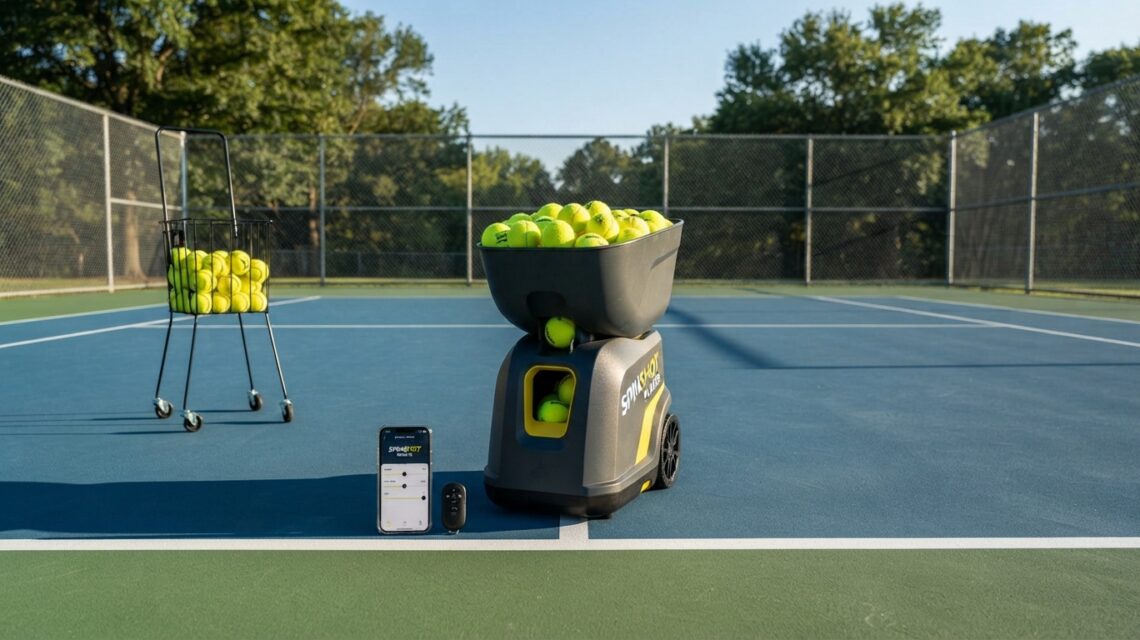
A battery-powered tennis ball machine is usually the better choice for players who practice at public parks, club courts, or facilities without electrical outlets near the baseline. An AC-powered machine, however, can be the smarter investment for a private court, tennis academy, or coach who feeds hundreds of balls every day and wants to avoid charging interruptions.
The difference goes beyond portability. Battery configuration affects transportation weight, charging schedules, replacement costs, and where a player can practice. Some manufacturers also sell hybrid models that operate on rechargeable batteries or external AC power, eliminating the need to choose just one.
For most recreational players, the decision should begin with a simple question: where will the machine actually be used?
Battery vs. AC Tennis Ball Machines at a Glance
| Feature | Battery-powered | AC plug-in | Hybrid AC/battery |
|---|---|---|---|
| Court access | Almost anywhere | Requires a compatible outlet | Both environments |
| Portability | Best for independent practice | Limited by cable length | Good when used on battery |
| Runtime | Typically 2–8 hours, depending on model and settings | Continuous while powered | Battery runtime or continuous AC operation |
| Charging | Required between sessions | Not required for pure AC models | Required when using battery |
| Transport | Machine and battery | Machine without battery may be lighter | Depends on battery configuration |
| Best use | Public courts, clubs, solo players | Private courts, fixed training areas | Players who use multiple court locations |
| Main drawback | Charging and battery replacement | Dependence on outlet and safe cable routing | Higher initial cost in some configurations |
The table describes general configurations rather than universal specifications. Actual runtime, machine weight, charging time, and available power options vary significantly between brands and models.
Why battery-powered machines dominate recreational practice
Most players do not own a tennis court. They travel to municipal facilities, clubs, schools, or community courts where electricity may not be available near the playing area. Even when an outlet exists, using it may require permission, an approved connection, or a safe cable arrangement.
That makes a rechargeable machine much easier to use. You can position it behind the baseline, adjust the feed interval, and begin practicing without needing to find an outlet or manage an extension cord across the court.
Modern battery machines can also provide several hours of practice on a single charge. Spinfire, for example, advertises approximately three to eight hours of operation for the Pro 2, depending on battery configuration and settings. Lobster’s Elite models offer different runtimes, with some machines rated for two to four hours and higher-capacity configurations capable of longer sessions.
For most recreational players, that is sufficient for several training sessions before charging becomes necessary. A machine feeding balls every few seconds does not need to operate continuously throughout an entire day to provide meaningful practice.
The trade-off is that battery performance depends on how the machine is used. Faster feeds, more demanding settings, battery age, temperature, and the selected power configuration can all affect available runtime.
Lithium vs. sealed lead-acid batteries: weight, charging and lifespan
The battery chemistry matters almost as much as whether the machine is rechargeable.
Older or lower-cost machines may use sealed lead-acid batteries, while premium portable configurations increasingly offer lithium batteries, including lithium iron phosphate (LiFePO4). Lithium options generally provide a better weight-to-capacity ratio, but the actual advantage depends on the machine and battery size.
Spinfire’s published specifications illustrate the difference. Its lithium battery option weighs approximately five to seven pounds, compared with around 14 pounds for the sealed lead-acid battery in some configurations. The lithium version also offers a longer manufacturer-reported cycle life, while SLA batteries generally require more careful charging and storage.
The practical advantage is not simply battery chemistry. A lighter battery can make a machine easier to transport, particularly for players who regularly lift it into a car or carry it through a club entrance. An external battery configuration can also let the owner leave the machine in the vehicle or storage area and bring only the battery pack indoors to recharge.
Battery longevity should not be treated as a guaranteed number of years or charge cycles. It depends on chemistry, depth of discharge, temperature, charging habits, and the manufacturer’s warranty. Before buying, check the replacement battery price, warranty duration, and whether the battery can be replaced without sending the entire machine to a service center.
When AC power becomes the better investment
A plug-in machine makes more sense when the court has reliable electrical access and the machine will remain in one location for long periods. Coaches running private lessons, academies feeding balls through multiple drills, and owners of backyard courts can benefit from continuous operation without waiting for a battery to recharge.
The advantage becomes more noticeable during long teaching days. Instead of monitoring battery levels or carrying a spare battery, the operator connects the machine to a compatible power supply and continues feeding balls.
However, AC power does not automatically make the machine more accurate or produce better shots. Ball speed, spin, elevation, feed intervals, and placement depend on the machine’s mechanical design, settings, ball condition, and throwing-wheel performance. The power source alone does not guarantee consistent feeds.
The biggest benefit is uninterrupted operating time, not inherently superior ball delivery.
Electrical safety also matters. Outdoor outlets should be properly protected, connections kept dry, and extension cords used only when suitable for the electrical load and environment. A cord must never create a trip hazard across an active court, and the machine should not be operated in rain or on wet surfaces unless the manufacturer explicitly permits the conditions.
Why hybrid machines may be the smartest long-term choice
A hybrid ball machine can use its internal or external battery at public courts and switch to AC power when an outlet is available. This arrangement makes sense for players who practice in different locations or coaches who use the same machine for private lessons and outdoor sessions.
The Spinfire Pro 2, for example, can be configured for battery operation or AC-only power, with an AC adapter also available for compatible battery configurations. Lobster offers battery and electric configurations across parts of its Elite range, including options that allow users to operate the machine using either power source.
Hybrid power can reduce the pressure to choose a single operating environment when buying an expensive machine. It also makes the equipment more adaptable if a player later moves from public courts to a private facility.
The limitation is cost. The AC adapter may be an additional purchase, and not every machine supports conversion after purchase. Buyers should verify compatibility before assuming a battery machine can later become a plug-in model.
Four ball machines illustrate the differences
| Model | Power configuration | Manufacturer-reported details | Best suited to |
|---|---|---|---|
| Spinfire Pro 2 | Battery, external battery, AC-only or compatible AC option | 150-ball hopper, up to 80 mph, approximately 3–8 hours on battery | Recreational and competitive players wanting flexible power |
| Lobster Elite Liberty | Battery | 150 balls, 35 lb, 70 mph, approximately 2–4 hours | Players prioritizing portability and straightforward solo drills |
| Lobster Elite Three | Battery, AC or combination | 150 balls, up to 80 mph, 44 lb, approximately 4–8 hours | Advanced players needing more drills and power flexibility |
| Lobster Elite One | Battery, external battery or AC configuration | 150 balls, up to 80 mph, approximately 4–8 hours on battery depending on configuration | Players wanting a versatile machine for home or club use |
Specifications are manufacturer-reported and can vary by battery option, regional version, and model year.
What should you buy for solo tennis practice?
Choose a battery-powered machine if you train at public courts, travel frequently, or want the freedom to practice without depending on electricity. For players who drive to the court and train for one or two hours at a time, battery power is generally the most practical setup.
Choose an AC-powered machine if you own a private court with safe, reliable electrical access or operate a fixed training facility where the machine feeds balls for extended periods. Avoid paying for battery capacity you rarely use if your equipment never leaves a powered court.
Consider hybrid power if you want one machine for both environments. The added flexibility can be worth the extra cost, particularly when the machine is a long-term investment.
The best ball machine is not necessarily the one with the fastest feed, largest hopper, or longest advertised runtime. It is the one you can set up easily, use consistently, and operate safely wherever you actually practice.
+ Siga o Giro no Facebook
+ Siga o Giro no Instagram
Leia Mais: