
Dry-feel and tacky overgrips behave differently when moisture builds up, but both can absorb sweat. Manufacturer specifications reveal why surface feel, thickness and replacement timing matter more than a simple indoor-versus-outdoor rule.
By Marcio Tamer
Updated November 22, 2026
Tourna sells a padel-specific three-pack of its original dry-feel overgrip for $8.99. Wilson charges $9 for three Pro Padel Overgrips, designed to provide the comfortable, slightly adhesive feel associated with its popular tennis grips.
The price difference is just one cent per pack. The more important distinction appears when a player’s hand begins to sweat.
Tourna says its original grip becomes tackier as moisture increases, while Wilson’s standard Pro Overgrip emphasizes comfortable contact and durability. Wilson also sells a perforated version designed to improve moisture absorption and drying.
For padel players dealing with humid courts, the best choice is not necessarily the grip with the strongest initial stickiness. It is the one that remains comfortable and secure throughout a match.
Tacky vs. dry overgrips: What actually changes?
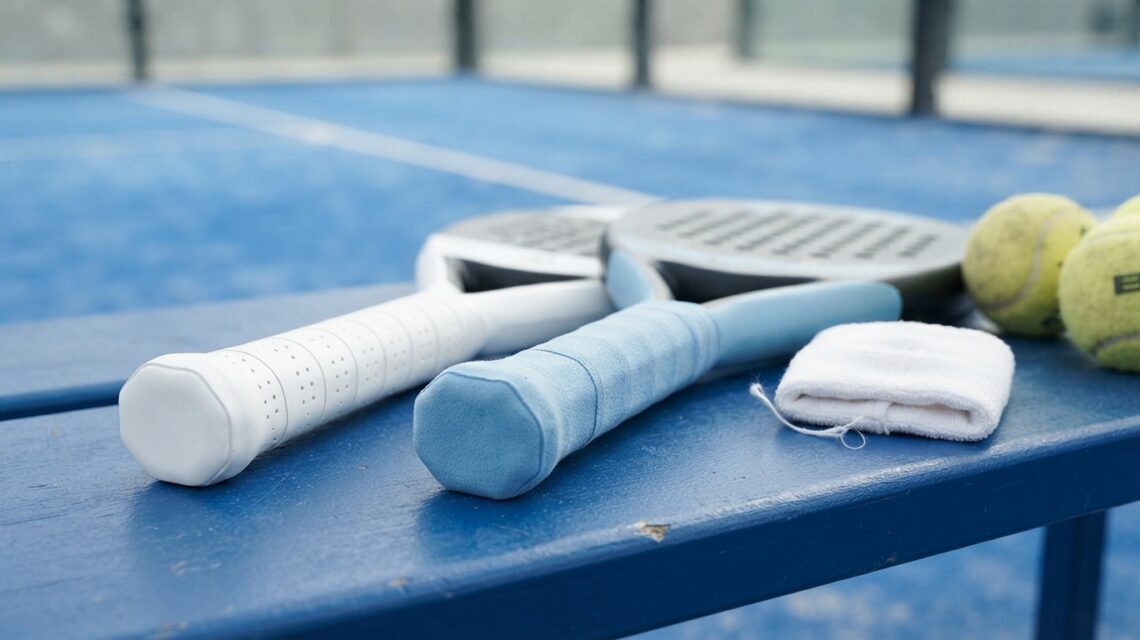
An overgrip is a thin wrapping applied over the racket’s existing handle grip. It changes the surface texture, absorbs some perspiration and slightly increases handle circumference.
| Feature | Tacky overgrip | Dry-feel overgrip |
|---|---|---|
| Initial sensation | Adhesive, slightly sticky | Matte, less sticky |
| Main attraction | Immediate traction against the palm | Comfortable handling when perspiration increases |
| Sweat management | Varies by material and design | Usually emphasizes absorption and moisture control |
| Typical examples | Wilson Pro, Yonex Super Grap | Tourna Grip, Yonex Dry Super Grap |
| Potential limitation | May feel slippery after becoming saturated | May wear or lose its preferred texture with use |
| Best starting point | Dry or moderately sweaty hands | Heavy perspiration and humid conditions |
These categories describe surface characteristics rather than completely different materials.
Yonex, for example, makes both its tacky Super Grap and its Dry Super Grap using polyurethane. The company describes the first as offering a tacky feel and the second as providing moisture-wicking performance with a drier sensation.
That makes it misleading to claim that all tacky grips use a waterproof film while all dry grips rely on exposed fabric fibers.
Why Tourna Grip behaves differently when wet
Tourna’s original grip has been marketed since 1977 around its ability to handle perspiration.
The manufacturer says its dry-feel surface becomes tackier when wet, making it particularly suitable for hot and humid conditions.
Its dedicated padel version comes with three grips and finishing tape for $8.99, equivalent to approximately $3 per wrap.
Tourna also offers Tourna Tuff, which the company describes as a more durable alternative retaining the original’s dry feel and moisture-related traction.
The important qualification is that these performance claims come from the manufacturer. Independent, standardized friction testing comparing all the overgrips discussed here was not established.
For a player who repeatedly loses grip traction during long rallies, however, Tourna’s design offers a logical product to test.
A practical comparison should include how the grip feels at the beginning of a match, after substantial sweating and during defensive shots where the racket is struck away from its center.
Why tacky overgrips remain popular
A tacky overgrip can feel secure immediately, before the player’s hands become sweaty.
Wilson Pro Overgrip is one of the best-known examples. Its three-pack costs $9 on Wilson’s US website, or $3 per grip.
The company also sells a padel-specific version at the same listed price. Unlike a full-length tennis wrap, the padel model is designed for the shorter handle of a padel racket.
Yonex Super Grap offers another established option. Its AC102 version measures 0.6 millimeters thick, 25 millimeters wide and 1,200 millimeters long.
Yonex explicitly states that Super Grap absorbs moisture as well as shock. That matters because tackiness and sweat absorption are not mutually exclusive.
Players with relatively dry hands may prefer the sensation of these grips, particularly when making quick adjustments between forehand, backhand and overhead positions.
However, no manufacturer specification can guarantee that a grip will remain secure for every player once saturated with sweat.
Perforated grips offer a third option
Wilson’s Pro Overgrip Perforated combines a tacky surface with small openings intended to improve moisture absorption and drying.
The manufacturer lists a three-pack at $9, matching the price of its standard Pro Overgrip.
Wilson also offers a 12-pack for $27, reducing the nominal price from $3 to $2.25 per grip.
This makes perforated overgrips a practical option for players who enjoy a tacky surface but want additional moisture-management features.
Perforation does not make a grip immune to saturation, however. The underlying material, sweat volume and condition of the wrap still matter.
For players with moderate perspiration, testing a perforated grip alongside a dry-feel design may be more useful than automatically assuming that one category is superior.
How much do thickness and handle size matter?
Grip thickness affects more than comfort.
Every additional layer changes the circumference of the handle. A player accustomed to feeling the racket’s bevels may find that several overlapping wraps make grip changes less precise.
Yonex Super Grap is specified at 0.6 millimeters thick. Its Dry Super Grap AC149, according to the company’s published catalog, measures 0.45 millimeters.
That difference of 0.15 millimeters per layer may sound small, but it changes the final handle dimensions when the grip is wrapped around the racket.
Players should therefore avoid treating two thin overgrips as automatically preferable to one thicker overgrip.
The better approach is to start with a comfortable handle size and add only enough wrapping to achieve the desired feel.
The original grip underneath also matters. If it has become compressed, slippery or damaged, applying another overgrip may conceal rather than solve the underlying problem.
Is an ergonomic undergrip worth the extra cost?
Bullpadel’s Hesacore offers a different approach to handle traction.
Instead of relying only on the outer surface, its honeycomb structure creates shaped contact areas for the fingers.
Bullpadel lists the standard Hesacore Grip at €19.99 and describes it as an ergonomic replacement grip designed to improve contact and comfort.
The company also makes claims about reduced effort and vibration transmission. These should be understood as manufacturer claims rather than proof that the product prevents tennis elbow or other injuries.
An ergonomic undergrip changes the handle’s shape and feel. It may suit some players, while others may prefer the familiar bevel definition of a conventional grip.
Players who install one should reassess their overgrip thickness rather than automatically adding multiple layers.
When should you replace a padel overgrip?
There is no reliable universal rule requiring replacement every two, three or four matches.
A player with heavy perspiration may notice declining traction during a single long session. Someone playing in cool indoor conditions may find the same grip acceptable for several outings.
The most useful replacement signals are a slippery or polished surface, visible wear, fraying, unpleasant odor or a noticeable change in handling.
Players should also consider how quickly the grip becomes saturated during matches.
For frequent play, buying larger packs can reduce costs. Wilson’s 30-pack of standard Pro Overgrips is listed at $59, equivalent to approximately $1.97 each, compared with $3 each in its three-pack.
That is a saving of about 34% per wrap, although the buyer must commit to a larger quantity.
A fresh overgrip is also more useful when paired with simple sweat-management habits. Drying the hand between games, using a towel and wearing a wristband can reduce the amount of moisture reaching the handle.
Which overgrip should you choose for humid padel courts?
For heavy palm sweat, start by testing a dry-feel option such as Tourna Grip or Yonex Dry Super Grap.
For dry hands or players who prioritize immediate stickiness, Wilson Pro Padel Overgrip or Yonex Super Grap may provide the preferred feel.
For moderate sweating combined with a preference for tackiness, Wilson Pro Overgrip Perforated offers a middle-ground design.
The most reliable comparison is a short trial under normal playing conditions. Use each grip for a similar session, paying attention to traction after sweating, handle rotation on off-center shots and whether the surface encourages uncomfortable squeezing.
No overgrip can guarantee protection from wrist or elbow injuries. Persistent pain should be assessed separately, with attention to technique, training load and racket setup.
For most players, the best overgrip is not the one that feels stickiest in the package. It is the one that remains comfortable and predictable when the match becomes physically demanding.
+ Siga o Giro no Facebook
+ Siga o Giro no Instagram
Leia Mais: