
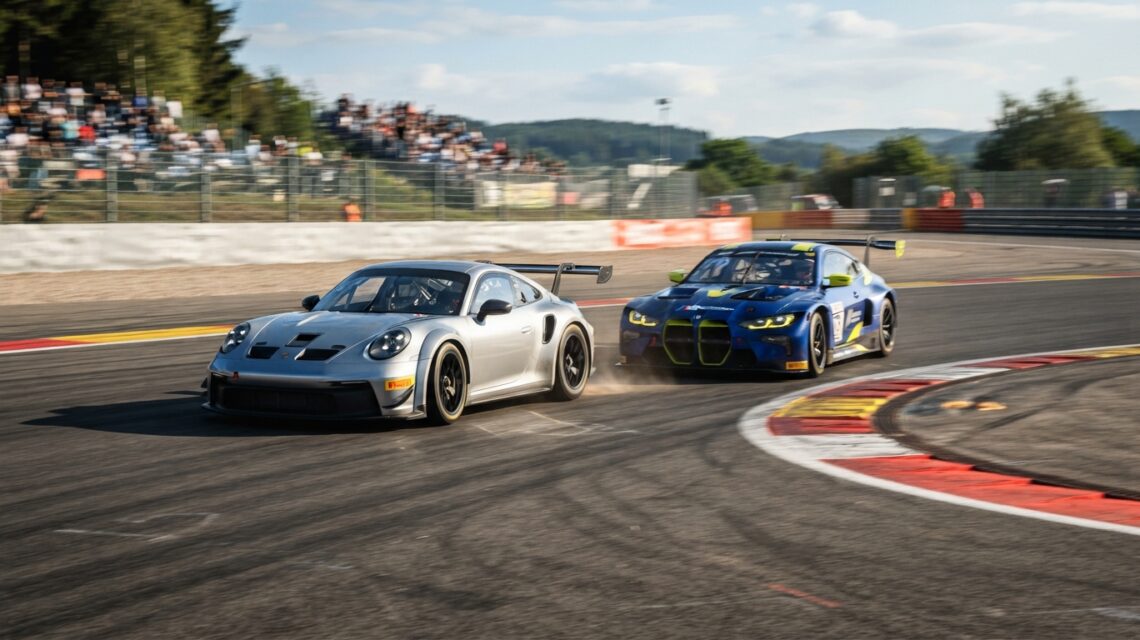
Both manufacturers provide high-performance cars, professional instructors and closed-course training, but Porsche emphasizes circuit-driving technique while BMW combines track sessions with skid-pad exercises, drifting and competitive challenges. Prices, age requirements and damage liability could determine which school is right for you.
By Marcio Tamer
Updated November 13, 2026
A first-time track driver can spend $2,500 on Porsche’s one-day Precision course at Barber Motorsports Park or $2,099 on BMW’s one-day M School in California or South Carolina.
The $401 difference is only the beginning of the comparison.
Porsche offers a structured path from introductory circuit driving to advanced performance training. BMW combines high-speed driving with exercises designed to teach braking, corner entry, vehicle balance and oversteer control.
Both schools provide their own performance cars, removing the need to expose a personal vehicle to the mechanical demands of track driving.
But there are important differences that beginners should understand before booking.
Porsche requires participants in its US Track Experience programs to be at least 21 years old. BMW M School accepts licensed drivers from 18.
Porsche also discloses substantial potential vehicle-damage liability, although participants in introductory courses can purchase a waiver to reduce their exposure.
For a newcomer, those practical details may matter as much as the badge on the steering wheel.
How much do Porsche Track Experience and BMW M School cost?
The manufacturers’ published US course prices show BMW offering the less expensive one-day entry point.
| Program | Location | Published tuition | Duration |
|---|---|---|---|
| Porsche Precision | Barber Motorsports Park, Alabama | $2,500 | 1 day |
| Porsche Precision | Laguna Seca, California | $3,600 | 1 day |
| Porsche Performance | Barber Motorsports Park, Alabama | $5,000 | 2 days |
| Porsche Performance | Laguna Seca, California | $6,700 | 2 days |
| BMW One-Day M School | California or South Carolina | $2,099 | 1 day |
| BMW Two-Day M School | California or South Carolina | $4,100 | 2 days |
Prices reflect published manufacturer rates and may change. Taxes, optional waivers and other charges should be confirmed before booking.
At Barber, Porsche’s introductory program costs $401 more than BMW’s one-day school.
At Laguna Seca, the difference grows to $1,501.
However, the courses are not identical products. The circuits, exercises, vehicle allocations and teaching structures differ.
Porsche’s Laguna Seca option also gives participants access to one of America’s most famous permanent racing circuits.
The correct comparison is therefore not simply the price per day, but the experience a driver wants to gain.
What Porsche teaches in its first-day Precision course
Porsche’s Precision program is designed for beginners and drivers seeking to improve their fundamental track skills.
The day begins with classroom instruction covering vehicle dynamics and the driving line.
Students then rotate through practical exercises involving braking, skid-pad control, autocross and track driving.
After lunch, the schedule includes additional vehicle-dynamics work, an autocross challenge and more circuit sessions.
At Barber Motorsports Park, the program uses a 2.38-mile circuit with 16 turns.
The layout features elevation changes and corners that reward careful positioning, controlled braking and smooth steering inputs.
Rather than focusing only on maximum speed, Porsche’s curriculum emphasizes how to enter a corner, reach the apex and position the car for the next section of track.
The school lists Porsche 911 and 718 Cayman models among its introductory vehicles, although the exact cars can change.
That variety gives students the opportunity to experience different vehicle layouts.
The 911 places its engine behind the rear axle, while the 718 Cayman uses a mid-engine configuration.
Those differences affect weight distribution and handling characteristics.
However, beginners should not assume they will automatically drive every advertised model. Vehicle allocation depends on the course and available fleet.
Why Porsche’s teaching structure appeals to drivers who want to progress
Porsche Track Experience offers a sequence of increasingly advanced courses.
Precision is the introductory one-day program.
Performance provides a two-day introductory option.
Masters and more advanced programs build on previous experience, with prerequisites and instructor approval applying to certain courses.
For example, Porsche’s Masters course requires prior completion of an eligible introductory course and instructor approval, although experienced drivers may be considered through a separate assessment process.
The progression is attractive to someone who wants to develop track skills over several visits.
A beginner can first learn braking points and the racing line, then return for more demanding exercises and greater independence.
But completing the Porsche curriculum should not be confused with automatically receiving a competition racing license.
Licensing is a separate process governed by the requirements of the relevant motorsport organization.
Porsche’s advantage is its structured driver-development pathway, not a guaranteed shortcut into competitive racing.
What BMW teaches in its one-day M School
BMW’s one-day M School approaches performance driving through a broader mix of car-control challenges.
The program begins with classroom instruction before students move to practical exercises.
According to BMW’s official schedule, the day includes skid-pad training, corner-entry work and a handling course.
The afternoon introduces competitive elements such as the Rat Race and timed autocross, alongside high-speed lead-follow driving.
Students finish with a hot lap driven by a professional instructor.
The exercises are designed to develop confidence while helping drivers recognize how a powerful car behaves when approaching the limits of grip.
BMW’s fleet includes models such as the M2, M3, M4 and M5, depending on the course and vehicle availability.
Unlike the mid- and rear-engine sports cars used by Porsche, BMW’s M vehicles are predominantly front-engine performance cars.
Some use rear-wheel drive, while others feature BMW’s M xDrive all-wheel-drive system.
That distinction matters because not every BMW M car behaves like a traditional rear-wheel-drive sports coupe.
The exact model and drivetrain used in a session can affect the skills being practiced.
Why BMW’s skid-pad exercises are especially useful for beginners
One of BMW M School’s most distinctive features is its emphasis on low-grip vehicle control.
A wet skid pad allows students to experience understeer and oversteer at more manageable speeds than would typically be required on a dry racing circuit.
Understeer occurs when the front tires cannot provide enough grip for the car to follow the intended turning path.
Oversteer occurs when the rear tires lose sufficient lateral grip and the car rotates more than intended.
Understanding those responses is valuable for both track driving and general vehicle control.
BMW’s two-day program adds more advanced exercises.
At its California location, the schedule includes a cloverleaf skid-pad exercise that links drifting transitions.
In South Carolina, the second day includes a figure-eight exercise, section training and additional high-speed lapping.
The one-day course already includes skid-pad work, but drivers specifically seeking extended drifting practice should examine the two-day syllabus rather than assume the shorter course provides the same depth.
Which school offers more actual track time?
Neither manufacturer publishes a directly comparable figure showing the exact number of minutes each beginner spends driving at speed.
That makes claims about one school delivering more seat time difficult to substantiate.
Porsche’s Precision course at Barber includes morning and afternoon driving rotations, with the day running from approximately 7:30 a.m. registration to late-afternoon activities.
BMW’s standard one-day schedule also includes morning and afternoon track sessions, followed by instructor hot laps.
Both divide the day between classroom learning and practical exercises.
The difference is how that time is used.
Porsche emphasizes developing a consistent approach to circuit driving, including braking points, cornering lines and vehicle dynamics.
BMW allocates time to a wider selection of exercises, including timed autocross and car-control challenges.
For a beginner interested primarily in learning to drive a permanent road circuit smoothly, Porsche may be the more natural choice.
For someone who wants to experience different handling situations in a controlled environment, BMW may be more appealing.
The biggest overlooked difference is the minimum age
The schools have different eligibility requirements.
Porsche Track Experience participants at Barber Motorsports Park and Laguna Seca must be at least 21 years old and hold a current, valid driver’s license.
BMW M School requires participants to be at least 18 years old with a valid driver’s license.
That makes BMW the straightforward option for licensed drivers aged 18 to 20.
A younger driver cannot simply pay Porsche’s tuition and participate in its standard US Track Experience course.
Both programs also require participants to comply with safety instructions and course rules.
Drivers should review the applicable requirements before making travel arrangements, especially when purchasing a course as a gift.
Does using a school car eliminate financial risk?
No. This is one of the most important corrections to the idea that factory-backed driving schools are risk-free.
Both programs supply vehicles, so students do not have to put their own cars through repeated hard braking, acceleration and cornering.
That avoids personal tire wear, brake wear and other track-related mechanical costs.
But using a manufacturer’s vehicle does not necessarily eliminate financial responsibility if the car is damaged.
Porsche’s published Track Experience terms state that participants at Barber and Laguna Seca can be personally responsible for up to $25,000 in vehicle damage per occurrence.
For introductory courses, Porsche offers an optional damage-limitation waiver costing $200 per day, reducing that exposure to $5,000.
Those are significant amounts.
A beginner purchasing the $2,500 Precision course at Barber and adding the $200 waiver would face a course-and-waiver cost of $2,700 before other applicable expenses.
BMW participants should also examine the specific damage and liability provisions in their booking agreement.
The availability of school cars is not equivalent to a promise that the driver has no financial exposure.
The practical rule is simple: read the damage agreement before paying.
Where can you attend each school?
Porsche Track Experience operates at two major US racing circuits.
Barber Motorsports Park, Alabama: The Precision course costs $2,500 and takes place on a technical permanent road circuit near Birmingham.
WeatherTech Raceway Laguna Seca, California: The Precision course costs $3,600 and offers the opportunity to learn on a famous circuit known for its elevation changes and the Corkscrew.
BMW operates two dedicated performance-driving facilities.
BMW Performance Center West, Thermal, California: The facility offers one-day and two-day M School programs, along with more advanced courses.
BMW Performance Center East, Greer, South Carolina: The facility offers skid-pad training, autocross, handling exercises and high-speed lapping.
The best location may depend on travel costs as much as tuition.
A driver living near Los Angeles might find BMW’s Thermal location more convenient than Porsche’s Alabama facility, although Porsche’s Laguna Seca option provides another California choice.
Someone traveling from the southeastern United States may find either Barber or BMW’s Greer facility practical.
Which school is better for learning to drift?
BMW M School has the clearer advantage for drivers whose primary interest is understanding and controlling oversteer.
Its published curriculum includes skid-pad exercises, and the two-day courses add more complex transitions.
Porsche also teaches vehicle dynamics and skid-pad control.
Its Precision program includes exercises that help students understand the limits of grip.
But Porsche’s broader course structure is particularly focused on precision circuit driving.
That includes braking technique, racing lines and consistent corner execution.
A driver hoping to learn controlled slides should not assume that every track-driving program devotes the same amount of time to drifting.
BMW provides a more explicit progression in that area.
Which school is better if you eventually want to race?
Both schools can help develop skills that are useful in motorsport.
Porsche’s curriculum offers a progressive approach to circuit technique, making it attractive to drivers who want to build speed and consistency over time.
BMW offers its own advanced training pathway.
Its official M School information states that graduates of Two-Day M School or Advanced M School become eligible for BMW’s Race License School at Thermal.
That is a more explicit connection to a dedicated licensing program than the basic comparison might suggest.
However, eligibility to attend a racing school is not the same as automatically obtaining a competition license.
Drivers should confirm what credentials a particular program provides and whether those credentials satisfy the requirements of the racing series or sanctioning body they intend to enter.
For a newcomer with serious racing ambitions, the best choice depends on the intended form of motorsport and the next training steps.
Porsche Track Experience vs. BMW M School: which should beginners choose?
Choose Porsche Precision if you want to:
- Learn racing lines, braking points and cornering technique on a permanent circuit.
- Experience the handling differences between Porsche’s rear-engine 911 and mid-engine 718 Cayman.
- Follow a structured progression toward more advanced track-driving courses.
- Drive at Barber Motorsports Park or Laguna Seca.
Choose BMW M School if you want to:
- Practice oversteer recovery and low-grip vehicle control.
- Experience skid-pad exercises, timed autocross and competitive driving challenges.
- Drive BMW M performance cars.
- Pay less for a one-day introductory program.
- Attend a school in California or South Carolina.
For most first-time participants without a strong preference for either brand, BMW’s one-day M School offers the more affordable starting point, with a wide range of practical exercises and two US locations.
Porsche Precision is especially compelling for drivers who want to experience the handling of a 911 and Cayman while developing technique on a permanent racing circuit.
Neither program requires previous track experience at its introductory level.
The deciding factors are the skills a driver wants to develop, the course location, the tuition and the financial terms attached to the booking.
Before paying, confirm the scheduled vehicles, minimum age, cancellation policy and damage liability.
A factory-backed school can make a first track experience far more accessible. The best choice is the one that teaches the skills you actually want to use afterward.
+ Siga o Giro no Facebook
+ Siga o Giro no Instagram
Leia Mais: