

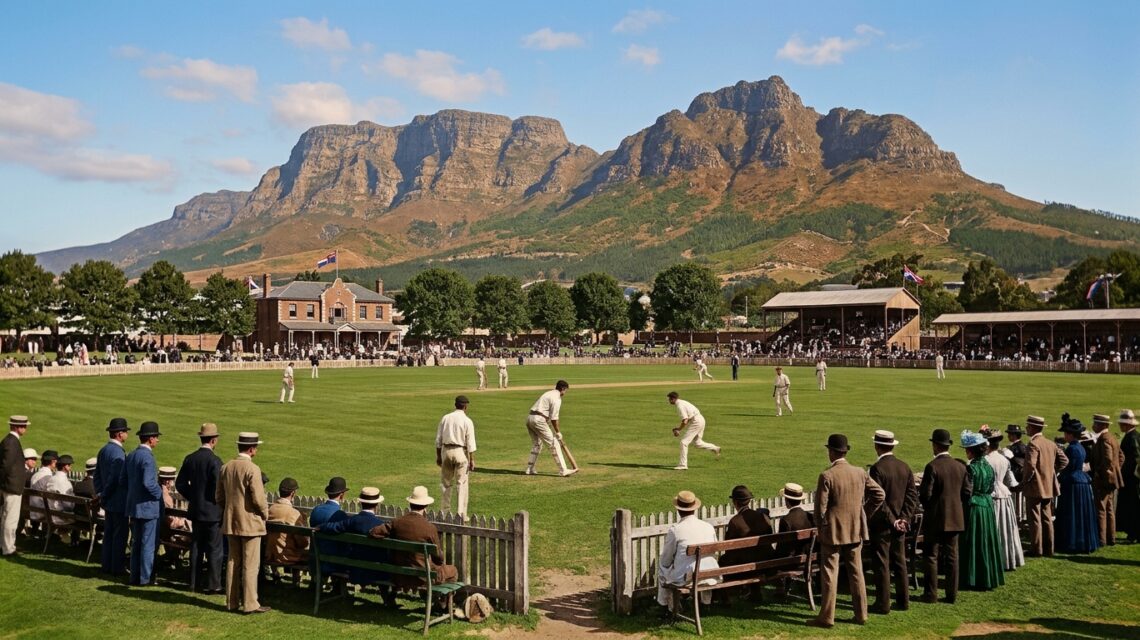
The extraordinary match against South Africa lasted from March 3 to 14, produced 1,981 runs and ended without a winner. England needed just 42 more runs when rain and a departing ocean liner brought cricket’s most famous timeless Test to an end.
By Marcio Tamer
Updated November 10, 2026
On March 14, 1939, England’s cricket team stood on the brink of one of the greatest victories in the sport’s history. After chasing an almost unimaginable target of 696 runs against South Africa, the visitors had reached 654 for five wickets at Kingsmead in Durban.
They needed another 42 runs to win.
There was just one problem: England’s players had to catch a ship home.
The match had begun on March 3 and was supposed to continue until a result was achieved. Instead, after nine days of actual play across a 12-day period, rain and the approaching departure of the touring party forced the teams to agree to a draw.
The contest became the longest Test match ever played, with 43 hours and 16 minutes of cricket and a combined total of 1,981 runs, according to Guinness World Records.
Its ending exposed a contradiction at the heart of the timeless Test: the rules placed no fixed limit on how long a match could last, but the players still lived in a world governed by travel schedules.
The match also became the last timeless Test in international cricket.
The historical mistake: the record was set in 1939, not 1899
The longest Test in cricket history is sometimes confused with an earlier England tour of South Africa.
The distinction is straightforward.
England played South Africa at Newlands in Cape Town in April 1899, but that match lasted three playing days and ended with England winning by 210 runs.
The extraordinary marathon occurred 40 years later, from March 3 to March 14, 1939, at Kingsmead in Durban.
The two matches involved the same national teams, but they took place in different cities, under different circumstances and with very different results.
The 1899 match was a conventional Test victory.
The 1939 match became a record-breaking contest that could not reach a sporting conclusion.
Contemporary scorecards and historical cricket records confirm the dates, venue, innings totals and result. <Cite refs={[“turn157886search0″,”turn157886search2″,”turn157886search4”]}/>
What was a timeless Test and why could it continue indefinitely?
A timeless Test was a form of international cricket without a predetermined final playing day.
In a conventional Test, teams have a limited number of days to complete their innings and produce a result.
If neither side wins before the allotted time expires, the match is drawn.
A timeless Test removed that deadline.
The intention was to keep playing until one team won, although ordinary cricket rules and practical circumstances could still prevent a result.
That did not mean players remained on the field continuously.
Matches still included scheduled breaks, overnight intervals and rest days. Weather could also interrupt play.
The absence of a fixed finishing date was intended to reduce the likelihood of draws caused solely by time running out.
But it created another problem: nobody could know exactly when a match would end.
That uncertainty was manageable when the game finished quickly.
It became much harder to accommodate when a contest lasted more than a week.
How South Africa turned the match into a marathon
The fifth and final Test of England’s 1938–39 tour began on March 3 at Kingsmead.
South Africa won the toss and chose to bat.
The home side then spent nearly three days building an imposing first-innings total of 530 runs.
Pieter van der Bijl scored 125, while Dudley Nourse contributed 103.
England’s Reg Perks took five wickets for 100 runs, but the tourists had already spent an enormous amount of time in the field.
England replied with 316 runs.
Wicketkeeper Les Ames top-scored with 84, but the visitors finished 214 runs behind South Africa’s first-innings total.
In a timeless Test, the situation offered South Africa an unusual strategic choice.
The home side did not need to rush toward a declaration to leave enough time to bowl England out.
Instead, South Africa could continue building its advantage.
That decision helped transform an already lengthy match into something extraordinary.
Why South Africa set England a target of 696 runs
South Africa batted again and scored another 481 runs.
Alan Melville made 103, while the rest of the batting order added enough runs to create a daunting target.
The arithmetic was simple.
South Africa had scored 530 in its first innings and 481 in its second, giving it 1,011 runs overall.
England had already scored 316.
To win, England therefore needed 696 runs in its second innings.
In ordinary Test cricket, a target that large would usually be accompanied by severe time pressure.
At Durban, there was no predetermined final day.
England could theoretically bat for as long as necessary, provided its wickets lasted and the match remained possible to continue.
The timeless format had created exactly the situation it was designed to permit: a team chasing a vast target without a formal deadline.
But South Africa’s bowlers were tired, and the visitors began to take advantage.
England’s astonishing chase from 0 to 654 runs
England began its second innings with a target that remains extraordinary even by modern standards.
The opening partnership did not settle the match immediately, but the middle order transformed the contest.
Paul Gibb scored 120 runs.
Bill Edrich produced the innings of his career, making 219.
Captain Wally Hammond added 140.
Together, they pushed England toward a target that had initially appeared almost unreachable.
Edrich’s innings was particularly important.
His 219 represented more than a third of England’s second-innings total at the point the match ended.
Hammond’s century kept the chase alive, while Gibb’s long innings helped establish the foundation.
By the end, England had reached 654 for five wickets.
Five batters had been dismissed, but the tourists still had five wickets remaining.
The target was 696.
Another 42 runs would have completed an extraordinary victory.
The scorecard shows how close England came before circumstances outside the boundary intervened. <Cite refs={[“turn157886search0″,”turn157886search5”]}/>
The numbers behind the longest Test ever played
| Match detail | Historical record |
|---|---|
| Teams | South Africa vs England |
| Venue | Kingsmead, Durban |
| Dates | March 3–14, 1939 |
| Calendar span | 12 days |
| Days of actual play | 9 |
| Recorded playing time | 43 hours, 16 minutes |
| South Africa’s first innings | 530 |
| England’s first innings | 316 |
| South Africa’s second innings | 481 |
| England’s second innings | 654/5 |
| England’s victory target | 696 |
| Runs still required | 42 |
| Combined runs | 1,981 |
| Official result | Draw by agreement |
The distinction between 12 calendar days and nine days of play matters.
The match included two scheduled Sunday rest days, March 5 and March 12, as well as weather interruptions.
The official scorecard lists the contest across March 3–14, while the Guinness record identifies 43 hours and 16 minutes of actual play.
It was not nine uninterrupted days of cricket.
Nor did the players spend 12 consecutive days batting and bowling.
The record reflects the extraordinary duration of a match that remained unresolved for nearly two weeks. <Cite refs={[“turn157886search0″,”turn157886search3”]}/>
Why England had to abandon the match with victory so close
The decisive obstacle was not South Africa’s bowling.
It was the timetable for England’s return journey.
In 1939, international cricket tours depended on ocean liners.
Commercial air travel had not yet developed into the routine means of transporting international sports teams between continents.
A touring party therefore had to coordinate its matches with scheduled sea departures.
Missing a ship could create serious logistical complications.
The timeless Test had been scheduled on the assumption that it would produce a result before England needed to leave.
That assumption proved wrong.
Rain disrupted the final stages of the match, and England’s departure could not be postponed indefinitely.
With the visitors on 654 for five and only 42 runs short, the teams agreed to end the contest as a draw.
The official scorecard records the result as “Match drawn (by agreement).”
The ship did not defeat England on the scoreboard.
But its departure deadline prevented the visitors from attempting to complete their chase.
The episode remains one of cricket’s most memorable examples of practical reality overruling a competition’s intended format.
Why the result was even more unusual than the score suggests
The match was remarkable not simply because England nearly chased 696.
It was remarkable because the timeless format had been created to avoid draws caused by a lack of time.
A conventional Test might finish without a winner because the final scheduled day arrived before either team could complete the necessary innings.
A timeless Test was supposed to remove that limitation.
Yet Durban ended in a draw anyway.
The reason was external to the playing rules.
The match had no fixed sporting deadline, but England’s travel arrangements imposed a real-world one.
That made the result an unusually direct demonstration of the format’s weakness.
A competition cannot be scheduled indefinitely if its participants must eventually travel, return to work or meet other commitments.
The longer the match lasted, the more obvious that contradiction became.
Did the players really score 1,981 runs?
Yes.
The total can be verified directly from the four innings recorded on the scorecard:
- South Africa: 530
- England: 316
- South Africa: 481
- England: 654/5
Together, those innings produced 1,981 runs.
Guinness World Records identifies that figure as the record aggregate for a Test match at the time of its record entry.
The enormous total was partly a consequence of the match’s length.
Batters had more time to accumulate runs, and the absence of a fixed finishing day reduced the pressure to accelerate scoring.
South Africa’s two completed innings alone produced 1,011 runs.
England then added 970 across its two innings, despite never finishing its second.
The scale of the scoring helps explain why the contest occupied such a prominent place in cricket history.
Was the pitch responsible for the extraordinary duration?
The scorecard and historical accounts suggest that batting conditions were generally favorable.
South Africa accumulated 530 in its first innings, and both teams produced substantial totals later in the match.
A relatively unresponsive pitch made it difficult for bowlers to dismiss batters quickly.
The duration of the contest also created fatigue.
South Africa’s attack had to bowl for long periods, and injuries further reduced its effectiveness.
Historical accounts of the series note that England’s second-innings chase came against an increasingly exhausted bowling attack.
That does not mean the pitch was the sole explanation for the record.
The timeless rules also shaped the captains’ decisions.
South Africa could bat again without worrying about using up the remaining days of a scheduled Test.
England could pursue a massive target without needing to score at a rate dictated by a final afternoon.
The combination of favorable batting conditions, exhausted bowlers and unlimited time made the extraordinary totals possible.
What happened to timeless Tests after Durban?
The Durban match became the last timeless Test played in international cricket.
The format had already been declining before 1939.
Its disadvantages were becoming increasingly apparent as cricket developed more organized international schedules.
A match without a known finishing date complicated travel arrangements, venue planning and the commitments of players and officials.
The Durban experience provided a particularly memorable demonstration of those problems.
The outbreak of the Second World War later in 1939 disrupted international cricket for years.
When Test cricket resumed after the war, the timeless format did not return.
Instead, the sport continued developing around matches with defined time limits.
Modern men’s Test cricket is generally scheduled for five days.
That structure does not guarantee a winner, but it allows teams, broadcasters, venues and supporters to know when a match is expected to finish.
Why five-day Tests replaced the timeless model
The five-day Test represents a compromise between cricket’s traditional emphasis on endurance and the practical need for scheduling.
A match remains long enough for changing pitch conditions, strategic declarations and multiple batting innings to influence the result.
But it also has a defined endpoint.
That matters for far more than player convenience.
Venues must organize staffing and security.
Broadcasters must allocate programming time.
Supporters need to arrange travel and accommodation.
Teams must move between cities and countries.
The economics of professional sport depend partly on being able to plan those activities.
A timeless match introduces uncertainty into almost every part of that process.
The Durban Test demonstrated how a theoretically elegant sporting rule could become impractical when confronted with the demands of international competition.
How cricket eventually moved toward even shorter matches
The end of timeless Tests did not immediately produce the short formats familiar today.
Five-day Test cricket remained the sport’s premier international format.
But later decades brought further changes.
One-day international cricket emerged in the 1970s, offering matches designed to finish within a single day.
Twenty20 cricket developed in the early 2000s, reducing each team’s innings to 20 overs.
Those formats were not created solely because of the 1939 Durban match.
They emerged from broader changes in audience preferences, television, commercial opportunities and the organization of the sport.
Nevertheless, they illustrate the same underlying issue.
Modern sports competitions must balance the integrity of the contest with the time available to players, organizers and audiences.
The timeless Test represented one extreme.
Twenty20 represents a very different solution.
Why the 1939 match remains cricket’s ultimate scheduling paradox
The longest Test match in history did not end with a dramatic final wicket or a winning boundary.
It ended with an agreement.
South Africa had scored 1,011 runs across two completed innings.
England had replied with 316 and then produced an extraordinary chase of 654 for five.
The visitors still had five wickets available and needed only 42 more runs.
But the match had already stretched across 12 calendar days, including nine days of play.
England’s return voyage could not wait any longer.
The contest designed to eliminate the possibility of running out of time had finally run out of time.
Eighty-seven years later, Durban’s 1939 timeless Test still holds the record for the longest Test match, and its final score remains a reminder that even a game without a deadline cannot escape the clock.
+ Siga o Giro no Facebook
+ Siga o Giro no Instagram
Leia Mais: