
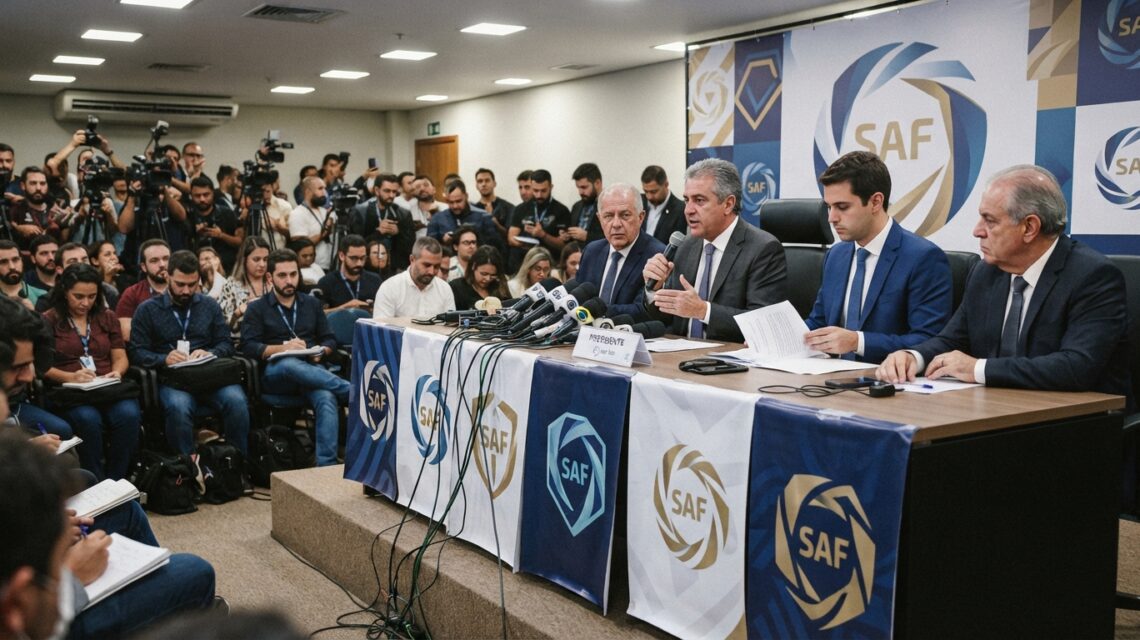
Brazil’s 2021 football corporation law brought major investment to Cruzeiro, Bahia, Atlético-MG, Vasco and Botafogo. But by November 2026, two of its most prominent takeovers had become ownership disputes, revealing the difference between attracting private capital and guaranteeing financial stability.
By Marcio Tamer
Updated November 9, 2026
Brazil’s football ownership revolution has reached an unexpected turning point.
Five years after the country created the Sociedade Anônima do Futebol (SAF), a corporate structure designed to attract investors and reorganize indebted clubs, two of its most prominent early deals are being restructured or contested.
At Vasco da Gama, the American investment group 777 Partners agreed in September 2026 not to oppose a plan to create a new football company and sell 90% of its shares through a court-supervised process.
At Botafogo, the ownership structure built around American businessman John Textor became the subject of legal disputes involving the club’s original association, Eagle Football and competing claims over control.
These developments stand in contrast to the optimism that followed Brazil’s SAF law in August 2021.
The legislation helped facilitate transactions involving some of the country’s most historic clubs, including Cruzeiro, Bahia and Atlético Mineiro.
It also created mechanisms for dealing with longstanding debts.
But the experience of the past five years has exposed an important limitation: turning a football club into a company does not guarantee that its investors will provide the promised funding, manage debts successfully or avoid ownership conflicts.
What Brazil’s SAF law actually changed
Brazil’s Law No. 14,193, enacted on August 6, 2021, established a specialized corporate framework for professional football.
Before the legislation, many major Brazilian clubs operated as nonprofit membership associations.
These organizations could generate substantial revenue, employ professional executives and participate in commercial transactions.
But their governance was often shaped by elected officials, internal political groups and association statutes.
The SAF framework created another option.
A club could establish a company responsible for its football activities and transfer relevant assets and operations into that entity.
The original association could retain shares or sell a controlling interest to investors.
The law also established specific governance, transparency, financing and debt-treatment provisions.
It did not require every Brazilian club to become a SAF.
Nor did it automatically privatize an association simply because it created a football company.
The transformation was a choice made through the applicable corporate and club approval procedures.
Why the debt provisions were as important as the investors
The SAF legislation attracted attention because it offered a route for outside investment.
But its debt mechanisms were equally significant.
Brazilian clubs had accumulated large obligations involving taxes, employees, suppliers, lenders and other creditors.
Some faced judicial enforcement proceedings that could disrupt their operations.
The law created a framework for organizing certain historical liabilities, including the Regime Centralizado de Execuções (RCE), or centralized enforcement regime.
Under that mechanism, eligible enforcement proceedings can be coordinated through a central judicial process.
The law provides for the allocation of a defined portion of the SAF’s revenue to the repayment of qualifying obligations.
The initial statutory framework establishes a six-year repayment period, with a possible extension under specified conditions.
The legislation also addresses judicial recovery procedures.
These mechanisms do not simply cancel debts.
They organize how obligations are addressed and can provide a more predictable environment for the club’s football operations.
The distinction matters because a team may improve its short-term cash flow while still owing substantial sums to creditors.
Cruzeiro became the first major example, then changed owners again
Cruzeiro was among the most prominent clubs to adopt the SAF model.
The Belo Horizonte club had suffered a severe financial and sporting crisis, including relegation from Brazil’s top division in 2019.
In December 2021, former Brazil striker Ronaldo Nazário agreed to acquire a controlling stake in Cruzeiro’s football company.
The arrangement gave Ronaldo’s investment vehicle control of 90% of the SAF, while the original association retained 10%.
The transaction was widely presented as a turning point for a club struggling with debts and sporting instability.
Cruzeiro returned to Brazil’s Série A after winning the second division in 2022.
But Ronaldo’s ownership did not become permanent.
In April 2024, he agreed to sell his controlling stake to Brazilian businessman Pedro Lourenço, whose business interests include the Supermercados BH retail group.
The transaction subsequently received favorable competition-regulatory review.
Cruzeiro therefore demonstrated two features of the SAF model.
Private investment could help restructure a club and support its return to the top division.
But controlling ownership could also change again within a relatively short period.
The SAF framework made that transfer of control possible without requiring the football operation to return to its previous association structure.
Botafogo won major trophies, then entered an ownership dispute
Botafogo’s SAF transaction initially became one of the most celebrated examples of foreign investment in Brazilian football.
In 2022, John Textor’s Eagle Football structure acquired a controlling interest in the club’s football company.
The original arrangement involved 90% of the SAF’s shares and investment commitments intended to support the club’s development.
Botafogo subsequently rebuilt its squad and improved its competitive position.
In 2024, the club won both the Brazilian Série A title and the Copa Libertadores.
Those achievements were significant for an institution that had spent years struggling with financial and sporting instability.
But success on the pitch did not prevent a dispute over ownership.
By 2026, Textor was involved in legal proceedings concerning his relationship with Eagle Football and the control of Botafogo’s SAF.
The dispute became more complicated after creditors appointed administrators to oversee part of the Eagle structure.
In September 2026, Botafogo’s original association asserted that it had become the majority shareholder through the exercise of contractual subscription rights.
Textor challenged aspects of that process.
The competing claims involved proceedings in Brazil, the United States and the United Kingdom.
A September ruling in Florida supported Textor’s claim to shares previously associated with Eagle Bidco, according to his public statements.
But that ruling did not, by itself, settle every corporate and judicial dispute concerning the SAF in Brazil.
The case shows how multiclub ownership structures can create complex questions about financing, voting rights and control.
Vasco’s deal with 777 Partners became a warning for other clubs
Vasco da Gama’s experience followed a different path.
In 2022, the club agreed to sell 70% of its SAF to 777 Partners, an American investment group building an international football portfolio.
The transaction involved a substantial investment commitment and plans to reorganize the club’s financial obligations.
But 777’s wider financial difficulties eventually affected the relationship.
In 2024, Vasco’s original association regained operational control of the football company through judicial measures.
The dispute continued through arbitration and litigation.
By 2026, Vasco was pursuing a judicial recovery process and a new ownership structure.
On September 2, 2026, Vasco and 777 Carioca LLC informed the court that they had reached a settlement in their arbitration dispute.
Under the agreement, 777 said it would not oppose the proposed creation of a new SAF or a competitive sale of 90% of that company’s shares.
The structure involved transferring football assets into the new company and offering its controlling stake through a court-supervised process.
That did not mean the sale had already been completed.
It meant a major legal obstacle had been addressed.
The distinction between an agreed restructuring and a completed transaction is central to understanding Vasco’s position.
Why Vasco’s proposed new SAF matters
Vasco’s restructuring illustrates a more sophisticated use of the SAF framework.
Rather than simply finding another buyer for the existing company, the plan involved establishing a new football entity within the judicial recovery process.
The proposed sale would be conducted through a competitive procedure.
That structure was intended to provide a legal basis for transferring the football business while addressing creditors and existing shareholder disputes.
The club also sought financing to support operations during the restructuring.
In September 2026, court-appointed monitors supported a proposed debtor-in-possession financing facility of up to R$150 million.
The financing was not intended to be released automatically in full.
Disbursements were to depend on demonstrated liquidity needs and judicial oversight.
This is an important distinction.
A credit facility provides access to financing under specified conditions.
It is not equivalent to an immediate R$150 million cash injection.
Vasco’s case demonstrates why financial restructuring can require more than a new shareholder.
It may also require court supervision, creditor agreements, operational funding and enforceable guarantees.
Bahia’s City Football Group deal followed a different trajectory
Bahia offers a contrasting example.
In May 2023, the club completed its transformation into a SAF and joined City Football Group, the international ownership network associated with Manchester City.
City Football Group acquired 90% of Bahia’s football company, while the original association retained 10%.
The transaction created a long-term investment relationship.
Bahia’s own financial disclosure identifies a minimum investment commitment of R$800 million over 90 years.
It also provides for a possible additional R$200 million dedicated to infrastructure.
Those figures are often summarized as a R$1 billion deal.
But that shorthand can be misleading.
The R$800 million is a minimum commitment spread across a long period.
The additional R$200 million is conditional and designated for a specific purpose.
Neither figure should be presented as money that was necessarily paid in full when the transaction closed.
The arrangement also gives Bahia access to an international football network with experience in recruitment, technical development and commercial operations.
The long-term challenge is whether those resources translate into sustainable financial growth and competitive performance.
Atlético-MG used local investors and assumed its historical debt
Atlético Mineiro adopted another variation of the SAF model.
In November 2023, the club completed the transfer of its football operations into a company controlled by Galo Holding.
The investment group acquired 75% of the SAF, while the original association retained 25%.
The transaction was structured around investors with longstanding ties to the club.
Atlético’s announcement identified an investment package of approximately R$915 million, including cash contributions and debt conversion.
The club also transferred responsibility for its historical liabilities to the SAF.
That was a different approach from arrangements relying primarily on the centralized enforcement regime.
The original transaction valued Atlético’s football-related assets at approximately R$2.1 billion.
Those assets included the Arena MRV stadium, training facilities and the football operation.
The valuation should not be confused with the amount of new cash invested.
A club can have a multibillion-real valuation while receiving a smaller cash contribution.
Atlético’s published financial reports also show the importance of distinguishing cash transfers from the conversion of existing credits into equity.
Both can strengthen a balance sheet, but only the first directly increases cash available for operations.
What the major SAF transactions actually involved
| Club | Original investor | Stake | Financial structure |
|---|---|---|---|
| Cruzeiro | Ronaldo Nazário | 90% | Controlling acquisition in 2021; stake sold to Pedro Lourenço in 2024 |
| Botafogo | Eagle Football / John Textor | Originally 90% | Investment commitments followed by ownership disputes |
| Vasco da Gama | 777 Partners | Originally 70% | Troubled investment followed by judicial restructuring and proposed new SAF |
| Bahia | City Football Group | 90% | Minimum R$800m commitment over 90 years, with possible additional infrastructure funding |
| Atlético-MG | Galo Holding | 75% | Investment package involving cash, debt conversion and assumption of liabilities |
The figures are not directly comparable.
Some transactions involved cash purchases of shares.
Others involved future investment commitments, debt conversions or obligations to repay existing liabilities.
The percentage acquired does not establish how much cash entered the football business.
Likewise, a club’s valuation is not the same as the amount received by the original association.
Understanding those differences is essential when assessing whether a transaction improved a club’s finances.
Does becoming a SAF eliminate a club’s debts?
No.
The SAF law provides mechanisms for organizing and addressing liabilities, but it does not automatically extinguish them.
The treatment of historical debt depends on the transaction structure, applicable law and judicial arrangements.
In some cases, the original association remains responsible for qualifying obligations while the SAF contributes revenue under a repayment mechanism.
In others, the corporate transaction includes the assumption or restructuring of liabilities.
The distinction can materially affect creditors.
A club may continue playing matches under a new corporate structure while creditors seek payment through a separate legal process.
That does not mean the obligations have disappeared.
It means the legal framework determines how they are managed.
The long-term success of a SAF therefore depends partly on whether its debt-repayment plan is realistic.
What happens to a club’s identity when investors take control?
The SAF framework does not require a club to abandon its history, colors or identity.
Brazilian law contains provisions addressing the preservation of key sporting and cultural elements.
But the relationship between the original association and the football company can still become contentious.
The association may retain minority shares, voting rights or protections over specific decisions.
Investors may control the budget, recruitment strategy and commercial operations.
Those arrangements must be defined through the law, corporate documents and transaction agreements.
A 10% minority stake does not necessarily give the association broad control over daily football decisions.
Conversely, a controlling investor does not automatically have unrestricted authority to change every aspect of a club’s identity.
The precise balance depends on the legal and contractual protections.
This is one reason supporters have increasingly scrutinized SAF agreements before approving them.
Why professional management is not guaranteed by the corporate model
SAFs operate under corporate governance and disclosure requirements.
They can appoint professional executives, establish boards and adopt formal financial controls.
But incorporation alone does not ensure good management.
A company can still borrow excessively, overpay for players, miss financial targets or become involved in shareholder disputes.
The cases of Vasco and Botafogo illustrate that risk.
The presence of an international investor does not eliminate the need for due diligence.
Clubs and their members must examine the buyer’s financial capacity, ownership structure and contractual obligations.
They also need mechanisms for responding if promised investment is not delivered.
The distinction between a legally enforceable commitment and a general business plan is especially important.
A SAF agreement can provide strong protections.
But those protections must be clearly drafted and enforceable.
What five years of SAFs have revealed
Brazil’s football corporation law created a new market for investment and ownership transfers.
It helped clubs attract capital, reorganize operations and negotiate historical debts.
It also made controlling stakes in traditional football institutions available to domestic and international investors.
But the outcomes have varied considerably.
Cruzeiro changed controlling owners again within three years.
Bahia entered a long-term partnership with City Football Group.
Atlético-MG adopted a locally backed investment structure.
Botafogo achieved major sporting success before becoming involved in ownership disputes.
Vasco entered a court-supervised restructuring after its relationship with 777 Partners deteriorated.
These examples do not prove that the SAF model has failed.
They show that the law created a financial and legal structure, not a guarantee of successful ownership.
The central question for Brazilian football is no longer simply whether clubs can attract private investors.
It is whether they can choose investors capable of meeting their obligations, protecting the institution and financing competitive teams without reproducing the debt problems that made the SAF model attractive in the first place.
What comes next for Vasco and Botafogo?
Vasco’s next steps depend on its judicial recovery process and the proposed sale of the new SAF.
The September 2026 agreement with 777 removed a significant obstacle, but it did not automatically complete a new ownership transaction.
Potential investors must satisfy the requirements of the court-supervised process.
Botafogo faces a different challenge.
Its competing shareholder claims and disputes involving Eagle Football require legal resolution.
The club’s sporting achievements do not determine the outcome of those proceedings.
For both institutions, the central issue is control over the football company and the financial obligations attached to that control.
The SAF revolution has already changed the ownership of some of Brazil’s most famous clubs.
Its next phase will be judged less by the size of the investment announcements and more by whether the promised money arrives, debts are repaid and ownership remains stable.
+ Siga o Giro no Facebook
+ Siga o Giro no Instagram
Leia Mais: