


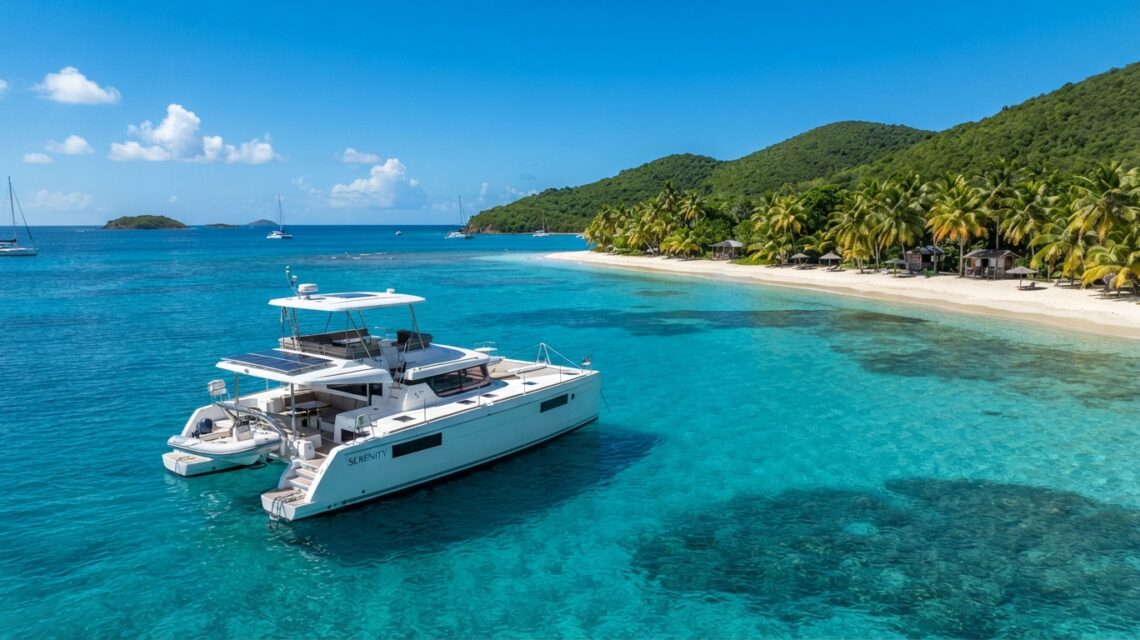
The British Virgin Islands do not universally require ASA 104 certification for bareboat charters, but operators assess sailing experience before handing over a yacht. Hiring a captain adds cost, changes cabin arrangements and removes much of the pressure of navigating unfamiliar waters.
By Marcio Tamer
Updated November 14, 2026
A seven-day bareboat yacht charter in the British Virgin Islands starts at $3,284 in the low season, while a skippered charter package starts at $6,284, according to pricing published by The Moorings for 2026.
The difference is approximately $3,000 for a week, although the final amount depends on the yacht, travel dates, number of guests and included services.
For travelers deciding between the two options, however, price is only part of the story.
A bareboat charter allows qualified guests to operate the yacht themselves, choosing routes, handling docking and mooring, monitoring weather and managing the vessel throughout the vacation.
A skippered charter places a professional captain aboard to take responsibility for the vessel’s operation, allowing guests to participate in sailing or simply enjoy the journey.
The most surprising distinction concerns certification.
Despite widespread claims that ASA 104 Bareboat Cruising is mandatory in the British Virgin Islands, major charter operators including The Moorings and Sunsail explicitly state that a formal sailing certificate is not universally required for their BVI bareboat charters.
Instead, they evaluate the applicant’s sailing experience.
That means a sailor with extensive experience but no ASA certificate may qualify, while someone who recently earned ASA 104 but lacks practical experience on comparable yachts may still need additional instruction or a professional skipper.
What is the difference between bareboat and skippered charters?
The two charter formats can involve similar yachts and destinations, but the responsibilities aboard are substantially different.
| Feature | Bareboat charter | Skippered charter |
|---|---|---|
| Who operates the yacht? | Guest skipper and crew | Professional skipper |
| Sailing experience required? | Yes, subject to operator approval | Generally not required for guests |
| Formal certification | Not universally mandatory in the BVI | Not required for guests |
| Navigation and route planning | Guest skipper | Professional skipper, with guest input |
| Docking and mooring | Guest skipper and crew | Professional skipper |
| Privacy | No hired skipper aboard | Skipper shares the yacht |
| Guest participation | Responsible for operating the yacht | Optional participation |
| Additional skipper expense | None | Included in a package or charged separately |
| Best suited for | Experienced sailors seeking independence | Beginners, families and travelers seeking relaxation |
A bareboat charter is not necessarily a sailing vacation without any crew assistance.
The charterer may bring friends or family members who help with sails, lines, navigation and mooring.
The difference is that no professional skipper is supplied to command the vessel.
In a skippered charter, the captain handles operational decisions, although guests can often participate under supervision.
A skippered charter should not be confused with a fully crewed luxury charter.
A fully crewed yacht may include a chef, steward or other hospitality staff. A skipper-only arrangement generally does not.
Do you need ASA 104 to rent a bareboat yacht in the BVI?
No. ASA 104 is a recognized and useful qualification, but it is not a universal legal requirement for every bareboat charter in the British Virgin Islands.
The Moorings states that no formal certification is required to sail in the BVI through its charter program.
However, all applicants must complete a sailing or powerboat résumé so the company can assess their ability.
Sunsail publishes a similar policy.
Its BVI destination guidance states that applicants must complete an online sailing résumé and achieve the operator’s required experience rating.
This distinction is essential.
Not requiring a certificate does not mean that an inexperienced sailor can automatically charter a yacht.
Operators still evaluate whether the proposed skipper has sufficient experience for the boat and cruising area.
Recognized qualifications such as ASA 104, US Sailing Bareboat Cruising and relevant Royal Yachting Association certifications can support an application.
But practical experience remains central to the approval process.
The overlooked requirement is experience on a comparable yacht
The Moorings and Sunsail classify the British Virgin Islands as a relatively accessible cruising destination.
Their Level 1 experience guidance includes at least nine days and 100 nautical miles as skipper on a yacht of equivalent size.
That is an operator-specific benchmark, not a blanket rule imposed on every charter company in the territory.
Other companies use different criteria.
BVI Yacht Charters, for example, states that it looks for recent experience captaining a similar-sized vessel, generally within five feet of the charter yacht’s length and within the previous five years.
It also expects relevant catamaran experience when someone applies to charter a catamaran.
That can be particularly important for sailors moving from smaller monohulls to large cruising catamarans.
A sailor may know how to handle sails and navigate but still be unfamiliar with the windage, docking characteristics and twin-engine maneuvering of a 45-foot catamaran.
The practical question is not simply whether someone has sailed before.
It is whether they have recently commanded a boat similar to the one they want to rent.
Can a sailing school certificate replace real charter experience?
A certificate demonstrates that a sailor has completed a defined training program and met its assessment requirements.
It does not guarantee proficiency in every yacht type or cruising environment.
ASA 104, for example, covers the skills involved in managing a multiday bareboat voyage.
Its curriculum includes passage planning, provisioning, anchoring, navigation, vessel systems and emergency procedures.
Those skills are relevant to the BVI.
But an operator may still ask how many days the applicant has spent as skipper, what size vessels they have commanded and whether they have previous charter experience.
A person who recently completed ASA 104 on a 35-foot monohull may not automatically qualify to captain a substantially larger catamaran.
Conversely, an experienced owner who has sailed similar yachts for years may satisfy an operator’s requirements without holding that particular certificate.
The safest approach is to submit a sailing résumé for approval before paying a nonrefundable deposit.
What happens if the charter company does not approve your sailing résumé?
Failing to meet a company’s bareboat requirements does not necessarily mean the vacation must be canceled.
Some operators offer a checkout skipper.
This is a professional captain who joins the charter for an initial period to assess the guest’s skills and provide orientation.
The arrangement may include docking practice, maneuvering under power, sail handling and familiarization with the yacht’s systems.
If the operator is satisfied, the guest may be permitted to continue independently.
Other companies may require a skipper for several days or the entire trip.
BVI Yacht Charters states that it may require a captain for one or more days depending on the applicant’s experience.
The Moorings also warns that if its base staff are not confident in a guest’s ability, a professional skipper may be assigned at the charterer’s expense.
This creates a financial risk for travelers who assume approval is automatic.
Someone booking a bareboat yacht to save money should confirm their eligibility before departure.
How much more does a skippered charter cost in the BVI?
The Moorings’ published 2026 pricing provides a useful comparison.
| Charter format | Seven-day low-season starting price | Seven-day high-season starting price |
|---|---|---|
| Bareboat sailing yacht | $3,284 | $14,484 |
| Skippered charter package | $6,284 | $24,834 |
| Fully crewed charter | $13,134 | $49,584 |
Published starting prices are based on the operator’s specified example booking and are subject to availability and change. They are not quotes for identical yachts.
The difference between bareboat and skippered packages is $3,000 at the low-season starting price.
In the high-season examples, the difference rises to $10,350.
Those figures should not be interpreted as the skipper’s salary alone.
The packages can involve different yachts, inclusions and booking conditions.
The Moorings also advertises a separate option to add a professional skipper to a bareboat booking for $330 per night.
Over seven nights, that would amount to $2,310 before other applicable costs.
However, adding a skipper separately does not necessarily provide the same inclusions as purchasing a dedicated skippered package.
The company states that its BVI skippered packages include skipper provisions and Wi-Fi, while those benefits are not automatically included when a skipper is added to a bareboat charter.
That difference can materially affect the final bill.
Why hiring a skipper can reduce the number of guests aboard
One of the most frequently overlooked consequences of hiring a captain is the need to provide sleeping accommodation.
A skipper generally requires a designated berth or cabin.
On a yacht with three guest cabins, that may mean only two remain available for the traveling party.
The impact depends on the boat’s layout.
Some catamarans have separate crew berths in the forward compartments.
Others may require the skipper to occupy a standard guest cabin.
The Moorings specifically advises guests adding a skipper to ensure that the yacht has suitable sleeping accommodation.
That means the cost of hiring a captain is not always limited to the daily fee.
A group of six adults might comfortably occupy a three-cabin yacht on a bareboat charter.
If a skipper needs one of those cabins, the same group may need a larger and more expensive vessel.
Before booking, ask exactly where the skipper will sleep and how many guest cabins remain available.
Who pays for the skipper’s meals and drinks?
The answer depends on the charter arrangement.
For a dedicated skippered package with The Moorings in the BVI, the operator states that the skipper’s provisions are included.
But when a skipper is added separately to a bareboat charter, guests are responsible for the skipper’s food and beverages.
That may mean including the captain when purchasing groceries, planning meals aboard or eating at restaurants.
Guests should also clarify how gratuities work.
The Moorings notes that tipping is customary but discretionary.
There is no reason to assume that a quoted skipper fee includes every onboard expense.
A useful comparison should account for the skipper’s daily rate, accommodation, provisions, gratuities and any difference in yacht size.
Those additional costs can make a supposedly inexpensive captain-only arrangement less economical than expected.
Why the BVI is popular with first-time charterers
The British Virgin Islands offer a combination of relatively short passages, established marine services and numerous sheltered anchorages.
Popular sailing destinations include Tortola, Virgin Gorda, Norman Island and Jost Van Dyke.
Many routes involve line-of-sight navigation, meaning sailors can often see the island or destination toward which they are traveling.
The northeast trade winds also provide favorable sailing conditions during much of the principal charter season.
Those characteristics help explain why operators classify the BVI as an accessible cruising area.
However, accessible does not mean risk-free.
Sailors must still monitor weather, manage reefs and shallow water, avoid restricted areas and understand local mooring arrangements.
A short passage between islands can become difficult if the weather deteriorates or a crew is inexperienced.
The availability of professional skippers is especially useful for visitors who want to experience the destination without taking on those responsibilities.
Why mooring balls are a major part of BVI sailing
Many popular BVI anchorages use mooring buoys.
A mooring ball is connected to a fixed underwater system designed to secure a vessel without requiring its own anchor to be deployed.
This helps manage boat traffic and can reduce damage to sensitive seabed habitats when the mooring system is properly maintained and used.
But picking up a mooring is a practical skill.
The skipper must approach at a controlled speed, account for wind and current, and coordinate with a crew member who retrieves the mooring line.
The maneuver becomes more demanding in crowded bays.
The Bight at Norman Island, Great Harbour at Jost Van Dyke and other popular stops can attract substantial traffic.
A bareboat skipper must be comfortable approaching a buoy and securing the yacht without losing control of the vessel.
A professional skipper handles that maneuver as part of the service.
For guests unfamiliar with mooring procedures, that alone can make a skippered charter more relaxing.
How much do BVI mooring balls cost?
The Moorings’ 2026 destination guidance indicates that mooring fees commonly range from approximately $30 to $55 per night.
Some first-come, first-served moorings are available for around $30 to $40.
Reserved moorings through BoatyBall may cost approximately $55.
Actual charges depend on the location, operator and type of mooring.
Over a seven-night charter, using paid moorings every night could add a few hundred dollars to the trip.
However, not every itinerary requires a paid mooring each night.
Some yachts may stay at marinas or anchor in permitted areas.
The skipper must understand where anchoring is allowed and whether a particular mooring is suitable for the yacht’s size and weight.
A professional skipper can help make those decisions, but guests still need to budget for the fees.
Does a skippered charter mean you cannot sail the yacht yourself?
Not necessarily.
Many skippered charter arrangements allow guests to participate in sailing under the captain’s supervision.
A guest may be able to steer, trim sails or assist with maneuvers when conditions are appropriate.
This can make a skippered vacation valuable for someone who has completed ASA 101 or ASA 103 but does not yet have enough experience to qualify for a bareboat charter.
Instead of assuming full responsibility for the yacht, the guest can gain exposure to cruising procedures while a professional manages the vessel.
However, a vacation skipper is not automatically a certified sailing instructor.
Someone who wants formal lessons or certification should arrange that specifically.
The skipper’s primary role is operating the yacht safely, not guaranteeing a structured training curriculum.
What changes when you charter with children or inexperienced guests?
A bareboat charter can be rewarding for families, but it requires realistic planning.
The designated skipper must remain responsible for navigation, weather decisions, docking and vessel safety.
If everyone else aboard has little sailing experience, the skipper may have limited assistance during demanding maneuvers.
A professional captain can reduce that operational burden.
This is particularly useful when traveling with children, older relatives or guests who primarily want a relaxing vacation.
But a skippered charter does not eliminate the need for sensible safety precautions.
Guests must still follow instructions, supervise children, use appropriate life jackets and understand basic onboard procedures.
The skipper also needs suitable accommodation, which may affect cabin arrangements for families.
A larger yacht may be necessary if every guest requires a separate berth.
How much freedom do you lose by hiring a skipper?
A bareboat charter offers the greatest operational independence.
The skipper can plan the itinerary, choose appropriate anchorages and adjust the schedule according to weather and crew preferences, within the charter company’s cruising restrictions.
A skippered charter still allows guests to influence the itinerary.
The captain can recommend destinations, snorkeling locations and restaurants based on local knowledge.
However, the professional skipper has authority over safety-related decisions.
If conditions make a proposed passage unsafe, the skipper may decline to follow the guests’ preferred route.
That is not a disadvantage unique to skippered charters.
Bareboat skippers also have a duty to make safe decisions.
The difference is who carries out that responsibility.
For some travelers, giving up operational control is the main benefit of hiring a captain.
For experienced sailors, it may be the main reason to choose bareboat instead.
What is the difference between a skippered charter and a fully crewed charter?
A skippered charter generally provides a professional captain without a dedicated hospitality crew.
Guests may still need to purchase groceries, prepare meals, clean shared spaces and manage ordinary living arrangements.
A fully crewed charter typically includes additional personnel and services.
Depending on the package, that can mean a chef, meal service, housekeeping and other onboard hospitality.
The Moorings’ published low-season starting price illustrates the difference.
A seven-day skippered package starts at $6,284, while a fully crewed charter starts at $13,134.
The price gap reflects more than an additional crew member.
Fully crewed yachts may differ in size, equipment, services and inclusions.
For travelers who want to avoid both sailing duties and meal preparation, a fully crewed charter may be a better match than a skipper-only booking.
When is the best time to charter a yacht in the BVI?
The BVI’s principal charter season generally runs through the Northern Hemisphere winter and early spring.
The Moorings identifies December through March as a peak-demand period, when prices tend to be higher.
The islands also experience a Caribbean hurricane season, officially extending from June through November.
That does not mean every day during those months is unsuitable for sailing.
It means travelers should pay particular attention to weather forecasts, travel insurance, cancellation terms and the charter operator’s seasonal policies.
Low-season pricing can be attractive, but savings should be weighed against weather-related uncertainty.
Travelers with limited flexibility may prefer to pay more for dates that better match their risk tolerance.
What should you confirm before booking a BVI yacht charter?
The first step is to establish whether the charter company will approve the intended skipper.
For bareboat bookings, submit a detailed sailing résumé that includes recent experience, yacht sizes, vessel types and previous charter history.
For skippered bookings, ask whether the skipper is included in the package or charged separately.
Confirm the sleeping arrangements, meal provisions, gratuity expectations and any additional taxes or fees.
Also review the yacht’s passenger capacity, insurance terms, security deposit, cancellation policy and cruising restrictions.
Mooring charges, marina fees, fuel and provisioning can affect the final budget.
Some charter packages include certain cruising permits or local fees, while others itemize them separately.
A quoted base price should never be treated as the guaranteed total vacation cost.
Which BVI charter style is best for your sailing level?
Bareboat is the stronger choice for experienced skippers who can demonstrate recent command experience on a similar yacht and want full control over their cruising itinerary.
It generally offers more privacy and avoids the expense of a professional captain.
Skippered is the better choice for beginners, less experienced sailors and groups that want a more relaxed vacation.
It removes much of the operational pressure while still allowing guests to participate in sailing when appropriate.
For someone between those two levels, a checkout skipper or a skipper hired for the first few days may offer a useful compromise, subject to the charter company’s approval.
The most important lesson from the BVI’s published charter requirements is that a certificate and practical competence are not interchangeable.
ASA 104 can strengthen a sailor’s qualifications, but it does not guarantee approval for every yacht.
And the absence of a universal certificate requirement does not mean that anyone can take command of a large charter vessel.
The best booking decision begins with an accurate assessment of the skipper’s experience, followed by a realistic comparison of total costs and onboard responsibilities.
+ Siga o Giro no Facebook
+ Siga o Giro no Instagram
Leia Mais: