

The Moorings and Sunsail recommend collapsible luggage, non-marking footwear and lightweight clothing for yacht vacations. Their 2026 guidance also reveals what is already supplied, why power outlets vary by vessel and how sunscreen laws differ between Caribbean destinations.
By Marcio Tamer
Updated November 14, 2026
A 45-foot charter catamaran can offer four cabins, multiple bathrooms, a spacious cockpit and enough accommodation for eight guests. But that does not mean eight people can bring the same luggage they would take to a resort.
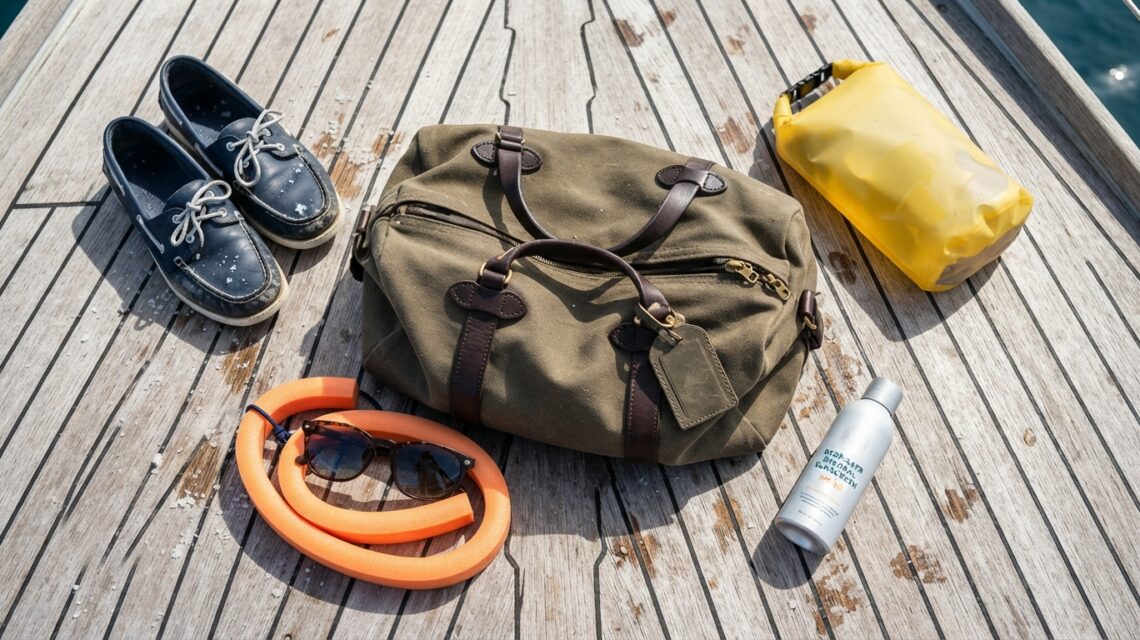
The Moorings and Sunsail recommend soft-sided bags for sailing vacations because storage aboard a yacht is limited and rigid suitcases are difficult to stow.
The distinction becomes obvious after boarding. Catamaran cabins are distributed between two narrow hulls, and much of the available space is occupied by berths, bathrooms, storage compartments and essential equipment.
A large suitcase that fits comfortably in a hotel room may be awkward to store aboard, particularly once the yacht is underway.
But luggage is only the first consideration.
Footwear must provide grip without damaging the deck. Clothing needs to dry quickly. Sunscreen must be appropriate for the destination. Electronic devices may need different charging arrangements depending on the yacht’s generator, inverter and shore-power connections.
There is also a financial reason to check the charter inventory before packing.
Major operators already provide many everyday items, including bedding, kitchen equipment and certain snorkeling accessories. Bringing duplicates can waste luggage space that would be better reserved for personal essentials.
For a seven-day trip, the most effective approach is to pack for the activities passengers will actually do rather than for every possible situation.
The complete seven-day catamaran charter packing checklist
This checklist is intended for a warm-weather sailing vacation in destinations such as the British Virgin Islands, U.S. Virgin Islands or Caribbean. Cooler Mediterranean itineraries may require additional clothing.
Luggage and waterproof storage
- One collapsible soft-sided duffel bag or travel backpack per person.
- One small waterproof dry bag for dinghy rides and beach visits.
- Packing cubes or reusable waterproof pouches for organizing clothing.
- A waterproof pouch for your phone, documents and small valuables.
- A separate bag for damp swimwear.
Clothing for seven days
- Three swimsuits or sets of swimwear.
- Four to six lightweight shirts or tops.
- Three pairs of shorts or equivalent casual bottoms.
- One or two UV-protective shirts or rash guards.
- One or two casual evening outfits.
- One lightweight windproof or waterproof jacket.
- One light long-sleeved layer.
- Seven sets of underwear, adjusted for laundry access.
- Sleepwear and any activity-specific clothing.
Shoes and sun protection
- One pair of secure, non-marking deck shoes.
- One pair of water shoes or strapped sandals for shore excursions.
- Sunglasses with a retaining strap.
- A sun hat with a secure fit or chin cord.
- Broad-spectrum SPF 30 or higher sunscreen suitable for the destination.
- SPF lip balm and after-sun moisturizer.
Personal health and comfort
- Essential prescription medication.
- Seasickness remedies appropriate for your needs.
- Personal toiletries and hygiene products.
- Insect repellent.
- Reusable water bottle.
- Small personal first-aid supplies.
- Any necessary prescription glasses or contact lenses.
Documents and electronics
- Valid passport and required travel documents.
- Charter booking confirmation and contact information.
- Sailing qualifications and résumé, if required for a bareboat charter.
- Credit cards and some local cash.
- Phone, charging cable and compatible power adapter.
- Portable power bank.
- Downloaded charts, maps and travel information where useful.
- Waterproof protection for electronics.
The list is deliberately shorter than a conventional weeklong vacation packing list.
The goal is to bring enough for comfort without turning every cabin into a storage area.
Why a soft duffel is better than a hard-shell suitcase
A collapsible duffel is one of the few packing recommendations shared consistently by major yacht charter companies.
In its February 2026 sailing vacation packing guide, Sunsail specifically includes a duffel bag among its recommended essentials.
The Moorings also recommends soft-sided luggage for British Virgin Islands charters.
The Royal Yachting Association’s sailing holiday guidance explains the reason: hard-sided suitcases are difficult to store aboard, while soft bags can be compressed after unpacking.
The advantage is not simply saving space during travel.
A soft bag can be folded into a locker or placed beneath a berth once the clothes have been removed.
A rigid suitcase retains its shape and may have to remain in the cabin or a shared area.
That can become inconvenient when several people are sharing the yacht.
For a weeklong tropical trip, a medium-sized soft bag is generally sufficient for most passengers.
There is no universal requirement to use a 60- or 80-liter bag.
A traveler who packs light may need considerably less.
The most practical choice is a bag that fits airline restrictions, is easy to carry across docks and can be compressed when empty.
Why non-marking shoes matter more than expensive sailing footwear
Shoes worn aboard a yacht should provide reliable traction without damaging the deck.
Sunsail’s official packing guide recommends deck shoes with good grip and non-marking soles.
The Moorings similarly advises rubber-soled boat shoes or tennis shoes rather than hard-soled footwear.
A non-marking sole is designed not to leave visible rubber streaks on the deck.
This is particularly useful on white fiberglass surfaces, where scuff marks can be noticeable.
However, sole color alone does not determine whether a shoe is non-marking.
Some dark soles are specifically designed not to mark surfaces, while certain light-colored soles can still leave residue.
The correct choice is footwear labeled as non-marking and suitable for wet decks.
Grip is equally important.
A smooth fashion sneaker may look appropriate but perform poorly on wet fiberglass.
Deck shoes should fit securely and allow the wearer to move safely around the cockpit, companionway and side decks.
Passengers should also check the charter company’s footwear policy.
Some operators ask guests to remove street shoes before boarding.
Is going barefoot safer on a catamaran?
Not necessarily.
Barefoot sailing is common in warm destinations, and some charter guests prefer it while relaxing in the cockpit or saloon.
But bare feet are not automatically safer on wet decks.
A yacht contains deck fittings, cleats, lines, steps and other surfaces that can cause injuries.
Wet fiberglass can also become slippery.
For moving around the vessel during docking, anchoring or sail handling, secure footwear with suitable grip may provide better protection.
The choice depends on the activity, conditions and the skipper’s instructions.
A passenger relaxing in a sheltered seating area has different footwear needs from a crew member handling lines near the bow.
The important principle is to avoid loose footwear that can slip off or interfere with safe movement.
Why you should bring separate shoes for shore excursions
The shoes used aboard should ideally remain clean and free of sand or grit.
A separate pair of water shoes or strapped sandals is useful for beach landings, rocky shorelines and dinghy transfers.
This is particularly relevant in destinations where restaurants and beaches are reached by tender rather than directly from a marina.
Sunsail recommends water shoes for excursions because they protect feet from rocks and hot sand.
Secure sandals can also be more practical than flip-flops when stepping between a moving dinghy and a dock.
Flip-flops may be convenient for casual walking ashore, but they provide limited support during wet or uneven transfers.
A second pair of footwear also helps reduce the amount of sand and debris carried onto the yacht.
That matters because grit can make decks uncomfortable underfoot and may contribute to surface wear.
How many clothes do you really need for seven days?
Most warm-weather charter guests spend much of the day in swimwear, shorts and lightweight shirts.
The Moorings’ 2026 BVI packing guide recommends two or three swimsuits, breathable clothing, a rash guard and a light layer for evenings.
Sunsail recommends several swimwear options, three pairs of shorts and a small number of evening outfits.
That is a useful starting point.
Three swimsuits allow one to be worn, one to dry and another to remain available.
Lightweight shirts can be reused depending on activity and access to laundry.
One or two casual evening outfits are usually enough for restaurants and beach bars.
Heavy denim, bulky sweaters and formal clothing may take up more space than their usefulness justifies.
However, clothing needs depend on the destination.
A Caribbean charter in warm weather is different from an early-season Mediterranean trip where temperatures can drop after sunset.
The weather forecast should determine the final adjustments.
Why a waterproof jacket belongs in a tropical packing list
A lightweight waterproof shell may seem unnecessary for a Caribbean vacation.
But tropical sailing conditions can change quickly.
Rain showers and squalls can arrive during a passage, bringing wind and reduced visibility.
Even without rain, the combination of wind, spray and wet clothing can make passengers uncomfortable.
Sunsail recommends carrying a light windproof and waterproof jacket.
The Moorings also suggests a windbreaker for cooler or windy evenings.
The jacket does not need to be a heavy offshore sailing suit for a typical sheltered-water charter.
A compact, breathable shell is generally more practical.
It can also be useful during airport travel, early-morning departures or unexpected changes in weather.
What sunscreen should you bring to the Caribbean?
Sunscreen deserves more attention than simply choosing the highest SPF number.
The U.S. Virgin Islands enacted legislation restricting sunscreens containing oxybenzone, octinoxate and octocrylene.
The restrictions took effect in 2020 and were introduced to reduce potential harm to marine ecosystems.
The U.S. Centers for Disease Control and Prevention also advises travelers to check destination-specific sunscreen regulations before departure.
Mineral sunscreens containing zinc oxide or titanium dioxide are widely recommended for travelers visiting environmentally sensitive marine areas.
However, the phrase reef-safe is not a standardized guarantee that a product is harmless to coral reefs.
Travelers should examine the ingredient list rather than relying entirely on marketing language.
It is also incorrect to assume that every Caribbean island or Mediterranean destination has identical sunscreen restrictions.
The U.S. Virgin Islands has specific legislation, but the rules in the British Virgin Islands and other destinations must be checked separately.
For practical sun protection, choose a broad-spectrum sunscreen with SPF 30 or higher, apply it according to the label and reapply after swimming or towel drying.
UV-protective clothing, shade and hats can reduce reliance on sunscreen alone.
Why spray sunscreen can be a problem aboard
Spray sunscreen is convenient on a beach, but it can create difficulties on a yacht.
Overspray may settle on deck surfaces, cushions or other equipment.
Some products leave an oily residue that can make surfaces slippery or stain upholstery.
A lotion or stick allows more controlled application.
This does not mean every charter operator has a universal ban on spray sunscreen.
Passengers should check the company’s rules.
But applying sunscreen carefully away from shared seating and walking surfaces is a sensible precaution.
It protects both the vessel and other guests.
What should you know about seasickness before departure?
Catamarans are often perceived as more stable than monohulls because their wide beam reduces some types of rolling.
However, that does not mean passengers cannot experience motion sickness.
Sea conditions, individual sensitivity and the motion of the vessel can still cause nausea.
Anyone who has experienced motion sickness before should plan ahead.
Possible options include behavioral measures and medications, but some motion-sickness medicines can cause drowsiness or other side effects.
That is especially important for guests who may be responsible for sailing, navigation or safety duties.
Prescription scopolamine patches also require appropriate medical advice and are not suitable for everyone.
Travelers should discuss medication choices with a qualified healthcare professional and follow product instructions.
Trying an unfamiliar sedating medication immediately before taking command of a yacht is not advisable.
For passengers, staying hydrated, getting fresh air and looking toward the horizon may help reduce discomfort.
Why a small dry bag is more useful than another large suitcase
A dry bag protects essential belongings during dinghy rides, beach landings and unexpected rain.
Sunsail includes a dry bag among its recommended sailing vacation accessories.
The Royal Yachting Association also recommends smaller waterproof bags for trips between the yacht and shore.
A 10- to 20-liter dry bag is a practical size for many day excursions, although there is no universal requirement.
It can hold a phone, wallet, sunglasses, towel and lightweight clothing.
A waterproof phone pouch provides an additional layer of protection.
However, not every dry bag or phone pouch is designed for prolonged submersion.
Travelers should check the manufacturer’s waterproof rating and test closures before relying on them.
Important documents and electronics are better kept dry and secure aboard unless needed ashore.
Do charter catamarans have normal electrical outlets?
The answer depends on the yacht.
This is one of the most consequential details to verify before packing chargers and electrical appliances.
The Moorings states that its yachts include a 12-volt DC outlet, commonly known as a car-style outlet.
Its published equipment information also explains that boats with generators may provide 110-volt outlets in the Caribbean and 220-volt outlets in Mediterranean and other destinations.
But the presence of an AC outlet does not guarantee that it will be powered continuously.
Some outlets require shore power, a generator or an inverter.
The Moorings’ October 2026 Exumas yacht guide explains that AC outlets may depend on the vessel’s specific equipment and operating mode.
Many newer catamarans have USB charging points and inverters, but their number, type and capacity vary.
It is therefore inaccurate to assume that every catamaran has the same charging system.
Before departure, check the exact model’s electrical specifications.
Which electronics are worth bringing?
A phone, charging cable and compact power bank are sufficient for many passengers.
A 12-volt USB adapter can be useful if the yacht has a compatible socket.
But some newer vessels offer built-in USB-A or USB-C charging ports, making an additional adapter unnecessary.
A power bank provides flexibility when outlets are occupied or unavailable.
Travelers flying to their charter base should follow airline rules for lithium batteries, including carrying power banks in hand luggage rather than checked baggage.
A waterproof phone pouch is useful for dinghy transfers and shore excursions.
For entertainment, downloaded books, music and films can be convenient when internet access is limited.
A dedicated camera or action camera is optional.
Passengers should avoid bringing more electronics than they can safely store and charge.
Can you bring a hair dryer or curling iron?
High-power electrical appliances require particular caution.
Hair dryers, curling irons and other heat-producing devices can draw substantial power.
Whether they can be used depends on the yacht’s AC electrical system, inverter capacity and generator.
A vessel with an appropriate generator may support appliances that would overload a smaller inverter.
But that cannot be assumed from the yacht’s length or number of cabins.
Before packing high-power devices, ask the charter operator whether they are compatible with the specific boat.
For a warm-weather sailing trip, leaving unnecessary styling appliances at home may be the simpler choice.
It also reduces luggage weight and the risk of electrical incompatibility.
Do you need to pack towels, bedding and snorkeling gear?
Not always.
The Moorings states that its charter yachts include linens and a range of household equipment.
Its published inventory also lists snorkeling fins, although it advises guests to bring their own masks and snorkels.
Children’s fin sizes may not be available.
Sunsail similarly advises guests to check what equipment is included in their specific charter.
That distinction can save substantial luggage space.
A passenger who packs a full bedding set, several bulky towels and duplicate kitchen equipment may be carrying items that are already aboard.
However, not every charter company includes the same inventory.
Beach towels, snorkeling equipment and water toys may be included, optional or available for an additional charge.
Before departure, confirm whether the yacht provides bath towels, beach towels, bedding, snorkeling masks, fins and children’s equipment.
For someone who regularly snorkels, a personally fitted mask may be worth bringing even when rental equipment is available.
What documents should you carry on a catamaran charter?
International travelers should bring a valid passport and any entry documents required for the destination.
A booking confirmation and the charter company’s emergency contact information should also be readily available.
For bareboat charters, the designated skipper may need to present sailing qualifications, a sailing résumé or other evidence of experience.
Requirements differ by country and charter operator.
Some destinations require original physical certificates rather than digital copies.
For example, The Moorings’ Greece travel guidance states that the skipper must carry a physical copy of the required sailing qualification.
A photograph on a phone is not accepted by the relevant marine authorities.
That rule should not be generalized to every charter destination.
The important step is to confirm the requirements for the country and operator involved.
A skippered charter may have different documentation requirements for guests because the professional captain is responsible for operating the vessel.
What should you leave at home?
A weeklong catamaran charter rarely requires a large wardrobe.
Rigid suitcases, multiple formal outfits, heavy jeans and bulky shoes can take up valuable space.
Expensive jewelry and unnecessary valuables also create avoidable concerns when moving between the yacht, beaches and dinghies.
Large quantities of toiletries may be unnecessary, particularly if the charter base has nearby shops.
Passengers should avoid bringing high-power electrical appliances without confirming compatibility.
Likewise, there is little reason to pack household items that the charter company already supplies.
The best way to reduce luggage is to review the yacht’s equipment inventory before departure.
That is more reliable than following a generic packing list that assumes every charter boat is equipped identically.
How should you pack if traveling with children?
Families should pay particular attention to equipment sizing and availability.
Children may need properly fitted life jackets, sun-protective clothing, water shoes and personal snorkeling equipment.
Do not assume the charter yacht automatically carries life jackets in every child’s required size.
Confirm the inventory before departure.
The same applies to snorkeling fins and masks.
The Moorings notes that children’s fin sizes may not be available in its standard equipment inventory.
Families should also bring essential medication, familiar personal-care items and enough suitable clothing for unexpected changes in weather.
A child’s favorite comfort item may be worth more than several additional outfits.
However, toys and loose objects should be stored securely when the yacht is underway.
What should you check 48 hours before boarding?
The final packing review should begin with the exact yacht model and charter confirmation.
Check whether the operator provides towels, bedding, snorkeling equipment and suitable life jackets.
Confirm the type of electrical outlets and whether a generator or inverter is fitted.
Review the destination’s sunscreen rules and weather forecast.
Make sure passports and any required sailing qualifications are available.
Check the airline’s baggage and battery restrictions.
If traveling with a skipper or crew, clarify whether the charter package includes their provisions and accommodation.
Finally, remove clothing and accessories that are unlikely to be used.
Most guests will spend the majority of a warm-weather charter in swimwear and lightweight casual clothing.
Packing extra items simply because there is room in the airline baggage allowance does not mean there will be convenient space aboard.
What is the smartest way to pack for seven days on a catamaran?
The strongest packing strategy is to prioritize compact luggage, secure footwear, sun protection, personal medication and essential documents.
A soft duffel is easier to stow than a rigid suitcase.
Non-marking deck shoes provide useful grip without leaving unwanted scuffs.
A dry bag protects electronics and valuables during dinghy transfers.
A small number of quick-drying outfits is usually more practical than a large wardrobe.
The details that deserve the most attention are those that vary between yachts and destinations.
Electrical outlets are not standardized across charter fleets. Sunscreen laws are not identical across Caribbean islands. Snorkeling equipment and towels may or may not be included.
Those differences matter more than whether a passenger packs three swimsuits or four.
A weeklong charter becomes easier when travelers arrive with the right personal essentials and leave behind equipment the yacht already provides.
+ Siga o Giro no Facebook
+ Siga o Giro no Instagram
Leia Mais: