

The two-time world champion left a winning Benetton team for a Ferrari squad without a Drivers’ Championship since 1979. Three victories in his debut season proved his value, but it took a technical revolution, six Constructors’ titles and five consecutive Drivers’ crowns to complete the transformation.
By Marcio Tamer
Updated October 31, 2026
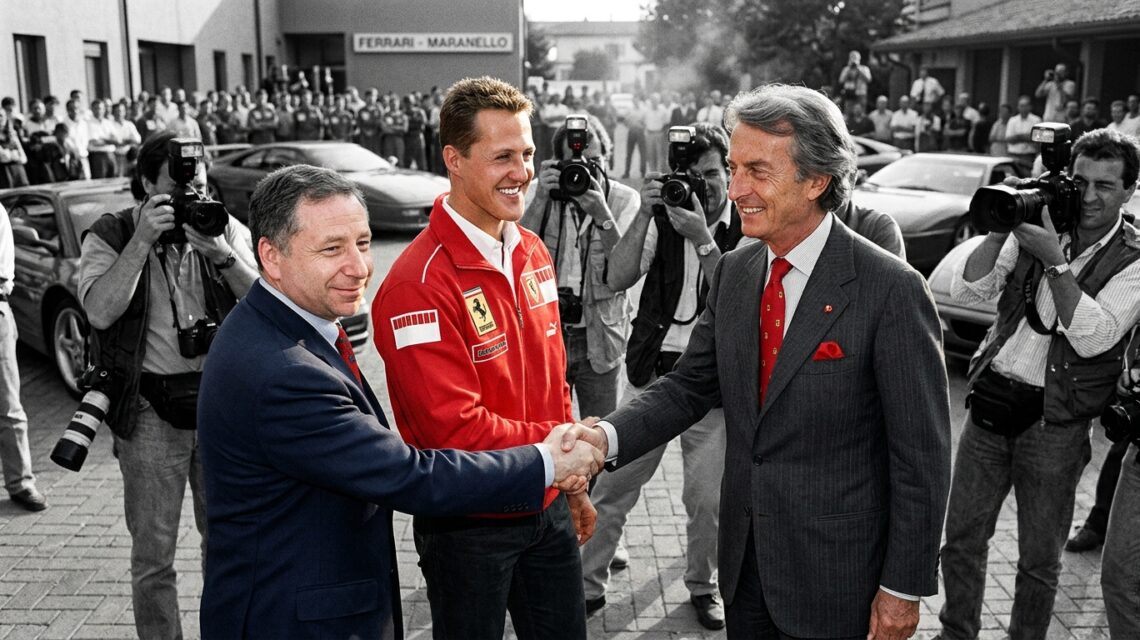
In 1996, Michael Schumacher arrived at Ferrari with two Formula 1 world championships, a reported annual salary approaching $30 million and an assignment that had defeated some of the sport’s greatest drivers: return the Italian team to the top of the world.
Ferrari had not won the Drivers’ Championship since Jody Scheckter in 1979. Its last Constructors’ Championship had come in 1983.
Schumacher was leaving Benetton, where he had won consecutive world titles in 1994 and 1995, for a team that had become synonymous with unfulfilled potential.
The financial commitment was extraordinary. Contemporary reporting put Schumacher’s compensation in the region of $25 million to $30 million annually, making him one of the highest-paid athletes in international sport.
But the investment did not produce an immediate championship.
Ferrari won three races in 1996, challenged for the title in 1997 and 1998, and lost Schumacher to a broken leg for much of the 1999 season.
Only in October 2000, more than four years after his arrival, did Schumacher finally deliver Ferrari’s first Drivers’ Championship in 21 years.
What followed was one of the most successful periods in Formula 1 history: five consecutive Drivers’ Championships from 2000 to 2004 and six straight Constructors’ Championships from 1999 to 2004.
The most important part of Ferrari’s investment was not simply the enormous salary.
It was the decision to combine an exceptional driver with a technical and organizational structure capable of turning his abilities into sustained success.
Why Ferrari was desperate to sign Schumacher in 1995
Ferrari’s Formula 1 history was already legendary by the mid-1990s.
The team had won world championships with Alberto Ascari, Juan Manuel Fangio, John Surtees, Niki Lauda and Jody Scheckter.
Its red cars were among the most recognizable symbols in international motorsport.
But tradition was no guarantee of contemporary success.
After Scheckter’s title in 1979, Ferrari endured a long period without another Drivers’ Championship.
The team occasionally produced competitive cars and race-winning performances, but it struggled to maintain the consistency required to defeat its rivals over an entire season.
Williams, McLaren and Benetton had all developed more successful championship-winning structures.
Ferrari’s problems were not limited to the driver lineup.
Its cars could be fast but unreliable.
Technical development was sometimes inconsistent.
Internal management disputes complicated decision-making.
And the team faced enormous expectations from Italian supporters and the media.
Luca di Montezemolo, who became Ferrari president in 1991, wanted to change that culture.
Jean Todt joined as general manager of Ferrari’s racing operation in 1993.
Their objective was to build a more disciplined, internationally competitive organization.
Schumacher represented the most important available piece of that strategy.
He was not simply a fast driver.
He was a proven world champion with exceptional technical feedback, physical preparation and the ability to organize a team around a clear performance objective.
Schumacher left Benetton after winning two consecutive world championships
Schumacher’s decision to leave Benetton was unusual because he was departing a successful team.
He had won the 1994 Drivers’ Championship after a dramatic season-long contest with Damon Hill.
In 1995, he defended the title with nine Grand Prix victories.
Benetton also won the Constructors’ Championship that year.
Schumacher therefore had little sporting reason to leave immediately.
His team had demonstrated that it could produce championship-winning cars.
Ferrari offered a different opportunity.
It provided the chance to become the central figure in the revival of Formula 1’s most famous team.
The move also promised exceptional financial rewards.
For Schumacher, the decision combined ambition, prestige and risk.
Winning another championship with Benetton would have reinforced his status as one of the sport’s leading drivers.
Winning with Ferrari would carry a different historical significance.
He would be attempting to restore a team that had spent more than a decade searching for a sustainable route back to the top.
That challenge became one of the defining decisions of his career.
How much did Ferrari really pay Schumacher?
Schumacher’s initial Ferrari salary has often been reported at approximately $30 million annually.
That figure became central to the story of his arrival.
However, it should be treated as a contemporary estimate rather than an independently verified contractual amount.
Ferrari did not publicly disclose the complete financial terms of his private agreement.
A report published by Grandprix.com in November 1996, when Schumacher extended his Ferrari contract through the end of 1999, stated that the new agreement was believed to be worth more than $25 million annually.
The same report noted that Schumacher could earn additional income from merchandising and endorsements.
That distinction is important.
A driver’s total annual earnings can include several separate components.
The team salary is one element.
Performance bonuses may provide additional compensation.
Personal sponsorships, licensing and merchandising can produce further income.
Schumacher’s commercial value was already substantial by the time he joined Ferrari.
His status as Germany’s first Formula 1 world champion made him particularly attractive to sponsors.
His move to Ferrari increased that visibility.
But the often-repeated $30 million figure should not be presented as an exact salary confirmed by a published Ferrari contract.
The available historical reporting supports the conclusion that Ferrari committed an exceptionally large amount of money to secure him.
It does not establish every detail of the original compensation package.
The 1996 Ferrari F310 was unreliable, but Schumacher still won three races
Schumacher’s first season in red demonstrated both the scale of Ferrari’s problems and the potential of its new driver.
The Ferrari F310 was the team’s first Formula 1 car powered by a V10 engine.
It represented a major technical transition.
But the car suffered from reliability problems and inconsistent performance.
Williams entered the season with a more competitive package.
Damon Hill won the Drivers’ Championship.
Ferrari finished second in the Constructors’ standings, but it was not a genuine title contender across the full season.
Schumacher nevertheless delivered three victories.
His first came at the Spanish Grand Prix in Barcelona.
The race was held in extremely wet conditions.
Schumacher started third but produced one of the most celebrated performances of his career, winning by more than 45 seconds.
The victory was significant because it came with a car that was generally inferior to the leading Williams.
It demonstrated his ability to extract exceptional performance in difficult conditions.
He won again at the Belgian Grand Prix at Spa-Francorchamps.
His third victory came at Monza, Ferrari’s home race.
That success was particularly important emotionally.
Ferrari had not won the Italian Grand Prix since 1988.
Schumacher’s victory in front of the team’s supporters reinforced the belief that the partnership could succeed.
The results did not solve Ferrari’s structural problems.
But they provided evidence that the driver was capable of winning even before the team had produced a championship-caliber car.
Ross Brawn and Rory Byrne became central to Ferrari’s reconstruction
Ferrari’s transformation accelerated after Schumacher’s first season.
The team recruited Ross Brawn, who had worked with Schumacher at Benetton.
Brawn became Ferrari’s technical director.
His arrival brought experience in race strategy, engineering management and championship-winning operations.
Ferrari also recruited designer Rory Byrne.
Byrne had played a major role in developing Benetton’s successful cars during Schumacher’s championship years.
After leaving Benetton, he had initially planned to step away from Formula 1.
He was persuaded to join Ferrari and help rebuild its technical department.
The combination was important.
Schumacher provided driving performance and detailed feedback.
Brawn helped coordinate engineering development and race operations.
Byrne led the design of the cars.
Jean Todt managed the broader organization.
Together, they established a more integrated approach to competition.
The success was not the work of one individual.
Ferrari’s engine department, aerodynamicists, mechanics, strategists and manufacturing staff all contributed.
But the arrival of Brawn and Byrne helped create a leadership structure with experience of winning championships.
The team increasingly developed its cars around a coherent technical philosophy.
That was a major change from the instability that had characterized earlier periods.
Ferrari came close in 1997, but Schumacher was disqualified from the championship standings
The 1997 season demonstrated how quickly Ferrari had improved.
Schumacher won five races and entered the final Grand Prix at Jerez with a one-point lead over Jacques Villeneuve.
The championship would be decided in Spain.
During the race, Schumacher and Villeneuve collided while fighting for position.
Schumacher retired.
Villeneuve continued and secured the points required to win the world championship.
The FIA subsequently investigated the collision.
Officials concluded that Schumacher had deliberately caused the incident.
He was disqualified from the 1997 Drivers’ Championship standings.
His race victories and individual results remained part of the historical record, but his championship classification was removed.
The incident was a serious setback.
It also showed how close Ferrari had come to ending its long title drought.
Only one season after Schumacher’s arrival, the team had taken the championship battle to the final race.
The car was improving.
The technical structure was becoming more effective.
But the championship remained out of reach.
Schumacher challenged again in 1998, then broke his leg in 1999
Ferrari continued progressing in 1998.
Schumacher won six races and challenged McLaren’s Mika Häkkinen for the Drivers’ Championship.
The title was decided at the Japanese Grand Prix.
Häkkinen won the race and the championship.
Schumacher finished second in the standings.
The result was another disappointment, but it confirmed that Ferrari had become a consistent title contender.
The following year brought a different obstacle.
At the 1999 British Grand Prix at Silverstone, Schumacher crashed heavily after a braking problem.
He suffered a broken leg.
The injury forced him to miss six races.
Ferrari continued its championship campaign with Eddie Irvine and substitute driver Mika Salo.
Irvine came close to winning the Drivers’ Championship, finishing two points behind Häkkinen.
Ferrari nevertheless won the Constructors’ Championship.
It was the team’s first constructors’ title since 1983.
That achievement was a major milestone.
It showed that Ferrari had become strong enough to win a championship even without Schumacher competing throughout the season.
The organization was no longer dependent solely on individual brilliance.
It had developed the technical depth and operational consistency required for sustained success.
The next step was ending the Drivers’ Championship drought.
The 2000 Japanese Grand Prix ended Ferrari’s 21-year wait
The 2000 season became the decisive breakthrough.
Schumacher and Häkkinen again fought for the championship.
Ferrari’s F1-2000 was one of the most competitive cars the team had produced in years.
Schumacher won races in Australia, Brazil, San Marino, Europe, Canada, Italy and the United States.
But the championship remained close.
The decisive moment came at the Japanese Grand Prix at Suzuka.
Schumacher started from pole position.
Häkkinen initially took the lead.
Ferrari’s strategy and Schumacher’s pace during the pit-stop sequence allowed him to regain the advantage.
He won the race.
The result secured his third Drivers’ Championship and Ferrari’s first since 1979.
The 21-year drought was over.
Schumacher became the first Ferrari driver to win the world championship since Jody Scheckter.
The achievement carried enormous emotional significance for the team.
It also validated the long-term strategy that had begun with his arrival in 1996.
Ferrari had not purchased an immediate championship.
It had invested in a driver who could help lead a multiyear reconstruction.
The success required technical recruitment, organizational reform, better cars and sustained development.
By 2000, those elements had finally come together.
Ferrari then won five consecutive Drivers’ Championships
The 2000 title was only the beginning.
Schumacher defended his championship in 2001.
He won again in 2002, producing one of the most dominant seasons in Formula 1 history.
That year, he finished on the podium in all 17 races.
He won 11 of them.
In 2003, he secured his sixth Drivers’ Championship, surpassing Juan Manuel Fangio’s long-standing record of five titles.
In 2004, Schumacher won 13 of the season’s 18 races.
He claimed his seventh world championship.
The five consecutive titles from 2000 through 2004 established a record that remains one of the sport’s most extraordinary achievements.
Ferrari’s success was even broader.
The team won six consecutive Constructors’ Championships from 1999 through 2004.
That streak reflected the strength of the entire organization.
Schumacher was the central figure, but Ferrari’s dominance also depended on teammates, engineers, strategists and technical development.
The team’s combination of speed, reliability and race execution became a benchmark for its competitors.
The investment made in the mid-1990s had produced sustained sporting success.
What Ferrari achieved during the Schumacher era
| Milestone | Result |
|---|---|
| Schumacher joins Ferrari | 1996 |
| Reported annual salary | Approximately $25 million to $30 million |
| Previous Drivers’ Championship | 1979, Jody Scheckter |
| Previous Constructors’ Championship | 1983 |
| First Ferrari victory | 1996 Spanish Grand Prix |
| Ferrari wins in Schumacher’s first season | 3 |
| First Constructors’ title of the new era | 1999 |
| First Schumacher Drivers’ title with Ferrari | 2000 |
| Consecutive Drivers’ titles | 5, from 2000 to 2004 |
| Consecutive Constructors’ titles | 6, from 1999 to 2004 |
| Schumacher’s total Ferrari victories | 72 |
| Schumacher’s total Ferrari Drivers’ Championships | 5 |
| Schumacher’s total career Drivers’ Championships | 7 |
The figures show why Ferrari’s decision became one of the most successful driver acquisitions in Formula 1 history.
Schumacher delivered 72 Grand Prix victories for the team.
He won five world championships in Ferrari colors.
And he helped create a period of sustained dominance that transformed the team’s competitive reputation.
The salary was enormous.
But the sporting return was equally exceptional.
Did Schumacher’s success generate billions for Ferrari?
The financial impact of Schumacher’s Ferrari career was substantial, but it is difficult to quantify precisely.
His victories increased the team’s global visibility.
Ferrari became closely associated with one of the most successful athletes in the world.
The partnership attracted enormous media attention and reinforced the brand’s international prestige.
Major sponsors benefited from the exposure generated by the team’s success.
Ferrari also developed a powerful commercial identity around Schumacher and its championship-winning cars.
However, claims that his salary directly generated billions of dollars in additional road-car sales are not supported by a simple, publicly verified calculation.
Ferrari’s road-car business operates in a different market from Formula 1.
Its sales depend on production capacity, pricing, product development, customer demand and broader economic conditions.
Racing success can strengthen brand prestige, but it is only one factor.
The company also maintained a deliberate strategy of limited production and exclusivity.
That makes it difficult to isolate the financial contribution of one driver.
Schumacher’s success almost certainly enhanced Ferrari’s global visibility and sporting reputation.
But assigning a specific multibillion-dollar return to his original salary would require detailed financial evidence that is not publicly established.
The strongest measurable return is sporting.
Ferrari went from a 21-year Drivers’ Championship drought to five consecutive titles.
It also won six straight Constructors’ Championships.
Those achievements are documented and directly connected to the period of reconstruction in which Schumacher played a central role.
The Schumacher deal changed Ferrari because it was part of a larger plan
The most important lesson of Schumacher’s move is that an expensive driver alone cannot guarantee success.
Ferrari already had a famous name, substantial resources and a passionate global following.
What it lacked was the consistent technical and organizational structure required to win championships.
Schumacher’s arrival helped change that.
He brought exceptional driving ability, relentless preparation and detailed technical feedback.
But Ferrari also needed Jean Todt’s leadership, Ross Brawn’s engineering management, Rory Byrne’s design expertise and the work of hundreds of specialists.
The team had to improve reliability.
It had to develop faster cars.
It had to make better strategic decisions.
And it had to maintain that performance across multiple seasons.
The process took years.
Schumacher’s first Ferrari title did not arrive until 2000.
By then, the team had already experienced major disappointments, including the 1997 disqualification, the 1998 championship defeat and Schumacher’s injury in 1999.
The eventual success was therefore not the result of a single expensive contract.
It was the outcome of a sustained investment in people, technology and management.
Ferrari’s $30 million gamble became one of Formula 1’s defining partnerships
When Schumacher left Benetton for Ferrari, he was already a two-time world champion.
He could have remained with a team that had recently demonstrated its ability to win.
Instead, he accepted the challenge of rebuilding a struggling giant.
Ferrari responded with one of the largest financial commitments Formula 1 had seen.
The reported $30 million annual salary reflected the team’s determination to secure the sport’s most valuable driver.
But the partnership’s true significance emerged gradually.
Three victories in 1996 showed that Schumacher could win with an imperfect car.
The 1997 and 1998 seasons demonstrated that Ferrari was becoming a championship contender.
The 1999 Constructors’ Championship proved the organization had developed the strength to win a title.
The 2000 Japanese Grand Prix ended the Drivers’ Championship drought.
And the following four seasons turned the breakthrough into a period of extraordinary dominance.
Ferrari did not simply pay for a driver who could win races.
It invested in the central figure of a technical and organizational transformation.
The reported $30 million salary became one of the most famous numbers in Formula 1 history.
But the more important numbers came later: 72 Ferrari victories, five consecutive Drivers’ Championships and six straight Constructors’ titles.
Those achievements explain why the Schumacher-Ferrari partnership remains one of the defining success stories in motorsport.
+ Siga o Giro no Facebook
+ Siga o Giro no Instagram
Leia Mais: