

The Scottish cyclist built Old Faithful using washing-machine bearings and invented a radical riding position that helped him defeat a nine-year-old world record. But his greatest innovation eventually collided with cycling’s governing body.
By Marcio Tamer
Updated October 30, 2026
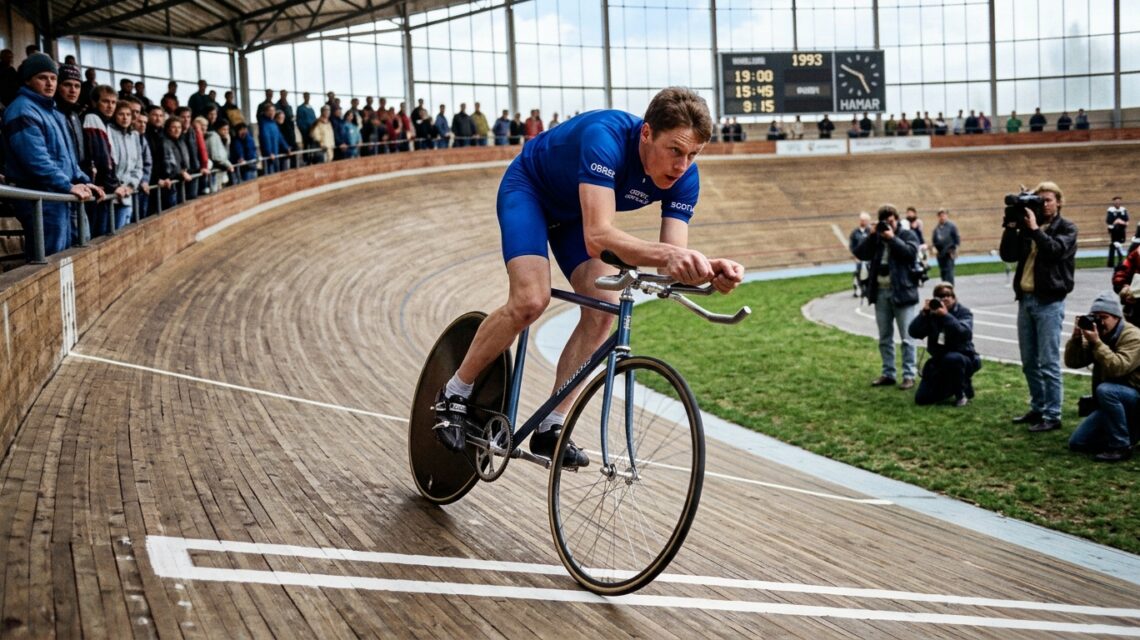
On July 17, 1993, Scottish cyclist Graeme Obree rode 51.596 kilometers in one hour at the Hamar velodrome in Norway, breaking a world record that had stood for nine years. His bicycle was not a cutting-edge machine developed by a major manufacturer. It was a homemade creation called Old Faithful, built with unconventional components, including bearings salvaged from a washing machine.
The achievement immediately made the 27-year-old one of cycling’s most remarkable innovators. Obree had surpassed the 51.151-kilometer record set by Italian champion Francesco Moser in 1984, using a bicycle and riding position that challenged established ideas about aerodynamic efficiency.
But his triumph lasted only six days.
On July 23, British rival Chris Boardman covered 52.270 kilometers in Bordeaux, France, taking the record away from Obree.
The Scottish cyclist responded the following year. On April 27, 1994, he returned to Bordeaux and covered 52.713 kilometers, reclaiming the world hour record with the same radical approach to aerodynamics.
The two performances established Obree as much more than an eccentric inventor.
They also placed him at the center of a technical dispute with the Union Cycliste Internationale (UCI), which subsequently prohibited the compact riding position that had helped make him famous.
Obree answered by inventing another aerodynamic posture, winning another world championship and forcing cycling to confront a question that remains relevant today: how much technological freedom should athletes have when pursuing a record?
Why Obree believed the cyclist’s body mattered more than an expensive bicycle
The world hour record has one of the simplest formats in competitive cycling.
A rider starts on a velodrome and attempts to cover the greatest possible distance in exactly 60 minutes.
There are no teammates to provide shelter from the wind, no downhill sections and no opportunities to recover behind another rider.
Success depends on sustained power, pacing, endurance and aerodynamic efficiency.
At the speeds required to challenge the record, overcoming air resistance consumes a substantial proportion of the cyclist’s energy.
Obree understood that reducing drag could be as important as increasing physical power.
The key was not simply to make the bicycle lighter.
It was to reduce the frontal area presented by the rider and bicycle to the airflow.
This led him toward an unconventional conclusion.
Instead of placing his arms forward in the usual racing position, he could bring them close to his body and reduce the space they occupied.
That idea became the foundation of his homemade bicycle.
Obree did not have the development budget of a major professional cycling team.
He relied on his own mechanical skills, experimentation and determination to test ideas that conventional manufacturers had not adopted.
The result was a bicycle designed around the position of its rider rather than the other way around.
How washing-machine bearings became part of Old Faithful
Obree built his record-breaking bicycle using a mixture of conventional components and parts adapted to his unusual design.
The machine became known as Old Faithful.
Its most famous feature was a set of bearings taken from a washing machine.
These were incorporated into the bicycle’s bottom bracket, the assembly that allows the crankset to rotate.
According to the National Museum of Scotland, Obree wanted a particularly narrow bottom bracket.
Conventional bicycle bearings did not suit the arrangement he had designed.
He experimented with washing-machine bearings to determine whether they could provide the required performance and fit.
The objective was not to create a magical friction-free drivetrain.
Bearings reduce friction, but no mechanical bearing eliminates it entirely.
The important advantage was that the salvaged components helped Obree achieve the narrow configuration he wanted.
That allowed his legs to move closer together and supported his broader aerodynamic concept.
Old Faithful also featured an unusual frame, a distinctive fork arrangement and a compact handlebar configuration.
Obree’s shoes were secured to the pedals, contributing to the highly specialized riding setup.
Each element was intended to improve efficiency.
The bicycle was unconventional because Obree had designed it around a specific aerodynamic problem.
The washing-machine bearings became the most memorable symbol of the project, but the real breakthrough came from the relationship between the machine and the rider’s position.
The revolutionary tuck position reduced the space Obree occupied in the wind
Obree’s most important innovation was the riding position commonly called the tuck or praying mantis position.
Instead of extending his arms forward, he folded them inward beneath his chest.
His elbows remained close to his body.
His hands rested on a narrow handlebar positioned unusually close to the saddle.
The posture resembled the compact stance adopted by downhill skiers seeking to minimize air resistance.
It reduced the rider’s exposed frontal area and changed the airflow around the upper body.
The National Museum of Scotland reports that the combination of Old Faithful and Obree’s riding position reduced aerodynamic drag by approximately 15%.
That figure is significant because even relatively small reductions in drag can make a substantial difference during a one-hour record attempt.
Obree was not merely trying to become stronger than his rivals.
He was attempting to make every watt of power produce more speed.
The position was uncomfortable and required adaptation.
It also demanded precise control of a bicycle whose handling differed from conventional racing machines.
But the potential reward was enormous.
If Obree could maintain the posture for an hour, he could compete against riders with more expensive equipment and larger support operations.
His first attempt showed how difficult that would be.
Obree failed on July 16, 1993, but returned to the track the next morning
On July 16, 1993, Obree attempted to break Francesco Moser’s world hour record at the Vikingskipet velodrome in Hamar.
The record stood at 51.151 kilometers.
Obree covered 50.689 kilometers.
He missed the mark by 462 meters.
Contemporary reporting from The Independent recorded the failed attempt and Obree’s determination to try again.
The effort was physically exhausting.
A world hour record attempt requires sustained maximal exertion, and riders normally devote substantial preparation to a single performance.
Obree nevertheless decided to return the following morning.
The decision was extraordinary because he had less than a day to recover from an effort that had already pushed him close to his physical limits.
There was also an important equipment distinction.
According to the National Museum of Scotland, Obree’s first attempt used a carbon replica of his original bicycle, built by the London bicycle shop Shorter with engineer Mike Burrows.
For the successful attempt, he returned to his own machine.
That detail makes the story more interesting than the familiar account of a rider simply trying twice on the same homemade bicycle.
The failed ride and the successful record were achieved on different versions of Obree’s design.
On July 17, 1993, Obree finally broke Moser’s nine-year-old record
The following morning, Obree returned to the Hamar track.
This time, he rode Old Faithful.
He adopted his compact tuck position and maintained the pace required to surpass Moser’s record.
After exactly one hour, the distance was confirmed.
Obree had covered 51.596 kilometers.
He had improved the world record by 445 meters.
The result was particularly striking because Moser’s previous mark had been established in Mexico City, where high altitude reduces air density and can provide an aerodynamic advantage.
Obree achieved his record at the Hamar velodrome in Norway, much closer to sea level.
The comparison made his performance especially impressive.
Moser had been one of cycling’s biggest stars, with major victories on the road and track.
Obree was a relatively unknown Scottish rider who had designed and assembled his own bicycle.
Yet the record books made no distinction between the resources available to the two men.
The only measurement that mattered was the distance traveled in 60 minutes.
Obree had gone farther.
The victory also demonstrated that his aerodynamic concept worked under the extreme demands of elite competition.
His invention was no longer simply an unusual bicycle.
It was a world-record machine.
Chris Boardman took the record just six days later
Obree’s first reign as world hour record holder was remarkably short.
On July 23, 1993, fellow British cyclist Chris Boardman attempted the record in Bordeaux.
Boardman was already an Olympic champion.
He had won the individual pursuit at the 1992 Barcelona Games and was one of the most technically sophisticated riders of his generation.
His equipment reflected a different approach to aerodynamic innovation.
While Obree had built Old Faithful around an unconventional compact riding position, Boardman used a highly developed aerodynamic bicycle.
Boardman covered 52.270 kilometers in one hour.
He became the first rider to exceed 52 kilometers under the record conditions of that period.
Obree’s achievement had lasted only six days.
But the rivalry was far from over.
Later in 1993, Obree defeated Boardman in the semifinals of the World Individual Pursuit Championship.
He went on to win the world title.
The victory confirmed that Obree’s success was not limited to a single record attempt.
He was capable of defeating elite international competitors in direct competition.
The rivalry also illustrated two different approaches to cycling performance.
Boardman represented highly sophisticated equipment development.
Obree relied on unconventional engineering, aerodynamic experimentation and exceptional athletic ability.
Both were pushing the sport toward new limits.
Obree reclaimed the hour record in April 1994 with 52.713 kilometers
On April 27, 1994, Obree returned to the world hour record.
This time, the venue was Bordeaux, France.
The target was Boardman’s 52.270 kilometers.
Obree again used his compact aerodynamic position.
After one hour, he had traveled 52.713 kilometers.
He had improved Boardman’s record by 443 meters.
The performance was even faster than his breakthrough ride in Hamar.
It also confirmed that his 1993 achievement had not been a one-off success.
Obree had now broken the world hour record twice.
The progression was remarkable.
In July 1993, he had surpassed Moser’s nine-year-old record by 445 meters.
Six days later, Boardman had taken the mark beyond 52 kilometers.
Less than a year afterward, Obree reclaimed it with another substantial improvement.
The sequence demonstrated how quickly the world hour record was changing during the 1990s.
New aerodynamic positions and bicycle designs were producing major gains.
But that rapid development also raised concerns among cycling officials.
The UCI faced increasing pressure to decide which innovations should be permitted and how to compare performances achieved with different technologies.
Obree’s unusual position became one of the central issues in that debate.
Why the UCI banned Obree’s original riding position
The UCI eventually prohibited the compact tuck position that Obree had used to break the hour record.
The restriction emerged during the 1994 season and affected his participation in major competitions.
The governing body’s concern extended beyond one cyclist.
Cycling was experiencing rapid technological change.
Aerodynamic frames, specialized handlebars, unconventional riding positions and increasingly sophisticated equipment were transforming record performances.
Officials faced a difficult question.
Should the sport allow virtually unlimited technical experimentation, or should it establish boundaries to preserve a recognizable relationship between athletic performance and equipment?
Obree’s position challenged conventional expectations about how a racing bicycle should be ridden.
Its aerodynamic advantages were substantial.
Other riders had begun experimenting with similar techniques.
The UCI responded by restricting the posture.
The decision was controversial because it removed an advantage Obree had developed through his own ingenuity.
But the available evidence does not justify presenting the ban as proof that the governing body acted solely out of hostility toward an independent Scottish inventor.
The dispute was part of a broader regulatory struggle over cycling technology.
Obree’s case became especially famous because his unconventional equipment had already produced world records.
The rule change forced him to rethink his approach.
Once again, he responded by inventing something new.
The Superman position became Obree’s second aerodynamic revolution
After the tuck position was prohibited, Obree developed another radical riding posture.
Instead of folding his arms beneath his chest, he extended them far forward.
The new arrangement became known as the Superman position.
The posture allowed the rider to maintain a flatter back and a streamlined upper body.
It offered another way to reduce aerodynamic drag.
Obree used the position to win the individual pursuit world championship in 1995.
It was his second world title in the discipline, following his victory in 1993.
The achievement demonstrated his ability to adapt.
He had lost the right to use the position that made him famous, but he developed a new one and returned to the top of international competition.
The Superman position also influenced other elite riders.
Chris Boardman later used an extended aerodynamic position to set a world hour record of 56.375 kilometers in 1996.
The UCI subsequently prohibited the Superman position as well.
Obree had now developed two unconventional aerodynamic techniques that achieved major competitive success before being restricted by the sport’s governing body.
The sequence made him one of cycling’s most influential technical innovators.
The hour record rules later changed again
The controversy surrounding Obree and other aerodynamic innovators contributed to a broader debate about how cycling records should be classified.
By the late 1990s, the world hour record had become increasingly dependent on specialized equipment and unconventional positions.
The UCI eventually introduced restrictions intended to bring record attempts closer to traditional bicycle configurations.
In 2000, the governing body established a distinction between the traditional hour record and performances achieved using more advanced aerodynamic equipment.
This resulted in the reclassification of several historic performances.
Eddy Merckx’s 1972 record of 49.431 kilometers became the reference point for the more restrictive category.
The changes were controversial because they altered how performances from different technological eras were compared.
The UCI revised its approach again in 2014.
It adopted rules allowing equipment consistent with contemporary track endurance competition, ending the earlier requirement to use a bicycle closely resembling Merckx’s 1972 machine.
The evolution of the hour record demonstrates that Obree’s dispute was part of a much larger issue.
Cycling has repeatedly struggled to define the relationship between human performance and technological innovation.
Obree’s homemade bicycle exposed that tension in one of its most memorable forms.
What made Old Faithful different from conventional record-breaking bicycles?
| Feature | Graeme Obree’s Old Faithful |
|---|---|
| Designer and builder | Graeme Obree |
| Country | Scotland, United Kingdom |
| Famous component | Washing-machine bearings |
| Component location | Bottom bracket |
| Original riding position | Compact tuck, also called praying mantis |
| Aerodynamic objective | Reduce the rider’s frontal area and drag |
| First successful hour record | July 17, 1993 |
| Venue | Hamar, Norway |
| Distance in 1993 | 51.596 km |
| Previous record | Francesco Moser, 51.151 km |
| Improvement in 1993 | 445 meters |
| Second hour record | April 27, 1994 |
| Venue | Bordeaux, France |
| Distance in 1994 | 52.713 km |
| Improvement over Boardman | 443 meters |
| World pursuit titles | 1993 and 1995 |
| Later riding innovation | Superman position |
| Present location of Old Faithful | National Museum of Scotland, Edinburgh |
The figures reveal the scale of Obree’s achievement.
He did not merely break a world record once.
He reclaimed it after another rider had surpassed his performance.
His two successful attempts were separated by less than a year, yet the second covered more than one additional kilometer.
That improvement reflected the rapid evolution of elite cycling during the period.
It also demonstrated the continued effectiveness of Obree’s aerodynamic approach.
Old Faithful is now preserved in a Scottish museum
The original Old Faithful bicycle survives.
It is part of the collection of the National Museum of Scotland in Edinburgh.
The museum identifies the machine as an important example of sporting and engineering innovation.
Its significance extends beyond the famous washing-machine bearings.
The bicycle demonstrates how an individual inventor challenged established technical assumptions without the resources of a major manufacturer.
Obree approached the problem of cycling speed from first principles.
He considered the position of the rider, the width of the drivetrain, the shape of the frame and the aerodynamic consequences of conventional equipment.
The result was a machine that looked unusual because it was designed to solve a specific performance problem.
Its success forced the sport to reconsider what was possible.
The museum’s preservation of Old Faithful also reflects the bicycle’s cultural importance.
It has become a symbol of independent invention, persistence and the tension between sporting innovation and regulation.
Obree’s legacy extends beyond two world records
Graeme Obree’s career was shaped by more than his achievements on the track.
He has spoken publicly about serious mental health struggles, financial difficulties and the pressures he faced during his sporting career.
His autobiography, The Flying Scotsman, explored those experiences.
His story was later adapted into a feature film.
But the historical significance of his cycling achievements does not depend on portraying personal adversity as the source of his engineering talent.
Obree succeeded because he combined exceptional athletic ability with an unusually inventive approach to bicycle design.
He understood that aerodynamic efficiency could transform performance.
He built equipment to test that belief.
He endured a failed record attempt and returned the following morning.
He lost the world record after six days and reclaimed it the next year.
When the UCI restricted his original riding position, he developed another one and won a second world championship.
The most revealing part of his story is that the bicycle itself was never the complete invention.
The real innovation was the system he created around the rider’s body.
The narrow bottom bracket, compact handlebars and unusual posture all served the same objective: reducing the energy required to move through the air.
The washing-machine bearings became the memorable detail, but they were only one part of a much larger idea.
On July 17, 1993, that idea carried Obree 51.596 kilometers in one hour.
On April 27, 1994, it carried him 52.713 kilometers.
Those two distances remain the clearest evidence of what his homemade experiment achieved.
+ Siga o Giro no Facebook
+ Siga o Giro no Instagram
Leia Mais: