


The 2013 agreement with Tottenham offered a cheaper immediate-payment option, a more expensive installment plan and a clause controlling the price disclosed to the press. Three years later, the documents exposed how football’s first €100 million transfer had been structured.
By Marcio Tamer
Updated November 2, 2026
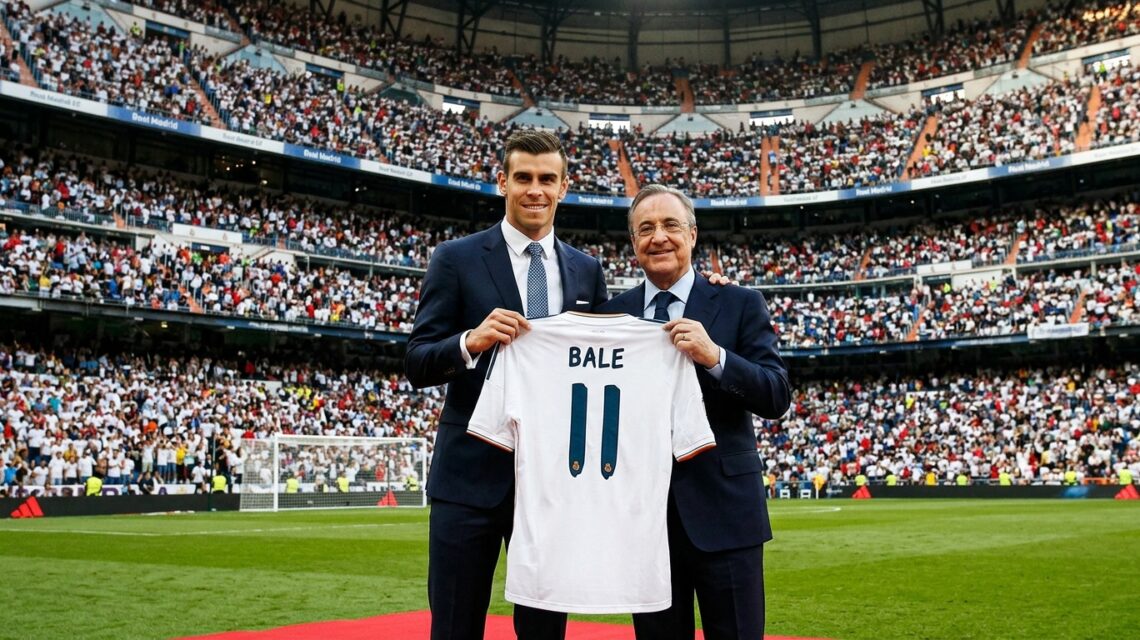
On September 1, 2013, Real Madrid announced the signing of Gareth Bale from Tottenham Hotspur, completing one of the most expensive transfers in football history.
The Spanish club maintained that the Welsh forward had cost approximately €91.6 million, less than the amount it had paid Manchester United for Cristiano Ronaldo four years earlier.
But in January 2016, a leaked six-page transfer agreement revealed a different financial picture.
According to documents published by Football Leaks and examined by Spanish and British media, Real Madrid had chosen a payment structure that brought the total transaction cost to approximately €100.76 million.
The agreement included four scheduled installments, an additional FIFA solidarity contribution and a clause specifying the lower figure Real Madrid could communicate publicly.
Tottenham, meanwhile, was restricted from disclosing the deal’s financial terms.
The revelation established that Bale’s transfer had exceeded the €100 million threshold, surpassing the approximately €94 million to €96 million commonly attributed to Ronaldo’s 2009 move.
But the most revealing aspect was not simply the difference between the two prices.
Real Madrid had reportedly been offered a cheaper option if it paid immediately. Instead, it selected a more expensive arrangement that spread payments across several years.
The decision illustrates an important principle of football finance: the headline transfer fee, the actual payment schedule and the accounting treatment of a player are not necessarily the same thing.
Why Real Madrid wanted Gareth Bale in 2013
Bale arrived at the Santiago Bernabéu after an exceptional season with Tottenham.
In 2012-13, the Welsh international scored 21 Premier League goals and became one of the competition’s most dangerous attacking players.
His combination of pace, long-range shooting and ability to decide matches made him an attractive target for Europe’s biggest clubs.
He also won the Professional Footballers’ Association Player of the Year and Young Player of the Year awards.
For Real Madrid president Florentino Pérez, Bale represented both a sporting opportunity and a high-profile addition to the club’s global brand.
Madrid had not won the Champions League since 2002.
Barcelona had dominated significant periods of Spanish football, while Madrid continued pursuing its tenth European title.
Cristiano Ronaldo was already the team’s leading star.
Karim Benzema provided another established attacking option.
Adding Bale promised to create one of Europe’s most formidable forward lines.
But Tottenham chairman Daniel Levy was unwilling to lose the club’s most valuable player cheaply.
Negotiations continued throughout the summer.
The eventual agreement became a landmark transaction, both for its size and for the financial details revealed later.
The leaked agreement showed two different ways to pay
The contract, dated August 31, 2013, reportedly established different financial outcomes depending on how Real Madrid paid Tottenham.
One option involved an accelerated payment.
The other spread the transfer consideration across several years.
Contemporary reporting based on the leaked document identified a nominal contractual figure of approximately €91,589,842, with a discount available under the immediate-payment option.
The cheaper option would have reduced the payment to approximately €87.01 million, according to Spanish reporting.
But Madrid chose the installment arrangement.
That increased the consideration payable to Tottenham to approximately €99.74 million.
After adding the FIFA solidarity contribution of roughly €1.02 million, the total reached approximately €100.76 million.
This distinction matters because the additional amount was associated with the contractual payment structure.
It should not automatically be described as interest charged by a particular bank.
The leaked agreement established the different prices and scheduled payments.
It did not, by itself, prove that a named financial institution supplied a dedicated loan covering the entire transfer.
The four-installment structure spread the cost until 2016
The installment option allowed Real Madrid to distribute its payments over several years.
Reporting on the leaked contract identified three scheduled payments of approximately €24.94 million, followed by a final installment denominated in pounds sterling.
The final payment was due in July 2016.
The structure reduced the need to transfer the entire sum immediately.
That was commercially useful even for a club with substantial annual revenue.
A football club may have valuable assets, major sponsorship agreements and considerable turnover without holding enough unrestricted cash to fund every transfer upfront.
Installments preserve short-term liquidity.
They also allow the buying club to coordinate transfer payments with other incoming and outgoing cash flows.
But deferred payment can increase the agreed price.
Bale’s transfer provided an unusually clear example.
The immediate-payment option was cheaper.
The installment option cost more.
Real Madrid chose flexibility over the lowest available nominal price.
That choice helped push the transaction beyond €100 million.
Why Real Madrid publicly maintained a lower transfer fee
The leaked document reportedly included a provision governing how the transfer would be described publicly.
According to reporting by AS, The Guardian and other outlets, the agreement specified that Real Madrid would announce the transfer at approximately €91.6 million.
Tottenham was not permitted to reveal the financial details.
That clause is one of the most unusual aspects of the transaction.
It shows that the clubs were concerned not only with payment obligations but also with how the deal would be presented.
The publicly circulated price differed from the total payable under the selected installment arrangement.
This created a long-running dispute over whether Bale or Ronaldo held the world transfer record.
At the time, Madrid’s public position preserved Ronaldo’s status as the more expensive signing.
But the existence of a controlled public figure does not establish every reason behind the decision.
The club may have had sporting, commercial, reputational or negotiating considerations.
The available evidence does not prove that protecting Ronaldo’s feelings was the sole or decisive motive.
Was the lower price intended to protect Cristiano Ronaldo’s status?
The Ronaldo explanation became one of the most widely repeated stories surrounding Bale’s transfer.
Real Madrid had signed Ronaldo from Manchester United in 2009 for a then-record fee commonly reported at approximately €94 million, with some accounts using €96 million depending on conversion and reporting conventions.
Bale’s transfer threatened to exceed that benchmark.
A higher fee could have created questions about status within the squad.
In January 2016, journalist Jonathan Northcroft said he had been asked not to raise the transfer-price comparison during an interview with Bale because Ronaldo disliked the suggestion that another player had cost more.
That account supports the idea that the issue was sensitive.
But it is not equivalent to documentary proof that the transfer agreement was designed primarily to satisfy Ronaldo.
The leaked contract reportedly established a public-disclosure clause.
It did not contain a statement explaining that the clause existed to protect the Portuguese forward’s ego.
The distinction is essential.
The price discrepancy was documented.
The explanation involving Ronaldo remained an interpretation supported by contemporary reporting, rather than a conclusively established contractual motive.
The €100.76 million figure included a FIFA solidarity payment
The final reported total requires another distinction.
The approximately €99.74 million payable to Tottenham was not identical to the complete cost associated with the transaction.
The leaked documents also identified an additional amount linked to FIFA’s solidarity mechanism.
Under FIFA’s rules, certain international transfers require contributions to clubs involved in a player’s training and development.
The system is intended to distribute a portion of transfer compensation to eligible training clubs.
In Bale’s case, reporting identified an additional contribution of approximately €1.02 million.
Adding that amount to the installment consideration produced the widely cited total of approximately €100.76 million.
That figure is therefore broader than the amount Tottenham was scheduled to receive under the principal installment arrangement.
It is also different from Bale’s wages, bonuses and other employment-related costs.
Those expenses were separate from the transfer consideration.
When comparing historic transfers, the definition of the fee matters.
Some figures include additional contractual charges or solidarity obligations.
Others refer only to the compensation paid to the selling club.
A consistent comparison is necessary before declaring a record.
The leaked contract contained other unusual protections for Tottenham
The financial clauses were not the only surprising details.
The agreement reportedly included restrictions on Bale making negative comments about Tottenham, its chairman or club employees.
Tottenham also negotiated protections concerning a potential future move back to the Premier League.
The contract included a right of first refusal in certain circumstances.
It also reportedly provided for additional compensation if Bale moved to another Premier League club within a specified period.
These provisions reflected Tottenham’s negotiating position.
The club was selling its most valuable player to one of Europe’s wealthiest teams.
But it still sought to protect its commercial and sporting interests.
A right of first refusal could provide an opportunity to bring Bale back if he later became available.
Restrictions on a rapid transfer to another English club could help prevent Tottenham from strengthening a domestic rival shortly after the sale.
The clauses also demonstrate how modern football transfers extend beyond a single fee.
Agreements may contain future-sale provisions, confidentiality requirements, payment conditions and other obligations.
The headline price is only one part of the legal arrangement.
Did Bankia and Santander finance the Bale transfer?
Claims about the banking arrangements behind Bale’s transfer require particular caution.
Some accounts have linked the transaction to major Spanish financial institutions, including Bankia and Santander.
Real Madrid had established banking relationships and access to credit facilities.
Its financial statements also recorded borrowings and obligations arising from player transfers.
But those general facts do not prove that Bale’s acquisition was funded through a dedicated Bankia-Santander financing package.
Nor do they establish that the transaction was secured against future stadium income, Adidas sponsorship payments or Emirates commercial revenue.
The leaked transfer agreement provides evidence about the payment obligations between Real Madrid and Tottenham.
It is not a complete record of Real Madrid’s internal treasury arrangements.
The distinction matters because installment payments and bank borrowing are not interchangeable.
A club can agree to pay a selling club over several years without borrowing the entire amount from a bank.
The selling club effectively accepts deferred settlement under the contract.
Bank guarantees may be used to secure those obligations, but the existence of a guarantee does not necessarily mean the buying club drew a loan for the full transfer price.
Without a verified financing agreement, attributing the transaction to specific banks or collateral arrangements would overstate the evidence.
Real Madrid had substantial revenue, but transfer obligations still mattered
Real Madrid was already one of the world’s largest football businesses in 2013.
The club generated hundreds of millions of euros annually through broadcasting, commercial agreements and matchday activity.
Its 2012-13 financial statements recorded revenue above €500 million.
That scale gave Madrid far greater financial flexibility than most European clubs.
But large revenue did not eliminate the need to manage debt and payment schedules.
Contemporary financial reporting showed that, as of June 30, 2013, Real Madrid had approximately €115 million in bank borrowings and around €127 million in future transfer-payment obligations.
The club also held substantial cash and receivables.
Those figures describe the broader financial position before Bale’s transfer was completed.
They should not be treated as evidence that a particular loan financed his signing.
The relevant financial question was how Madrid could manage a major acquisition alongside other player purchases, wages and operating expenses.
An installment arrangement offered flexibility.
It allowed the club to spread cash payments while immediately registering Bale as a player.
That was one reason the transfer could be financially attractive despite the higher overall consideration.
Transfer installments are different from accounting amortization
Bale’s deal also illustrates a common misunderstanding about football accounting.
The contract reportedly required payments over several years.
But that payment schedule was not the same as the accounting amortization of his registration.
When a club purchases a player’s registration, the transfer cost is generally recognized as an intangible asset.
The club then allocates that cost over the player’s contract term.
This accounting process is called amortization.
Bale signed a six-year contract when he joined Real Madrid.
Using a simplified €100 million registration cost, straight-line amortization over six years would amount to approximately €16.7 million annually.
That is an illustration, not a reconstruction of Madrid’s precise accounting entries.
The actual treatment depends on the recognized acquisition cost, contract terms and applicable accounting rules.
The important point is that a club can pay the selling club over four years while amortizing the player’s registration over six years.
The two schedules serve different purposes.
Installments determine when cash is paid.
Amortization determines how the acquisition cost is recognized in financial statements.
Confusing them can lead to misleading claims about how much a player costs in a particular season.
Bale’s arrival completed the BBC attacking trio
On the field, Bale joined Cristiano Ronaldo and Karim Benzema.
The three forwards became known as the BBC.
Their combination of speed, movement, finishing and counterattacking ability gave Real Madrid an exceptional attacking force.
Bale’s arrival also changed the team’s tactical options.
Ronaldo was already one of the world’s most productive goalscorers.
Benzema provided link-up play and movement.
Bale added explosive pace and a powerful left-footed shot.
The trio became central to Madrid’s attacking identity during one of the club’s most successful European periods.
But Bale’s contribution was not limited to his association with Ronaldo and Benzema.
He produced decisive individual performances in major finals.
Those moments became essential to how his transfer was remembered.
The €100 million signing delivered two decisive goals in 2014
Bale’s first season provided immediate evidence of his sporting value.
On April 16, 2014, Real Madrid faced Barcelona in the Copa del Rey final.
With the score tied at 1-1, Bale accelerated down the left wing, ran beyond defender Marc Bartra and scored the winning goal.
The strike became one of the most recognizable moments of his career.
A little more than a month later, Madrid faced Atlético de Madrid in the Champions League final in Lisbon.
Atlético led until Sergio Ramos equalized in stoppage time.
In extra time, Bale scored with a header to put Madrid ahead.
Real eventually won 4-1.
The victory delivered La Décima, the club’s tenth European Cup.
For a player signed at a record-breaking price, the timing was extraordinary.
Within his first season, Bale had scored decisive goals in two major finals.
The performances strengthened the argument that the transfer had delivered significant sporting value.
But sporting success and financial return are different measures.
Winning trophies can increase revenue and brand value.
It does not automatically prove that a particular player generated enough additional commercial income to repay his transfer fee.
The 2018 Champions League final strengthened Bale’s legacy
Bale’s most spectacular European moment came on May 26, 2018.
Real Madrid faced Liverpool in the Champions League final in Kyiv.
Bale began the match on the bench.
He entered in the 61st minute.
Two minutes later, he scored an extraordinary overhead kick from Marcelo’s cross.
The goal restored Madrid’s lead.
Bale later scored again with a long-range shot as Real won 3-1.
UEFA named him the final’s player of the match.
The performance helped Madrid win a third consecutive Champions League title.
It also ensured that Bale’s career would be remembered for more than his transfer fee.
He had delivered decisive goals in two Champions League finals.
Those achievements became part of the club’s modern European history.
Was Bale worth €100 million?
Evaluating Bale’s transfer requires separating sporting achievements from financial performance.
His nine seasons at Real Madrid included major successes.
According to the club’s official historical record, he won five Champions League titles, three La Liga titles and one Copa del Rey.
He also won four Club World Cups and three UEFA Super Cups.
His goals in the 2014 and 2018 Champions League finals were particularly important.
Those achievements support the argument that Bale made a substantial sporting contribution.
But his later years were more difficult.
Injuries affected his availability.
His relationship with sections of the Madrid fanbase deteriorated.
He spent the 2020-21 season on loan at Tottenham.
His final seasons in Spain produced fewer appearances and less consistent influence.
The financial assessment is therefore more complicated.
Madrid paid a historic transfer fee and committed to a long-term employment contract.
Bale helped the club win major trophies.
But the public record does not establish how much incremental revenue his presence generated through sponsorship, merchandise or other commercial activities.
It would be misleading to claim that shirt sales or marketing income definitively repaid the transfer cost without supporting financial evidence.
The sporting return is clear.
The precise commercial return is not.
Bale’s transfer in numbers
| Financial or sporting milestone | Figure |
|---|---|
| Transfer agreement dated | August 31, 2013 |
| Signing announced | September 1, 2013 |
| Publicly circulated transfer figure | Approximately €91.6 million |
| Reported immediate-payment option | Approximately €87.01 million |
| Installment consideration | Approximately €99.74 million |
| FIFA solidarity contribution | Approximately €1.02 million |
| Total reported transaction cost | Approximately €100.76 million |
| Payment schedule | Four installments |
| Final scheduled installment | July 2016 |
| Initial Real Madrid contract | Six years |
| Football Leaks disclosure | January 2016 |
| Champions League titles won with Madrid | Five |
| La Liga titles won with Madrid | Three |
| Copa del Rey titles won with Madrid | One |
| Real Madrid career | 2013-2022 |
| Retirement announced | January 9, 2023 |
The figures show why the transaction became a landmark.
The public price was lower than the amount ultimately associated with the selected payment structure.
The installment option gave Madrid financial flexibility.
The additional consideration helped push the transfer beyond €100 million.
And the player’s sporting contribution became part of one of the most successful periods in Real Madrid’s history.
The deal helped normalize nine-figure transfer fees
Bale’s transfer was not the first example of extreme spending in football.
Real Madrid had already broken records with major signings, including Luís Figo, Zinedine Zidane, Kaká and Cristiano Ronaldo.
Other clubs had also invested heavily in elite players.
But Bale’s move represented a new threshold.
A transfer worth more than €100 million was no longer theoretical.
It had become a documented commercial transaction.
The market continued evolving.
In 2016, Manchester United signed Paul Pogba from Juventus for a fee reported at approximately €105 million.
In 2017, Paris Saint-Germain paid Neymar’s €222 million release clause to Barcelona.
Those later deals were substantially larger.
But Bale’s transfer demonstrated that clubs were willing to structure nine-figure transactions through complex payment arrangements.
It also showed how transfer prices could become matters of public-relations management.
The number announced to supporters was not necessarily the full amount payable under the chosen contractual terms.
That became an important lesson for journalists, analysts and fans trying to compare football’s biggest transfers.
The most revealing clause was not about money alone
The leaked Bale agreement attracted attention because it appeared to settle the transfer-record debate.
Real Madrid had publicly maintained a lower price.
The documents showed a more expensive installment arrangement.
The total exceeded €100 million.
But the contract’s public-disclosure provision revealed something broader.
The clubs were not only negotiating the economic terms of the transfer.
They were also negotiating how those terms would be communicated.
That distinction matters in an industry where transfer fees influence reputation, negotiating leverage and expectations.
A club may want to demonstrate financial strength.
It may also want to avoid creating unnecessary pressure around a new signing.
A selling club may prefer confidentiality to protect future negotiations.
A player’s status can also become part of the public discussion.
Bale’s transfer brought all those issues together.
The documents supported the conclusion that Madrid and Tottenham agreed to restrict disclosure of the financial terms.
They did not establish every personal or strategic reason behind that decision.
The €100 million record became a financial case study
Bale left Real Madrid in 2022 after nine seasons.
He later joined Los Angeles FC and announced his retirement in January 2023.
By then, the transfer fee that had shocked football in 2013 was no longer the world record.
Other clubs had completed substantially larger deals.
But Bale’s agreement remained important because its structure became unusually visible.
The leaked documents revealed an immediate-payment option, a more expensive installment arrangement, additional solidarity obligations and restrictions on public disclosure.
The transaction demonstrated that the price of a footballer could depend on how and when the buying club paid.
It also showed that the figure presented publicly might differ from the complete contractual cost.
For Real Madrid, the sporting results included five Champions League titles and decisive performances in major finals.
For football finance, the lasting lesson was different.
A €100 million transfer was not simply a €100 million payment.
It was a negotiated package of timing, obligations, accounting consequences and public messaging.
The Bale deal became famous for breaking a financial barrier.
Its leaked contract explained how that barrier had actually been crossed.
+ Siga o Giro no Facebook
+ Siga o Giro no Instagram
Leia Mais: