


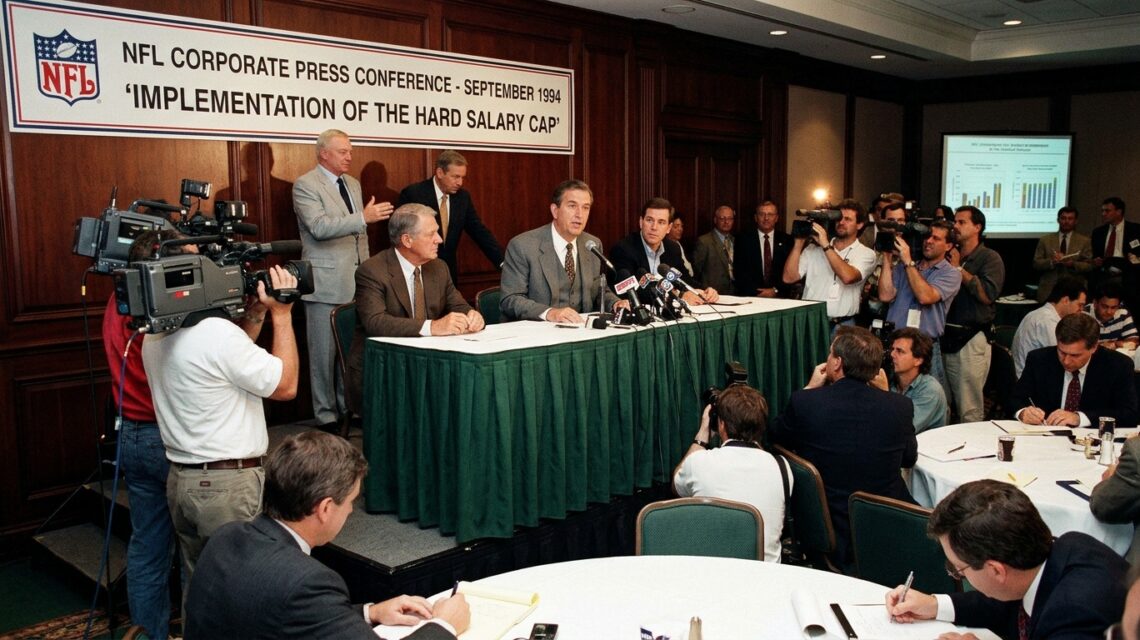
Green Bay receives the same national revenue distribution as Dallas and New York. The system began with a $4.65 million television contract in 1962 and now combines equal payments, payroll restrictions and local competition, without guaranteeing equal profits or championships.
By Marcio Tamer
Updated November 3, 2026
In 2026, the Green Bay Packers disclosed a figure that explains why the NFL operates differently from most major football competitions.
The franchise received $453.2 million in national revenue during its latest fiscal year.
The Dallas Cowboys received the same amount.
So did the New York Giants, Los Angeles Rams and the NFL’s other 28 teams.
Multiply the payment by 32 franchises and the result is approximately $14.5 billion in shared annual revenue.
The distribution is remarkable because the teams operate in dramatically different markets.
Green Bay is a Wisconsin city with a population of roughly 107,000.
Dallas and New York belong to metropolitan areas with millions of residents and enormous commercial opportunities.
Yet the league does not award its biggest national television payments according to local population, franchise valuation or championship success.
Each club receives an equal share.
The system is reinforced by another financial restriction.
For the 2026 season, the NFL established a base player salary cap of $301.2 million per team.
That means the wealthiest owners cannot simply spend unlimited amounts on player contracts to overpower smaller-market rivals.
Together, revenue sharing and payroll restrictions form the foundation of a business model sometimes described as billionaire socialism.
The phrase is provocative, but the underlying arrangement is real.
NFL owners compete fiercely for victories while cooperating to distribute a large portion of the industry’s income.
The result is a league in which even a small-market franchise can receive hundreds of millions of dollars before selling a single local sponsorship or premium stadium ticket.
Green Bay’s financial statements reveal the NFL’s economic engine
Most NFL teams are privately owned and do not publish detailed financial results.
The Packers are different.
They are owned by a nonprofit corporation with hundreds of thousands of shareholders.
The team publishes annual financial information, offering a rare view into the league’s economics.
Its latest report showed $453.2 million in national revenue.
That represented an increase from the previous year’s $432.6 million.
The Packers also generated approximately $299.8 million in local revenue.
Their combined revenue reached approximately $753 million.
The national payment accounted for about 60.2% of Green Bay’s total revenue.
The local portion accounted for the remaining 39.8%.
Those percentages are important.
The NFL’s shared revenue provides a substantial financial foundation.
But it does not eliminate the importance of local business operations.
Green Bay still earns money through ticket sales, stadium activities, sponsorships, concessions and other commercial arrangements.
A franchise in a larger market may have greater opportunities to generate income from those sources.
The NFL therefore combines equal national distributions with unequal local earnings.
It is not a system in which every club receives exactly the same total revenue.
The Dallas Cowboys still have a major financial advantage
The NFL’s revenue-sharing system does not erase every financial difference between franchises.
The Dallas Cowboys remain the clearest example.
Their brand, stadium and commercial operations generate exceptional local revenue.
AT&T Stadium offers premium seating, luxury suites, corporate hospitality and major event opportunities.
Those activities create revenue that does not necessarily flow equally to the other 31 teams.
The Cowboys have consistently ranked as the NFL’s most valuable franchise.
Their valuation reflects not only national media distributions but also local commercial strength, real estate and brand power.
That distinction explains why revenue sharing does not make every NFL business equally profitable.
Green Bay receives the same national distribution as Dallas.
But Dallas can generate substantially more money through its own commercial operations.
The two clubs also face different stadium costs, staffing expenses and other financial obligations.
Equal national revenue therefore creates a common foundation rather than identical financial results.
The system reduces one major source of inequality.
It does not eliminate every other one.
The financial revolution began in 1961, not with the salary cap
The NFL’s modern economic structure developed over several decades.
Its first major breakthrough came through television.
Before 1961, NFL teams negotiated many of their broadcasting agreements individually.
That created significant differences between large and small markets.
Teams in major cities could command higher fees because broadcasters valued their local audiences.
Smaller-market clubs had fewer opportunities.
Pete Rozelle, who became NFL commissioner in 1960, believed the arrangement threatened the league’s long-term competitive balance.
If wealthy franchises consistently earned more television revenue, they could gain financial advantages over smaller teams.
That could weaken the competition as a whole.
Rozelle proposed selling the league’s television rights collectively.
The idea was commercially attractive.
But it created an antitrust problem.
Federal law restricted competitors from combining to sell products under certain circumstances.
The NFL needed legal protection to negotiate broadcasting rights as a single organization.
Congress provided that protection through the Sports Broadcasting Act of 1961.
The law created a limited antitrust exemption for pooled television-rights agreements involving professional football, baseball, basketball and hockey.
It did not exempt the NFL from every antitrust law.
But it allowed teams to negotiate certain television packages collectively.
That decision helped establish the modern NFL’s financial model.
The first pooled TV contract paid $4.65 million per year
After Congress passed the Sports Broadcasting Act, the NFL negotiated a collective television agreement with CBS.
The contract paid approximately $4.65 million annually for the 1962 and 1963 seasons.
The money was divided equally among the league’s 14 teams.
Each franchise received approximately $332,000 per year.
The figure seems small compared with today’s distributions.
But it was transformative at the time.
Previously, some smaller-market teams had earned far less from individual broadcasting arrangements.
The pooled agreement gave every franchise access to the value of the national television audience.
It also strengthened the NFL’s negotiating position.
Broadcasters could purchase a coordinated package of games rather than negotiating separately with individual clubs.
The league could offer a more consistent national product.
That helped increase the value of future contracts.
In 1964, CBS agreed to pay approximately $14.1 million annually.
The new deal was roughly three times larger than the previous agreement.
The growth demonstrated the commercial power of collective negotiation.
It also established a principle that continues to define the league.
The national audience belongs to the competition as a whole, not exclusively to its largest franchises.
Why sharing television money makes the NFL more valuable
The logic behind revenue sharing is unusual because it asks competing businesses to cooperate.
A team wants to defeat its rivals.
But the league needs those rivals to remain financially viable.
A championship involving only a few competitive franchises would be less attractive to many fans.
The NFL therefore has an incentive to maintain a broad base of financially stable teams.
Equal national revenue helps achieve that objective.
A small-market franchise can pay competitive salaries, invest in facilities and maintain professional operations.
The system also protects the value of the league’s schedule.
Broadcasters purchase games involving teams from across the country.
They benefit when supporters believe their clubs have a realistic opportunity to compete.
The arrangement does not guarantee close games or equal championship probabilities.
But it reduces the extent to which local television-market size determines financial capacity.
That is a major difference from many European football leagues.
In European soccer, clubs often generate substantial portions of their income through international competitions, commercial sponsorships and other sources that vary sharply between teams.
The NFL centralizes a much larger part of its national media business.
That gives smaller franchises a more predictable revenue base.
The NFL’s current television contracts are worth roughly $110 billion
In March 2021, the NFL announced long-term media agreements with Amazon, CBS, ESPN/ABC, FOX and NBC.
The contracts began with the 2023 season and extend through 2033.
Industry reporting valued the package at approximately $110 billion over 11 years.
That represents an average of roughly $10 billion annually.
The agreements cover major television and streaming packages.
Amazon became the exclusive home of Thursday Night Football.
CBS and FOX retained major Sunday afternoon packages.
NBC continued Sunday Night Football.
ESPN and ABC expanded their NFL coverage.
The league also developed additional streaming arrangements, including Sunday Ticket through YouTube.
These contracts demonstrate the value of live NFL programming.
Football games attract large audiences at scheduled times.
That makes them particularly valuable to broadcasters and advertisers.
The NFL can negotiate from a position of strength because its games remain among the most-watched programs in American television.
The financial benefits extend across the league.
National media revenue contributes to the shared payments received by every franchise.
The salary cap arrived in 1994 and changed how teams compete
Revenue sharing alone does not prevent wealthy owners from spending more than their rivals.
A franchise with substantial local revenue could theoretically use that money to offer much larger player contracts.
The NFL addressed that issue through its salary cap.
The cap was introduced in 1994 as part of the collective bargaining system negotiated between the league and the NFL Players Association.
The first salary cap was approximately $34.6 million per team.
It established a limit on the amount of player compensation that could count against a club’s salary cap in a given season.
The system became known as a hard salary cap.
Unlike a soft cap, it does not generally allow teams to exceed the limit simply by paying a luxury tax.
Clubs must comply with the accounting rules.
Violations can trigger penalties.
The cap creates a common spending framework.
A wealthy owner cannot simply ignore the limit and purchase an unlimited collection of expensive players.
That helps protect competitive balance.
But the cap does not make every team’s actual payroll identical.
Contract structures, bonuses, unused cap space and other adjustments create differences.
The important point is that all teams operate under the same collective bargaining framework.
The 2026 salary cap reached $301.2 million
The NFL announced that the 2026 base salary cap would be $301.2 million per club.
That was an increase of $22 million from the 2025 figure of $279.2 million.
It also marked the first time the league’s base cap exceeded $300 million.
The growth has been substantial.
In 1994, the cap was $34.6 million.
By 2026, it had increased by approximately 770%.
The rise reflects the expansion of the NFL’s commercial business.
As league revenue grows, the collectively bargained player-compensation system allows more money to flow to athletes.
The cap therefore serves two purposes.
It restricts individual teams from spending without limit.
It also provides a mechanism through which players participate in the league’s financial growth.
The 2026 figure does not mean every team can spend exactly $301.2 million in identical circumstances.
Teams may carry over unused cap room from the previous season.
They may also have adjustments related to incentives and other accounting items.
The base cap is the common starting point.
Each club’s adjusted cap can differ.
A hard cap does not mean every player contract is paid in the same year
NFL salary-cap accounting is more complicated than simply adding up annual salaries.
A player may receive a large signing bonus when a contract is signed.
For salary-cap purposes, that bonus is generally allocated across multiple contract years, subject to league rules.
This allows teams to manage the timing of cap charges.
A club may pay substantial cash immediately while recognizing the cap cost over several seasons.
That creates flexibility.
But it also creates future obligations.
If a player leaves the team, previously allocated bonus amounts may accelerate into dead-money charges.
Those charges count against the cap even though the player is no longer on the roster.
The system therefore rewards careful financial planning.
Teams can restructure contracts to create short-term room.
But they cannot make the underlying obligations disappear.
The cap limits spending through accounting rules rather than by imposing an identical cash payroll on every franchise.
That distinction is essential to understanding how NFL teams build rosters.
The salary floor prevents owners from spending too little
A salary cap protects teams from unlimited competition for players.
But a cap alone could create another problem.
An owner might collect shared revenue while minimizing player spending.
The NFL’s collective bargaining agreement addresses that possibility through minimum cash-spending requirements.
Under the current agreement, each team must spend at least 90% of the cumulative salary caps in cash over the 2024-2026 period.
The league as a whole must meet a 95% cash-spending threshold over the same period.
These requirements are not calculated as a simple 90% minimum in every individual season.
A team can spend less in one year and more in another, provided it meets the cumulative requirement.
The distinction matters because cash spending and salary-cap accounting are different measures.
A large signing bonus may create substantial cash spending in one season while its cap charge is spread across several years.
The minimum-spending rules help ensure that players receive a substantial share of the league’s financial resources.
They also discourage owners from operating permanently below competitive spending levels.
If a team fails to meet the required threshold, the agreement provides for payments to affected players.
The system therefore combines spending limits with spending obligations.
Players receive approximately 48% of defined NFL revenue
The NFL’s collective bargaining agreement also determines how league revenue is allocated between players and owners.
Under the current framework, players receive a negotiated share of defined revenue.
The percentage varies depending on the applicable provisions and adjustments.
It is often summarized as approximately 48% of league revenue.
But that does not mean exactly 48 cents of every dollar received by every NFL-related business automatically becomes player salary.
The agreement contains detailed definitions, exclusions, adjustments and accounting procedures.
Player benefits are also part of the broader compensation system.
The salary cap is calculated after accounting for projected benefits and other negotiated components.
The 2026 base cap was $301.2 million.
NFL officials also identified approximately $77.6 million per club in player benefits.
Together, those amounts represented approximately $378.8 million per team in player costs and benefits.
That distinction explains why the salary cap alone does not capture the full economic cost of employing NFL players.
The league’s compensation system is designed to link player spending to the financial performance of the business.
Why the Packers can compete with much larger markets
Green Bay is the clearest example of the NFL’s financial structure.
The Packers operate in one of the smallest major professional sports markets in North America.
Their city has a population of roughly 107,000.
Yet the team receives the same national revenue distribution as franchises in much larger metropolitan areas.
That gives Green Bay a substantial financial foundation.
The salary cap also prevents larger-market teams from using unlimited player spending to overwhelm the Packers.
Green Bay can compete for free agents.
It can retain valuable players.
It can invest in scouting and player development.
The team still faces challenges.
Its local sponsorship opportunities differ from those available in New York, Los Angeles or Dallas.
Its commercial operations are shaped by the size and characteristics of its market.
But the NFL’s national revenue system reduces the importance of those differences.
The Packers have also built a powerful national fanbase.
Their history, community ownership and long-term success contribute to their commercial strength.
Green Bay’s viability therefore reflects both league-wide financial cooperation and the franchise’s own business development.
Revenue sharing does not guarantee equal profits
The claim that every NFL franchise earns the same profit is incorrect.
National revenue distributions are equal.
Total revenues are not.
Local commercial income varies.
Operating expenses vary.
Stadium financing arrangements vary.
Debt obligations also differ.
A team with a highly profitable stadium business may earn substantially more than a club with fewer premium seating opportunities.
A franchise that recently invested in a new stadium may face different costs from one operating an older facility.
The Packers’ public accounts demonstrate the distinction.
Their latest revenue totaled approximately $753 million.
Of that amount, $453.2 million came from national distributions.
The remaining $299.8 million was generated locally.
Other franchises may have much larger local revenue streams.
That means equal national payments do not produce equal financial outcomes.
The NFL’s structure reduces risk.
It does not eliminate it.
Nor does it guarantee that every team will report a profit in every accounting period.
The league’s financial stability is unusually strong, but claims of absolute protection from losses or insolvency go beyond the evidence.
The salary cap does not guarantee competitive parity
The NFL’s financial rules are designed to support competitive balance.
But they do not guarantee that every franchise has an equal chance of winning.
Teams differ in coaching quality, scouting, player development and management.
Quarterback performance is particularly important.
A franchise with an elite quarterback may enjoy a sustained competitive advantage.
Teams also benefit from successful drafting and efficient contracts.
The salary cap can make it difficult to retain every expensive player.
But well-managed organizations can remain competitive for long periods.
The New England Patriots won six Super Bowls with Tom Brady and Bill Belichick.
The Kansas City Chiefs later established another period of sustained success with Patrick Mahomes and Andy Reid.
Those examples show that the NFL can produce dynasties despite its financial restrictions.
The system limits one source of competitive advantage.
It does not eliminate differences in sporting competence.
That is why revenue sharing and the salary cap should be understood as mechanisms that support parity, not guarantees of unpredictable results.
The draft adds another layer of competitive balance
The NFL’s financial system operates alongside its player draft.
The draft generally gives weaker teams earlier selections.
That allows struggling franchises to acquire promising young players without competing in an unrestricted bidding market.
The system is designed to distribute new talent across the league.
Rookie contracts also operate under a structured compensation framework.
That reduces the immediate cost of acquiring high draft picks compared with an unrestricted market.
A successful draft can therefore provide substantial sporting value at a relatively controlled cost.
The draft does not guarantee success.
Teams can select the wrong players.
Prospects can fail to develop.
Injuries can disrupt careers.
But the system gives weaker teams access to talent that might otherwise be concentrated among the wealthiest franchises.
Combined with revenue sharing and the salary cap, the draft creates multiple mechanisms intended to prevent permanent financial and sporting dominance by a small group of clubs.
The NFL’s financial model in numbers
| Financial mechanism | Figure or rule |
|---|---|
| NFL franchises | 32 |
| National revenue received by each club in latest Packers report | $453.2 million |
| Total national revenue shared across 32 clubs | Approximately $14.5 billion |
| Packers local revenue | $299.8 million |
| Packers total revenue | Approximately $753 million |
| National revenue share of Packers total | Approximately 60.2% |
| First pooled NFL television contract | $4.65 million annually |
| First pooled contract seasons | 1962-1963 |
| Approximate payment per club in 1962 | $332,000 |
| Current major media agreements | 2023-2033 |
| Reported total value of major media package | Approximately $110 billion |
| Salary cap introduced | 1994 |
| First salary cap | $34.6 million |
| 2025 base salary cap | $279.2 million |
| 2026 base salary cap | $301.2 million |
| 2026 player benefits per club | Approximately $77.6 million |
| 2026 player costs and benefits per club | Approximately $378.8 million |
| Minimum team cash spending, 2024-2026 | 90% of cumulative salary caps |
| Minimum league-wide cash spending, 2024-2026 | 95% of cumulative salary caps |
The figures reveal how the NFL combines cooperation and competition.
National media income is shared.
Player spending is regulated.
Teams still compete for local revenue, talent and championships.
The result is a business model that supports small-market franchises without eliminating commercial differences between clubs.
The NFL is not literally a socialist business
The phrase billionaire socialism is frequently used to describe the NFL.
It captures the apparent contradiction of wealthy owners sharing revenue while competing in a capitalist sports market.
But the phrase is metaphorical.
The NFL is not a publicly owned economic system.
Most franchises are privately controlled businesses.
Owners can benefit from rising franchise valuations and operating profits.
The league’s revenue-sharing arrangements are negotiated among the teams.
They are designed to strengthen the value of the collective product.
The financial logic is commercial.
A stronger league can attract larger television audiences.
Larger audiences can support more valuable media contracts.
Those contracts increase the revenue available to every franchise.
The system therefore creates incentives for cooperation.
Owners may accept limits on individual financial freedom because those limits help protect the value of the league.
That is not the same as eliminating private ownership or equalizing all profits.
It is a form of coordinated business management within a professional sports competition.
Why European football operates differently
European football generally has a different economic structure.
Clubs compete in domestic leagues and international tournaments.
They generate revenue through broadcasting, sponsorship, ticket sales, merchandise and player transfers.
But the distribution of income can vary substantially.
Major clubs often have larger global fanbases and more valuable commercial agreements.
Participation in the Champions League can create additional financial advantages.
Domestic broadcasting distributions also differ between leagues.
Some competitions share substantial portions of television income relatively evenly.
Others allocate more money according to sporting performance or audience-related criteria.
European football also operates within a promotion-and-relegation system.
Clubs can move between divisions.
That creates financial risks that do not exist in the same form for established NFL franchises.
The NFL has a closed membership structure.
Its 32 franchises retain their places in the league regardless of their win-loss records.
That stability supports long-term commercial planning.
The two systems therefore differ in more than salary rules.
They have different ownership structures, competition formats and revenue arrangements.
The NFL’s model cannot be transferred directly to European football without changing fundamental features of the sport.
The real advantage is financial predictability
The NFL’s strongest financial feature may be predictability rather than equality.
A franchise can anticipate substantial national revenue distributions.
It operates under a collectively negotiated player-compensation system.
It has a permanent place in the league.
And it participates in a media business supported by long-term contracts.
Those conditions reduce uncertainty.
They make it easier to plan investments.
They also make franchises attractive to investors.
But the system does not remove every risk.
Local revenue can fluctuate.
Stadium projects can become expensive.
Management decisions can reduce profitability.
And teams can perform poorly for years despite receiving the same national distributions as their rivals.
The NFL’s financial rules protect the collective business more effectively than they guarantee the success of any individual franchise.
That distinction explains why the league can be economically stable while remaining highly competitive and unpredictable on the field.
The $453 million payment reveals the NFL’s most important business decision
The NFL’s financial success is often attributed to its popularity, television ratings and Super Bowl audiences.
Those factors are essential.
But the league’s structure determines how the resulting money is distributed.
In 1961, Pete Rozelle persuaded owners that selling television rights collectively would strengthen the competition.
The first pooled contract generated $4.65 million annually.
More than six decades later, the Packers’ financial statements revealed approximately $14.5 billion in shared national revenue.
The scale has changed dramatically.
The underlying principle has remained recognizable.
Every franchise benefits from the national popularity of the league.
The salary cap adds another layer by limiting how much teams can spend on player compensation.
The draft and minimum-spending rules further shape the competitive environment.
The result is not perfect equality.
Dallas can still generate more local revenue than Green Bay.
Some teams are better managed than others.
Dynasties can still emerge.
But the NFL has reduced the extent to which market size determines a franchise’s ability to compete.
The most revealing figure is therefore not the $301.2 million salary cap.
It is the $453.2 million national payment received by every team.
That money gives the smallest NFL market access to the same national commercial foundation as the largest.
The league’s owners have spent decades building a system in which cooperation protects the value of competition.
And that financial architecture has become one of the NFL’s greatest competitive advantages in the global sports business.
+ Siga o Giro no Facebook
+ Siga o Giro no Instagram
Leia Mais: