

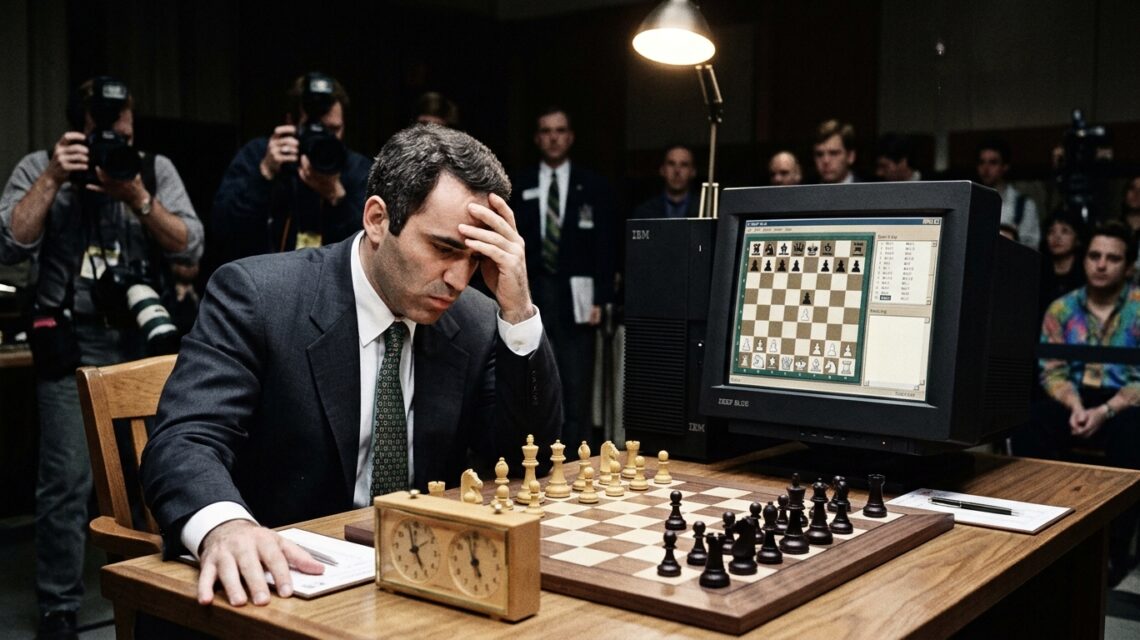
IBM’s supercomputer defeated the reigning world chess champion 3.5-2.5 in New York. Fifteen years later, an engineer revealed that a mysterious move in the opening game had been generated by a programming error. The bug was real, but whether it contributed to Kasparov’s historic defeat remains disputed.
By Marcio Tamer
Updated October 27, 2026
On May 11, 1997, Garry Kasparov resigned the sixth and final game of his chess match against IBM’s Deep Blue after just 19 moves.
The reigning world champion had lost a six-game contest to a computer by 3.5 points to 2.5.
It was the first time a machine had defeated a reigning world chess champion in a match played under standard tournament time controls.
The result became an international sensation. IBM had built a system capable of examining approximately 200 million chess positions per second, and its victory appeared to demonstrate that computing power had crossed a historic threshold.
But one of the strangest details of the match remained largely unknown for another 15 years.
During the first game, which Kasparov actually won, Deep Blue had made an apparently inexplicable rook move.
Kasparov could not identify a convincing strategic reason for the decision.
In 2012, IBM researcher Murray Campbell revealed that the move had been caused by a software bug.
The computer had failed to select a move through its normal process and resorted to a fallback mechanism that chose a legal move at random.
The revelation transformed a curious moment in chess history into a compelling story about the relationship between human psychology and machine intelligence.
Yet the most sensational interpretation, that a single programming error caused Kasparov to lose the entire match, goes beyond what the evidence establishes.
The bug occurred in a game the human champion won. The decisive defeat came eight days later, after a separate controversy involving Deep Blue’s unexpectedly sophisticated play.
Kasparov had already beaten Deep Blue in 1996
The 1997 encounter was not the first match between Kasparov and IBM’s chess computer.
They had met in Philadelphia in February 1996.
Deep Blue won the opening game, becoming the first computer to defeat a reigning world champion in a game under standard tournament conditions.
Kasparov recovered.
He won three games, drew two and took the six-game match 4-2.
The result demonstrated both the progress of computer chess and the continuing advantages of human strategic understanding.
Deep Blue could calculate enormous numbers of variations.
But Kasparov was still better at exploiting some of the system’s weaknesses.
IBM returned to development with a clear objective.
The next version had to become faster, more knowledgeable and more difficult to manipulate strategically.
The engineers had approximately one year to prepare.
The resulting machine was substantially more powerful.
IBM rebuilt Deep Blue to examine 200 million positions per second
The 1997 version of Deep Blue used 32 processors working in parallel.
IBM equipped the system with specialized chess hardware capable of evaluating enormous numbers of possible positions.
According to the company’s historical account, Deep Blue could examine approximately 200 million positions per second.
That processing speed was extraordinary for the period.
But it is important to understand what the number means.
The computer was not evaluating 200 million complete chess games every second.
It was examining positions within a search process, using specialized algorithms and evaluation functions to estimate the consequences of possible moves.
The system combined brute-force calculation with human-designed chess knowledge.
Its development team included computer scientists Feng-hsiung Hsu, Murray Campbell and Joseph Hoane.
Grandmaster Joel Benjamin also contributed chess expertise.
The machine drew on opening preparation, databases and evaluation methods developed with human assistance.
That was not unusual or prohibited.
The central distinction was between preparation and modifications permitted under the match rules, and unauthorized human selection of moves during active play.
IBM maintained that Deep Blue selected its moves during the games without such intervention. <Cite ref=”turn500251search8″/>
The first game contained a move that appeared to make no sense
The 1997 rematch began on May 3 in New York.
Kasparov played White.
Deep Blue played Black.
The champion established a strong position and eventually gained a decisive advantage.
Near the end of the game, the computer made a strange decision.
After Kasparov played 44.f6, Deep Blue responded with 44…Rd1.
The rook moved to the first rank rather than delivering a more conventional check.
The move did little to address the threats against Black’s position.
Kasparov continued with 45.g7.
Deep Blue resigned shortly afterward.
Kasparov had won the opening game.
On the scoreboard, nothing suggested a crisis.
But the unusual rook move became one of the match’s most discussed mysteries.
Why would a machine capable of analyzing millions of possibilities choose such an apparently pointless continuation?
The answer would not become public until years later.
The mysterious rook move was caused by a programming bug
In 2012, statistician Nate Silver published The Signal and the Noise, which included an interview with Murray Campbell.
Campbell described an unexpected malfunction in Deep Blue’s move-selection process.
The system had encountered a bug near the end of Game 1.
Unable to produce a move through its normal procedure, it activated a fallback mechanism.
That mechanism selected a legal move randomly.
The result was 44…Rd1.
Campbell explained that the development team had previously encountered a similar problem during testing.
They believed they had fixed it.
But one case remained.
The engineers corrected the issue after the first game.
The revelation was striking because the move had not emerged from an exceptionally deep calculation.
It was not a brilliant strategic idea that Kasparov had failed to understand.
It was a software error.
The machine had behaved unpredictably because its program malfunctioned.
The incident became widely known after Silver’s account was discussed by The Washington Post and Wired. <Cite refs={[“turn534116search0″,”turn534116search8”]}/>
Why the bug could have influenced Kasparov’s perception of the machine
Campbell suggested that the malfunction might have affected how Kasparov understood Deep Blue’s capabilities.
The reasoning was straightforward.
A human opponent sometimes makes an unusual move because they have discovered a hidden strategic possibility.
An elite player must therefore consider whether an apparently weak move contains a deeper idea.
Against another grandmaster, Kasparov could use his understanding of the opponent’s style and intentions.
Against Deep Blue, that process was more difficult.
The computer did not have human emotions or a recognizable psychological profile.
Its decisions emerged from algorithms, hardware and programmed evaluation methods.
A move that appeared irrational could therefore create uncertainty.
Was the machine making a mistake?
Or had it calculated something that the human champion could not see?
Silver argued that the mysterious move contributed to Kasparov’s later difficulties.
Campbell acknowledged that it might have influenced the champion’s perception.
But neither observation establishes that the bug caused the final defeat.
Kasparov had won Game 1.
The more consequential events occurred in Game 2.
Game 2, not Game 1, became the center of the cheating controversy
The second game took place on May 4, 1997.
Deep Blue played White.
Kasparov played Black.
The computer produced several moves that appeared unusually sophisticated for the computer chess programs of the period.
One decision attracted particular attention.
After 36.axb5 axb5, Deep Blue played 37.Be4.
The move prioritized positional control rather than immediately capturing additional material.
It limited Kasparov’s counterplay and strengthened White’s position.
Some observers regarded it as a remarkably human-looking choice.
Kasparov later questioned whether a grandmaster had assisted the machine during the game.
IBM denied the allegation.
No evidence establishing unauthorized human intervention was produced.
The controversy was significant because it concerned a move that genuinely influenced the competitive struggle.
Unlike the random rook move in Game 1, 37.Be4 was part of Deep Blue’s successful positional strategy. <Cite refs={[“turn534116search2″,”turn534116search27”]}/>
Kasparov resigned Game 2 in a position that may still have been defensible
The second game produced another remarkable moment.
Kasparov resigned after Deep Blue’s 45.Ra6.
At the time, he believed his position was lost.
Subsequent analysis identified a possible defensive resource involving 45…Qe3.
Some analysts concluded that Black might have been able to force a draw through perpetual check.
Other evaluations have questioned how straightforward that drawing line really was.
The important distinction is that Kasparov’s resignation came under circumstances that were later disputed by chess analysts.
He had not simply been checkmated.
He had decided that continuing was pointless.
The loss was psychologically significant because Kasparov believed the computer had displayed an unexpected level of positional understanding.
His suspicion of human intervention intensified the controversy.
The match was now tied 1-1.
Deep Blue had demonstrated that it could win not only through tactical calculation but also through positional decisions that challenged expectations about machine play.
What the first two games actually proved
The contrast between Games 1 and 2 is central to understanding the story.
In Game 1, Deep Blue made a strange move because of a software malfunction.
In Game 2, it made a sophisticated positional move through its chess-playing system.
Those were different events.
The first involved a random fallback decision in a position the computer was already losing.
The second involved a strategic choice in a game the computer ultimately won.
Popular retellings sometimes merge them into one narrative.
They suggest that Kasparov saw a random move, mistook it for superhuman intelligence and then lost because his confidence collapsed.
That explanation is dramatic.
But it compresses several distinct events and assigns a causal relationship that cannot be demonstrated.
The historical record supports a narrower conclusion.
The bug was real.
Kasparov was troubled by aspects of Deep Blue’s play.
He raised suspicions about the legitimacy of some moves.
And he eventually lost the match.
Whether the first event directly caused the others remains uncertain.
Three consecutive draws left the match tied before the final game
After the first two games, the match became more cautious.
Game 3 ended in a draw.
So did Game 4.
Game 5 also finished level.
That left the score tied at 2.5-2.5 entering the sixth and final game.
The result would determine the winner.
Kasparov had White in the opening game and won.
Deep Blue had White in Game 2 and won.
The remaining games had not produced a decisive result.
The final encounter therefore carried enormous pressure.
A victory would secure the match.
A draw would leave the overall score tied.
The world champion faced a machine that had already demonstrated its ability to calculate deeply and make unexpected strategic decisions.
But the final game’s decisive moment was not a mysterious computer maneuver.
It was an opening choice by Kasparov that allowed a known tactical sacrifice.
Kasparov chose the Caro-Kann Defense in Game 6
On May 11, Deep Blue opened with 1.e4.
Kasparov responded with 1…c6, entering the Caro-Kann Defense.
The opening is generally considered solid and reliable.
But the specific variation chosen by Kasparov contained tactical dangers.
The game continued:
1.e4 c6
2.d4 d5
3.Nc3 dxe4
4.Nxe4 Nd7
5.Ng5 Ngf6
6.Bd3 e6
7.N1f3 h6
Kasparov’s seventh move, 7…h6, challenged the white knight.
But it also allowed a known sacrifice.
Deep Blue responded immediately:
8.Nxe6!
The computer sacrificed a knight to disrupt Black’s position.
Kasparov’s king became vulnerable, and his pieces struggled to coordinate.
The attack was not a mysterious new discovery.
The tactical idea was already known in opening theory.
Kasparov had entered a variation in which the sacrifice was available.
The computer found it.
The knight sacrifice destroyed Kasparov’s position
After 8.Nxe6, the game continued:
8…Qe7
9.O-O fxe6
10.Bg6+ Kd8
Kasparov had accepted the knight.
But the material gain came at a heavy positional cost.
His king had been forced away from its starting square.
His development was restricted.
Deep Blue’s pieces became increasingly active.
The computer continued applying pressure.
By move 18, the position had deteriorated dramatically.
Deep Blue played 18.Rxe7, sacrificing a rook to capture Black’s queen.
Kasparov recaptured with his bishop.
Then came 19.c4.
The move attacked Black’s central structure and reinforced White’s overwhelming advantage.
Kasparov resigned.
The game had lasted only 19 moves.
It was a stunning conclusion to a match that had attracted worldwide attention.
The world champion had not been defeated in a long technical endgame.
He had been overwhelmed in the opening. <Cite refs={[“turn500251search0″,”turn500251search2”]}/>
Was Kasparov’s final mistake caused by the earlier bug?
This is the central question behind the popular story.
The answer is that no reliable evidence establishes a direct causal connection.
The software bug occurred in Game 1.
Kasparov won that game.
The move was unusual, but the computer was already in a losing position.
The most consequential psychological controversy developed during Game 2, when Deep Blue made strong positional moves that Kasparov found difficult to reconcile with his expectations of computer chess.
The final game took place a week later.
Kasparov chose a risky opening variation and allowed a known tactical sacrifice.
It is possible that the pressure of the match influenced his decisions.
It is also possible that his uncertainty about Deep Blue’s capabilities affected his preparation.
But those possibilities are not the same as proof.
Kasparov himself has challenged simplified accounts that attribute his defeat to the mysterious move in Game 1.
The bug remains an extraordinary detail.
It should not be presented as the single verified explanation for the result.
IBM’s victory did not mean Deep Blue possessed human intelligence
Deep Blue’s achievement was historic.
But the machine’s capabilities were specialized.
It was designed to play chess.
Its architecture combined search algorithms, evaluation functions, databases and dedicated hardware.
It did not understand the game in the same way a human grandmaster does.
It did not possess general reasoning abilities comparable to those of a person.
And it was not capable of transferring its chess expertise directly to unrelated problems.
The system’s strength came from its ability to examine enormous numbers of positions and evaluate them using carefully designed methods.
That approach was highly effective in chess because the game has clear rules, a finite set of legal moves and well-defined outcomes.
Deep Blue demonstrated that a specialized computer could outperform the world’s leading human player in a demanding intellectual competition.
It did not establish that machines had achieved general human-level intelligence.
That distinction remains important when interpreting the event as a milestone in artificial intelligence.
Why the 1997 match mattered to the history of AI
Before Deep Blue, chess had long been regarded as a test of intellectual ability.
Grandmasters were celebrated for calculation, intuition, memory and strategic understanding.
The idea that a computer could defeat the world champion carried enormous symbolic weight.
IBM’s victory showed that specialized computing systems could surpass elite human performance in a domain associated with intelligence.
The achievement also demonstrated the power of parallel processing.
Deep Blue used multiple processors and specialized chips to explore possible moves at extraordinary speed.
The system’s success encouraged further research into high-performance computing and artificial intelligence.
But later AI systems developed through different approaches.
Modern machine-learning systems can learn patterns from large datasets rather than relying primarily on handcrafted evaluation functions.
Deep Blue was therefore a major milestone, but not a direct technological equivalent of today’s generative AI models.
Its importance lies in what it demonstrated about computation.
A machine did not need to think like a human to outperform one at a particular task.
The six games that changed chess history
| Game | Date | Result | Match score |
|---|---|---|---|
| 1 | May 3, 1997 | Kasparov wins | Kasparov 1-0 |
| 2 | May 4, 1997 | Deep Blue wins | 1-1 |
| 3 | May 6, 1997 | Draw | 1.5-1.5 |
| 4 | May 7, 1997 | Draw | 2-2 |
| 5 | May 10, 1997 | Draw | 2.5-2.5 |
| 6 | May 11, 1997 | Deep Blue wins | Deep Blue 3.5-2.5 |
The sequence reveals why the bug story is more complicated than it initially appears.
The malfunction happened in the first game, which Kasparov won.
Deep Blue’s most controversial positional play came in the second game.
Three draws followed.
The match was decided by a 19-move victory in the final game.
The result emerged from six separate contests, not one isolated programming error. <Cite ref=”turn534116search2″/>
Kasparov demanded a rematch, but IBM retired Deep Blue
After the defeat, Kasparov questioned aspects of the match and sought further information about the computer’s operation.
He wanted access to technical records and proposed another encounter.
IBM maintained that the match had been conducted properly.
The company did not arrange a third contest.
Instead, Deep Blue was retired.
The decision prevented a definitive rematch between the world champion and the improved system.
It also contributed to the controversy surrounding the result.
Kasparov continued competing at the highest level and remained a major figure in chess.
He later wrote extensively about the encounter and the broader relationship between humans and intelligent machines.
His 2017 book Deep Thinking revisited the match and examined how computer chess had developed.
By then, chess engines had become dramatically stronger than their 1990s predecessors.
The question was no longer whether a computer could defeat a world champion.
It was how humans should use machines that had become indispensable tools for analysis and preparation.
The bug was real, but the deeper story is about uncertainty
The most surprising fact about Deep Blue’s 1997 victory is not that the computer made a random move.
It is that the move became meaningful to human observers precisely because they did not know it was random.
Kasparov was facing an unfamiliar kind of opponent.
He could not read its intentions through facial expressions, body language or emotional responses.
He could only examine the moves it played.
When Deep Blue produced an apparently inexplicable decision, the champion had to decide whether he was witnessing a mistake or a level of calculation beyond his understanding.
That uncertainty is central to the story.
Humans routinely interpret behavior by assigning intentions to it.
We assume that unusual decisions may conceal deeper reasoning.
But software does not always behave according to a coherent strategic plan.
Sometimes it malfunctions.
Deep Blue’s random rook move was one such case.
The computer did not make the move because it had discovered a brilliant hidden idea.
It made the move because its normal decision process had failed.
Yet the machine still won the match.
That is the lasting irony of the encounter.
One of the most famous victories in the history of artificial intelligence included a moment when the computer behaved irrationally because of a bug.
The victory demonstrated the extraordinary power of computation.
The bug demonstrated that powerful systems could still produce unexpected errors.
And the controversy showed how difficult it can be for humans to interpret the behavior of machines whose internal processes they cannot directly observe.
+ Siga o Giro no Facebook
+ Siga o Giro no Instagram
Leia Mais: