

The North American Soccer League tried to sell the world’s most popular sport to American audiences with a countdown clock, a 35-yard offside line and a scoring system worth up to nine points per match. Its biggest experiment disappeared in 1984, then returned when MLS launched in 1996.
By Marcio Tamer
Updated October 27, 2026
In 1977, a North American Soccer League match could end with something almost unrecognizable to European or South American football fans.
An attacker would place the ball 35 yards from goal, approximately 32 meters away. At the referee’s signal, a five-second countdown began.
The player could dribble, change direction, feint or shoot. The goalkeeper could leave the goal line and rush forward to intercept.
Five seconds later, the attempt was over.
It was not a traditional penalty kick. It resembled a breakaway in ice hockey, transformed into a one-on-one football contest.
The NASL introduced this distinctive shootout to settle matches that remained tied after regulation and any required extra time. The league wanted every game to produce a winner.
But the shootout was only one part of a much larger experiment.
During the 1970s and early 1980s, North American football also featured countdown clocks, unusual league points systems and an offside rule based on a line 35 yards from goal rather than the halfway line.
The changes were intended to make the sport more attractive to audiences accustomed to American football, basketball and hockey.
Meanwhile, the league was recruiting some of the greatest players in football history.
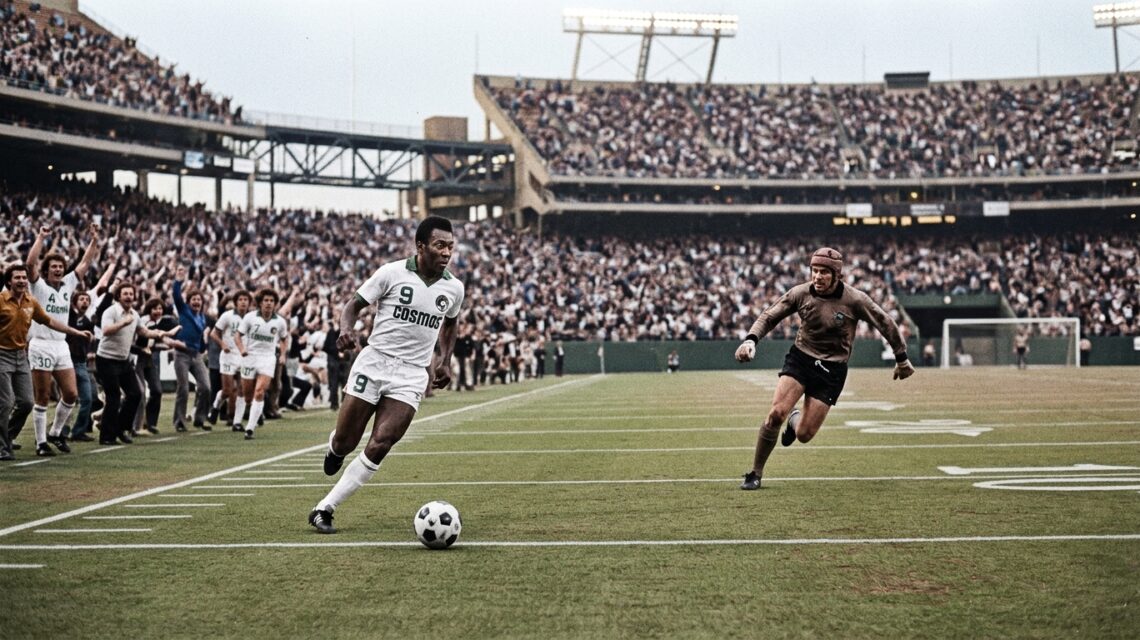
Pelé joined the New York Cosmos in 1975. Franz Beckenbauer followed in 1977. Johan Cruyff, George Best, Carlos Alberto and Giorgio Chinaglia also became major attractions.
For a brief period, American soccer combined international superstars with rules that looked unlike those used almost anywhere else.
The experiment helped build a new audience. But it also created tensions with football’s international authorities and failed to prevent the league’s eventual collapse.
The NASL existed before Pelé, and its biggest problem was attracting spectators
The original North American Soccer League began in 1968 after the merger of two competing professional leagues.
Its early years were difficult.
Football had passionate communities of supporters in the United States and Canada, but it lacked the broad commercial position enjoyed by established North American sports.
The league needed television coverage, recognizable stars and paying spectators.
In 1969, average NASL attendance fell to just 2,930 per match.
By 1974, that figure had increased to 7,770.
The improvement was meaningful, but the league remained a relatively small operation compared with the NFL, Major League Baseball, the NBA and the NHL.
Commissioner Phil Woosnam became a central figure in the effort to expand professional soccer.
The strategy had two parts.
First, the NASL sought internationally recognizable players who could attract attention.
Second, its executives experimented with the presentation and rules of the game.
The assumption was that unfamiliar aspects of traditional football might discourage American spectators.
A match ending 0-0 could seem unsatisfying to fans accustomed to a clear winner.
A clock that counted upward while the referee decided added time could appear confusing.
And the offside law could seem restrictive to audiences expecting fast attacks and frequent scoring.
The NASL attempted to address those concerns by changing the product.
Pelé’s arrival in 1975 transformed the league’s commercial prospects
On June 10, 1975, Pelé signed with the New York Cosmos.
The Brazilian had won three World Cups and was arguably the most recognizable footballer on the planet.
His arrival generated international headlines.
Five days later, he made his NASL debut against the Dallas Tornado at Downing Stadium in New York.
According to the league’s historical account, approximately 10 million television viewers watched the CBS broadcast.
The Cosmos’ home attendance tripled during the remainder of Pelé’s first season.
The signing demonstrated that American soccer could become a major attraction when audiences were given a compelling reason to watch.
Other stars followed.
Beckenbauer joined the Cosmos in 1977.
Carlos Alberto became another important member of the New York team.
Cruyff later played for the Los Angeles Aztecs and Washington Diplomats, while George Best represented several NASL clubs.
The league’s popularity increased dramatically.
From 1977 through 1983, average NASL attendance exceeded 13,000 per game every season.
The Cosmos became its leading commercial attraction, averaging more than 40,000 spectators per match in three seasons.
Yet the arrival of global stars did not end the NASL’s interest in changing football’s rules.
The league believed entertainment required more than famous players.
It wanted a different kind of match.
Why the NASL refused to accept drawn games
A central principle of traditional league football is that a match can end in a draw.
If two teams finish level after regulation time, both receive points in the standings.
The NASL regarded that outcome as commercially problematic.
League executives believed American audiences preferred a definitive result.
The solution evolved over several seasons.
Earlier NASL competitions had experimented with extra time and sudden-death goals.
In the mid-1970s, the league moved toward shootouts to determine winners when matches remained tied.
Initially, the NASL used more conventional penalty-kick procedures.
In 1977, it introduced the distinctive moving shootout from 35 yards.
The new system was designed to create a final moment of individual drama.
Instead of a stationary kick from the penalty spot, spectators watched an attacker and goalkeeper confront each other in open space.
It transformed the resolution of a tied match into a separate spectacle.
How the five-second NASL shootout worked
The NASL shootout began with the ball 35 yards from goal.
That distance was approximately three times greater than the 12-yard distance used for a conventional penalty kick.
At the signal, the attacker had five seconds to attempt to score.
The player could advance with the ball, attempt to dribble around the goalkeeper or shoot from distance.
The goalkeeper was not required to remain on the goal line.
They could rush toward the attacker, narrow the angle and attempt to win the ball.
Each team normally received five attempts.
If the scores remained level, additional rounds could determine the winner.
The system rewarded a different combination of skills from a traditional penalty.
A stationary penalty emphasizes shooting accuracy, composure and the goalkeeper’s ability to anticipate the strike.
The NASL shootout also tested dribbling, acceleration, decision-making and one-on-one defending.
An attacker who waited too long could run out of time.
A goalkeeper who advanced too aggressively could be beaten by a quick touch or feint.
The format produced moments of excitement, but it also created controversy.
Traditionalists argued that it changed the character of football.
Supporters believed it offered a more entertaining way to decide matches.
The shootout’s first NASL season produced a new kind of football drama
The moving shootout made its regular-season debut in 1977.
On April 8, the Seattle Sounders faced Team Hawaii.
The match became an early example of the new format.
Seattle’s Harry Redknapp missed his attempt, while Team Hawaii’s Brian Tinnion scored in what football historian accounts identify as the first successful NASL shootout of this type.
The episode illustrated how quickly the league had moved away from conventional football.
A tied match could now be decided by a sequence of individual duels.
The shootout also created unusual tactical decisions.
Coaches had to choose players capable of handling pressure while dribbling at speed.
Goalkeepers needed to judge when to remain near the goal and when to charge forward.
The format could produce dramatic endings even after a relatively uneventful match.
But the spectacle came at a cost.
A team could perform better during regulation time yet lose the match through a separate contest that did not resemble ordinary football.
That tension would follow the shootout into the next generation of American professional soccer.
The countdown clock changed how matches ended
The NASL also departed from football’s traditional approach to timekeeping.
Under the international laws of the game, a match consists of two 45-minute halves, with the referee responsible for accounting for time lost through stoppages.
The NASL used a visible clock that counted down toward zero.
The clock could be stopped under league procedures during specified interruptions.
The system was familiar to North American sports audiences.
Basketball, American football and hockey already relied on visible countdown clocks.
The NASL believed a similar presentation would make football easier to follow.
Fans could see exactly how much displayed time remained.
A match could end when the countdown reached zero rather than through the referee’s less predictable final whistle.
That created a different atmosphere during the closing seconds.
A team protecting a lead knew precisely when the clock would expire.
A team chasing a goal could see its remaining opportunity disappearing.
The countdown also changed the presentation of the sport for television.
However, it would be misleading to claim that the clock automatically solved broadcasting problems.
The NASL’s matches still involved unpredictable stoppages and the ordinary uncertainties of live sport.
The innovation primarily changed how time was displayed and administered.
The 35-yard offside line was the league’s most controversial rule change
The NASL’s most significant departure from international football was not the shootout.
It was the offside line.
Under traditional football rules, a player cannot be offside while positioned in their own half of the field.
The NASL experimented with extending that protection farther toward the opposing goal.
It introduced a line 35 yards from each goal.
A player could not be penalized for offside while outside that attacking zone.
Offside restrictions applied only once the player entered the final 35 yards.
The intention was to reduce defensive offside traps and create more attacking opportunities.
In theory, forwards could position themselves farther upfield without being penalized.
That could encourage long passes, rapid counterattacks and more open play.
But the tactical consequences were not necessarily straightforward.
Defenders might respond by remaining deeper, making it harder for their teams to support attacks.
The rule could therefore create space in midfield while also encouraging defensive caution.
Football historian Roger Allaway notes that its overall effect on attacking production was never conclusively established.
The NASL wanted more goals.
But changing where offside applied did not guarantee that outcome.
FIFA initially approved the experiment, then demanded that it end
A crucial distinction separates the NASL’s offside rule from its other innovations.
The offside line changed one of football’s fundamental playing laws.
That required international authorization.
According to research published by the Society for American Soccer History, FIFA granted permission in 1973 for the NASL to experiment with the 35-yard line.
The trial was not intended to continue indefinitely.
But the league retained the rule for years beyond the original authorization.
By 1981, FIFA had become increasingly frustrated.
The disagreement created a serious risk for American soccer.
If the United States Soccer Federation lost its standing with FIFA, the NASL could face restrictions affecting its international relationships and access to players.
The league ultimately agreed to abandon the 35-yard offside line after the 1981 season.
The change took effect in 1982.
This was a significant turning point.
The NASL could experiment with the presentation of matches and its own competition format.
But it could not indefinitely rewrite the fundamental laws of football without international approval. <Cite ref=”turn531093search1″/>
A win could be worth six points, with extra rewards for goals
The NASL’s league table also looked different from conventional football standings.
In many seasons, a victory was worth six points.
Teams could receive additional bonus points for goals scored, up to a specified maximum.
Under one widely used version of the system, clubs earned one bonus point for each of their first three goals.
That meant a team winning 3-2 could receive nine points: six for the victory and three for its goals.
A team winning 1-0 would receive seven points.
The purpose was to encourage attacking football.
A team leading 2-0 still had an incentive to score again.
A club losing a match could also gain something from continuing to attack.
The system attempted to reward entertainment rather than merely results.
But it created unusual standings.
A team with fewer victories could potentially finish ahead of a rival with more wins because it had accumulated additional goal bonuses.
The league’s historical account notes that the scoring system produced such outcomes on multiple occasions.
The NASL was not simply changing how matches ended.
It was changing how success was measured over an entire season.
The NASL’s rules were not all introduced at the same time
The league’s experiments are often described as though they formed one fixed rulebook throughout the 1970s.
That is misleading.
The NASL repeatedly adjusted its regulations.
The 35-yard offside line emerged in the early 1970s and remained until the end of 1981.
Shootout procedures changed over time.
The distinctive five-second moving shootout began in 1977.
The points system also evolved, including changes to the value of shootout victories.
By 1981, a shootout victory was worth four points rather than the six points awarded for a regulation victory.
The NASL was constantly adjusting its approach in response to commercial pressures, competitive concerns and international objections.
Its rulebook was therefore a series of experiments rather than one stable alternative to global football.
The NASL grew rapidly, but expansion created financial pressure
The league’s most successful years also contained the seeds of its eventual collapse.
In 1973, the NASL had nine teams.
By 1975, it had expanded to 20.
In 1978, the league reached 24 clubs.
That expansion created a much larger national footprint.
It also increased costs.
Teams needed stadiums, staff, travel budgets and competitive playing squads.
The pursuit of international stars placed further pressure on club finances.
Pelé’s arrival had demonstrated the commercial potential of famous players.
But not every franchise could reproduce the Cosmos’ success.
Some clubs struggled to attract sufficient attendance or television revenue to justify their spending.
The league’s rapid growth made its financial structure increasingly vulnerable.
The NASL could generate excitement around major stars while still failing to establish sustainable economics across all its franchises.
Why Pelé and the Cosmos could not save the entire league
The New York Cosmos became the NASL’s flagship club.
They attracted international attention and large crowds.
But their success was not representative of every team.
Some franchises operated in markets where professional soccer remained a difficult commercial proposition.
Others struggled with ownership instability or insufficient revenue.
The league’s dependence on imported stars also created challenges.
High-profile players could attract spectators, but their salaries increased operating costs.
And when the stars departed, some clubs struggled to maintain interest.
Pelé retired in 1977.
The Cosmos remained successful for several years, but the league’s broader financial problems continued.
By the early 1980s, franchises were folding or withdrawing.
The NASL reduced its size as it attempted to survive.
The final season took place in 1984.
On March 28, 1985, the league announced that it would suspend operations for the coming season.
The original NASL never resumed.
Its rule experiments had generated attention, but they had not solved the underlying financial problems.
The NASL ended in 1984, but its ideas returned in 1996
The collapse of the NASL did not end the American search for a commercially successful professional football league.
The United States hosted the 1994 FIFA World Cup.
Major League Soccer began play in 1996.
And the new competition revived several ideas associated with the NASL.
MLS introduced a countdown clock.
It also adopted the five-second shootout from 35 yards.
Matches that ended tied after regulation time were decided through the moving one-on-one format.
The system was intended to produce clear winners and appeal to American audiences.
But the new league used a different points structure.
A regulation victory was worth three points.
A shootout victory earned one point.
A team that lost the shootout received none.
The NASL’s influence was unmistakable.
More than a decade after the original league disappeared, its most distinctive rule innovation had returned to top-level American professional soccer.
MLS abandoned the shootout after four seasons
The MLS shootout lasted from 1996 through 1999.
During those four seasons, the format produced memorable moments and unusual results.
One of the most remarkable occurred in 1996, when the Kansas City Wiz and San Jose Clash required 16 rounds to settle a shootout.
But the system also faced criticism.
Some players disliked the format because it placed a different kind of pressure on attackers and goalkeepers.
Traditional football supporters argued that draws were a legitimate part of the sport.
The shootout also failed to establish itself as a universally accepted solution to the league’s commercial challenges.
In November 1999, MLS announced major rule changes for the 2000 season.
The moving shootout was eliminated.
The countdown clock was also abandoned.
Matches would return to a clock counting upward, with the referee controlling official time.
MLS initially replaced the shootout with sudden-death overtime, but that experiment also ended after the 2003 season.
By 2004, regular-season MLS matches could finish as draws without an overtime period.
The league had moved much closer to international football conventions. <Cite refs={[“turn531093search3″,”turn531093search6″,”turn531093search15”]}/>
The numbers behind the NASL’s Americanized football experiment
| Feature | NASL approach | Traditional international football |
|---|---|---|
| Match clock | Countdown toward zero | Counts upward toward 90 minutes |
| Tied matches | Shootouts used in later NASL seasons | Draws permitted in league competition |
| Shootout starting distance | 35 yards (32 meters) | Penalty mark at 12 yards |
| Shootout time limit | Five seconds | No equivalent time-limited dribbling attempt |
| Offside | Applied inside the final 35 yards during the experiment | Applied in the attacking half |
| League points | Often six for a win, plus goal bonuses | Traditionally two, later three, for a win |
| First NASL season | 1968 | Not applicable |
| Final NASL season | 1984 | Not applicable |
| MLS revival of moving shootouts | 1996-1999 | Not adopted globally |
The differences were substantial.
The NASL changed how matches ended, how time was displayed, how offside operated and how league standings were calculated.
Some innovations were competition rules.
Others affected football’s fundamental laws.
The distinction mattered because international authorities were willing to tolerate some experimentation but resisted permanent changes to the sport’s basic structure.
Did the NASL’s rule changes actually make football more popular?
The league’s popularity increased dramatically during the 1970s.
Average attendance rose from fewer than 3,000 spectators per game in 1969 to more than 13,000 in each season from 1977 through 1983.
The Cosmos became one of the most recognizable football clubs outside Europe and South America.
But those figures do not prove that the unusual rules caused the growth.
Several major changes happened at the same time.
Pelé arrived.
Other international stars followed.
The league expanded into new markets.
Television coverage increased.
And youth participation in soccer was growing.
The rules may have contributed to the NASL’s entertainment appeal.
But it is not possible to isolate their effect from those other developments.
The same caution applies to the league’s collapse.
The NASL did not fail simply because it used shootouts or a countdown clock.
Its financial problems were more fundamental.
Rapid expansion, uneven attendance, high operating costs and unstable franchises played major roles.
The rule experiments were part of the league’s identity, but they were neither a complete explanation for its growth nor a sufficient explanation for its demise.
The 35-yard line reveals the limits of changing football for a new audience
The NASL’s offside experiment illustrates the challenge particularly clearly.
The league believed that moving the offside line closer to goal would encourage attacking play.
But football tactics are interconnected.
Changing one rule can produce unexpected adjustments elsewhere.
Forwards could move higher up the field without being offside.
Defenders could respond by dropping deeper.
Midfield space might increase, but attacking combinations could become more difficult.
The outcome was not necessarily more goals.
The rule also created international complications.
FIFA had approved the experiment for a limited period.
When the NASL continued using it beyond that authorization, the dispute threatened the league’s relationship with football’s governing structure.
The experiment demonstrated that adapting football for local audiences involved more than entertainment.
It also required compatibility with a global sporting system.
What the NASL got right about American soccer
The original NASL did not achieve long-term financial stability.
But it made important contributions to football’s development in North America.
It introduced international stars to audiences that had rarely seen players of their stature in domestic competition.
It created professional opportunities for North American players.
It helped establish soccer as a spectator sport in cities across the United States and Canada.
And it demonstrated that large crowds could be attracted to high-profile football matches.
The league’s most successful years provided evidence that professional soccer had commercial potential.
Its failures also offered lessons for future organizers.
MLS launched with a more controlled business structure and gradually abandoned many of the NASL’s unusual rules.
The modern league’s growth reflects a different approach.
Rather than permanently redesigning football to resemble other American sports, MLS increasingly adopted the international game’s conventions while building its own clubs, rivalries and commercial identity.
The Americanized football experiment still shapes debates today
The NASL’s innovations are often remembered as eccentric relics of the 1970s.
But the underlying questions remain relevant.
Should football use a visible stopped clock to reduce time-wasting?
Should matches always produce a winner?
Could alternative shootout formats create more exciting conclusions?
How much should a league adapt its rules to local audiences?
These debates continue to appear in discussions about the sport’s future.
The NASL’s experience provides a useful historical warning.
Rule changes can create excitement, but they do not automatically solve commercial problems.
A league also needs financially stable clubs, strong local support, credible competition and a sustainable relationship with the wider football world.
The NASL succeeded in attracting extraordinary players and generating national attention.
It failed to convert that excitement into a lasting professional structure.
Its most distinctive rule, the five-second shootout, disappeared with the league in 1984, returned with MLS in 1996 and vanished again after 1999.
The format remains one of the most unusual experiments in professional football history.
And it captures the central contradiction of the NASL era: a league that brought some of the world’s greatest footballers to North America while trying to make the sport look less like the football they had played everywhere else.
+ Siga o Giro no Facebook
+ Siga o Giro no Instagram
Leia Mais: