

The second Tour de France covered roughly 2,400 kilometers in six punishing stages. By the end, accusations of cheating, roadside violence and sabotage had forced cycling officials to overturn the results, making a 19-year-old the youngest champion in the race’s history.
By Marcio Tamer
Updated October 27, 2026
In July 1904, Maurice Garin crossed the finish line in Paris believing he had won the Tour de France for the second consecutive year.
He had completed six enormous stages, covering approximately 2,400 kilometers of French roads. The race had lasted more than three weeks and attracted intense public interest following the success of its inaugural edition in 1903.
But the result did not stand.
On November 30, 1904, the Union Vélocipédique de France, the country’s cycling governing body, imposed sweeping sanctions after investigating allegations of cheating and misconduct.
Garin was disqualified. So were Lucien Pothier, César Garin and Hippolyte Aucouturier, the next three riders in the original overall standings.
The official victory passed to Henri Cornet, who had initially finished fifth.
Cornet was only 19 years old, making him the youngest Tour de France winner in history, a record that still stands.
The scandal was extraordinary even by the standards of early professional cycling.
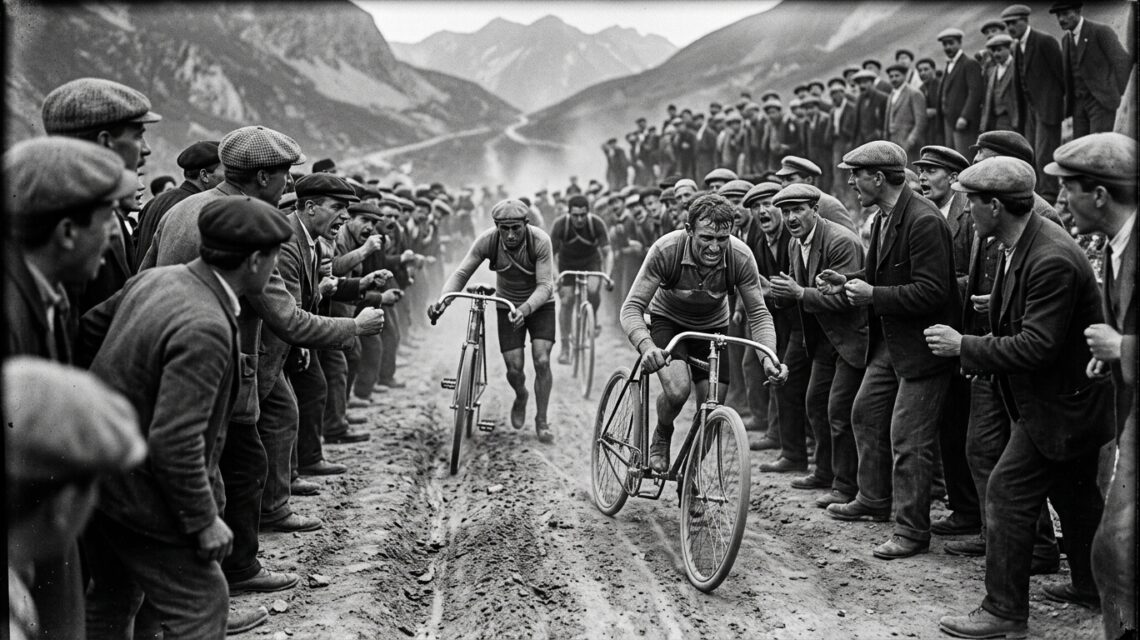
Competitors had been accused of taking trains, using automobiles and receiving prohibited assistance. Spectators blocked roads, attacked riders and scattered sharp objects to puncture tires.
During one confrontation near Saint-Étienne, race officials reportedly fired shots into the air to disperse an aggressive crowd.
The Tour’s founder, Henri Desgrange, became so disillusioned that he publicly questioned whether the race should continue.
The second Tour de France had almost become the last.
The first Tour de France was created to sell newspapers
The Tour de France began in 1903 as an ambitious promotional project for the French sports newspaper L’Auto.
The publication faced intense competition in the sporting press and needed an event capable of attracting national attention.
Journalist Géo Lefèvre proposed a bicycle race that would travel around France.
Desgrange, the newspaper’s editor and the Tour’s principal organizer, supported the idea.
The first edition began in July 1903 and immediately captured public interest.
Maurice Garin emerged as its champion.
The race generated extensive newspaper coverage and established a new kind of sporting spectacle: an endurance competition linking distant regions of France through a single national event.
Its appeal was not limited to the riders.
Communities along the route could watch the competitors pass through their towns, creating a direct connection between the race and local audiences.
That popularity became a major asset.
It also created problems that the organizers had not anticipated.
The second edition would demonstrate how quickly regional loyalty, commercial interests and weak enforcement could undermine the competition.
The 1904 route was an extreme endurance test
The 1904 Tour largely followed the structure of the inaugural event.
It consisted of six stages spread across approximately three weeks.
The total distance is commonly recorded as 2,428 kilometers, although historical sources differ slightly in their calculations.
The stages were enormous by modern standards.
Riders faced journeys of several hundred kilometers, often beginning during the night and continuing for many hours.
The roads were frequently rough, poorly maintained and unsuitable for the kind of racing that would later become standard.
Bicycles were heavy compared with modern racing machines.
Mechanical assistance was tightly restricted.
Competitors were expected to repair many problems themselves.
The race therefore demanded exceptional endurance.
But the extreme distances also made effective supervision difficult.
Officials could not monitor every rider continuously across hundreds of kilometers of countryside.
That weakness created opportunities for competitors willing to break the rules.
Why night racing made cheating easier
The Tour’s early stages often required riders to travel through darkness.
That presented an obvious challenge for the organizers.
Officials relied on checkpoints and observers to confirm that competitors were following the prescribed route.
But long stretches of road remained unsupervised.
A rider could potentially leave the course, travel by another means and rejoin later.
Trains were especially attractive because railway lines connected many of the towns along the route.
Automobiles also offered opportunities for prohibited assistance.
Some competitors were accused of using vehicles to gain distance or conserve energy.
Others allegedly took shortcuts or received help from people outside the race.
The problem was not simply that cheating was possible.
It was that the structure of the event made it difficult to establish exactly what had happened.
Officials often had to rely on witness testimony, complaints from rivals and investigations conducted after the race.
That uncertainty became central to the scandal.
Riders were accused of using trains and automobiles
The most famous allegations from the 1904 Tour involved competitors traveling part of the route without pedaling.
Historical accounts describe riders using trains or motor vehicles to avoid sections of the course.
Other allegations concerned illegal pacing, assistance from outsiders and shortcuts.
These practices violated the basic premise of the competition.
The Tour was supposed to determine which rider could complete the prescribed route fastest under the rules.
A competitor who traveled by train or automobile gained an advantage unrelated to cycling ability.
The consequences extended beyond individual results.
If officials could not determine who had completed the course legitimately, the overall classification lost credibility.
However, an important distinction is necessary.
The surviving historical record does not establish that every leading rider personally used a train.
Nor does it support every colorful story later attached to the scandal.
Some accusations were documented through disciplinary proceedings, while others became part of cycling folklore.
The governing body’s final decisions confirmed serious irregularities, but the precise reasons for every individual disqualification were not always publicly explained in detail.
The established fact is that the race’s results were fundamentally compromised.
Regional rivalries turned spectators into participants
The cheating scandal was only one part of the crisis.
Spectator violence became another major problem.
In the early Tour, local communities often developed intense loyalties toward riders from their region.
A successful local cyclist could become a source of enormous pride.
But that enthusiasm sometimes crossed into intimidation and violence.
Supporters attempted to interfere with rivals who threatened their preferred competitors.
Roads were blocked.
Riders were assaulted.
Sharp objects were scattered along sections of the route to cause punctures.
The attacks transformed ordinary sporting rivalry into direct interference with the competition.
The danger was especially severe because riders were already exhausted from traveling enormous distances.
An unexpected confrontation could cause injury, mechanical damage or withdrawal.
The organizers faced a problem that modern race security systems are designed to prevent.
Spectators were no longer simply watching the event.
Some were attempting to determine its outcome.
The attack near Saint-Étienne became the race’s most notorious incident
One of the most serious episodes occurred during the second stage, between Lyon and Marseille.
The stage took place on July 10, 1904.
Near the Col de la République, also known as the Col du Grand-Bois, above Saint-Étienne, supporters of local rider Antoine Faure confronted leading competitors.
According to the municipal archives of Saint-Étienne, the crowd attacked Maurice Garin.
The situation became sufficiently dangerous that race organizers used a revolver to disperse the assailants.
Other historical accounts describe shots being fired into the air to clear the road.
The incident illustrated how regional loyalty could turn violent.
The attackers were not protesting a technical rule or a disputed result.
They were attempting to help a favored rider by obstructing his competitors.
The consequences could have been catastrophic.
Cyclists were traveling through mountainous roads while exhausted, and the presence of an aggressive crowd created immediate physical danger.
The episode also demonstrated the limits of the Tour’s security arrangements.
The organizers had created a national sporting spectacle without the infrastructure needed to control hostile spectators along the entire route.
The gunfire was associated with race officials, not a confirmed duel between riders
Some retellings of the 1904 Tour describe riders and spectators exchanging gunfire.
Others suggest that cyclists carried weapons to defend themselves.
The surviving evidence requires a more cautious interpretation.
The well-documented incident near Saint-Étienne involved race officials using a firearm to disperse a crowd attacking competitors.
The municipal archives of Saint-Étienne specifically describe organizers using a revolver during the confrontation.
That is different from claiming that Antoine Faure or another rider personally fired shots.
The distinction matters because the historical episode is already extraordinary without embellishment.
A professional cycling race had reached the point where officials needed to use gunfire to protect competitors from spectators.
The event exposed a breakdown in the basic conditions required for fair and safe competition.
Nails and broken glass became weapons against rival cyclists
The violence was not limited to physical assaults.
Sharp objects were deliberately placed on the roads.
Tacks, nails and broken glass could puncture bicycle tires and force riders to stop.
In a race covering hundreds of kilometers per stage, even a single puncture could be costly.
Repairing a tire required time and physical effort.
Multiple punctures could destroy a rider’s chances.
Historical accounts describe spectators using these tactics to hinder competitors.
The practice was particularly dangerous because a puncture at speed could cause a crash.
It also created a form of sabotage that was difficult to investigate.
A rider might encounter nails on an isolated road without knowing who had placed them there.
The organizers could remove visible hazards, but they could not inspect every kilometer continuously.
The problem reinforced the broader crisis.
The Tour was no longer being decided solely by the performance of the cyclists.
Outside interference was affecting the competition.
Maurice Garin finished first, but the celebration did not last
Despite the violence and controversy, the race continued.
Garin completed the Tour in first place.
He had already won the inaugural edition in 1903 and appeared to have established himself as the dominant figure in the new competition.
His victory would have made him the Tour’s first two-time champion.
The original final standings placed Lucien Pothier second, César Garin third and Hippolyte Aucouturier fourth.
Henri Cornet finished fifth.
But complaints and accusations continued after the race.
The organizers and cycling authorities faced growing pressure to investigate.
The Union Vélocipédique de France began examining evidence concerning the conduct of competitors.
Witnesses were questioned.
Reports of prohibited assistance and other irregularities were reviewed.
The investigation took several months.
The result would overturn the race’s official history.
The French cycling federation disqualified the first four finishers
On November 30, 1904, the Union Vélocipédique de France issued its disciplinary decisions.
The first four riders in the original overall classification were disqualified.
Maurice Garin lost the title.
Lucien Pothier, César Garin and Hippolyte Aucouturier were also removed from the standings.
Additional riders received sanctions.
Garin was suspended for two years.
Pothier initially received a lifetime ban, although his punishment was later reduced.
The scale of the disciplinary action was unprecedented for the young Tour.
The race’s leading finishers had all been removed.
The official results had to be reconstructed.
The decision also revealed the seriousness of the misconduct.
This was not a minor dispute involving one rider or one stage.
The governing body concluded that the integrity of the entire competition had been compromised.
Henri Cornet became champion without crossing the finish line first
The revised standings produced an unexpected winner.
Henri Cornet, originally fifth, was promoted to first place.
He was only 19 years old when the race ended.
That made him the youngest Tour de France champion in history.
The record remains intact.
Cornet’s victory was unusual because he did not experience the traditional moment of crossing the final finish line as the winner.
He had completed the race behind four competitors who were later disqualified.
Only after the investigation did he become the official champion.
The result demonstrates how dramatically the disciplinary proceedings changed the event.
The race that spectators had watched in July was not the race recorded in the final official standings.
The champion was determined months after the competition ended.
The final classification was almost completely rewritten
The scale of the changes becomes clearer when the original and revised results are compared.
| Position | Original finish order | Official result after sanctions |
|---|---|---|
| 1 | Maurice Garin | Henri Cornet |
| 2 | Lucien Pothier | Jean-Baptiste Dortignacq |
| 3 | César Garin | Aloïs Catteau |
| 4 | Hippolyte Aucouturier | Jean Dargassies |
| 5 | Henri Cornet | Julien Maitron |
The first four finishers disappeared from the official classification.
Cornet moved from fifth to first.
Dortignacq rose from sixth to second.
Catteau advanced from eighth to third.
The revisions affected not only the overall result but also the stage classifications.
The disciplinary proceedings effectively rewrote the sporting record of the 1904 Tour.
That is why the edition remains one of the most controversial in cycling history.
The scandal did not merely produce a disputed champion.
It forced the authorities to reconstruct the competition months after it had finished.
Only 15 riders remained in the official classification
The 1904 Tour began with approximately 88 riders.
Historical sources differ slightly in how they count starters and finishers, partly because the later disqualifications changed the official record.
Twenty-seven riders are commonly listed as having reached the finish before the disciplinary revisions.
After sanctions, only 15 remained in the official classification.
The distinction is important.
The number of riders who physically completed the route was not the same as the number recognized in the final results.
That difference captures the scale of the scandal.
More than a dozen competitors who had reached the end of the race were excluded from the final classification.
The Tour had survived its six stages.
But its official result had been severely damaged.
Henri Desgrange believed the Tour might be finished
The disciplinary decisions devastated Henri Desgrange.
The Tour had been created to attract readers and establish a major national sporting event.
Its first edition had been a success.
The second had produced accusations of cheating, violence and corruption.
Desgrange publicly questioned whether the race could continue.
He described the Tour as having been destroyed by the passions it had created.
The statement reflected more than personal disappointment.
The organizer faced a serious commercial and sporting problem.
A competition that could not guarantee fair results risked losing the confidence of riders, sponsors and spectators.
The Tour’s reputation had been damaged after only two editions.
Continuing would require changes.
The organizers needed to make cheating more difficult and restore confidence in the race.
The 1905 Tour introduced a different scoring system
The Tour returned in 1905.
But the organizers changed important elements of the competition.
One of the most significant reforms involved the general classification.
Instead of determining the overall winner through accumulated time, the Tour adopted a points-based system.
Riders received points according to their finishing positions on each stage.
The competitor with the lowest total won.
The change was intended to reduce some of the incentives and opportunities associated with the earlier format.
The organizers also increased supervision and adjusted the race structure.
The 1905 edition featured more stages over shorter distances than the previous Tours.
These changes did not eliminate cheating from cycling.
But they demonstrated that the organizers were willing to modify the competition in response to the scandal.
The Tour survived because it adapted.
Why the 1904 scandal nearly destroyed the Tour de France
The second Tour exposed several weaknesses at once.
The stages were so long that continuous supervision was nearly impossible.
Night racing created opportunities for riders to leave the course.
Regional rivalries encouraged spectators to interfere with competitors.
Commercial interests increased pressure to win.
And the governing authorities lacked a mature system for investigating and preventing misconduct during such a large event.
The combination was explosive.
The Tour was trying to become a national sporting institution before the infrastructure needed to protect its integrity had fully developed.
The scandal therefore represented a crisis of organization as much as a crisis of individual behavior.
Some riders cheated.
Some spectators committed acts of violence.
But the race’s structure also created conditions in which those actions were difficult to prevent.
The reforms introduced afterward were part of the process through which the Tour became a more established competition.
What the 1904 Tour reveals about the early history of professional sport
The 1904 edition is often presented as a bizarre collection of stories about trains, nails and gunfire.
Those details are memorable.
But the deeper significance lies in the relationship between popularity and regulation.
The Tour became successful before its organizers had developed effective systems to control the consequences of that success.
Large crowds brought excitement and publicity.
They also created opportunities for intimidation and violence.
Long stages attracted attention because of their extreme difficulty.
They also made cheating harder to detect.
Commercial rewards encouraged participation.
They also increased the temptation to break the rules.
The scandal demonstrated that a major sporting event needed more than spectacular competition.
It required credible enforcement, reliable results and protection for participants.
Without those elements, popularity could become a threat to the event itself.
The numbers behind the 1904 Tour de France scandal
| Detail | Historical record |
|---|---|
| Edition | Second Tour de France |
| Dates | July 2-24, 1904 |
| Stages | 6 |
| Distance | Approximately 2,428 km |
| Riders at the start | About 88 |
| Riders who reached the finish before sanctions | Commonly reported as 27 |
| Riders in the final official classification | 15 |
| Original first-place finisher | Maurice Garin |
| Official winner | Henri Cornet |
| Cornet’s age | 19 |
| First four finishers | All disqualified |
| Disciplinary decision | November 30, 1904 |
| Major incidents | Illegal assistance, road blockages, assaults and sabotage |
| Race continued in | 1905 |
The statistics reveal the extraordinary scale of the crisis.
The Tour covered more than 2,400 kilometers in six stages.
The first four finishers were removed from the results.
Only 15 riders remained officially classified.
And the eventual winner was a teenager who had originally finished fifth.
The competition had not simply suffered a controversial incident.
Its entire sporting outcome had been transformed.
Why the 1904 Tour remains cycling’s most chaotic early chapter
The Tour de France eventually became one of the world’s most prestigious annual sporting events.
Its history now spans more than a century.
But the second edition came close to ending the competition before it had established a lasting tradition.
The race combined extraordinary physical endurance with weak supervision, intense regional rivalry and widespread allegations of misconduct.
The attacks near Saint-Étienne demonstrated how dangerous spectator interference could become.
The accusations involving trains and automobiles revealed the limitations of the early enforcement system.
The disqualification of the first four finishers destroyed the credibility of the original results.
And the promotion of Henri Cornet created one of the most unusual championship outcomes in sporting history.
The Tour survived because its organizers recognized that the event needed to change.
The reforms of 1905 did not solve every problem, but they helped establish a more sustainable structure.
The scandal remains a reminder that major sporting institutions are not created fully formed.
They develop through mistakes, disputes and reforms.
In 1904, the Tour de France almost collapsed under the weight of its own popularity.
Instead, it survived and became one of the defining competitions in world sport.
+ Siga o Giro no Facebook
+ Siga o Giro no Instagram
Leia Mais: