

Trailing in the qualification race despite leading Grenada 2-1, Barbados exploited a golden-goal rule that counted extra-time winners twice. The resulting tactical paradox turned the final minutes into a contest in which either team could benefit from scoring into its own net.
By Marcio Tamer
Updated October 29, 2026
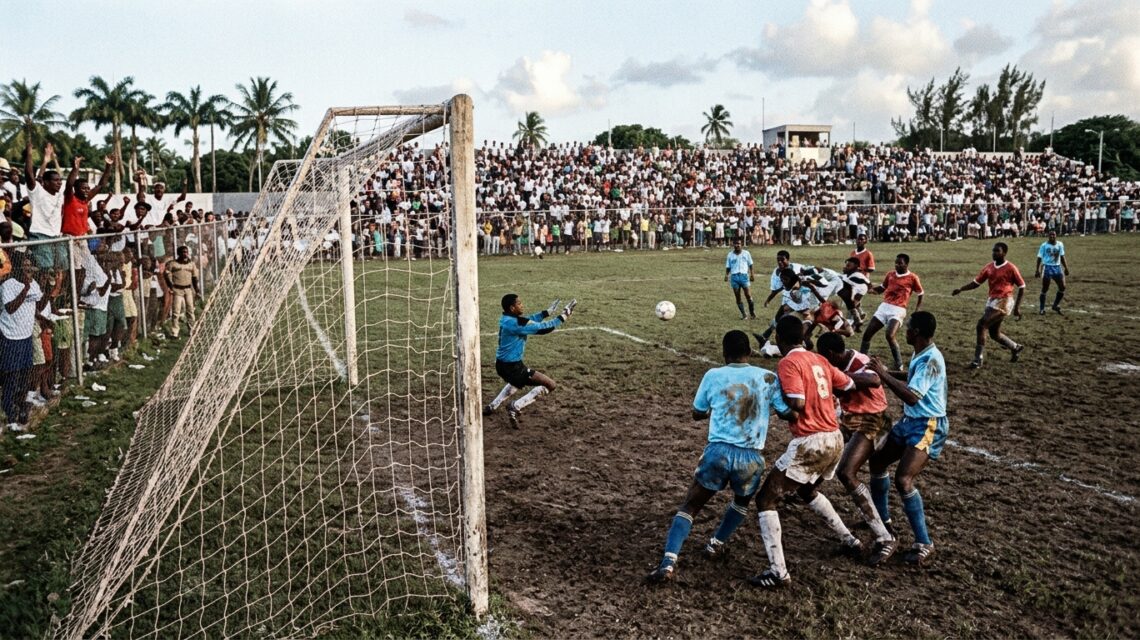
On January 27, 1994, Barbados was winning a football match it could not afford to win by just one goal.
With three minutes remaining against Grenada in Caribbean Cup qualifying, the home side led 2-1. Ordinarily, protecting that advantage would have been the obvious strategy. But Barbados needed to win by at least two goals to advance, and time was running out.
Its players responded by doing something almost unimaginable in international football.
They deliberately kicked the ball into their own net.
The score became 2-2. Barbados had surrendered its lead, but it had also created a new opportunity: if the match reached extra time, a special tournament rule meant that one golden goal would count as two goals in the official scoring calculation.
That would give Barbados the two-goal winning margin it needed.
Grenada quickly recognized the problem. A draw would now lead to extra time, where Barbados could eliminate it with a single goal.
The visitors needed to change the score before the final whistle. And under the peculiar qualification rules, they could do that by scoring at either end.
If Grenada scored against Barbados, it would win 3-2.
If Grenada scored an own goal, it would lose 3-2 but still advance because Barbados would have won by only one goal.
For the remaining minutes, Barbados faced a tactical challenge unlike almost anything seen in international football: it had to protect its own goal and prevent Grenada from scoring into Grenada’s goal.
Barbados survived, forced extra time and scored the winner.
The match ended 3-2 in goals actually scored, but the competition counted the result as 4-2.
Barbados qualified. Grenada went home. And a rule intended to make football more exciting had produced one of the clearest examples of a competition format rewarding behavior that appeared to contradict the sport itself.
Why Barbados needed a two-goal victory against Grenada
The match was part of the qualifying tournament for the 1994 Caribbean Cup, which was staged in Trinidad and Tobago.
Barbados, Grenada and Puerto Rico were competing in the same three-team preliminary group.
Only the group winner would advance to the final tournament.
Barbados entered its final match under pressure because it had lost 1-0 to Puerto Rico on January 23.
Two days later, Grenada had beaten Puerto Rico through a golden goal in extra time.
That result left Grenada in a stronger position heading into the decisive meeting.
Barbados needed to win by at least two goals to finish ahead on goal difference.
A one-goal victory would not be enough.
The difference between winning 2-1 and winning 3-1 was therefore the difference between elimination and qualification.
For much of the match, Barbados appeared to have solved the problem.
It built a 2-0 lead.
With that score, the home team was on course to advance.
Then Grenada scored.
The goal reduced Barbados’s advantage to 2-1 in the 83rd minute, leaving the home side with only seven minutes to restore its two-goal margin.
That was when the tournament’s unusual extra-time rule became decisive.
The Caribbean Cup used a golden goal worth two goals
In 1994, the Caribbean Football Union introduced an experimental variation of the golden-goal rule.
Matches in the qualifying competition could not finish level.
If a game was tied after 90 minutes, it would proceed to sudden-death extra time.
The first team to score would win immediately.
But there was an additional provision.
A golden goal would count as two goals for the competition’s scoring records and goal-difference calculations.
The organizers apparently intended to reward teams that won in extra time.
Instead, the rule created an incentive that could make a draw more valuable than a narrow victory.
Consider the situation Barbados faced.
A 2-1 win would give it a one-goal margin and leave it eliminated.
A 2-2 draw after 90 minutes would create the possibility of a golden-goal victory.
If Barbados then scored once in extra time, the competition would credit it with two additional goals.
The result would count as 4-2, a two-goal margin.
The rule turned a deliberate own goal into a rational qualification strategy.
It also created a second, even stranger incentive for Grenada.
Once the score became 2-2, Grenada could benefit from scoring an own goal of its own.
The problem was not that either team misunderstood the rules.
It was that both teams understood them.
Barbados was leading 2-1 when it decided that an own goal was the better option
After Grenada reduced the deficit, Barbados tried to score again.
Its players needed a third goal to restore the required two-goal margin.
But as the final minutes passed, the possibility of a conventional victory became increasingly remote.
Around the 87th minute, Barbados changed its approach.
Instead of attacking Grenada’s goal, its players moved the ball toward their own.
They deliberately scored an own goal.
The score was now 2-2.
From an ordinary football perspective, Barbados had thrown away a victory.
Under the tournament’s regulations, however, it had exchanged an insufficient one-goal win for the chance to secure a qualifying two-goal margin in extra time.
The maneuver was extraordinary, but it was not irrational.
Barbados had identified a flaw in the relationship between the match rules and the qualification standings.
The team was attempting to maximize its chances of advancing.
Its own goal was a calculated response to the incentives the organizers had created.
Grenada suddenly needed to score into either net
The consequences became apparent almost immediately.
Grenada had entered the final minutes with a simple objective: avoid losing by two goals.
At 2-1 down, that objective was being achieved.
At 2-2, however, the visitors faced the prospect of a golden-goal defeat that would count as a two-goal loss.
They therefore needed to prevent the match from reaching extra time.
Scoring into Barbados’s goal would make it 3-2 to Grenada and guarantee qualification.
But scoring into their own goal would also work.
A Grenada own goal would make the score 3-2 to Barbados.
Because that would be a one-goal defeat, Grenada would still advance.
This was the central paradox.
Grenada could improve its qualification position by scoring a goal against itself.
Barbados, meanwhile, needed to prevent any goal from being scored.
It could not simply defend its own penalty area.
It also had to stop Grenada’s players from deliberately putting the ball into their own net.
The result was a tactical reversal in which the ordinary meaning of attack and defense broke down.
The ball could be dangerous to Barbados regardless of which goal it approached.
For three minutes, Barbados had to defend both ends of the field
Accounts of the final minutes describe Grenada attempting to exploit both possible scoring routes.
Its players sought opportunities to attack Barbados’s goal while also recognizing that an own goal could preserve their qualification hopes.
Barbados responded by defending both ends.
The home side had to prevent Grenada from scoring normally and from deliberately conceding.
The situation was unlike a conventional match in which one team attacks and the other defends.
Both goals had become potential threats to Barbados.
The tactical chaos lasted for approximately three minutes.
The unusual sequence was later documented by The Guardian, which described the episode as a real event rather than an urban legend.
The report explained that Grenada needed to score at either end to advance, while Barbados had to protect both penalty areas.
Barbados managed to keep the score at 2-2 until the end of regulation.
The match moved into extra time.
The home team’s gamble had worked.
But qualification still depended on scoring the golden goal.
Trevor Thorne scored the golden goal that sent Barbados through
Extra time began with a simple equation.
If Barbados scored first, it would advance.
If Grenada scored first, Grenada would advance.
The bizarre double-goal rule meant that Barbados needed only one successful attack to obtain the two-goal margin it had been unable to achieve in regulation.
Approximately four minutes into extra time, Trevor Thorne scored for Barbados.
Under ordinary football scoring, the goal made it 3-2.
Under the Caribbean Cup’s special regulation, the golden goal counted twice.
The official competition calculation therefore recorded a 4-2 Barbados victory.
The match ended immediately.
Barbados had qualified for the final tournament.
Grenada had been eliminated.
The sequence was complete: Barbados deliberately conceded to force extra time, defended both goals to preserve the draw and then scored once to receive credit for a two-goal victory.
The strategy was so unusual that the match became a frequently cited example of how poorly designed competition rules can produce unintended behavior.
Why some records say 3-2 while others say 4-2
One of the most confusing aspects of the match is its final score.
Some historical databases list Barbados 3-2 Grenada.
Others show Barbados 4-2 Grenada.
Both figures describe different aspects of the same result.
Three Barbados goals were actually scored during play.
Two came in regulation, and one came in extra time.
Grenada scored twice, including the deliberate Barbados own goal.
The physical match therefore ended with three goals credited to Barbados and two to Grenada.
But the golden-goal rule required the extra-time winner to count as two goals for tournament purposes.
That produced a competition score of 4-2.
The distinction is not a minor technicality.
It was precisely the mechanism Barbados exploited.
Without the doubled golden goal, a 3-2 victory would have left Barbados with an insufficient winning margin.
With the rule, the same match produced a qualifying 4-2 result.
The historical record reflects that distinction.
The Rec.Sport.Soccer Statistics Foundation, known as RSSSF, lists the match as 3-2 after sudden-death extra time while showing a 4-2 score in the tournament’s goals-for and goals-against calculations.
That apparent contradiction is the mathematical heart of the story.
The final standings show how one rule decided the group
All three teams finished the preliminary group with three points.
The qualification place was decided by goal difference.
The special golden-goal rule changed the numbers enough to put Barbados ahead.
| Team | Played | Won | Lost | Goals for | Goals against | Goal difference | Points |
|---|---|---|---|---|---|---|---|
| Barbados | 2 | 1 | 1 | 4 | 3 | +1 | 3 |
| Grenada | 2 | 1 | 1 | 4 | 4 | 0 | 3 |
| Puerto Rico | 2 | 1 | 1 | 1 | 2 | -1 | 3 |
Barbados finished first with a goal difference of +1.
Grenada finished second at zero.
Puerto Rico finished third at -1.
The margins were extremely narrow.
Barbados advanced not because it had won more matches or collected more points, but because the tournament credited its extra-time winner as two goals.
The special rule did not merely influence the match.
It determined which country progressed.
The Grenada coach said the rules made no sense
Grenada’s coach, James Clarkson, was furious after the match.
He argued that the rules had created an absurd situation in which players could no longer follow football’s basic attacking logic.
In a widely reported post-match reaction, Clarkson said he felt cheated and criticized the rulemakers for allowing a match in which players were confused about which goal they should attack.
His complaint captured the central problem.
Football normally rewards a team for scoring against its opponent and preventing goals at its own end.
The Caribbean Cup’s double golden goal created circumstances in which those incentives were reversed.
For Barbados, scoring an own goal became the best route to qualification.
For Grenada, scoring an own goal became a way to avoid elimination.
The rules had turned the normal objectives of football into tactical liabilities.
Clarkson’s frustration was directed not only at Barbados but also at the competition format that had made such behavior advantageous.
Barbados was not disqualified because the strategy exploited the rules as written
The deliberate own goal raised obvious questions about sporting integrity.
Was Barbados manipulating the result?
Was the team violating the spirit of the game?
Should a side be punished for intentionally scoring against itself?
Historical accounts indicate that FIFA did not impose a penalty on Barbados.
The reason was that the team had acted within the tournament’s regulations.
The own goal was deliberate, but the competition rules had created a direct incentive for it.
Barbados was attempting to qualify under the system established by the organizers.
That does not mean the tactic was conventional or universally admired.
It means the governing framework failed to prevent the situation.
The distinction matters because the incident is often described as a cheating scandal.
It is more accurately understood as a rules-design failure.
The team did not secretly break a rule to gain an advantage.
It publicly exploited a consequence of the rules that the organizers had apparently failed to anticipate.
The double golden-goal rule was abandoned after the tournament
The 1994 Caribbean Cup qualifying competition used the double golden-goal system in several matches.
The rule was not created specifically for Barbados and Grenada.
It was part of a broader attempt to make extra-time victories more valuable.
But the Barbados match exposed a serious flaw.
The organizers had introduced a rule intended to reward attacking play.
Instead, it rewarded deliberate own goals.
The system was not retained in subsequent editions.
The broader golden-goal concept continued to appear in international football during the 1990s and early 2000s.
But the Caribbean Cup’s doubled version became an example of how a seemingly small modification can radically alter competitive incentives.
The rule’s failure was not that it produced an unexpected score.
It was that it changed what teams needed to do to achieve their legitimate objectives.
What happened to Barbados after the extraordinary qualification?
Barbados advanced to the final stage of the 1994 Caribbean Cup in Trinidad and Tobago.
Its campaign did not continue with another dramatic victory.
The team was placed in a group with Trinidad and Tobago, Guadeloupe and Dominica.
Barbados drew 2-2 with Guadeloupe.
It drew 1-1 with Dominica.
It then lost 2-0 to Trinidad and Tobago.
With two points from three matches, Barbados finished third in its group and did not reach the semifinals.
Trinidad and Tobago went on to win the tournament, defeating Martinique 7-2 in the final.
That outcome adds an important perspective.
The remarkable own-goal strategy secured Barbados a place in the final tournament, but it did not make the team a championship contender.
Its lasting significance came from the qualifying match itself.
The tactical paradox became far more famous than Barbados’s subsequent results.
The Barbados match became a textbook example of perverse incentives
The 1994 match is now frequently discussed in studies of sports rules and tournament design.
The problem is known as an incentive-compatibility failure.
A competition is incentive-compatible when teams improve their chances of success by pursuing the behavior the sport is supposed to reward.
In football, that normally means scoring against the opponent and preventing goals.
The Caribbean Cup’s system failed that test.
Because a golden goal counted double, a team could sometimes benefit from deliberately conceding.
The rules rewarded behavior that contradicted the sport’s ordinary objectives.
Researchers have used the Barbados-Grenada match as a real-world example of how tournament structures can create unexpected strategic opportunities.
The lesson extends beyond football.
Any competition that uses points, margins, bonuses or tiebreakers can create unusual incentives if the rules are not carefully tested.
A system intended to encourage one behavior may accidentally reward the opposite.
The Barbados match was an extreme demonstration because the contradiction became visible on the field.
Players were not merely choosing a conservative strategy or manipulating possession.
They were deliberately trying to put the ball into their own goal.
The incident was not the only time football rules encouraged an own goal
The Barbados-Grenada match is unusual, but it is not the only example of footballers deliberately scoring against themselves for strategic reasons.
In the 1998 Tiger Cup, Indonesia and Thailand faced another strange incentive problem.
Both teams had already qualified for the semifinals.
The result would determine which opponent they faced next.
Indonesia had reasons to prefer finishing second rather than first.
Late in the match, Indonesian defender Mursyid Effendi deliberately scored an own goal.
The incident produced disciplinary consequences.
FIFA imposed sanctions on the teams, and Effendi received a lengthy international ban.
The comparison is useful because it shows that perverse incentives can arise in different forms.
In 1994, the problem came from a doubled golden-goal rule.
In 1998, it came from the relationship between group standings and knockout-stage opponents.
In both cases, teams faced situations in which scoring an own goal could improve their competitive prospects.
But the governing responses were different.
Barbados was not punished for exploiting the 1994 rules.
The 1998 incident resulted in sanctions.
That contrast illustrates why competition design and disciplinary rules must work together.
Why the match still matters more than 30 years later
The Barbados-Grenada match remains one of football’s clearest examples of a rule producing the opposite of its intended effect.
The organizers wanted decisive matches.
They introduced a golden-goal system to eliminate draws.
They added a double-goal bonus to reward extra-time winners.
But they failed to account for how the bonus would interact with qualification margins.
Barbados recognized that interaction.
Its players calculated that a draw followed by a golden goal would be more valuable than a narrow victory.
Grenada then recognized the same logic from the opposite perspective.
The final minutes became a contest in which both teams had reasons to score into their own nets.
The result was not random chaos.
It was the predictable consequence of a badly designed incentive system.
That is what makes the match historically important.
It demonstrates that rules do more than define what players are allowed to do.
They shape what players are motivated to do.
When those incentives are poorly aligned, even the simplest objectives of a sport can become distorted.
On January 27, 1994, Barbados did not forget how football was supposed to work.
It understood exactly how the tournament rules worked.
And for three extraordinary minutes, that was enough to turn the game upside down.
+ Siga o Giro no Facebook
+ Siga o Giro no Instagram
Leia Mais: