

The St. Louis Olympic marathon began in 90°F heat with just one official water station. By the finish, a runner had cheated with an automobile, another had been chased by dogs, and the eventual champion had been given a potentially lethal stimulant.
By Marcio Tamer
Updated October 28, 2026
On August 30, 1904, Fred Lorz entered the Olympic stadium in St. Louis and crossed the marathon finish line to thunderous applause. He appeared to have won one of the most demanding events in the Games, and Alice Roosevelt, daughter of U.S. President Theodore Roosevelt, was preparing to honor him.
There was one problem: Lorz had traveled a substantial part of the course in an automobile. After abandoning the race, he had accepted a ride, then resumed running when the vehicle broke down. His supposed victory collapsed when the deception was exposed.
The man who eventually received the gold medal had an even stranger story.
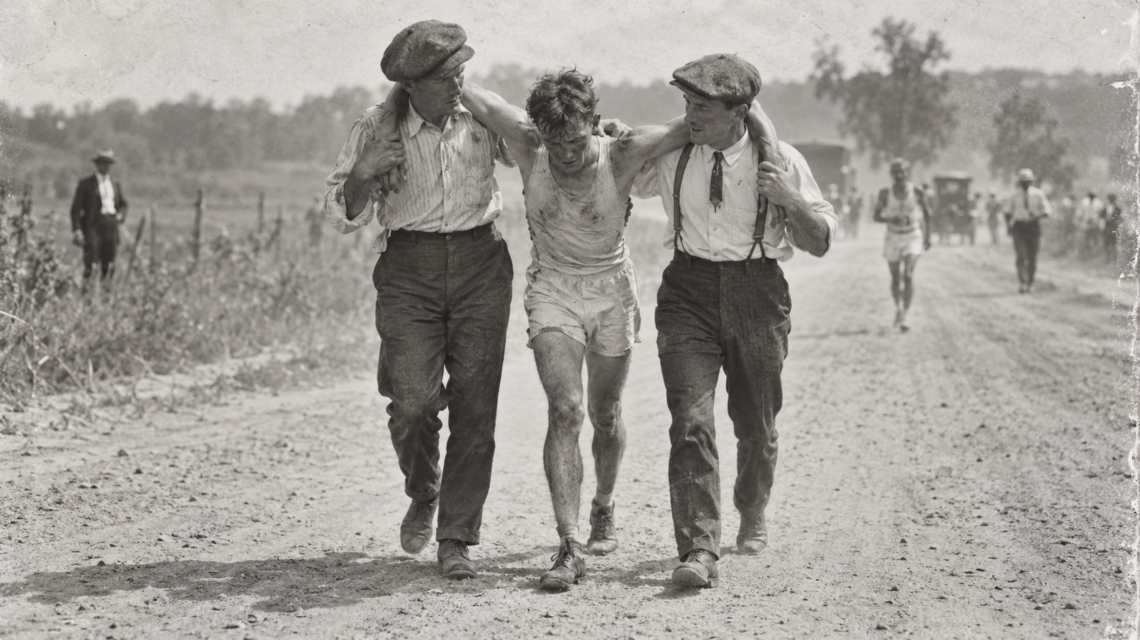
Thomas Hicks, an English-born runner representing the United States, had spent the final miles struggling with exhaustion. His handlers administered strychnine sulfate, a toxic substance used in small doses as a stimulant, along with egg whites and brandy. They also provided physical assistance as he struggled toward the stadium.
Hicks finished in 3 hours, 28 minutes and 53 seconds, the slowest winning time in Olympic men’s marathon history.
Of the 32 competitors recorded as participants, only 14 finished. The 40-kilometer race unfolded in temperatures of approximately 90°F (32°C), on dusty roads shared with escort vehicles, with only one official water station.
The extraordinary events were not simply a collection of bizarre sporting anecdotes. They exposed the dangerous assumptions about hydration, medical treatment and race organization that shaped endurance competition in the early Olympic era.
Why the marathon began at 3 p.m. in extreme heat
The 1904 Olympic Games were held alongside the Louisiana Purchase Exposition, better known as the St. Louis World’s Fair.
The marathon took place on August 30, beginning at approximately 3 p.m., when the afternoon heat was already severe. Rather than following a protected modern road-racing route, competitors ran over uneven, dusty country roads and rolling hills.
The race covered 40 kilometers, or approximately 24.85 miles. That was shorter than the modern marathon distance of 42.195 kilometers, which was not standardized internationally until years later.
The roads created problems beyond the heat. Automobiles carrying officials, trainers and journalists traveled alongside the runners, raising clouds of dust that made breathing difficult.
One competitor, William Garcia, collapsed after suffering serious internal bleeding. Contemporary accounts attributed his condition to the extreme dust exposure and physical stress. Later reports described his condition as potentially fatal without medical assistance.
The course was difficult enough on its own. The way the event was organized made it substantially more dangerous.
The organizers provided one water station because they wanted to study dehydration
The most consequential decision came before the runners started.
James E. Sullivan, the chief organizer of the Games, supported a theory that restricting water during endurance exercise could be beneficial. He regarded the marathon as an opportunity to investigate what he called purposeful dehydration.
Only one official drinking-water station was provided, at approximately the 12-mile mark, or 19 kilometers into the race.
That meant competitors were expected to cover nearly half the course before reaching the principal organized water supply.
The decision was not an unavoidable consequence of the era’s limited resources. It reflected an intentional approach to hydration that modern sports medicine has rejected.
Today, endurance athletes are advised to manage fluid intake according to exercise conditions and individual needs, avoiding both dangerous dehydration and excessive drinking.
In St. Louis, however, the organizers deliberately restricted access to water during a race held in extreme heat.
The consequences became visible as competitors began collapsing, vomiting or abandoning the event.
The most remarkable aspect is that Sullivan did not immediately interpret the disaster as evidence that his experiment was misguided. Historical accounts indicate that he questioned whether the marathon should remain an Olympic event at all.
Fred Lorz abandoned the race, rode in a car and returned as the apparent winner
Fred Lorz was an American distance runner who began the race as a legitimate competitor.
After approximately nine miles, or 14 kilometers, he developed severe cramps and stopped running.
He accepted a ride in an automobile.
The vehicle carried him for roughly 11 miles, although contemporary accounts differ about the precise distance traveled by car.
When the automobile broke down, Lorz got out and began running again.
He eventually entered the stadium ahead of the legitimate leaders.
Spectators celebrated.
For a brief period, Lorz appeared to be the Olympic marathon champion.
But the deception was exposed before the victory could become official.
Lorz maintained that he had been joking rather than deliberately attempting to steal the gold medal. That explanation did not satisfy race officials, who disqualified him.
He was initially suspended from amateur competition, although the penalty was later lifted.
In 1905, just one year after the Olympic scandal, Lorz won the Boston Marathon.
His later victory confirmed that he was a capable distance runner, but it did not erase what happened in St. Louis.
The episode remains one of the most notorious cases of course-cutting in Olympic history.
Thomas Hicks was winning, but his body was beginning to fail
While Lorz was riding in an automobile, Thomas Hicks was still completing the course on foot.
Hicks had moved into the lead after other competitors began struggling with the conditions.
But as the race progressed, he became increasingly exhausted.
He pleaded for water.
His handlers attempted to keep him moving, sometimes using wet sponges to relieve his discomfort.
By the final miles, his condition had deteriorated severely.
Hicks wanted to stop.
His attendants instead gave him substances intended to stimulate his nervous system and sustain his effort.
The treatment included strychnine sulfate, egg whites and brandy.
These were not secret substances administered in violation of a modern anti-doping code.
At the time, strychnine was sometimes used medicinally in small doses as a stimulant.
Its use was dangerous, but it was not prohibited by the Olympic anti-doping regulations that exist today.
The distinction matters because Hicks’s victory is frequently described as the first Olympic doping scandal.
It is more precise to say that his treatment is an early, well-documented example of performance-enhancing drug use in Olympic competition.
The winning runner was given a poison that could also stimulate the nervous system
Strychnine is a highly toxic alkaloid that affects the central nervous system.
It interferes with normal inhibitory signaling in the spinal cord and brainstem, potentially producing severe muscle spasms and convulsions.
At low doses, it was historically used as a stimulant.
But the difference between a stimulating dose and a dangerous one can be small.
The substance later became notorious as a component of rodent poisons.
In Hicks’s case, his handlers reportedly administered approximately one-sixtieth of a grain of strychnine sulfate, equivalent to about one milligram, followed by another dose later in the race.
The treatment also included egg whites and brandy.
A historical analysis published in the British Journal of Sports Medicine describes the administration of the stimulant and the runner’s increasingly desperate condition.
The handlers believed the substances would help him finish.
From a modern medical perspective, giving strychnine to a severely exhausted and dehydrated runner would introduce additional danger rather than provide appropriate treatment.
Hicks survived, but the circumstances illustrate how little protection early Olympic competitors had from hazardous interventions presented as performance aids.
Hicks crossed the finish line in 3:28:53 and needed immediate medical attention
The final miles were an ordeal.
Hicks was barely able to continue.
His attendants supported and encouraged him as he approached the stadium.
Historical descriptions indicate that he alternated between running and walking, with assistance from the people accompanying him.
When he finally reached the finish line, his official time was 3:28:53.
That result was extraordinary for reasons beyond the conditions.
The first Olympic marathon winner, Spyridon Louis, had finished the 1896 race in 2:58:50, approximately half an hour faster.
Hicks’s time remains the slowest winning performance in the history of the Olympic men’s marathon.
He required medical care after finishing and was too weak to celebrate normally.
The result was nevertheless recorded as an American gold medal.
The contradiction is striking: the legitimate champion had completed the course, but only after receiving dangerous stimulants and extensive assistance from his handlers.
His victory would be impossible to separate from the medical practices of the era.
A Cuban mail carrier stopped to eat fruit and still finished fourth
One of the most memorable competitors was Félix Carvajal, a Cuban mail carrier who traveled to St. Louis under difficult circumstances.
Carvajal was not equipped like the leading American runners.
He reportedly arrived wearing ordinary clothes and shoes unsuitable for competitive distance running.
Before the start, other participants helped him modify his clothing so he could race more comfortably.
His running style was unconventional.
He chatted with spectators and stopped during the race.
According to widely repeated accounts, he took fruit from an orchard, ate apples that caused stomach cramps and rested before continuing.
Some versions of the story describe him taking a nap.
Despite those interruptions, Carvajal finished fourth.
That achievement was remarkable in a field where more than half the runners failed to complete the course.
His performance also showed that the race’s chaos was not limited to the leading competitors.
Even a runner who stopped to eat and rest could finish near the podium because so many others had been defeated by the conditions.
A South African runner was chased off course by dogs
The marathon also included two Black South African competitors, Len Taunyane and Jan Mashiani, whose names appear in historical records under several spellings.
Their participation was significant.
They were among the earliest Black African athletes to compete in the modern Olympic Games.
They were in St. Louis in connection with the World’s Fair, which included deeply racist displays of people from colonized regions.
Their participation in the marathon took place within that wider setting of racial discrimination and exploitation.
Taunyane encountered an extraordinary obstacle during the race.
According to historical accounts, dogs chased him off the course.
He was forced to run approximately a mile away from the intended route before returning.
He eventually finished ninth.
Mashiani finished twelfth.
Their results were achieved despite the same heat, dust and limited hydration faced by the other runners.
The episode is often presented as a bizarre comic detail.
But it also illustrates how poorly protected the athletes were from hazards unrelated to running.
A modern Olympic road race would not be expected to expose competitors to uncontrolled traffic, loose animals and such severe shortages of drinking water.
Only 14 runners finished, and the official records do not agree on every entry
The St. Louis marathon is commonly described as having 32 starters and 14 finishers.
That is the count used by the International Olympic Committee and Olympedia.
However, some contemporary accounts and later historical studies refer to 31 starters.
The discrepancy reflects differences in historical recordkeeping and how competitors were counted.
The most reliable modern Olympic databases list 32 participants.
The number of finishers is consistently reported as 14.
That means fewer than half the field completed the race.
The dropout rate was approximately 56%.
It was an extraordinary level of attrition for an Olympic championship.
The combination of heat, dust, difficult roads, poor hydration and uneven preparation created conditions that overwhelmed many competitors.
Importantly, there is no reliable evidence that half the runners died.
That claim appears in some sensational retellings of the event, but it is false.
The race was dangerous and nearly fatal for at least one competitor, yet the historical record does not establish deaths caused by the marathon itself.
The race was also shaped by the racism of the 1904 World’s Fair
The marathon cannot be fully understood without the setting in which it occurred.
The St. Louis World’s Fair included displays that presented people from different cultures through racist and colonial stereotypes.
The Olympic events were closely connected to the exposition.
Organizers also staged so-called Anthropology Days, in which Indigenous and colonized people were made to participate in sporting contests intended to reinforce racist ideas about physical ability.
The marathon itself included competitors whose presence in St. Louis was linked to these displays.
The treatment of Black African athletes reflected the racial attitudes of the period.
This context complicates the popular portrayal of the marathon as merely a collection of funny mishaps.
The event was chaotic, but it also took place within a broader system of discrimination.
Understanding that setting helps explain why some competitors received inadequate preparation, limited support and unequal treatment.
The race’s history is therefore both a story of sporting absurdity and a record of the social conditions surrounding the early Olympic movement.
The marathon did not immediately create modern hydration rules or an Olympic doping ban
One of the most common myths about the 1904 race is that its disastrous conditions forced the International Olympic Committee to introduce modern safety regulations immediately.
The historical record does not support that claim.
The marathon continued to evolve gradually over subsequent decades.
The standard distance of 42.195 kilometers was not formally adopted until 1921.
Organized hydration practices improved over time, influenced by changing medical knowledge and race regulations.
But there was no immediate transformation in 1904 that established today’s hydration standards.
The same is true of doping.
Hicks’s use of strychnine did not produce an immediate Olympic ban on performance-enhancing substances.
Formal anti-doping regulation developed much later.
The International Olympic Committee created its Medical Commission in 1967.
Drug testing was introduced at the Olympic Games in 1968.
The World Anti-Doping Agency was established in 1999.
Those developments occurred decades after Hicks crossed the finish line.
The St. Louis marathon is an important early example of the dangers associated with performance-enhancing substances, but it was not the direct origin of the modern anti-doping system.
The numbers behind the 1904 Olympic marathon
| Detail | Historical record |
|---|---|
| Date | August 30, 1904 |
| Location | St. Louis, Missouri, United States |
| Starting time | Approximately 3 p.m. |
| Distance | 40 km (24.85 miles) |
| Temperature | Approximately 90°F (32°C) |
| Participants | 32 in modern Olympic records |
| Finishers | 14 |
| Nonfinishers | 18 |
| Official water stations | One |
| Water station location | Approximately 12 miles (19 km) |
| First runner to enter stadium | Fred Lorz, later disqualified |
| Official winner | Thomas Hicks |
| Winning time | 3:28:53 |
| Runner-up | Albert Corey |
| Third place | Arthur Newton |
| Fourth place | Félix Carvajal |
| Ninth place | Len Taunyane |
| Twelfth place | Jan Mashiani |
| Substances given to Hicks | Strychnine sulfate, brandy and egg whites |
The figures help explain why the race has remained famous for more than a century.
It was not simply slow.
It was a competition in which the physical demands of a marathon were intensified by decisions that would be considered unacceptable in modern elite sport.
The heat was severe.
The roads were dusty.
Water was restricted.
Medical interventions were hazardous.
And one competitor briefly appeared to win after traveling part of the course in a car.
The most absurd marathon in Olympic history left a serious legacy
The 1904 St. Louis marathon is often described as the strangest race in Olympic history.
That reputation is justified by the documented events.
A runner cheated with an automobile and briefly received the crowd’s applause.
The eventual champion was given a toxic stimulant and alcohol while struggling to remain conscious.
A Cuban mail carrier stopped for fruit and still finished fourth.
A South African runner was chased off course by dogs.
Only 14 competitors reached the finish.
But the race’s deeper significance lies in what it reveals about the early Olympic movement.
The organizers did not yet have a reliable understanding of hydration during endurance exercise.
The use of potentially dangerous stimulants was tolerated.
Athlete safety procedures were rudimentary.
And the event was staged within a World’s Fair shaped by the racial prejudices of its time.
Modern marathon running developed through decades of changes in medical knowledge, race organization and athlete protection.
The St. Louis race did not single-handedly produce those reforms.
It remains a vivid reminder of why they became necessary.
+ Siga o Giro no Facebook
+ Siga o Giro no Instagram
Leia Mais: