

Jordan initially preferred Adidas, but his mother persuaded him to hear Nike’s offer. The contract helped create Air Jordan, generated $126 million in first-year sales and produced one of sports marketing’s most enduring myths about a banned sneaker.
By Marcio Tamer
Updated October 30, 2026
In October 1984, Michael Jordan signed a five-year endorsement agreement with Nike worth a reported $2.5 million in guaranteed compensation, or $500,000 annually, plus royalties. The 21-year-old Chicago Bulls rookie had not yet played an official NBA regular-season game, but the company was already offering him something few basketball players had ever received: a signature shoe line built around his identity.
Forty-two years later, the scale of that decision is extraordinary.
According to Nike’s fiscal 2026 annual report, Jordan Brand generated $7.034 billion in annual revenue, despite sales declining from $7.270 billion the previous year.
That means a partnership that began with a $500,000 annual endorsement commitment now supports a business generating approximately $19.3 million in sales per day.
The comparison is not a measure of profit or Jordan’s personal earnings. It illustrates how dramatically the commercial value of his name has grown.
The original deal also contains one of the most misunderstood stories in sports marketing.
The famous black-and-red Air Jordan 1 was advertised as a sneaker banned by the NBA, with Nike supposedly paying a $5,000 fine every time Jordan wore it.
But Nike’s own historical account acknowledges that the controversy began with a different shoe, the Nike Air Ship, and that the familiar story of repeated $5,000 fines is not established by the documentary evidence.
The real history is more interesting than the legend.
It involves a reluctant rookie, a determined mother, an ambitious agent, a company searching for growth and an advertising campaign that transformed a uniform dispute into a global cultural phenomenon.
Why Michael Jordan wanted Adidas instead of Nike
When Jordan entered the NBA in 1984, he was already one of the most promising young basketball players in the United States.
He had won the NCAA championship with the University of North Carolina in 1982, making the decisive shot against Georgetown.
He had also helped the United States win Olympic gold in Los Angeles in 1984.
The Chicago Bulls selected him third overall in the NBA Draft, behind Hakeem Olajuwon and Sam Bowie.
His commercial potential was obvious, but the basketball footwear market looked very different from today’s industry.
Converse had established relationships with major NBA stars, including Magic Johnson, Larry Bird and Julius Erving.
Adidas was another prestigious basketball brand.
Nike, meanwhile, had built much of its reputation around running shoes.
Although the company was already a significant athletic footwear business, it was not the dominant basketball brand it would later become.
Jordan preferred Adidas.
In the documentary The Last Dance, he explained that he had little interest in visiting Nike.
His agent, David Falk, believed otherwise.
Falk saw an opportunity to structure a partnership around Jordan rather than simply add another athlete to a manufacturer’s endorsement roster.
The problem was persuading his client to attend the meeting.
Deloris Jordan persuaded her son to listen to Nike’s offer
The decisive intervention came from Jordan’s mother, Deloris Jordan.
Falk had struggled to convince the young player to visit Nike.
He turned to Deloris for help.
Jordan later recalled that his mother insisted he hear the company’s proposal, even if he ultimately rejected it.
That decision brought Jordan to Nike’s headquarters in Oregon.
The company presented a strategy that differed from the conventional basketball endorsement model.
Instead of placing Jordan in an existing shoe, Nike proposed building a product identity around him.
The company would develop a signature basketball sneaker.
Its marketing would emphasize Jordan’s athleticism, personality and potential to become a defining figure in the sport.
Falk was particularly interested in this approach.
His agency had represented prominent athletes in individual sports, where signature equipment and personal branding were already established commercial tools.
He believed a basketball player could be marketed in a similar way.
The proposal gave Jordan something Adidas and Converse had not offered on comparable terms.
He would not simply endorse Nike.
He would become the centerpiece of a dedicated product line.
Why Nike offered $500,000 a year to an unproven NBA rookie
The reported agreement guaranteed Jordan $500,000 annually for five years.
That represented $2.5 million over the contract’s initial term, before royalties and other possible payments.
The figure was extraordinary for a rookie.
Guinness World Records identifies the agreement as a record-setting sneaker endorsement, reporting that it was worth approximately three times the value of previous NBA endorsement deals.
The NBA’s own historical coverage describes the annual payment as substantially larger than what established basketball stars typically received from footwear sponsors.
There was an obvious risk.
Jordan had demonstrated exceptional ability in college and international competition, but he had not yet proved that he could become a dominant NBA player.
Nike was making a major financial commitment based on future potential.
The agreement also reportedly included performance and sales-related provisions.
According to NBA reporting, Nike retained the ability to end the arrangement under certain conditions if the shoes failed to reach specified commercial targets.
The company was therefore taking a significant gamble, but not one without safeguards.
The crucial difference was the size and structure of the opportunity.
Jordan would receive guaranteed compensation, a signature product and participation in the commercial success of the line.
The exact original royalty provisions have been described differently in retrospective accounts.
A commonly repeated figure is 5%, but the complete private agreement has not been publicly reproduced in a way that independently verifies every original term.
What is established is that royalties became a defining feature of Jordan’s long-term relationship with Nike.
That arrangement would eventually prove far more valuable than the original guaranteed salary.
Nike expected a few million dollars in sales, but Air Jordan made $126 million
Nike’s initial commercial expectations were modest compared with what followed.
David Falk has recalled that the company hoped to generate approximately $3 million in Air Jordan sales over several years.
Accounts differ over whether the original projection covered three or four years.
The outcome, however, is consistently reported.
Air Jordan generated approximately $126 million in sales during its first year.
That was more than 40 times the frequently cited $3 million initial target.
The result transformed the economics of the partnership.
Nike had committed millions to a rookie whose commercial potential was uncertain.
Within a year, his signature line was producing sales that far exceeded the company’s original expectations.
The success was not simply a consequence of advertising.
Jordan’s performances on the court provided an exceptionally strong foundation.
During the 1984-85 NBA season, he averaged 28.2 points, 6.5 rebounds and 5.9 assists per game.
He won the NBA Rookie of the Year award.
His spectacular dunks and attacking style made him one of the league’s most exciting new stars.
Nike connected those performances to a distinctive product identity.
The name Air Jordan suggested flight.
The shoe design used bold colors.
The advertising presented Jordan as an athlete who challenged conventional expectations.
The combination helped move basketball shoes beyond the court and into everyday fashion.
But one marketing story became especially influential.
The NBA’s banned sneaker controversy began with the Nike Air Ship
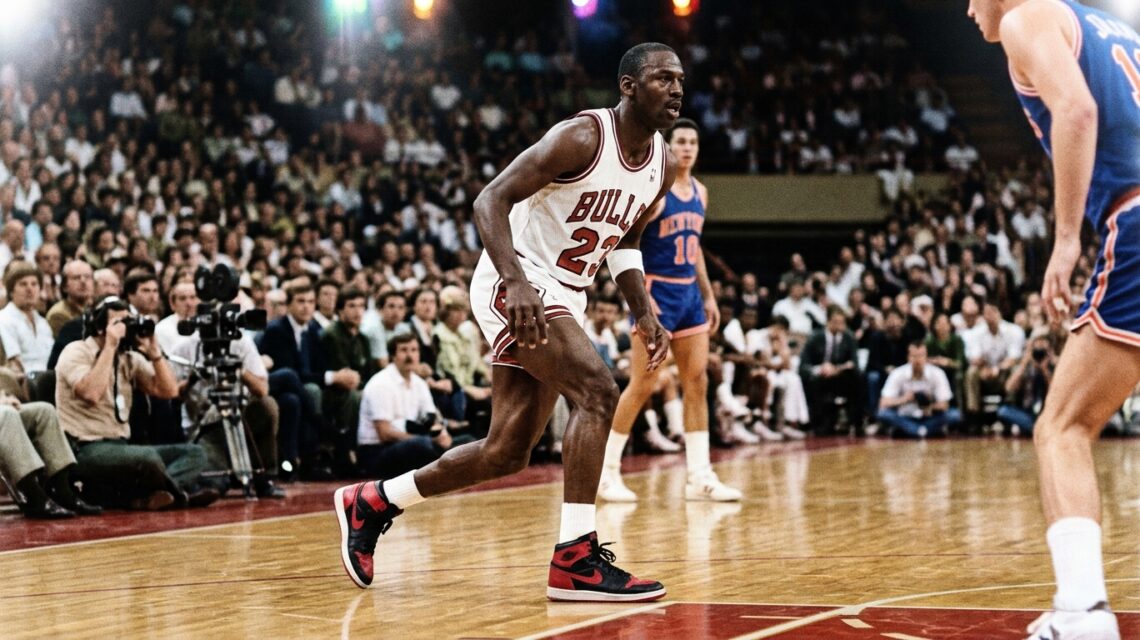
The familiar version of the story says that Jordan wore a black-and-red Air Jordan 1 during his rookie season, the NBA banned the shoe, and Nike paid $5,000 every time he ignored the restriction.
The documentary record is more complicated.
Nike’s own historical account explains that Jordan wore a black-and-red Nike Air Ship during preseason games in October 1984.
The Air Ship preceded the commercial launch of the Air Jordan 1.
On October 18, 1984, Jordan wore the black-and-red Air Ship during a preseason game at Madison Square Garden.
The shoe attracted attention because it did not comply with the NBA’s uniform requirements.
At the time, the league required basketball shoes to be predominantly white and consistent with the team’s uniform standards.
Jordan’s black-and-red footwear stood out dramatically.
The league objected.
Nike’s archival account also identifies a February 25, 1985, letter concerning footwear that violated uniformity rules.
By then, Jordan had begun wearing versions of the Air Jordan 1.
The controversy therefore involved more than one shoe and more than one stage of the product’s development.
The Air Ship played the central role in the original 1984 dispute.
The Air Jordan 1 became the product that transformed the dispute into an advertising phenomenon.
That distinction matters because the two models are frequently treated as though they were the same sneaker.
They were not.
Did Nike really pay a $5,000 fine every time Jordan wore the shoes?
The claim that Nike repeatedly paid $5,000 fines has become one of the most famous stories in sneaker history.
But it should not be presented as a confirmed financial fact.
Nike acknowledges that the popular account of Jordan wearing the black-and-red Air Jordan 1 throughout the season and receiving a $5,000 fine for every appearance is an oversimplification.
The company has documented the uniform controversy and the league’s objections.
What has not been established is a complete series of fines paid at the widely repeated amount.
There is also no reliable evidence that Jordan wore the black-and-red Air Jordan 1 in every regular-season game while Nike routinely paid penalties.
In reality, Jordan wore several different Nike shoes during his rookie campaign.
Many complied with the NBA’s requirements.
The distinction does not diminish the advertising campaign’s effectiveness.
It reveals how Nike transformed a real uniform dispute into a larger cultural narrative.
The company did not need a season-long series of documented fines to create the impression of rebellion.
It needed a recognizable athlete, a distinctive product and a compelling story.
Nike turned a uniform dispute into one of basketball’s most famous advertisements
When the Air Jordan 1 reached consumers in 1985, Nike embraced the controversy.
Its advertising presented the shoe as something basketball authorities had attempted to keep off the court.
The message suggested that although the NBA could regulate what Jordan wore during games, it could not control what ordinary consumers chose to buy.
That was a powerful marketing idea.
The controversy transformed the sneaker from sporting equipment into a symbol of individuality.
The product’s appeal was no longer limited to its performance features.
Consumers were buying a connection to Jordan’s image and the rebellious identity created around the shoe.
The campaign also benefited from the contrast between Jordan’s status and the league’s restrictions.
He was a spectacular young athlete whose style appeared to challenge the established order.
The shoe became an extension of that personality.
Nike’s marketing connected the product to a story that consumers could understand immediately.
The NBA had objected to the colors.
Nike turned the objection into a reason to want the shoes.
The campaign became one of the foundations of modern sneaker culture.
The Air Jordan 1 helped turn basketball shoes into cultural products
Before Air Jordan, basketball shoes were already popular among athletes and fans.
Jordan’s partnership did not invent athlete endorsements or signature sporting equipment.
But it expanded their commercial possibilities.
The Air Jordan 1 became desirable beyond basketball.
Its colors, design and association with Jordan made it a fashion product as well as a performance sneaker.
Nike continued releasing new Jordan models as his career developed.
Each product became associated with a different period of his playing history.
The brand benefited from his growing achievements.
Jordan won his first NBA championship with the Chicago Bulls in 1991.
He went on to win six titles, five regular-season MVP awards and six NBA Finals MVP awards.
His competitive success reinforced the credibility and cultural appeal of the products carrying his name.
Advertising campaigns also evolved.
Filmmaker Spike Lee became closely associated with Air Jordan marketing through his Mars Blackmon character.
The commercials helped connect basketball, film, music and street fashion.
By the 1990s, Air Jordan had become much more than a single shoe.
It was a recurring product franchise with an identity capable of surviving beyond Jordan’s playing career.
Jordan Brand became a multibillion-dollar business inside Nike
The commercial expansion eventually led to the creation of Jordan Brand as a distinct business identity within Nike.
It developed its own product lines, athlete partnerships and marketing campaigns.
The brand expanded beyond Michael Jordan’s signature basketball shoes.
It began producing footwear and apparel for other athletes, teams and consumers.
That expansion helped transform a personal endorsement into a business with global reach.
Nike’s financial statements reveal the scale of the operation.
In fiscal 2024, Jordan Brand generated $8.701 billion in revenue.
Sales declined to $7.270 billion in fiscal 2025.
In fiscal 2026, they fell again to $7.034 billion.
The latest figure represents a 3% decline from the previous year.
That matters because the brand’s history is not a story of uninterrupted growth.
Jordan Brand remains a major business, but its recent revenue has fallen from its 2024 peak.
Even after those declines, the company generated more than $7 billion in annual sales.
The original endorsement agreement had helped create a business whose revenue now exceeds the entire initial five-year guarantee by thousands of times.
The comparison is striking, although the two figures measure different things.
The $2.5 million was Jordan’s reported guaranteed endorsement compensation.
The $7.034 billion represents annual Jordan Brand sales, not profit and not Jordan’s personal income.
How much money does Michael Jordan make from Nike?
Jordan’s original contract was unusual partly because it allowed him to participate in the commercial success of the products carrying his name.
That distinction became increasingly important as Jordan Brand expanded.
An athlete receiving only a fixed endorsement fee benefits from the contract’s guaranteed payments.
An athlete receiving royalties can also benefit when sales increase.
Jordan’s long-term arrangement with Nike has reportedly generated enormous earnings.
Forbes has estimated that his corporate partnerships, including Nike, Hanes and Gatorade, produced billions of dollars in cumulative pretax income.
Its profile of Jordan also reports that Nike pays him nearly $300 million annually.
That figure is an estimate rather than a publicly disclosed payment from Nike’s financial statements.
Nike does not separately publish Jordan’s personal royalty checks in its annual report.
Consequently, Jordan Brand’s $7.034 billion in revenue should not be multiplied by an assumed royalty percentage and presented as a verified personal payment.
The precise terms of his current agreement are not publicly disclosed in full.
The broader financial conclusion is nevertheless clear.
Jordan’s partnership with Nike became one of the most lucrative athlete endorsement relationships in history.
Its value continued growing long after his final NBA retirement in 2003.
Jordan became a billionaire through endorsements and team ownership
Michael Jordan became a billionaire in 2014, according to Forbes estimates.
He appeared on the publication’s annual billionaires list in 2015.
His Nike partnership was a major source of wealth, but it was not the only factor.
Jordan also accumulated significant assets through business investments.
One of the most important was his ownership of the Charlotte NBA franchise.
He acquired a controlling stake in the Charlotte Bobcats in 2010.
The franchise later returned to the Hornets name.
As NBA team valuations increased, Jordan’s ownership interest became increasingly valuable.
In 2023, he sold his majority stake in the Charlotte Hornets in a transaction that valued the franchise at approximately $3 billion.
The sale substantially increased his estimated wealth.
By 2026, Forbes estimated Jordan’s fortune at more than $4 billion.
That figure includes business assets and investments, not simply money earned from playing basketball.
Jordan’s NBA salaries totaled approximately $90 million across his career.
His wealth therefore illustrates a major change in the economics of professional sport.
For elite athletes, commercial rights, brand partnerships and ownership stakes can ultimately become more valuable than playing contracts.
Jordan helped establish that model.
The Nike-Jordan deal in numbers
| Milestone | Reported figure |
|---|---|
| Year of original agreement | 1984 |
| Original contract duration | Five years |
| Reported guaranteed compensation | $2.5 million |
| Average annual guarantee | $500,000 |
| Additional compensation | Royalties |
| Initial Air Jordan sales target | Approximately $3 million over several years |
| First-year Air Jordan sales | Approximately $126 million |
| Air Jordan 1 commercial launch | 1985 |
| Jordan Brand revenue, fiscal 2024 | $8.701 billion |
| Jordan Brand revenue, fiscal 2025 | $7.270 billion |
| Jordan Brand revenue, fiscal 2026 | $7.034 billion |
| Decline from fiscal 2025 to 2026 | 3% |
| Jordan’s NBA career salary | Approximately $90 million |
| Year Jordan reached billionaire status | 2014, according to Forbes estimates |
The figures show how dramatically the partnership evolved.
Nike initially committed to paying a promising rookie $500,000 annually.
The company then discovered that Jordan’s name could support a product business worth hundreds of millions of dollars.
Over the following decades, that business expanded into a global brand generating billions.
The commercial opportunity proved far greater than either side could reasonably have quantified in 1984.
Why the original contract changed athlete endorsements
The Nike-Jordan partnership did not create the concept of a signature shoe.
Athletes in basketball and other sports had received personalized equipment and endorsement deals before 1984.
Its significance was the scale of the commitment and the way Nike built a long-term product identity around one athlete.
The company treated Jordan as more than a promotional representative.
His name became central to the product.
His performances became part of the marketing.
His image helped define the brand.
The royalty structure aligned his financial interests with the commercial success of the products.
The approach provided a model for later partnerships involving major athletes.
It also demonstrated that a sporting endorsement could become a business with a lifespan far longer than the athlete’s competitive career.
Jordan’s last NBA game took place in April 2003.
More than two decades later, Jordan Brand was still generating billions in annual revenue.
That endurance is one of the most important consequences of the original deal.
The brand no longer depends on Jordan appearing in NBA games.
It draws value from his sporting legacy, product history and continued cultural relevance.
The most important part of Nike’s 1984 gamble was not the banned sneaker
The Air Jordan 1’s banned-shoe story remains one of the most recognizable advertising narratives in sports.
But it is not the strongest explanation for the partnership’s success.
The campaign worked because Nike had already made a much larger strategic decision.
It committed substantial money to a rookie before he had established himself as an NBA superstar.
It offered him a signature product line.
It connected his identity to the brand.
And it created a commercial arrangement that allowed the partnership to grow with his success.
The famous uniform controversy helped attract attention.
Jordan’s performances helped sustain demand.
The product designs and marketing campaigns turned that demand into a lasting business.
By fiscal 2026, Jordan Brand was generating $7.034 billion annually despite two consecutive years of declining revenue.
That figure is the clearest measure of the scale of what began in 1984.
The most consequential decision was not Nike’s willingness to advertise a supposedly forbidden sneaker.
It was the company’s willingness to build a business around a 21-year-old basketball player who initially did not even want to attend its sales presentation.
+ Siga o Giro no Facebook
+ Siga o Giro no Instagram
Leia Mais: