

The Brazilian’s record-breaking transfer more than doubled football’s previous benchmark and triggered a dispute over financial regulations. Nine years later, its most surprising legacy is how differently the two clubs spent their money and pursued European success.
By Marcio Tamer
Updated October 30, 2026
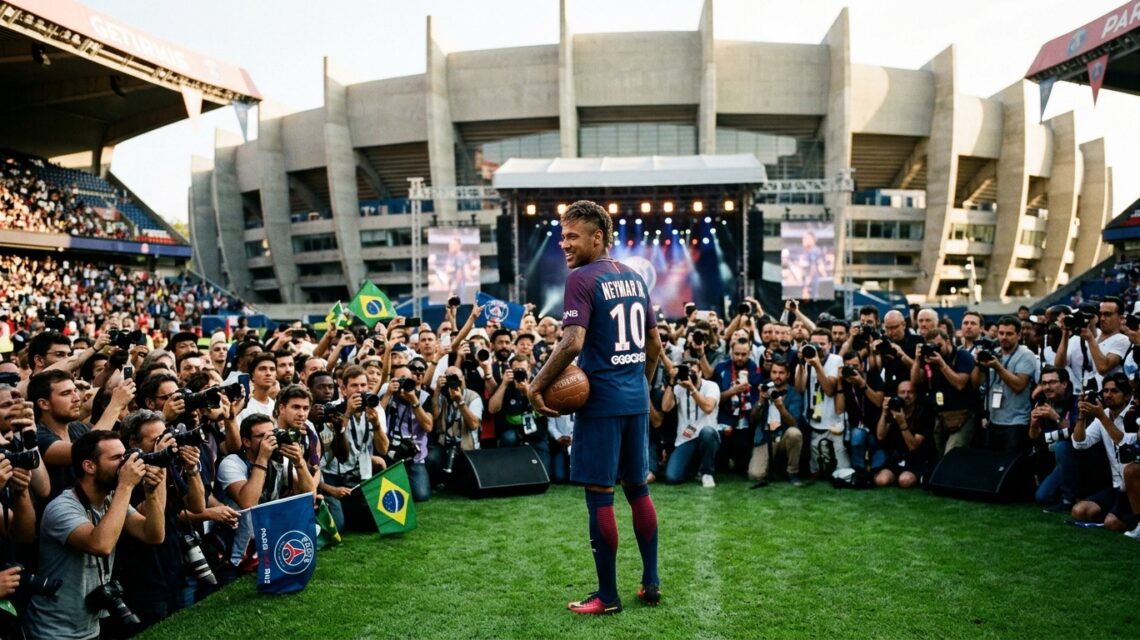
On August 3, 2017, Barcelona confirmed that Neymar’s representatives had paid €222 million to terminate his contract. The Brazilian forward was leaving for Paris Saint-Germain in a deal that more than doubled the previous world transfer record and fundamentally changed expectations about how much a footballer could cost.
The payment was so large that Spain’s La Liga initially refused to accept it.
But that did not stop the transfer.
Neymar’s lawyers went directly to Barcelona, paid the release clause in the player’s name and completed the process that allowed him to join PSG.
The operation created a new financial benchmark. Manchester United had paid approximately €105 million to sign Paul Pogba from Juventus in 2016. PSG’s expenditure on Neymar was €117 million higher, an increase of approximately 111%.
Nine years later, the €222 million fee remains the highest recorded transfer payment in football history.
But the consequences went far beyond one player’s valuation.
Barcelona responded to Neymar’s departure by committing at least €345 million in fixed transfer fees to Ousmane Dembélé, Philippe Coutinho and Antoine Griezmann between 2017 and 2019. Potential bonuses pushed the combined value of those agreements even higher.
PSG, meanwhile, spent six seasons attempting to win the Champions League with Neymar.
He departed in 2023 without achieving that objective.
Paris finally won Europe’s biggest club competition in May 2025, defeating Inter Milan 5-0, with Dembélé, one of Barcelona’s expensive post-Neymar signings, playing a central role.
That extraordinary sequence reveals why the Neymar transfer remains one of the most consequential financial decisions in modern football.
Why PSG was willing to pay more than twice the previous transfer record
By the summer of 2017, Neymar was one of the most valuable footballers in the world.
He had joined Barcelona from Santos in 2013 and become a central figure in an attacking trio alongside Lionel Messi and Luis Suárez.
The partnership helped Barcelona win the Champions League in 2015.
Neymar also scored in that year’s final against Juventus.
At 25, he was entering what should have been the most productive years of his career.
He had already won major domestic and international trophies and was widely regarded as a potential future Ballon d’Or winner.
For PSG, signing Neymar offered an opportunity that extended beyond his immediate sporting contribution.
The French club had been controlled by Qatar Sports Investments since 2011.
Its ownership had invested heavily in building a team capable of competing with Europe’s established powers.
PSG had become a dominant force in French football, but the Champions League remained its principal sporting objective.
Signing Neymar would give the club one of the game’s most recognizable stars.
It would also send a powerful message to competitors.
PSG was prepared to pay a price that other clubs had previously considered unrealistic.
The transaction was therefore both a football decision and a statement about the club’s financial ambitions.
Barcelona’s €222 million release clause was supposed to protect its biggest assets
The transfer was possible because Neymar’s Barcelona contract contained a release clause.
In Spanish football, such clauses establish the compensation required for a player to terminate a contract unilaterally.
Barcelona had set Neymar’s clause at €222 million from July 1, 2017.
The amount was extraordinarily high by the standards of the period.
For most clubs, it would have represented an effective barrier to signing him.
But a release clause does not necessarily prevent a transfer.
It establishes the price at which the player can leave if the relevant contractual and legal requirements are satisfied.
PSG was prepared to meet that price.
On August 2, Neymar informed Barcelona that he wanted to leave.
The club publicly confirmed his decision and insisted that the full €222 million clause would have to be paid.
The following day, his representatives attempted to complete the payment.
That was when the transfer became a legal and regulatory confrontation.
La Liga rejected the payment, so Neymar’s lawyers went directly to Barcelona
On the morning of August 3, 2017, lawyers representing Neymar arrived at La Liga’s headquarters in Madrid.
They intended to deposit the €222 million required to terminate his Barcelona contract.
La Liga refused to accept the payment.
Its president, Javier Tebas, had publicly raised concerns about PSG’s financial arrangements and their compatibility with UEFA’s Financial Fair Play regulations.
The league questioned the circumstances surrounding the operation.
However, La Liga’s refusal did not mean it had established a violation of UEFA rules.
Nor did it give the Spanish league final authority to determine whether PSG complied with European financial regulations.
Neymar’s representatives then took a different route.
They visited Barcelona’s offices and made the payment directly to the club.
Barcelona confirmed the transaction in an official statement that afternoon.
The club said the €222 million had been paid in Neymar’s name and that his contract had been terminated.
Barcelona also announced that it would provide UEFA with information about the operation.
That sequence corrects a common misconception about the transfer.
La Liga did not ultimately accept and process the €222 million payment. Barcelona received it directly from Neymar’s representatives.
The distinction matters because the payment mechanism became part of the wider controversy surrounding the deal.
How the €222 million transfer worked under Financial Fair Play
The size of the fee immediately raised questions about UEFA’s Financial Fair Play rules.
At the time, those regulations required clubs participating in European competitions to operate within specified financial limits over a monitoring period.
The objective was to prevent clubs from financing excessive losses through unrestricted owner contributions.
But Financial Fair Play did not operate as a simple ban on expensive transfers.
A club could spend heavily on a player while still complying with the regulations, depending on its revenue, other expenses, transfer income and accounting treatment.
One important concept was amortization.
When a club purchased a player under a multiyear contract, the transfer fee was generally distributed across the contract’s duration for accounting purposes.
Neymar signed an initial five-year agreement with PSG.
A €222 million transfer fee spread evenly over five years would represent approximately €44.4 million annually in amortization expense.
That is an accounting calculation, not evidence that PSG paid Barcelona in five installments.
The release clause was paid in full.
The accounting expense could nevertheless be recognized over several years.
PSG also had to account for Neymar’s wages and other relevant costs.
Contemporary reporting estimated his annual net salary at around €30 million, although published estimates varied and the complete private contract was not publicly disclosed.
Claims that the operation cost more than €400 million over its original contract are therefore estimates based on the transfer fee and projected employment costs, not a single verified payment.
The central question for UEFA was whether PSG’s overall financial position complied with the applicable regulations.
UEFA investigated PSG, but the legal outcome was more complicated than the accusations
On September 1, 2017, UEFA opened a formal investigation into PSG’s finances.
The inquiry followed the arrivals of Neymar and Kylian Mbappé, whose move from Monaco was initially structured as a loan before becoming a permanent transfer.
UEFA examined PSG’s financial information, sponsorship arrangements and compliance with its break-even rules.
In June 2018, UEFA’s Club Financial Control Body closed the investigation.
Its initial assessment found that the accounting treatment of the Neymar and Mbappé transactions appeared consistent with the relevant regulations, subject to verification of audited financial statements.
The process did not end there.
UEFA subsequently attempted to review the decision.
PSG challenged that action before the Court of Arbitration for Sport.
In March 2019, CAS ruled in PSG’s favor because UEFA had failed to respect the applicable deadline for reopening the case.
That ruling was procedural.
It did not establish that every aspect of PSG’s financial arrangements was beyond criticism.
But it also did not support claims that the Neymar transfer had been formally proven illegal.
The distinction is important.
An investigation is not a conviction.
A complaint is not evidence of wrongdoing by itself.
And a procedural victory does not necessarily resolve every substantive financial question.
The Neymar operation remained controversial, but its legal history cannot be reduced to a claim that PSG simply bypassed Financial Fair Play without consequences.
Qatar’s ownership gave the transfer a geopolitical dimension
PSG’s spending also attracted attention because of its ownership structure.
Qatar Sports Investments acquired control of the club in 2011.
QSI is associated with Qatar’s state-backed investment strategy and has been central to the country’s expansion into international sport.
The acquisition of PSG preceded Qatar’s hosting of the 2022 FIFA World Cup.
During that period, the country invested heavily in sporting infrastructure, sponsorships and international events.
Researchers and commentators have interpreted these investments partly through the concept of soft power.
Soft power refers to the ability to build influence through attraction, visibility and cultural relationships rather than military or direct economic pressure.
A globally recognized football club can contribute to that objective.
Signing Neymar made PSG an even more prominent international brand.
His popularity extended across Europe, South America, Asia and other major markets.
His arrival attracted global media coverage and increased attention toward the club.
However, it would be misleading to claim that the €222 million transfer was conclusively designed as a specific promotional operation for the 2022 World Cup.
The broader relationship between Qatar’s sporting investments and international influence is well documented.
The precise motivations behind individual investment decisions are more difficult to establish.
What can be said is that Neymar’s signing strengthened the global visibility of a club controlled by QSI.
It also demonstrated how state-backed investment had changed the competitive landscape of European football.
Barcelona received €222 million and immediately entered an expensive transfer market
The consequences for Barcelona were immediate.
The club had lost one of its most important attacking players.
It also possessed an extraordinary amount of money from the release-clause payment.
That combination created an unusual negotiating position.
Barcelona needed to strengthen its squad, but other clubs knew it had received €222 million.
Within weeks, Barcelona agreed to sign Ousmane Dembélé from Borussia Dortmund.
The initial fee was €105 million, with additional performance-related payments possible.
Barcelona announced the agreement on August 25, 2017.
Dembélé was viewed as a replacement for Neymar, particularly because of his pace, dribbling and ability to play on either wing.
But the spending continued.
In January 2018, Barcelona signed Philippe Coutinho from Liverpool in a deal widely reported at €120 million plus potential bonuses.
In July 2019, the club paid Antoine Griezmann’s €120 million release clause to Atlético Madrid.
The three transfers represented a combined €345 million in fixed fees.
That was €123 million more than Barcelona had received for Neymar.
And it excluded potential bonuses.
The spending illustrates how one record-breaking transfer was followed by several other enormous deals.
But the timing and motivations of those transactions were not identical.
Dembélé was recruited immediately after Neymar’s departure.
Coutinho arrived five months later.
Griezmann was signed almost two years afterward.
They should not all be described as direct replacements for the same player.
Did Neymar’s transfer cause football inflation?
The €222 million fee undoubtedly changed perceptions of the upper limit of the transfer market.
Before August 2017, a fee above €100 million was still exceptional.
PSG had demonstrated that a club could spend more than twice that amount on a single player.
The psychological effect was considerable.
Selling clubs could point to Neymar’s price when negotiating for their own stars.
Buying clubs faced growing expectations about what elite players should cost.
Barcelona’s subsequent deals provided some of the clearest examples of the new market environment.
However, the claim that Neymar’s transfer alone caused football-wide inflation is too simplistic.
Transfer fees had already been rising for years.
Broadcasting revenue, commercial income, international investment and growing competition among wealthy clubs all contributed to that trend.
The Premier League’s television contracts were especially important in expanding the spending power of English clubs.
Neymar’s transfer was therefore both a product of football’s growing financial resources and a powerful new benchmark.
It accelerated the perception that nine-figure fees were becoming normal for elite players.
But it did not independently create the economic forces behind rising transfer prices.
Barcelona’s expensive signings became part of a larger financial problem
Barcelona’s spending after Neymar’s departure later became closely associated with the club’s financial difficulties.
Coutinho struggled to establish himself consistently.
Dembélé experienced repeated injury problems during his Barcelona career.
Griezmann also failed to deliver the sustained impact expected from his transfer fee.
Those sporting outcomes complicated the financial returns on the investments.
But Barcelona’s later financial crisis had multiple causes.
The club carried an enormous wage bill.
Its operating costs had grown substantially.
The COVID-19 pandemic reduced matchday and other revenue.
Long-term financial commitments also limited flexibility.
The expensive transfers contributed to the pressure, but they were not the sole explanation.
The distinction matters because the Neymar payment itself initially increased Barcelona’s financial resources.
The later difficulties arose partly from how the club used those resources, alongside other financial decisions and external shocks.
The most revealing comparison is not simply that Barcelona received €222 million and later experienced a crisis.
It is that the club committed at least €345 million to three attacking players without achieving the sustained sporting improvement those investments were intended to deliver.
Neymar won domestic trophies in Paris but never delivered the Champions League
Neymar’s six seasons at PSG were not without success.
He won five French league titles.
He also helped the club win domestic cups and reach the Champions League final in 2020.
During that campaign, PSG advanced to its first European Cup final.
But Bayern Munich won the match 1-0.
The defeat became one of the defining moments of Neymar’s Paris career.
The club had assembled an extraordinarily expensive team with the objective of becoming European champion.
Neymar had been signed for a world-record fee.
Mbappé had also joined in 2017.
Lionel Messi arrived in 2021.
Yet PSG did not win the Champions League while Neymar was at the club.
Injuries also affected his availability during important periods.
He remained an exceptionally talented player, but the sporting return was more complicated than the transfer fee suggested.
In August 2023, PSG sold Neymar to Saudi Arabian club Al-Hilal.
The transfer was widely reported at approximately €90 million, with potential additional payments.
That was substantially less than the €222 million PSG had paid Barcelona six years earlier.
The difference does not represent a straightforward accounting loss, because Neymar had provided six seasons of service and the original transfer fee had been amortized over time.
Nevertheless, it illustrates the scale of the club’s initial commitment.
PSG eventually won the Champions League with Barcelona’s former replacement for Neymar
The most unexpected chapter came after Neymar had left Paris.
In August 2023, PSG signed Ousmane Dembélé from Barcelona.
Dembélé had been Barcelona’s first major purchase after Neymar’s departure in 2017.
He was also one of the players whose transfer fee symbolized the spending wave that followed the Brazilian’s move.
In Paris, Dembélé developed into a central figure under coach Luis Enrique.
During the 2024-25 season, he produced the most successful campaign of his career.
PSG won Ligue 1 and the Coupe de France.
On May 31, 2025, the club defeated Inter Milan 5-0 in Munich to win its first Champions League title.
Dembélé was named UEFA Champions League Player of the Season.
In September 2025, he won the Ballon d’Or.
The sequence created a striking historical contrast.
PSG had paid €222 million to take Neymar from Barcelona in 2017.
Barcelona had then paid at least €105 million to sign Dembélé as part of its response.
Six years later, Dembélé joined PSG.
And in 2025, he helped the French club achieve the European triumph that had eluded Neymar during his time there.
This does not prove that PSG would have been better off never signing Neymar.
The club’s development involved many other players, coaches and financial decisions.
But the contrast demonstrates how unpredictable the sporting returns on enormous transfer investments can be.
The player who originally helped Barcelona respond to Neymar’s departure eventually became a central figure in PSG’s greatest achievement.
Neymar’s €222 million transfer remains football’s benchmark in 2026
Despite enormous spending across European football, Neymar’s transfer fee has not been surpassed.
As of October 2026, the €222 million payment remains the highest recorded fee for a footballer.
Kylian Mbappé’s €180 million move from Monaco to PSG ranks among the closest comparisons.
Other expensive transfers, including those involving Dembélé, Coutinho, Jude Bellingham and Alexander Isak, have approached or exceeded €100 million.
But none has reached Neymar’s figure.
The record’s longevity is notable.
The transfer initially appeared to establish a new ceiling that other clubs might quickly surpass.
Instead, it remained unmatched for more than nine years.
That does not mean football spending stopped growing.
Clubs continued investing heavily in transfer fees, wages, signing bonuses and agent payments.
But Neymar’s deal remains exceptional because of the enormous amount committed to a single player in one transaction.
The €222 million transfer in numbers
| Financial milestone | Amount |
|---|---|
| Neymar’s Barcelona release clause, 2017 | €222 million |
| Previous record, Paul Pogba to Manchester United, 2016 | Approximately €105 million |
| Increase over previous record | €117 million |
| Percentage increase | Approximately 111% |
| Neymar’s initial PSG contract | Five years |
| Illustrative annual amortization over five years | €44.4 million |
| Dembélé to Barcelona, 2017, initial fee | €105 million |
| Coutinho to Barcelona, 2018, reported initial fee | €120 million |
| Griezmann to Barcelona, 2019 | €120 million |
| Combined initial fees for those three players | €345 million |
| Amount above Neymar’s release-clause payment | €123 million |
| Neymar to Al-Hilal, 2023, reported fee | Approximately €90 million, plus possible add-ons |
| PSG’s first Champions League title | 2025 |
The figures show why the operation cannot be understood simply as a record-breaking purchase.
PSG’s payment created a new valuation benchmark.
Barcelona’s subsequent spending exceeded the amount it had received.
UEFA investigated the financial implications.
And the sporting consequences continued unfolding long after Neymar left Paris.
The transfer changed football’s financial expectations, but not the uncertainty of success
The Neymar transfer demonstrated that the market value of an elite footballer could exceed €200 million.
It also showed that contractual release clauses, once regarded as effective barriers, could be activated by clubs with sufficient financial resources.
The transaction intensified debates over Financial Fair Play, state-backed ownership and competitive balance.
It changed how clubs approached negotiations for their most valuable players.
And it helped establish the modern era of nine-figure transfer fees.
But the events that followed also exposed the limits of spending.
Barcelona received a record payment and then committed even larger sums to new players.
PSG assembled one of football’s most expensive attacking groups but failed to win the Champions League during Neymar’s six seasons.
The French club eventually achieved that objective in 2025, after changing its sporting approach and rebuilding the team.
The irony is that one of the players who helped deliver the trophy was Dembélé, whom Barcelona had originally bought in response to Neymar’s departure.
Nine years after the €222 million transaction, its most enduring lesson is not that money guarantees success.
It is that a single transfer can transform the financial expectations of an entire industry while leaving the sporting outcome uncertain.
+ Siga o Giro no Facebook
+ Siga o Giro no Instagram
Leia Mais: