

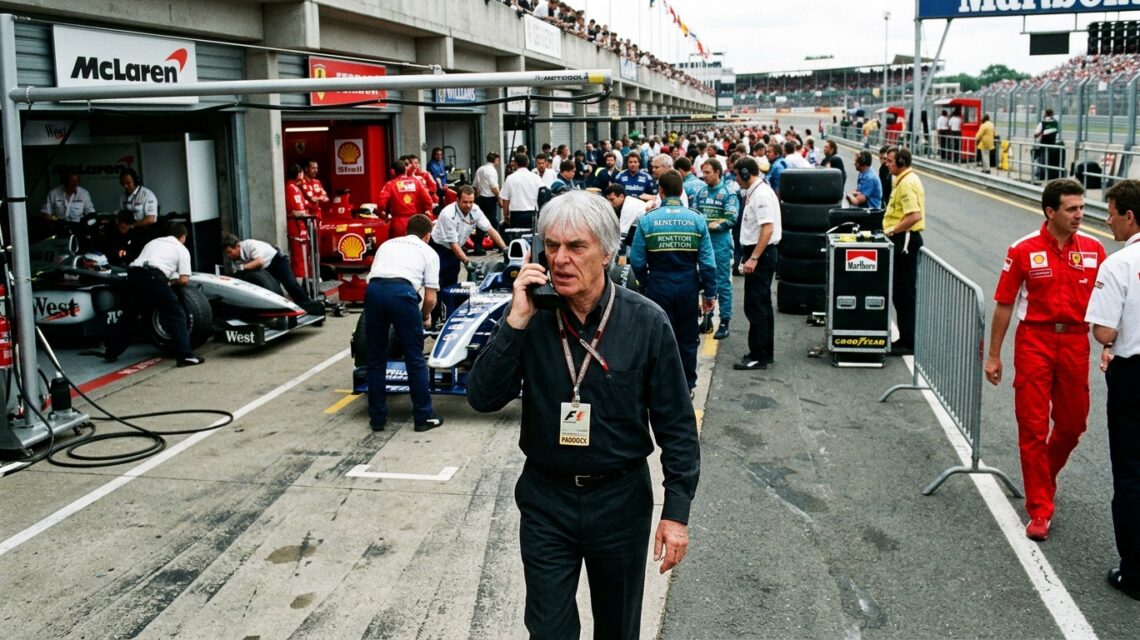
The former Brabham owner helped turn a fragmented racing championship into a global television business. His biggest financial move came in 2001, when an agreement with the FIA secured commercial rights through 2110, decades beyond his own career.
By Marcio Tamer
Updated November 2, 2026
In 2001, companies associated with Bernie Ecclestone secured the commercial rights to Formula 1 for 100 years in exchange for approximately $313.6 million.
The agreement covered the period from 2011 through 2110.
Fifteen years later, Liberty Media announced the acquisition of Formula 1 at an enterprise valuation of approximately $8 billion.
By 2025, the championship was generating $3.87 billion in annual revenue, with reported operating income of $632 million.
Those three figures reveal the scale of one of the most remarkable transformations in sports business.
Ecclestone did not invent Formula 1, which began its World Championship in 1950. Nor did he single-handedly create its international popularity.
His achievement was to recognize that the championship’s television broadcasts, sponsorship opportunities and race-hosting agreements could become a coordinated global business.
He helped replace fragmented negotiations with a system in which commercial rights could be packaged and sold across multiple countries.
He also established a business model in which circuits and race promoters paid substantial fees to stage Grands Prix.
The result was a championship that could generate revenue from the same event in several different ways.
Broadcasters paid to show the race.
Promoters paid to host it.
Sponsors paid to associate their brands with it.
Corporate customers paid for premium hospitality.
And teams received commercial distributions that helped support their participation.
The system made Formula 1 increasingly valuable.
It also concentrated commercial power and created disputes over how much money should reach the teams.
The story of Ecclestone’s financial empire is therefore not simply about a businessman who made racing profitable.
It is about how control of a sport’s commercial rights became an asset worth billions.
Formula 1 was already international, but its business was fragmented
Formula 1 had been a world championship for decades before Ecclestone became its dominant commercial figure.
Its calendar included prestigious events such as the Monaco, British and Italian Grands Prix.
Manufacturers including Ferrari, Mercedes-Benz, Renault and others had contributed to its international reputation.
The championship attracted elite drivers, engineering talent and passionate supporters.
But the commercial organization was less unified than the sporting competition.
Individual race promoters historically negotiated many arrangements for their events.
Television coverage varied considerably between countries.
Some races were broadcast live.
Others received delayed or limited coverage.
The teams depended on a combination of sponsorships, prize money and manufacturer support.
The absence of a fully coordinated global commercial system made it difficult to maximize the value of the championship.
A sponsor seeking international exposure could not always rely on consistent television coverage.
A broadcaster could not necessarily purchase a standardized package of races.
Race organizers operated under different commercial arrangements.
The sport was already valuable, but its business structure did not fully reflect that value.
Ecclestone recognized the opportunity to change it.
How Ecclestone moved from Brabham to Formula 1’s commercial leadership
Bernie Ecclestone had been involved in motor racing for years before he became Formula 1’s leading businessman.
He competed briefly as a driver and worked in racing management.
His commercial influence increased after he purchased the Brabham Formula 1 team in 1971.
Owning a team gave him direct experience of the championship’s financial problems.
Teams needed reliable prize money.
They needed predictable race calendars.
They also wanted greater influence over the commercial arrangements that supported the sport.
Ecclestone became a central figure in the Formula One Constructors Association, commonly known as FOCA.
The organization represented the interests of participating teams, particularly independent constructors.
Ecclestone worked closely with Max Mosley, a former team owner and lawyer who became an important figure in the sport’s governance.
Together, they challenged the established distribution of commercial and regulatory authority.
The struggle was not simply about money.
It also involved technical regulations, sporting governance and the balance of power between teams and the governing body.
But the financial consequences were enormous.
If the teams could negotiate collectively, they could demand a larger share of the championship’s income.
They could also help create a more consistent product for broadcasters and sponsors.
The FISA-FOCA conflict nearly split Formula 1
During the late 1970s and early 1980s, Formula 1 experienced a major power struggle.
FOCA represented the commercial and sporting interests of many constructors.
The Fédération Internationale du Sport Automobile, or FISA, was responsible for sporting regulation under the wider FIA structure.
FISA was led by Jean-Marie Balestre.
The two organizations disagreed over technical rules, political authority and commercial revenue.
The conflict became known as the FISA-FOCA war.
It threatened the stability of the championship.
Teams protested against decisions.
Some events became entangled in disputes over participation and regulatory legitimacy.
The 1980 Spanish Grand Prix was excluded from the official World Championship because of the conflict.
The prospect of a divided competition created a serious commercial problem.
Television networks wanted a reliable calendar.
Sponsors wanted predictable exposure.
Race promoters needed confidence that leading teams would participate.
A championship split between rival organizations could undermine all three.
The conflict eventually produced negotiations that reshaped Formula 1’s governance.
The first Concorde Agreement in 1981 created a more stable commercial structure
The first Concorde Agreement was signed in 1981.
Its name came from the Place de la Concorde area of Paris, where the FIA was based.
The agreement helped end the confrontation between FISA and FOCA.
Its detailed terms were confidential, but its broad significance is well established.
It clarified the relationship between the governing authorities, the teams and the championship’s commercial organization.
It also helped ensure that teams would participate in a coordinated calendar.
That reliability was essential for television.
A broadcaster purchasing Formula 1 coverage needed confidence that the major teams would appear at scheduled events.
The agreement helped make the championship a more dependable commercial product.
It also strengthened the position of the organizations managing television and other commercial rights.
Ecclestone’s influence grew through that process.
However, the agreement did not give him unrestricted personal ownership of every Formula 1 asset.
The FIA retained its regulatory role.
Teams continued negotiating over their financial shares.
Commercial rights were governed by evolving contracts.
The 1981 agreement was an important stage in a longer transformation, not the completion of it.
Television turned Formula 1 into a global commercial product
Ecclestone understood that television was essential to Formula 1’s financial expansion.
A race held in one country could reach viewers across multiple continents.
That audience made the championship attractive to multinational sponsors.
It also increased the value of broadcasting agreements.
The commercial challenge was to provide broadcasters with a consistent product.
Formula 1 needed reliable coverage.
It needed predictable race scheduling.
And it needed a system that could negotiate rights across different markets.
Centralized commercial management helped address those problems.
Instead of relying entirely on fragmented local arrangements, Formula 1 developed a more coordinated approach to international broadcasting.
That allowed the championship to build long-term relationships with television networks.
It also supported improvements in production standards.
The sport became increasingly recognizable as a global television product.
The same race could generate value in Europe, Asia, the Americas and other regions.
For sponsors, the appeal was clear.
A brand appearing on a Formula 1 car or at a circuit could receive exposure across multiple countries.
The championship offered an international audience that few other sporting competitions could match.
Television transformed Formula 1 from a collection of prestigious races into a commercial platform with global reach.
Ecclestone created multiple revenue streams from the same race
Formula 1’s commercial model became especially powerful because it did not depend on one source of income.
A Grand Prix could generate revenue through several separate arrangements.
The local promoter paid for the right to host the event.
Television networks paid for broadcasting rights.
Sponsors paid for advertising and commercial association.
Corporate customers purchased hospitality experiences.
Licensing and other commercial activities created additional income.
The model allowed Formula 1 to monetize the same sporting event repeatedly.
The local promoter often remained responsible for significant event-related costs.
These could include circuit preparation, staffing, security, infrastructure and other operational expenses.
Formula 1’s commercial rights holder could receive contractual fees without bearing every cost associated with staging the race.
That division of responsibilities became central to the business.
It also created tensions.
Promoters wanted events that attracted spectators and generated economic benefits.
Formula 1 wanted reliable hosting fees and commercially attractive locations.
Those objectives were not always aligned.
Some traditional circuits struggled to justify the cost of remaining on the calendar.
Other locations were willing to pay more because they viewed a Grand Prix as a tourism, investment or international branding opportunity.
Race-hosting fees became one of Formula 1’s most powerful commercial tools
As Formula 1’s international profile grew, hosting a Grand Prix became increasingly valuable to governments and promoters.
Ecclestone used that demand to negotiate substantial race-promotion fees.
The fees varied by event and contract.
Some historic races operated under different commercial arrangements from newer events.
But the broader pattern was clear.
Formula 1 could use competition for calendar places to strengthen its negotiating position.
A city or country seeking a Grand Prix might view the event as a way to attract visitors, promote tourism and increase international visibility.
Those potential benefits could justify public or private investment.
For Formula 1, the hosting agreement provided a contractual revenue stream.
The model helped finance the championship’s expansion into new markets.
It also contributed to the growth of races in Asia and the Middle East.
However, the economic benefits claimed by promoters were not always independently established.
A Grand Prix may generate tourism spending and media exposure.
But those benefits must be weighed against hosting fees, infrastructure costs and public subsidies.
The financial success of Formula 1’s commercial rights holder does not automatically mean every host city earns a profit.
That distinction remains important when evaluating the legacy of Ecclestone’s business model.
The 2001 commercial-rights agreement was the decisive financial move
The most consequential deal in Ecclestone’s commercial career came in 2001.
The FIA agreed to grant Formula 1’s commercial rights for a period of 100 years.
The agreement covered 2011 through 2110.
The price was approximately $313.6 million.
The rights were held through companies within the Formula One commercial group.
The transaction was not a personal purchase by Ecclestone.
It involved corporate entities and shareholders associated with the Formula 1 business.
The agreement also included ongoing regulatory payments to the FIA.
The distinction matters because the rights were licensed for commercial exploitation.
The FIA remained the governing body responsible for the championship’s sporting and regulatory framework.
The commercial rights holder gained the ability to exploit the championship’s major revenue opportunities under the agreement.
The arrangement created extraordinary long-term certainty.
A company controlling rights through 2110 could negotiate with broadcasters, promoters and sponsors over extended periods.
It could also attract investors who valued predictable access to a major global sports property.
The agreement became one of the foundations of Formula 1’s later valuation.
Why $313.6 million for 100 years was such an extraordinary deal
The financial significance of the agreement becomes clearer when compared with Formula 1’s later performance.
The commercial rights were secured for approximately $313.6 million.
By 2011, Formula 1 was generating annual revenue of approximately $1.5 billion.
Its reported net profit that year was approximately $358 million, according to financial analysis published in 2013.
That meant the business generated more net profit in one year than the one-time payment associated with the 100-year rights agreement.
The comparison is striking.
But it requires an important qualification.
The $313.6 million payment was not the total cost of operating Formula 1 for a century.
The commercial business also had substantial expenses.
It made payments to teams.
It incurred production, administrative and other costs.
It also had contractual obligations to the FIA.
The agreement nevertheless provided access to a valuable asset over an exceptionally long period.
That helped make Formula 1 attractive to investors.
The commercial rights holder was not simply purchasing individual events.
It was securing the ability to develop a global sports business over generations.
The 100-year deal also intensified disputes over money
The agreement strengthened the commercial rights holder’s position.
But it did not eliminate conflict.
Teams continued questioning how Formula 1’s income was distributed.
Some argued that they should receive a larger share of television and other commercial revenue.
The dispute became particularly visible during the early 2000s.
Major manufacturers were investing heavily in Formula 1.
They wanted greater influence over the sport’s commercial future.
Some threatened to establish a rival championship.
The possibility of a breakaway competition created uncertainty.
It also demonstrated that Ecclestone’s commercial power depended on maintaining agreements with the teams.
Formula 1 needed the leading manufacturers and constructors to participate.
Without them, the value of its television product would decline.
The commercial rights holder therefore had to negotiate financial distributions that kept the championship together.
The Concorde Agreements became central to that process.
They provided a framework for participation, governance and revenue sharing.
But negotiations were often difficult.
The distribution of Formula 1’s income remained one of the sport’s most contentious issues.
Ecclestone’s companies became valuable investment assets
As Formula 1’s commercial revenue expanded, ownership of the rights-holding companies became increasingly valuable.
Ecclestone had built the business through a network of corporate entities.
Those companies held or managed commercial agreements associated with the championship.
Over time, outside investors acquired substantial stakes.
German media companies became involved in the early 2000s.
Later, private-equity firm CVC Capital Partners emerged as the controlling shareholder.
Ecclestone remained the dominant executive figure even as ownership changed.
That distinction is important.
He controlled much of the commercial operation through management authority and contractual relationships.
But he did not personally own 100% of Formula 1.
The business had shareholders, debt and complex corporate structures.
Its value was therefore not identical to Ecclestone’s personal wealth.
The distinction became especially relevant when Liberty Media acquired the championship.
Liberty Media’s $8 billion valuation was not an $8 billion cash payment
In September 2016, Liberty Media announced an agreement to acquire Formula 1.
The transaction was valued at approximately $8 billion on an enterprise-value basis.
Its equity value was approximately $4.4 billion.
Those figures describe different things.
Enterprise value represents the value of the operating business, taking account of debt and cash.
Equity value represents the value attributable to shareholders.
Liberty’s transaction included cash, shares and other financial instruments.
It also involved existing debt.
The company initially acquired an 18.7% stake in September 2016.
The acquisition was completed on January 23, 2017.
Liberty’s filings later described approximately $3.05 billion in cash consideration and additional non-cash consideration.
The transaction therefore should not be described as a simple $8 billion cash purchase.
The enterprise valuation was nevertheless a remarkable measure of the business Ecclestone had helped build.
Formula 1 had become a global commercial property with valuable long-term contracts.
Its revenue came from broadcasting, race promotion, sponsorship and other activities.
Investors were willing to pay billions for control of that business.
Ecclestone left Formula 1’s executive leadership in January 2017
Liberty Media completed its acquisition in January 2017.
The ownership change also ended Ecclestone’s long period as Formula 1’s chief executive.
Chase Carey became chairman and chief executive.
Ecclestone was given the title of chairman emeritus.
The transition marked the end of an era.
Ecclestone had dominated Formula 1’s commercial management for decades.
He had negotiated with broadcasters, governments, race promoters and team owners.
His influence had shaped the championship’s business model.
But Liberty Media wanted to pursue a different strategy.
The new ownership emphasized digital platforms, social media, audience engagement and commercial expansion.
It also sought to develop Formula 1’s entertainment appeal beyond traditional racing audiences.
The change reflected the evolution of the media industry.
Ecclestone had built much of Formula 1’s business around television rights and race-hosting agreements.
Liberty inherited those assets and expanded the commercial strategy into streaming, digital content and broader entertainment.
Formula 1’s revenue reached $3.87 billion in 2025
The latest completed financial year provides a clear measure of Formula 1’s commercial scale.
According to Liberty Media’s 2025 annual report, Formula 1 generated $3.873 billion in revenue.
That compared with $3.411 billion in 2024.
The increase was approximately 14%.
The business reported operating income of $632 million.
Its adjusted operating income before depreciation and amortization, known as adjusted OIBDA, reached $946 million.
Those figures should not be confused.
Revenue measures the income generated by the business.
Operating income reflects revenue after operating expenses and certain accounting charges.
Adjusted OIBDA is a different performance measure that excludes selected items.
The figures show a profitable commercial operation, but they do not represent Formula 1’s total market valuation.
The championship’s 2025 revenue came from several sources.
Primary Formula 1 revenue totaled approximately $3.086 billion.
Other Formula 1 revenue contributed approximately $787 million.
The primary category included broadcasting, race-promotion and sponsorship revenue.
Other revenue included hospitality, logistics, licensing and related activities.
The structure reflects the commercial model developed over decades.
Formula 1 earns money from the event, its distribution and its associated commercial products.
The modern business still depends on Ecclestone’s original revenue model
Liberty Media has expanded Formula 1’s commercial strategy.
But the fundamental revenue categories remain familiar.
Broadcasters and streaming platforms pay for access to races.
Promoters pay to stage events.
Sponsors pay to associate their brands with the championship.
Corporate customers purchase hospitality.
Licensing and related activities generate additional income.
In 2025, Formula 1 held 24 championship events.
The season attracted approximately 6.75 million spectators across its race weekends, according to Liberty Media.
The company also reported growth in live viewership.
The audience and commercial expansion demonstrate how valuable the championship has become.
But the modern Formula 1 business is not simply Ecclestone’s original model operating unchanged.
Liberty has invested in digital media.
It has developed new fan-engagement strategies.
It has expanded entertainment and hospitality offerings.
The Las Vegas Grand Prix has become an important part of its commercial operations.
Formula 1’s growth also reflects broader changes in global sports consumption.
Streaming, social media and international sponsorship have created opportunities that were less developed during Ecclestone’s leadership.
His legacy lies in the commercial foundation.
Liberty’s strategy represents a further stage in the business’s evolution.
The Formula 1 commercial empire in numbers
| Milestone | Figure |
|---|---|
| Formula 1 World Championship begins | 1950 |
| Ecclestone purchases Brabham | 1971 |
| First Concorde Agreement | 1981 |
| FIA grants 100-year commercial rights | 2001 |
| One-time payment for the 100-year rights | Approximately $313.6 million |
| Commercial rights period | 2011-2110 |
| Formula 1 annual revenue in 2011 | Approximately $1.5 billion |
| Liberty Media acquisition announced | September 2016 |
| Formula 1 enterprise valuation | Approximately $8 billion |
| Formula 1 equity valuation | Approximately $4.4 billion |
| Liberty completes acquisition | January 23, 2017 |
| Formula 1 revenue in 2024 | $3.411 billion |
| Formula 1 revenue in 2025 | $3.873 billion |
| Formula 1 operating income in 2025 | $632 million |
| Formula 1 adjusted OIBDA in 2025 | $946 million |
| Formula 1 events in 2025 | 24 |
| Total 2025 race attendance | Approximately 6.75 million |
The figures show how Formula 1 developed from a fragmented commercial structure into a global sports business.
The 1981 Concorde Agreement helped stabilize the championship.
The 2001 rights agreement secured long-term commercial control.
The 2016 transaction demonstrated the value investors placed on that control.
And the 2025 financial results show how much revenue the business now generates.
The transformation was gradual.
It depended on legal agreements, commercial negotiations, technological changes and the continued participation of the teams.
But Ecclestone played a central role in creating the structure.
Ecclestone’s legacy also includes controversy over commercial power
Ecclestone’s business achievements were accompanied by disputes over governance and financial control.
Critics argued that the commercial rights holder retained too much revenue.
Teams repeatedly challenged the distribution system.
Manufacturers threatened to establish rival competitions.
The relationship between the FIA and the commercial business also attracted scrutiny.
The European Commission examined concerns about conflicts between regulatory authority and commercial interests.
Those concerns contributed to changes intended to separate the FIA’s regulatory role from the commercial exploitation of Formula 1.
Ecclestone also faced legal proceedings relating to the sale of Formula 1 interests.
In 2014, a British High Court judgment examined allegations connected to the sale of shares in the commercial business.
The court rejected the claimant’s damages claim.
The proceedings nevertheless revealed details of Formula 1’s corporate arrangements and the 100-year rights agreement.
These disputes form part of the history of the commercial empire.
The business became enormously valuable.
But the concentration of rights and revenue created recurring conflicts over who should benefit from that value.
The biggest deal was not the $8 billion sale
The most famous financial milestone in Ecclestone’s career is often the 2016 sale of Formula 1 to Liberty Media.
The $8 billion enterprise valuation was a remarkable result.
But the more consequential transaction may have occurred 15 years earlier.
In 2001, the FIA granted Formula 1’s commercial rights for 100 years in exchange for approximately $313.6 million.
That agreement secured the commercial foundation of the business through 2110.
It allowed the rights holder to develop long-term relationships with broadcasters, promoters and sponsors.
It also created an asset that investors could value independently of any single racing season.
The commercial structure was not without controversy.
Teams disputed the distribution of revenue.
Governance arrangements attracted scrutiny.
And the business continued evolving after Ecclestone left.
But the central financial insight endured.
Formula 1’s value was not limited to the cars, drivers or individual races.
It also existed in the legal right to sell the championship’s commercial product.
Ecclestone understood that distinction.
He helped turn the right to broadcast, promote and sponsor a global racing championship into an asset worth billions.
The $8 billion valuation in 2016 showed what investors were willing to pay for that business.
The $3.87 billion in revenue generated in 2025 shows how much income it continues to produce.
And the commercial rights agreement running through 2110 demonstrates how far into the future Ecclestone’s financial architecture still extends.
+ Siga o Giro no Facebook
+ Siga o Giro no Instagram
Leia Mais: