


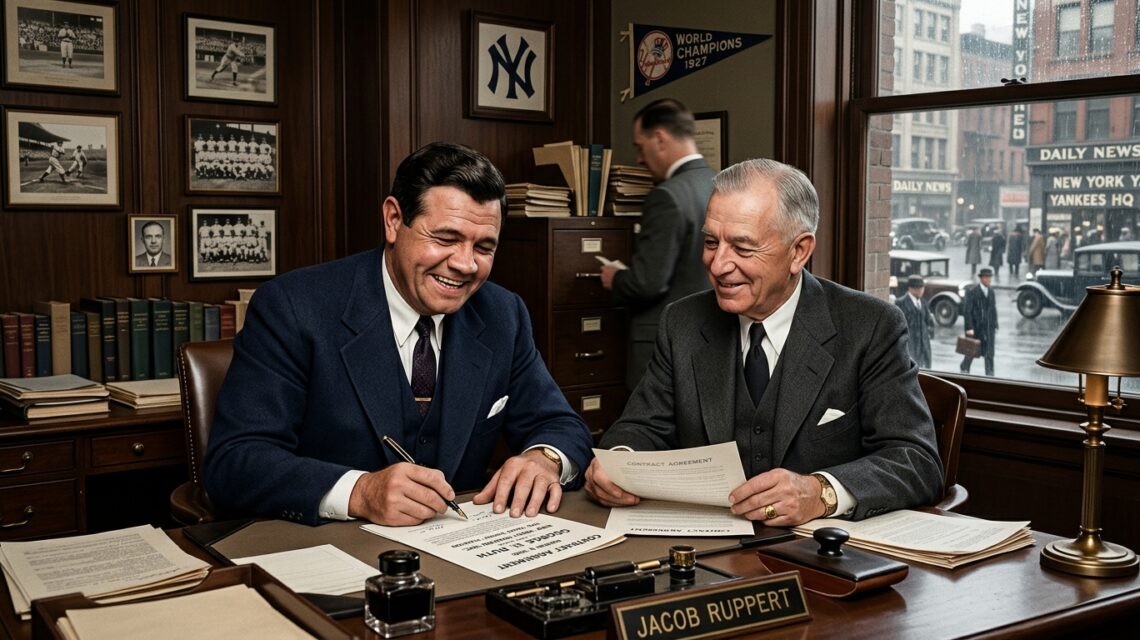
A surviving contract confirms baseball’s biggest salary of the era. The Yankees increased Ruth’s pay just months after the Wall Street crash, and their attendance rose nearly 22%, although the famous presidential comeback remains partly a matter of legend.
By Marcio Tamer
Updated November 2, 2026
On March 10, 1930, Babe Ruth signed a two-year contract with the New York Yankees worth $80,000 per season, making him the highest-paid baseball player of his time.
The agreement came less than five months after the Wall Street crash of October 1929, as the United States entered the economic downturn that became the Great Depression.
Ruth’s salary exceeded the $75,000 annual compensation of President Herbert Hoover by $5,000, or approximately 6.7%.
That comparison produced one of the most enduring stories in American sports history.
When a reporter supposedly questioned whether a baseball player deserved more money than the president, Ruth reportedly answered, “I had a better year.”
The precise wording and circumstances remain uncertain. Historians have repeated different versions of the exchange, and the Herbert Hoover Presidential Library has acknowledged that the story may have acquired legendary details over time.
But the contract itself is not in dispute.
The original document, dated March 10, 1930, bears the signatures of Ruth and Yankees president Jacob Ruppert. It was later cataloged by Christie’s.
What happened next makes the financial story even more interesting.
In 1930, the Yankees attracted 1,169,230 spectators, up from 960,148 in 1929.
That was an increase of 209,082 fans, or approximately 21.8%, during the first full baseball season after the stock market crash.
The Yankees led the American League in attendance.
Ruth’s salary was extraordinary, but the club’s audience showed why its greatest attraction possessed unusual bargaining power.
Why the Yankees agreed to pay Ruth more during an economic crisis
Ruth entered the 1930 season as one of the most recognizable figures in American culture.
He had already transformed the way baseball was played.
His power hitting helped popularize the home run and made him a national celebrity.
In 1927, he hit 60 home runs, establishing a major league record that stood for decades.
The Yankees won the World Series that year and again in 1928.
Although they failed to win the American League pennant in 1929, Ruth remained exceptionally productive.
He hit 46 home runs, drove in 154 runs and finished with a .345 batting average.
Those numbers strengthened his negotiating position.
Ruth was not asking for a record salary after an ordinary season.
He was demanding higher compensation after another year of elite performance.
The Yankees also understood that his value extended beyond statistics.
He attracted newspaper coverage, sold tickets and helped maintain the club’s national reputation.
In an era before modern television rights became baseball’s dominant revenue source, the ability to attract paying spectators was especially important.
Ruth was therefore valuable as both a player and a public attraction.
The $80,000 contract was a raise, not a sudden jump from an ordinary salary
The 1930 agreement did not create Ruth’s financial status overnight.
He had already become the sport’s best-paid player during the 1920s.
His salary rose sharply after the Yankees acquired him from the Boston Red Sox.
In 1920, Ruth earned approximately $20,000.
By 1922, his salary had reached $52,000.
In 1927, he signed a three-year contract worth $70,000 annually.
That arrangement covered the 1927, 1928 and 1929 seasons.
The 1930 contract increased his annual salary by $10,000.
That represented a raise of approximately 14.3%.
The increase was substantial, particularly during an economic downturn.
But it was not an unprecedented leap from a modest income.
Ruth had already established a pattern of using his extraordinary popularity to negotiate exceptional contracts.
The 1930 agreement represented the peak of that process.
He would never again receive a higher annual salary as a major league player.
The original contract still exists
One of the strongest pieces of evidence is the surviving 1930-31 agreement.
Christie’s cataloged the document as Ruth’s two-year Yankees contract.
It was dated March 10, 1930.
The second page carried the signatures of Jacob Ruppert and George Herman Ruth.
The agreement specified $80,000 for each season.
That meant Ruth was entitled to $160,000 over two years in baseball salary under the contract.
The document is important because it establishes the actual financial terms independently of later anecdotes.
The salary was not an estimate.
It was not a figure reconstructed from newspaper reports.
It was recorded in a signed agreement.
Christie’s described it as the highest salary paid by a professional sports team to an athlete before World War II.
The contract also demonstrated how far Ruth had moved beyond the earnings of ordinary baseball players.
Most major leaguers earned only a fraction of his salary.
Even other stars on the Yankees were paid substantially less.
Ruth earned more than President Hoover, but what did that mean?
President Herbert Hoover received an annual salary of $75,000.
Ruth’s $80,000 salary was therefore $5,000 higher.
The comparison was irresistible to newspaper reporters.
It placed a professional athlete above the president in one highly visible measure of compensation.
But the two positions were not economically comparable in every respect.
The president’s salary was established by law.
It was not negotiated annually based on ticket sales or public popularity.
Ruth’s compensation came from a private sports business.
The Yankees paid him because they believed his performance and commercial appeal justified the expense.
The difference illustrated two distinct compensation systems.
Government salaries reflected public office and statutory arrangements.
Professional sports salaries reflected negotiations between teams and athletes.
Ruth’s contract did not establish that athletes should be paid more than political leaders.
It showed that an exceptional player could command extraordinary compensation when his employer believed he generated substantial value.
That principle later became central to modern professional sports.
Did Babe Ruth really say he had a better year than Hoover?
The famous quotation has survived in several versions.
The White House Historical Association recounts Ruth responding to a question about his higher salary by saying he had enjoyed a better year than Hoover.
The National Baseball Hall of Fame also repeats the story.
But the Herbert Hoover Presidential Library and Museum has described the surrounding anecdotes as potentially apocryphal.
The historical uncertainty concerns the exact wording and circumstances, not the salary comparison.
Ruth was indeed paid $80,000.
Hoover’s salary was $75,000.
Ruth had also enjoyed another outstanding season in 1929.
The joke therefore reflected a genuine contrast.
But historians cannot confidently establish that every word in the familiar quotation was spoken exactly as later accounts describe.
The most accurate presentation is to attribute the remark to Ruth while acknowledging the uncertainty.
The story remains revealing because it captures how Americans understood his fame.
A baseball player had become so commercially valuable that his salary could be compared with that of the nation’s president.
How much was $80,000 in today’s money?
The purchasing power of Ruth’s salary was extraordinary.
Using the U.S. Consumer Price Index, $80,000 in 1930 was equivalent to approximately $1.54 million in 2025 dollars.
The calculation uses the 1930 annual CPI of 16.7 and the 2025 annual CPI of 321.943.
That produces an inflation multiplier of approximately 19.28.
The result is useful for understanding the purchasing power of Ruth’s income.
But it does not fully capture his economic position.
A salary of $1.54 million is substantial today, yet it would not rank among the highest annual salaries in modern Major League Baseball.
Ruth’s relative position within his profession was much more exceptional.
He earned far more than most teammates and competitors.
His salary was also vastly greater than typical American household income.
The comparison therefore requires two perspectives.
Inflation adjustment shows what the money could purchase.
Relative income shows how unusual Ruth’s compensation was within the economy of his time.
Both demonstrate that he occupied an extraordinary financial position.
Ruth’s salary was more than 20% of the Yankees’ estimated payroll
Baseball-Reference’s historical data estimates the Yankees’ 1930 player payroll at approximately $393,650.
Ruth’s $80,000 salary represented about 20.3% of that estimated total.
That is a striking concentration of spending on one player.
The calculation is based on a reconstructed historical payroll estimate, not a complete audited modern-style financial statement.
But it illustrates the scale of Ruth’s compensation relative to his teammates.
The Yankees were not distributing their payroll evenly.
They were paying a substantial premium for their greatest attraction.
That reflected Ruth’s exceptional position within the sport.
He was both a leading performer and a national celebrity.
The club could justify paying him far more than most players because it believed he contributed unusually large value.
The arrangement anticipated a familiar feature of modern professional sports.
Elite stars can command a disproportionate share of payroll because their performance and commercial influence are difficult to replace.
The Yankees drew more than 1.16 million fans in 1930
The attendance figures provide the clearest evidence of the Yankees’ commercial strength.
In 1929, the club drew 960,148 spectators.
In 1930, attendance increased to 1,169,230.
That represented a gain of approximately 21.8%.
The Yankees led the American League in attendance.
Their average reported attendance was approximately 15,385 per game.
The increase was especially notable because the economy was deteriorating.
The stock market had crashed in October 1929.
Businesses were under pressure.
Unemployment was rising.
Yet the Yankees attracted more spectators than they had the previous season.
Ruth’s popularity was an important part of the club’s appeal.
But it would be inaccurate to attribute the entire attendance increase to his new contract or individual performance.
Attendance was influenced by multiple factors, including opponents, scheduling, weather, ticket prices and broader public interest.
The available figures establish that the Yankees remained a major attraction.
They do not prove precisely how many additional tickets were sold because of Ruth alone.
The Depression eventually reached Yankee Stadium
The 1930 attendance increase did not continue indefinitely.
In 1931, Yankees attendance fell to 912,437.
That was a decline of approximately 21.9% from the previous season.
The drop occurred as the Great Depression deepened.
The club still led the American League in attendance, but the decline showed that even baseball’s most commercially successful team was vulnerable to the broader economy.
Attendance remained below the 1930 level in subsequent years.
The Yankees drew 962,320 fans in 1932.
In 1933, the total fell to 728,014.
That was approximately 37.7% below the 1930 figure.
The trend complicates the idea that Ruth’s popularity made the Yankees immune to economic conditions.
His star power helped attract audiences.
But it could not eliminate the effects of a prolonged national downturn.
The 1930 season was therefore unusual.
The Yankees experienced a strong attendance year at the beginning of the Depression.
As the crisis intensified, attendance declined substantially.
The Yankees’ attendance during Ruth’s $80,000 contract
| Season | Yankees attendance | Change from previous year |
|---|---|---|
| 1927 | 1,164,015 | — |
| 1928 | 1,072,132 | -7.9% |
| 1929 | 960,148 | -10.4% |
| 1930 | 1,169,230 | +21.8% |
| 1931 | 912,437 | -22.0% |
| 1932 | 962,320 | +5.5% |
| 1933 | 728,014 | -24.3% |
The figures show both the strength and the limitations of Ruth’s commercial appeal.
The Yankees attracted more than one million spectators in several seasons during his peak years.
But attendance fluctuated.
The club’s financial performance depended on more than one player’s popularity.
Ruth was a major attraction.
He was not a guarantee against economic decline.
Yankee Stadium had already been built around Ruth’s popularity
The original Yankee Stadium opened in 1923.
It quickly became associated with Ruth.
The ballpark earned the nickname “The House That Ruth Built.”
The phrase reflected the enormous popularity he brought to the Yankees after joining the club in 1920.
Before moving into their own stadium, the Yankees had shared the Polo Grounds with the New York Giants.
Ruth’s arrival helped transform the club into a major box-office attraction.
The new stadium provided greater capacity and a permanent home.
It also became a symbol of the Yankees’ growing commercial and sporting power.
But the stadium was not built in 1930.
It had opened seven years before Ruth signed his record contract.
The relationship between the stadium and Ruth’s salary was therefore part of a longer process.
His popularity had already helped expand the Yankees’ business.
The 1930 contract reflected the value he had accumulated over the previous decade.
Ruth’s earnings extended beyond his Yankees salary
Ruth’s baseball salary was only one part of his income.
He also earned money through endorsements, personal appearances, exhibition games and entertainment projects.
His celebrity status made him valuable to businesses outside baseball.
He appeared in advertisements.
He participated in promotional events.
He was involved in films and other commercial activities.
The Society for American Baseball Research estimates that Ruth may have earned close to $200,000 in total income during 1930 when those additional sources are included.
That figure is an estimate rather than a documented total from a complete set of financial records.
But it demonstrates how far Ruth’s commercial activities extended beyond his Yankees contract.
The modern sports superstar often earns substantial income through sponsorships and licensing.
Ruth was already operating in a similar environment decades before contemporary endorsement deals became commonplace.
His name and image had commercial value independent of his salary.
That helped establish him as one of the earliest examples of a nationally marketed sports celebrity.
Ruth’s contract did not mean baseball players had modern bargaining power
Ruth’s negotiating success should not be confused with the labor rights enjoyed by modern professional athletes.
In 1930, Major League Baseball operated under the reserve clause.
The system severely restricted a player’s ability to negotiate with competing teams.
Players generally could not become free agents and offer their services to the highest bidder.
Ruth’s leverage came from his extraordinary status.
The Yankees knew that losing or alienating their biggest star could damage the club’s sporting and commercial interests.
Most players lacked comparable bargaining power.
They could negotiate, hold out or seek better terms.
But they did not have the modern free-agency system that later transformed baseball salaries.
That distinction makes Ruth’s contract even more unusual.
He commanded a record salary in an industry where players had limited freedom to change employers.
His achievement was exceptional partly because the surrounding labor system gave teams substantial control.
The modern era of baseball free agency would not arrive until the 1970s.
Ruth remained productive after signing the record deal
Ruth’s 1930 salary was not simply a reward for past achievements.
He continued performing at an elite level.
In 1930, he hit 49 home runs.
He batted .359 and drove in 153 runs.
The Yankees scored 1,062 runs as a team, an extraordinary offensive total.
But they finished third in the American League.
The Philadelphia Athletics won the pennant.
Ruth was again outstanding in 1931.
He hit 46 home runs and posted a .373 batting average.
The Yankees finished second.
The team did not win the World Series during the two seasons covered by his $80,000 contract.
That is another important distinction.
Ruth justified his individual salary through exceptional performance.
But his production did not automatically produce a championship.
The Yankees returned to the top in 1932, winning the World Series against the Chicago Cubs.
By then, Ruth’s salary had been reduced to $75,000.
His record salary proved vulnerable to the same economy that made it famous
Ruth’s $80,000 annual salary lasted for two seasons.
In 1932, his pay fell to $75,000.
In 1933, it dropped to approximately $35,000.
That was a dramatic reduction from his peak.
Age and changing performance expectations were important factors.
Ruth was moving into the final years of his career.
But the economic environment also placed pressure on baseball clubs.
The Great Depression reduced consumer spending and affected attendance.
Owners became more cautious about payroll commitments.
Ruth’s experience therefore reveals both sides of the sports business.
An exceptional athlete can command extraordinary compensation when his commercial value is high.
But even the greatest stars remain exposed to changing market conditions.
His record salary did not establish a permanent upward trajectory.
It marked the peak of a particular relationship between a player, a team and an audience.
Babe Ruth’s $80,000 salary in perspective
| Measure | Figure |
|---|---|
| Contract signed | March 10, 1930 |
| Contract duration | 2 seasons |
| Annual salary | $80,000 |
| Total contract salary | $160,000 |
| President Herbert Hoover’s annual salary | $75,000 |
| Difference | $5,000 |
| Ruth’s premium over Hoover | 6.7% |
| Ruth’s 1929 salary | $70,000 |
| Salary increase for 1930 | 14.3% |
| Estimated Yankees payroll in 1930 | $393,650 |
| Ruth’s share of estimated payroll | 20.3% |
| Yankees attendance in 1929 | 960,148 |
| Yankees attendance in 1930 | 1,169,230 |
| Attendance increase | 21.8% |
| Ruth’s 1929 home runs | 46 |
| Ruth’s 1930 home runs | 49 |
| Inflation-adjusted 1930 salary in 2025 dollars | Approximately $1.54 million |
The figures explain why the contract became a landmark.
Ruth earned more than the president.
He received a substantial raise during an economic crisis.
He accounted for a remarkable share of the Yankees’ estimated payroll.
And the club attracted more than 1.16 million spectators during the first season of the agreement.
The combination made him an early example of an athlete whose commercial value extended far beyond ordinary sporting performance.
The most important number was not the president’s salary
The comparison with Herbert Hoover made Ruth’s contract famous.
It was memorable because it challenged conventional assumptions about the value of professional athletes.
But the Yankees’ attendance figures reveal the underlying business logic.
In 1930, the club drew 1,169,230 fans.
That was more than 200,000 additional spectators compared with the previous season.
The Yankees led the American League in attendance despite finishing third in the standings.
Ruth’s popularity was central to the club’s identity.
He was not merely a player receiving an unusually large salary.
He was a national celebrity whose performances helped make baseball a major commercial entertainment business.
The $80,000 contract reflected that value.
But the following seasons also showed its limits.
Attendance declined as the Depression deepened.
Ruth’s salary eventually fell.
The Yankees could not escape the economic conditions affecting the rest of the country.
The enduring significance of the 1930 agreement lies in that contrast.
Ruth demonstrated that a superstar could command extraordinary compensation because of his sporting and commercial appeal.
Yet his earnings still depended on the financial health of the business employing him.
The famous Hoover quotation captured the public imagination.
The surviving contract and attendance records explain why the Yankees were willing to pay him so much.
+ Siga o Giro no Facebook
+ Siga o Giro no Instagram
Leia Mais: