
Strategic Sports Group invested an initial $1.5 billion in 2024 and helped create a commercial company that offered golfers ownership stakes. Less than three years later, LIV Golf’s Saudi funding ended, a proposed $300 million rescue failed and the PGA Tour was planning its next transformation.
By Marcio Tamer
Updated November 6, 2026
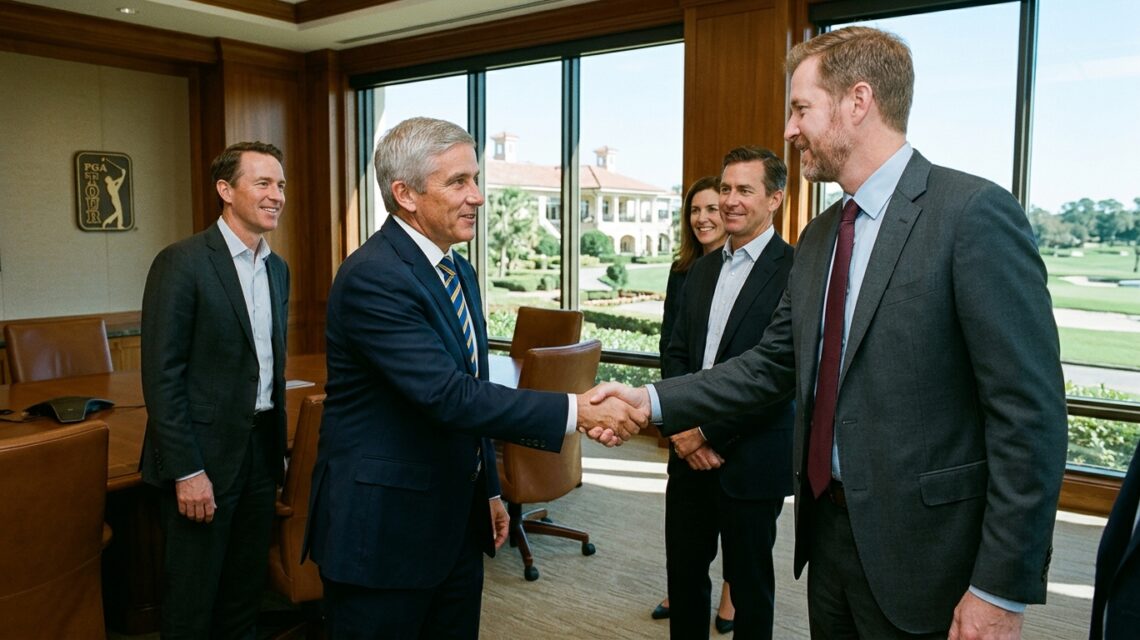
On January 31, 2024, the PGA Tour announced a deal with a group of American sports investors willing to commit up to $3 billion to its commercial business.
The Strategic Sports Group, led by Fenway Sports Group, agreed to invest an initial $1.5 billion in PGA Tour Enterprises, a newly established for-profit company controlled by the Tour.
The arrangement introduced another unusual feature: nearly 200 eligible golfers would have the opportunity to become shareholders in the business they helped generate revenue for.
At the time, the deal appeared to be a defensive response to LIV Golf, the rival circuit financed by Saudi Arabia’s Public Investment Fund.
LIV had offered lucrative contracts to established stars, challenged the PGA Tour’s dominance and helped trigger an expensive commercial arms race.
But the balance of power changed dramatically.
On November 5, 2026, LIV Golf announced that it would begin an orderly wind-down and liquidation after losing Saudi financial support and failing to complete a proposed $300 million financing arrangement.
Reuters reported that the PIF had invested more than $5 billion in LIV before deciding that the circuit no longer aligned with its investment strategy.
The PGA Tour, meanwhile, had secured private capital, introduced player equity and appointed a former NFL executive to lead its next phase.
The contrast is striking.
One organization attracted investors who expected a return from a commercial sports business.
The other depended heavily on continued funding from a sovereign wealth fund.
That difference did not explain every development in the golf conflict, but it became central to the outcome.
Why the PGA Tour needed outside investment
LIV Golf began staging tournaments in June 2022.
Its financial model was radically different from the PGA Tour’s traditional approach.
The Saudi-backed circuit offered substantial guaranteed contracts to leading players.
Its events featured smaller fields, team competition and large prize funds.
Players including Dustin Johnson, Phil Mickelson, Brooks Koepka and Bryson DeChambeau joined the rival organization.
Jon Rahm’s move in late 2023 intensified the pressure.
The PGA Tour responded by increasing prize money and restructuring its tournament schedule.
It introduced designated events, later known as Signature Events, designed to bring leading players together more frequently.
The changes increased the financial rewards available to top golfers.
They also raised the Tour’s costs.
The PGA Tour had significant broadcasting and sponsorship agreements, but it was competing against an organization backed by a sovereign wealth fund.
LIV did not need to generate conventional operating profits immediately to continue offering extraordinary player contracts.
That created an asymmetrical financial contest.
The PGA Tour needed to strengthen its commercial business without relying indefinitely on rising tournament expenditures.
The June 2023 Saudi agreement did not produce a merger
The golf world was stunned on June 6, 2023, when the PGA Tour, DP World Tour and PIF announced a framework agreement.
The parties proposed combining certain commercial rights and businesses into a new structure.
They also agreed to end related litigation.
The announcement appeared to offer a path toward reunifying professional men’s golf.
But it was not a completed merger.
The agreement was a framework for further negotiations.
Important issues remained unresolved, including governance, financial terms and the future of LIV Golf.
The proposal also attracted scrutiny from American lawmakers and competition authorities.
The original deadline for completing a definitive agreement passed without a final deal.
Negotiations continued.
Meanwhile, the PGA Tour began exploring another source of capital.
That process led to Strategic Sports Group.
Who was behind the $3 billion investment?
Strategic Sports Group brought together investors with extensive experience owning major sports franchises.
The consortium was led by Fenway Sports Group, whose interests included the Boston Red Sox, Liverpool FC and the Pittsburgh Penguins.
John W. Henry, Fenway’s principal owner, became a central figure in the transaction.
Other participants included Steven Cohen’s investment interests and Arthur Blank, owner of the Atlanta Falcons.
The consortium also included investors associated with several other major American sports organizations.
Their experience mattered because the PGA Tour was not simply seeking a loan.
It wanted partners capable of helping expand the commercial value of its properties.
American professional sports franchises had experienced substantial increases in valuations over previous decades.
Media rights, sponsorship, hospitality and international expansion had become major drivers of that growth.
SSG’s investors understood those markets.
They also understood how ownership structures could align investors, management and athletes.
The consortium’s involvement gave the PGA Tour access to capital and commercial expertise.
But it did not give SSG control of the entire Tour.
The PGA Tour retained control of PGA Tour Enterprises.
SSG became a minority investor.
The initial investment was $1.5 billion, not $3 billion
The headline figure of $3 billion requires careful interpretation.
The agreement provided for an initial $1.5 billion investment.
The consortium could invest up to another $1.5 billion under the broader arrangement.
That made the total potential commitment $3 billion.
But the entire amount was not transferred immediately in January 2024.
Contemporary reporting valued PGA Tour Enterprises at approximately $12 billion in connection with the transaction.
That figure was an estimated business valuation, not annual revenue or cash available for tournament prizes.
The distinction is important.
An investment values a company’s future commercial potential.
It does not establish that the company already earns the same amount in profit.
The initial $1.5 billion gave the Tour substantial financial flexibility.
But the money still needed to be deployed through business decisions.
It was not an unrestricted fund dedicated entirely to increasing prize money.
Why the PGA Tour created a for-profit company
The PGA Tour historically operated through a nonprofit organizational structure.
The creation of PGA Tour Enterprises introduced a separate for-profit commercial entity.
The new company housed major commercial assets, including sponsorship and media agreements.
That structure made it possible for outside investors to acquire equity.
It also created a framework for players to receive ownership interests.
The PGA Tour itself did not simply disappear or become a conventional privately owned sports league.
The commercial company was established under the Tour’s control.
The distinction matters because the investment involved a specific business structure rather than a complete sale of the governing organization.
The arrangement also changed the Tour’s incentives.
Instead of measuring success only through tournament operations and prize money, the commercial entity could focus on long-term business value.
That included media rights, sponsorship, fan engagement and other revenue opportunities.
The new structure made those commercial assets more directly investable.
Nearly 200 golfers became eligible for ownership stakes
The player equity program was one of the most innovative elements of the transaction.
The PGA Tour announced that nearly 200 members would have the opportunity to become equity holders in PGA Tour Enterprises.
The program was designed to reward past achievements and encourage future participation.
It also created a financial incentive for players to support the Tour’s commercial growth.
Instead of receiving compensation only through tournament winnings and sponsorships, eligible golfers could participate in the value of the organization.
The Tour said players would collectively have access to more than $1.5 billion in immediate and future equity grants.
But that did not mean $1.5 billion in cash was distributed to players in 2024.
The grants represented ownership interests.
They were subject to eligibility requirements and vesting conditions.
Their eventual financial value depended on the company’s performance and the terms governing the equity.
That distinction is central to understanding the arrangement.
A restricted equity grant is not the same as a guaranteed cash bonus.
The first $930 million in equity was distributed unevenly
A February 2024 memorandum from commissioner Jay Monahan provided more detail.
The Tour planned to award approximately $930 million in initial equity grants to 193 players.
The distribution was divided into four groups.
| Player group | Number of players | Initial equity allocation |
|---|---|---|
| Group 1: Leading players based on career results, recent performance and commercial impact | 36 | $750m |
| Group 2: Players assessed mainly on recent performance | 64 | $75m |
| Group 3: Other eligible fully exempt members | 57 | $30m |
| Group 4: Players recognized for contributions to the modern Tour | 36 | $75m |
| Total | 193 | $930m |
The top 36 players were allocated approximately 80.6% of the initial equity pool.
That concentration was deliberate.
The program sought to reward golfers who had contributed most to the Tour’s competitive and commercial success.
It also recognized that star players generate a disproportionate share of attention and sponsorship value.
But the structure raised questions about fairness.
Players outside the top tier received much smaller allocations.
The program therefore reflected the economic hierarchy already present in professional golf.
It did not create equal ownership for every Tour member.
The remaining $600 million was designed to reward future performance
The player equity program also included recurring grants.
The Tour planned to award $100 million annually from 2025 through at least 2030.
That represented another $600 million over six years.
The recurring program was intended to reward future performance and contributions to the Tour.
Eligibility was broader than the initial grants.
Players who did not receive an initial allocation could still qualify for future awards.
The grants were designed to create continuing incentives.
A golfer who performed well and supported the Tour’s commercial objectives could receive additional equity.
The structure also encouraged players to remain active within the organization.
That was particularly relevant during the conflict with LIV Golf.
The PGA Tour was trying to make departure more expensive in opportunity-cost terms.
A player leaving the Tour could lose access to future equity awards and potentially affect the vesting of existing grants.
The program therefore served both a compensation purpose and a retention purpose.
Equity grants were not immediately available cash
The ownership program included restrictions.
Initial grants were designed to vest over time.
Players generally needed to meet participation or service requirements.
Monahan’s memorandum referred to playing at least 15 PGA Tour events annually or satisfying comparable service obligations.
The program also operated under securities-law requirements.
The Tour’s player handbook specified that restricted units could be accepted only by accredited investors.
That legal requirement limited participation in ways that ordinary tournament prize money does not.
The value of the grants also depended on the commercial company’s performance.
A player could receive an equity allocation without being able to sell it immediately.
The distinction between ownership and liquidity is important.
An athlete may hold an interest valued at millions of dollars.
But that does not mean the athlete can immediately convert the entire amount into cash.
The program aligned players with the company’s long-term value.
It did not replace ordinary prize money with guaranteed liquid wealth.
The investment strengthened the PGA Tour’s negotiating position
The SSG agreement changed the PGA Tour’s relationship with Saudi Arabia’s PIF.
Before the investment, the Tour faced pressure from a rival backed by enormous financial resources.
LIV could offer guaranteed contracts and substantial prize funds.
The PGA Tour had to respond while maintaining its existing commercial operations.
SSG’s initial $1.5 billion investment provided a new financial foundation.
It also demonstrated that private investors believed the Tour’s commercial assets had significant long-term value.
That mattered during negotiations with the PIF.
The PGA Tour no longer needed to treat Saudi investment as its only potential source of major outside capital.
But the SSG deal did not formally exclude the PIF.
The January 2024 announcement explicitly allowed for a possible Saudi co-investment, subject to regulatory approval.
The PGA Tour and PIF continued discussing a potential agreement.
The new American investment changed the balance of negotiations.
It did not immediately end them.
The PGA Tour ultimately rejected a separate Saudi proposal
Negotiations between the PGA Tour and PIF continued through 2024 and into 2025.
But the parties did not complete the commercial combination envisioned in June 2023.
According to Reuters reporting in November 2026, the PGA Tour rejected a proposed $1.5 billion investment from the Saudi fund.
The proposal was tied to conditions including LIV Golf remaining in operation and PIF governor Yasir Al-Rumayyan becoming co-chair of PGA Tour Enterprises.
Those governance conditions were significant.
The PGA Tour had already established a commercial company controlled by its existing organization.
Accepting a new investor under different governance terms could have altered that structure.
The rejection demonstrated that the dispute was not simply about the amount of capital available.
Control and the future of LIV Golf also mattered.
The parties had competing visions for how professional golf should be organized.
The negotiations did not produce a final agreement.
Brian Rolapp brought NFL business experience to the Tour
The PGA Tour’s next major leadership change came in June 2025.
The organization appointed Brian Rolapp as chief executive officer.
Rolapp had spent more than two decades with the NFL.
He had been responsible for major media and commercial operations, including broadcasting agreements and digital distribution.
His appointment reflected the PGA Tour’s growing emphasis on commercial strategy.
The organization was no longer focused only on tournament administration.
It was developing a business with outside shareholders, player equity and significant media assets.
Rolapp was tasked with improving the product for fans and strengthening its long-term commercial position.
In June 2026, the Tour announced that he would succeed Jay Monahan as commissioner on January 1, 2027.
The leadership transition was part of a broader restructuring.
The PGA Tour was preparing to change its competitive format while maintaining control over its commercial direction.
The Tour began planning a new competitive structure for 2028
Under Rolapp, the PGA Tour developed plans for a revised competition model.
The proposed structure was scheduled to begin in 2028.
It would introduce two connected series: the PGA Tour Championship Series and the PGA Tour Challenger Series.
The objective was to create a clearer hierarchy of events.
Leading players would compete more frequently against one another.
Other golfers would have opportunities to advance through performance.
The model was intended to make the season easier for fans to follow.
It also aimed to create a stronger commercial product for broadcasters and sponsors.
The Tour’s existing major media agreements were due to expire in 2030.
That made the competition redesign commercially important.
A more coherent schedule could strengthen future negotiations.
Rolapp said in June 2026 that the Tour had completed $1.2 billion in contractual revenue across 36 partners in 2025.
He also reported $347 million in new deals across 13 partners in 2026.
Those figures referred to contracted commercial revenue, not necessarily cash received or annual profit.
They nevertheless indicated substantial business activity during the restructuring period.
LIV Golf’s financial model became increasingly difficult to sustain
While the PGA Tour developed its commercial structure, LIV faced growing financial pressure.
The Saudi-backed circuit had spent heavily to recruit leading players and stage events.
Its business model relied on continued support from the PIF.
The organization generated attention and disrupted professional golf.
But it struggled to establish a conventional commercial foundation capable of supporting its costs independently.
In April 2026, the PIF announced that LIV no longer aligned with its investment strategy.
The fund said it would stop providing financial support beyond the completed 2026 season.
Reuters reported that the PIF had invested more than $5 billion in the circuit.
That figure demonstrated the scale of the Saudi commitment.
It also highlighted the difference between spending money to establish a sports property and building a business capable of sustaining itself.
LIV needed alternative financing.
Without continued sovereign backing, its future became uncertain.
LIV filed for bankruptcy protection in September 2026
The financial crisis intensified in September 2026.
LIV Golf sought Chapter 11 bankruptcy protection in the United States.
The filing did not immediately mean the organization would cease operating.
Chapter 11 can allow a company to restructure its liabilities and seek new financing.
But the filing created uncertainty for players, employees and commercial partners.
Several prominent golfers began leaving the circuit.
Jon Rahm announced plans to compete on the DP World Tour in 2027.
The PGA Tour maintained restrictions on players returning from LIV.
The possibility of a unified professional golf structure remained unresolved.
LIV’s management sought new capital.
A proposed financing arrangement with BC Partners offered a possible route forward.
But the agreement depended on conditions that ultimately could not be satisfied.
A proposed $300 million rescue collapsed in November 2026
The final crisis came in early November.
LIV had explored approximately $300 million in financing from BC Partners’ credit business.
The arrangement was intended to support tournaments in 2027.
But the financing plan fell apart after several prominent players declined to commit to the league.
On November 5, LIV announced that it would begin an orderly wind-down and liquidation.
The organization said it remained willing to consider third-party offers for its assets during the process.
That qualification matters.
Liquidation does not necessarily mean every asset immediately disappears.
Brand rights, contracts and other properties may still have value.
But the announcement marked the end of LIV’s attempt to continue operating under its existing business model.
The circuit that had challenged the PGA Tour with enormous guaranteed contracts was now preparing to close.
The development fundamentally changed the interpretation of the SSG investment.
The PGA Tour had secured capital from private sports investors.
LIV had lost the sovereign funding on which it depended.
The $3 billion deal in numbers
| Indicator | Figure |
|---|---|
| SSG agreement announced | January 31, 2024 |
| Initial SSG investment | $1.5bn |
| Additional potential SSG investment | Up to $1.5bn |
| Total potential SSG commitment | Up to $3bn |
| Reported PGA Tour Enterprises valuation | Approximately $12bn |
| Initial player equity grants | $930m |
| Players eligible for initial grants | 193 |
| Equity allocated to top 36 players | $750m |
| Share of initial equity allocated to top 36 | Approximately 80.6% |
| Planned recurring player equity | $600m |
| Annual recurring grants | $100m |
| Recurring grant period | 2025–2030 |
| Total announced player equity opportunity | More than $1.5bn |
| PGA Tour CEO Brian Rolapp appointed | June 2025 |
| Rolapp scheduled to become commissioner | January 2027 |
| New competitive model planned | 2028 |
| LIV Golf launches | June 2022 |
| PGA Tour-PIF framework announced | June 2023 |
| Reported PIF investment in LIV | More than $5bn |
| LIV Chapter 11 filing | September 2026 |
| Proposed LIV rescue financing | Approximately $300m |
| LIV announces liquidation | November 5, 2026 |
The figures reveal two contrasting financial strategies.
SSG invested in an established commercial sports organization with media rights, sponsorship agreements and a long operating history.
The PIF financed a new rival circuit designed to challenge that organization.
Both approaches involved substantial capital.
But they had different risk profiles.
The PGA Tour was attempting to strengthen an existing business.
LIV was attempting to create a competing commercial ecosystem.
Why the SSG investment was not a guaranteed rescue
The PGA Tour’s agreement with SSG was a major financial achievement.
But it should not be described as proof of permanent financial security.
The initial investment provided capital.
The player equity program created new incentives.
The commercial company offered a structure for growth.
But the Tour still faced significant challenges.
It needed to improve the viewing experience.
It had to manage tournament costs.
It needed to retain leading players.
It also had to prepare for future media-rights negotiations.
The new ownership structure introduced additional expectations.
Private investors generally seek financial returns.
That can create pressure to increase revenue, improve margins and control costs.
The PGA Tour’s restructuring therefore involved trade-offs.
It gained financial resources.
But it also accepted the discipline associated with outside equity investors.
The success of the arrangement will depend on how the commercial company performs over time.
The PGA Tour also faced difficult internal changes
The transition to a more commercially focused structure was not painless.
In April 2026, the PGA Tour eliminated approximately 4% of its workforce.
Reuters reported that 56 full-time employees in the United States were laid off.
Another 73 vacant positions were left unfilled.
The changes followed an organizational review.
They reflected the Tour’s effort to restructure operations under its new leadership and commercial model.
The layoffs were a reminder that major investment does not eliminate pressure to control expenses.
A company can receive substantial new capital while still reducing costs.
The PGA Tour was attempting to allocate resources toward its future business priorities.
That process affected employees as well as players.
The SSG agreement created opportunities.
It also introduced a more explicit focus on commercial efficiency.
What the deal changed for professional golfers
The player equity program altered the relationship between athletes and the organization.
Traditionally, PGA Tour members competed for prize money.
They could also earn income through endorsements.
But they did not hold direct ownership interests in the Tour’s commercial business.
The new structure gave eligible players a potential share in long-term enterprise value.
That created incentives beyond individual tournament results.
A golfer could benefit if the business became more valuable.
The program also rewarded historical contributions.
Players who had helped build the Tour’s commercial appeal could receive equity even if they were no longer at their competitive peak.
But the grants were not distributed equally.
The largest allocations went to the most commercially and competitively valuable players.
The structure therefore reinforced the importance of star power.
It also created a mechanism for future generations to earn ownership interests.
The long-term effect will depend on how those interests vest, how they are valued and whether players eventually gain opportunities to realize their value.
The LIV collapse does not prove SSG alone won the golf war
The sequence of events is compelling.
The PGA Tour secured up to $3 billion in private investment in 2024.
LIV lost Saudi funding in 2026.
The rival circuit then entered bankruptcy and announced liquidation.
But the outcome cannot be attributed solely to the SSG agreement.
Several factors contributed.
LIV’s costs were substantial.
Its commercial revenue did not develop sufficiently to replace sovereign funding.
The PIF changed its investment priorities.
The proposed BC Partners financing failed.
Prominent players left the circuit.
The PGA Tour also benefited from its existing commercial relationships and established tournament structure.
The SSG investment strengthened the Tour’s position.
It was one important part of a broader competitive and financial environment.
The available evidence does not establish that the investment directly caused LIV’s collapse.
It does show that the two organizations entered late 2026 with very different financial foundations.
The next question is how the PGA Tour uses its advantage
With LIV preparing to liquidate, the PGA Tour faces a different challenge from the one it confronted in 2024.
The immediate threat of a rival circuit offering enormous guaranteed contracts has diminished.
But the Tour still needs to justify its commercial valuation and deliver returns to investors.
It must also manage the consequences of the golf conflict.
Players who joined LIV may seek opportunities to return to established tours.
Eligibility rules and disciplinary policies remain contentious.
The PGA Tour has indicated that returning players will be subject to restrictions.
Meanwhile, the planned 2028 competition structure will test whether the organization can make its product more compelling for fans.
The Tour’s future media agreements will provide another major commercial test.
Those negotiations will help determine whether the new business model can generate the growth investors expect.
The SSG agreement gave the PGA Tour financial resources and a new ownership structure.
It did not complete the work of building a more valuable sports business.
That work is still underway.
+ Siga o Giro no Facebook
+ Siga o Giro no Instagram
Leia Mais: