

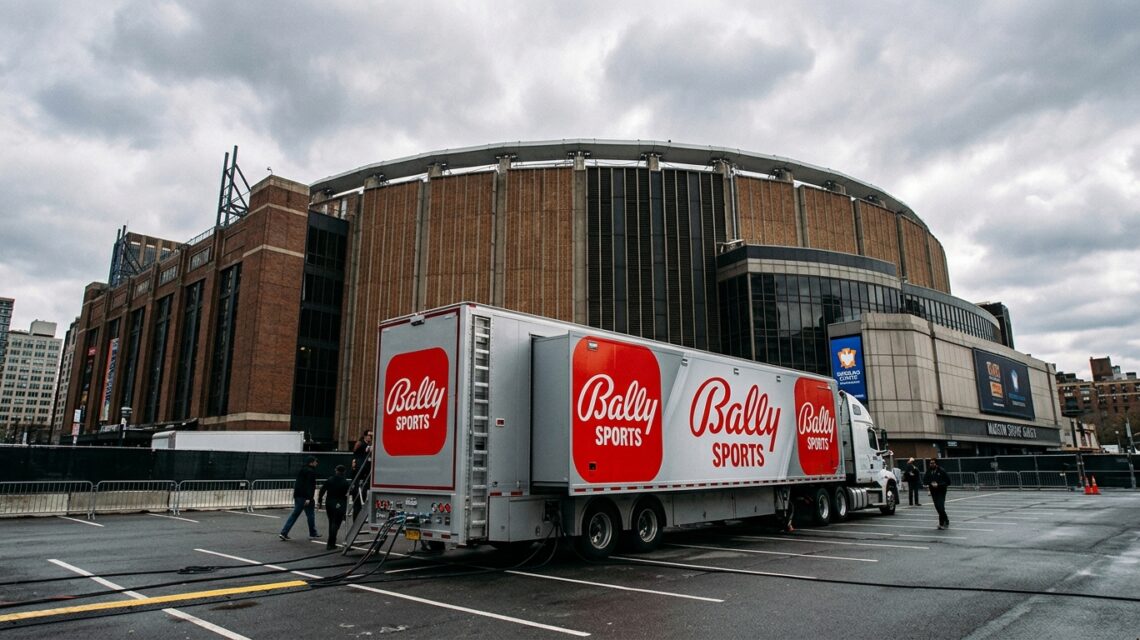
The bankruptcy of Bally Sports’ parent company exposed the economics behind local MLB, NBA and NHL broadcasts. Even after a court-approved restructuring, its successor could not sustain the old cable television model, forcing dozens of teams to find new ways to reach fans.
By Marcio Tamer
Updated November 5, 2026
In January 2025, Diamond Sports Group emerged from bankruptcy with a new name and what appeared to be a radically improved balance sheet.
The operator of the former Bally Sports regional networks, renamed Main Street Sports Group, announced that it had reduced approximately $9 billion in pre-bankruptcy debt to just $200 million.
The company still controlled local television rights for 29 professional teams across Major League Baseball, the NBA and NHL.
Its networks were rebranded as FanDuel Sports Network, and the restructuring was intended to give the business a fresh start.
But the rescue did not last.
By early 2026, Main Street was again missing payments to teams. Its remaining MLB partners terminated their agreements, while NBA and NHL franchises prepared alternative broadcasting arrangements.
In spring 2026, the company wound down its regional sports network operations.
The outcome revealed something more important than the failure of a heavily indebted broadcaster: even removing almost all the debt could not restore the economics of the business that Sinclair had purchased in 2019.
That business depended on millions of households paying for sports channels through cable and satellite television packages, whether they watched the games or not.
As those households canceled subscriptions, the revenue supporting expensive local sports contracts disappeared.
The consequences extended across three of North America’s largest professional leagues.
How a $10.6 billion acquisition became a financial trap
The story began with Disney’s acquisition of 21st Century Fox.
As part of that transaction, Disney acquired a portfolio of regional sports networks but was required to sell them because of competition concerns.
Sinclair Broadcast Group agreed to purchase the networks in May 2019.
The transaction closed on August 23 that year.
According to the companies’ official announcement, the portfolio had an enterprise value of $10.6 billion.
After adjustments for minority interests, the aggregate purchase price was approximately $9.6 billion.
Those figures describe different measures of the transaction and should not be treated as interchangeable.
The acquisition included 21 regional sports networks and Fox College Sports.
The portfolio carried local broadcasting rights associated with 42 professional teams, comprising 14 MLB clubs, 16 NBA franchises and 12 NHL teams.
It was an enormous collection of valuable sports content.
But Sinclair financed much of the transaction through borrowing.
The original acquisition announcement identified approximately $8.2 billion in debt financing incurred by Diamond, alongside equity and other funding.
That capital structure left the business exposed if its operating income declined.
And the decline was already underway.
Why cable television made regional sports so profitable
Regional sports networks, commonly called RSNs, were built around a powerful financial arrangement.
Cable and satellite distributors paid the networks a monthly fee for each subscriber receiving a package containing the channel.
Those payments were known as carriage fees.
Crucially, the distributor generally paid for every eligible subscriber, not just the households watching sports.
A family interested in movies, news or entertainment could indirectly help finance its local baseball or basketball team through the cost of its television package.
That gave regional sports networks access to a much larger paying audience than their actual viewership.
The networks used those fees, together with advertising revenue, to purchase local broadcasting rights.
Teams benefited from long-term agreements that promised substantial annual payments.
For many franchises, local media rights became an important source of predictable income.
The arrangement worked while the pay-TV subscriber base remained large.
But it contained a structural weakness.
The network’s revenue depended heavily on the number of households maintaining traditional television subscriptions.
Its payments to sports teams were often contractually fixed or increased over time.
When subscriber numbers declined, the two sides of the financial equation moved in opposite directions.
Cord-cutting broke the model’s underlying mathematics
Americans had been canceling traditional pay-TV subscriptions for years before Diamond filed for bankruptcy.
Streaming services offered alternatives to expensive cable packages.
Younger consumers increasingly watched entertainment through internet-connected devices.
Households that rarely watched live sports had less reason to pay for packages containing regional sports networks.
For RSNs, every departing subscriber represented lost carriage-fee revenue.
The losses accumulated even if the number of dedicated sports fans remained relatively stable.
That distinction matters.
A network could retain a passionate audience for its teams and still experience financial deterioration because millions of less-engaged households stopped subsidizing it.
The problem was compounded by negotiations with distributors.
Cable companies faced their own shrinking customer bases and resisted expensive channel fees.
Some regional networks lost distribution on major television platforms.
Others were moved into more expensive subscription tiers.
Those changes reduced their potential audience further.
Diamond was caught between falling distribution revenue and costly sports-rights obligations.
Its heavy acquisition debt made the pressure worse.
Diamond filed for Chapter 11 in March 2023
On March 14, 2023, Diamond Sports Group filed for Chapter 11 bankruptcy protection in the Southern District of Texas.
The company operated 19 regional sports networks under the Bally Sports brand.
It had more than $8 billion in debt.
The restructuring was designed to reduce its liabilities and allow the business to continue operating.
Diamond said it had approximately $425 million in cash to support operations during the proceedings.
Chapter 11 did not mean that its television channels immediately shut down.
Nor did it mean that the MLB, NBA and NHL teams holding contracts with Diamond were themselves bankrupt.
The legal process allowed Diamond to continue broadcasting while negotiating with creditors and reviewing its contractual obligations.
But the filing created uncertainty for teams expecting rights payments.
A regional sports network’s promise to pay a club millions of dollars annually is valuable only if the broadcaster can honor it.
Diamond’s bankruptcy placed those commitments under court supervision.
That changed the bargaining position of teams and leagues.
Why baseball faced the most immediate danger
Diamond entered bankruptcy shortly before the 2023 MLB season.
That timing made baseball especially vulnerable.
MLB teams play 162 regular-season games.
Local broadcasts therefore account for a large amount of television inventory.
Some teams depended on substantial annual rights payments from Diamond.
The San Diego Padres were among the first to experience the consequences.
Diamond failed to make a scheduled payment under its broadcasting agreement.
After the applicable grace period expired, MLB stepped in.
On May 31, 2023, the league began producing and distributing Padres games.
It was an emergency response to a commercial failure.
But it also became the beginning of a much larger transformation.
MLB had to perform functions that regional networks had traditionally handled, including production, distribution and coordination with television providers.
The league also introduced a direct-to-consumer streaming option for local fans.
The objective was to keep games available even after the broadcaster’s contract collapsed.
The Padres gained access to millions of additional homes
MLB’s intervention produced an unexpected result.
Under the previous arrangement, Padres broadcasts reached approximately 1.13 million homes in the team’s local television territory.
The new distribution agreements expanded potential availability to approximately 3.26 million homes.
That represented an increase of more than 2.13 million homes, or roughly 189%.
The change did not mean that the Padres immediately gained two million new viewers.
It meant that broadcasts became available to substantially more households.
The distinction between potential reach and actual audience is essential.
The new model combined traditional television distribution with local streaming.
Fans could purchase access directly rather than relying exclusively on a regional sports network within a cable package.
MLB also removed the local streaming blackout for the new Padres offering.
The arrangement improved accessibility.
But it created a financial trade-off.
The club no longer had the same guaranteed rights payment from Diamond.
Greater distribution reach did not automatically replace the lost revenue.
Arizona became the second major test case
The Arizona Diamondbacks followed a similar path in July 2023.
A bankruptcy court permitted Diamond to reject its broadcasting agreement with the club.
MLB assumed production and distribution of Diamondbacks games beginning July 18.
The league announced that the new arrangement expanded potential availability from approximately 930,000 homes to 5.6 million homes.
That was an increase of approximately 4.7 million homes, or 506%.
The figure was remarkable.
It showed how the old regional network structure could limit the availability of local sports even while charging substantial carriage fees.
MLB’s replacement model reached more potential viewers through a combination of distributors and direct streaming.
But the same financial challenge remained.
The previous broadcaster had paid for exclusive rights.
The replacement system had to generate revenue through a different combination of subscriptions, distribution agreements and advertising.
The league could make games easier to watch.
It could not guarantee that the new model would immediately match the old one financially.
Diamond emerged from bankruptcy in 2025 with most of its debt eliminated
After a lengthy court process, Diamond’s restructuring plan was confirmed in November 2024.
The company emerged from Chapter 11 on January 2, 2025.
It adopted the name Main Street Sports Group.
Its networks operated under the FanDuel Sports Network brand, replacing Bally Sports.
The financial restructuring was dramatic.
The company said its approximately $9 billion in pre-bankruptcy debt had been reduced to $200 million.
That represented a reduction of roughly 97.8%.
The business also emerged with a smaller portfolio.
Instead of the original 42 professional team relationships, Main Street entered 2025 with rights involving 29 teams.
Those included 13 NBA teams, eight MLB teams and eight NHL teams.
The company operated 16 regional sports networks.
The debt reduction appeared to provide breathing room.
But it did not reverse the decline in traditional television subscriptions.
Nor did it eliminate the expensive commitments associated with live sports rights.
The underlying business remained difficult.
The 2026 collapse showed that debt relief was not enough
The most revealing development came roughly a year after Main Street emerged from bankruptcy.
The company again struggled to meet its contractual obligations.
In early 2026, MLB teams began terminating their agreements after missed payments and uncertainty about future funding.
The departing teams included the St. Louis Cardinals, Cincinnati Reds, Kansas City Royals, Miami Marlins, Milwaukee Brewers and Tampa Bay Rays.
Other clubs, including the Atlanta Braves, Detroit Tigers and Los Angeles Angels, also moved away from Main Street’s previous arrangements.
Some chose MLB’s production and distribution operation.
Others pursued team-controlled networks or different commercial partnerships.
By February 2026, MLB’s local media operation was involved in broadcasts for approximately half the league.
The development demonstrated that Diamond’s bankruptcy had not been an isolated financial event.
The successor company had inherited a shrinking market.
Even after eliminating almost all its debt, it could not reliably support its remaining rights commitments.
That was the clearest evidence that the problem extended beyond leverage.
FanDuel Sports Network wound down in spring 2026
Main Street’s difficulties eventually reached the NBA and NHL.
In April 2026, the company confirmed that it was preparing to wind down operations.
It arranged to continue NBA coverage through the end of the regular season and NHL coverage through the first round of the playoffs.
The shutdown affected local broadcasting arrangements for 13 NBA teams and seven NHL teams.
Those franchises needed new media partners ahead of the 2026–27 seasons.
Some pursued local broadcast television.
Others explored direct streaming or partnerships with digital distributors.
The transition was not identical for every team.
Local rights, existing distribution arrangements and commercial priorities differed.
The important change was structural.
A network group that had once controlled rights to 42 professional teams was no longer operating as the central broadcaster for those clubs.
The business had survived bankruptcy.
It had not survived the market conditions that followed.
Why free local television became attractive again
The collapse encouraged teams to reconsider a model that had once appeared less financially attractive: free over-the-air television.
Traditional broadcast stations can reach households without requiring a cable subscription.
Viewers need a compatible television and, in many cases, an antenna.
For teams seeking to rebuild their audiences, that accessibility is valuable.
The Phoenix Suns had already moved toward a free local television model in 2023.
The Vegas Golden Knights adopted a similar approach.
Those decisions predated Main Street’s final collapse but reflected the same broader shift.
Teams were increasingly willing to trade some guaranteed media revenue for greater reach.
The strategy can create benefits beyond television income.
More viewers may strengthen sponsorship value.
Broader exposure can help develop younger audiences.
It can also support merchandise sales and long-term fan engagement.
But those benefits are not guaranteed.
Free television does not automatically replace the large annual rights fees previously paid by regional sports networks.
Teams must balance audience growth against the financial consequences of losing guaranteed payments.
Streaming removes blackouts but changes who bears the risk
Direct-to-consumer streaming offers another alternative.
Instead of relying on a regional network to collect fees from cable distributors, a team or league can sell access directly to fans.
That can simplify the viewing experience.
It can also reduce geographic restrictions.
But the economics are fundamentally different.
Under the traditional cable model, millions of households indirectly paid for sports through bundled subscriptions.
Under a direct subscription model, the product depends more heavily on viewers willing to pay specifically for the games.
That creates a smaller potential paying base.
It also increases the importance of pricing, customer retention and marketing.
A team may gain control over its subscriber relationship.
But it also assumes more commercial risk.
The broadcaster’s guaranteed payment disappears.
Revenue becomes more directly connected to the number of paying customers.
The transition may improve long-term sustainability.
It can also produce short-term financial losses.
MLB’s response was different from the NBA’s and NHL’s
The three leagues faced related problems but adopted different strategies.
MLB moved quickly to create a centralized local media operation.
The league could produce games, negotiate distribution agreements and offer streaming subscriptions.
That allowed it to respond when regional network contracts failed.
By 2026, MLB’s operation had expanded to a substantial portion of the league.
The NBA and NHL had more fragmented local media arrangements.
Some teams already operated their own networks.
Others relied on regional broadcasters or direct streaming services.
The collapse of Main Street accelerated the search for alternatives.
The NBA explored a more centralized approach to local streaming rights.
But a fully unified replacement system had not been established across every franchise by November 2026.
The NHL also continued operating through a variety of local arrangements.
The result was a transitional period.
Fans could find games through free television, team-controlled platforms, league services or other streaming partners depending on their market.
The old model had weakened.
A single replacement had not yet emerged.
The collapse in numbers
| Milestone | Figure |
|---|---|
| Sinclair’s acquisition announced | May 2019 |
| Acquisition completed | August 2019 |
| Enterprise value of acquired networks | $10.6bn |
| Adjusted aggregate purchase price | Approximately $9.6bn |
| Debt financing identified at acquisition | Approximately $8.2bn |
| Regional networks acquired | 21 |
| Professional team rights relationships in 2019 | 42 |
| MLB teams in original portfolio | 14 |
| NBA teams in original portfolio | 16 |
| NHL teams in original portfolio | 12 |
| Diamond Chapter 11 filing | March 14, 2023 |
| Debt at bankruptcy filing | More than $8bn |
| Cash available during restructuring | Approximately $425m |
| MLB takes over Padres broadcasts | May 31, 2023 |
| MLB takes over Diamondbacks broadcasts | July 18, 2023 |
| Bankruptcy plan confirmed | November 2024 |
| Diamond exits bankruptcy | January 2, 2025 |
| Pre-bankruptcy debt cited at emergence | Approximately $9bn |
| Debt remaining after restructuring | Approximately $200m |
| Approximate debt reduction | 97.8% |
| Teams served at 2025 emergence | 29 |
| Main Street winddown | Spring 2026 |
| NBA teams affected by final winddown | 13 |
| NHL teams affected by final winddown | 7 |
The numbers illustrate the scale of the transformation.
Sinclair purchased a portfolio associated with 42 professional teams.
Diamond entered bankruptcy with more than $8 billion in debt.
Its successor emerged after eliminating nearly all of that debt.
Yet the regional network operation still collapsed.
The sequence shows why the crisis cannot be explained solely as a badly financed acquisition.
The acquisition made the company vulnerable.
The decline of the cable television model undermined its ability to recover.
Why the original acquisition was so difficult to justify
Sinclair’s 2019 transaction was based on the expectation that regional sports networks would continue generating substantial carriage-fee revenue.
The company acquired valuable rights to live sports.
Those rights were difficult to replicate.
Fans often wanted to watch their local teams in real time.
That gave the networks leverage in negotiations with cable distributors.
But the acquisition occurred during a period of rapid change.
Streaming services were expanding.
Traditional television subscriptions were declining.
The cost of sports rights remained high.
Sinclair’s financing structure assumed that the business could support substantial debt.
When revenue deteriorated, the interest burden became increasingly difficult to manage.
The company had limited flexibility.
It could not simply reduce payments to teams without renegotiating contracts.
It could not easily replace lost cable subscribers with direct streaming customers.
And it could not assume that distributors would continue paying the same fees.
The acquisition price reflected the economics of an earlier media era.
The business soon had to operate under a different set of conditions.
The 2026 shutdown did not mean every regional sports network disappeared
The failure of Diamond and Main Street was a major industry event.
But it did not eliminate regional sports broadcasting altogether.
Some teams continued using successful regional networks.
Others operated networks through joint ventures or direct ownership.
The New York Yankees’ YES Network and the Boston Red Sox’s NESN remained important examples of established local sports media businesses.
Other clubs developed their own distribution arrangements.
The Los Angeles Dodgers continued operating through SportsNet LA.
The Chicago Cubs used Marquee Sports Network.
The Toronto Blue Jays remained connected to Sportsnet in Canada.
Those businesses have different ownership structures, distribution agreements and financial characteristics.
The Diamond collapse therefore did not prove that every RSN was economically impossible.
It showed that a heavily indebted portfolio of regional networks was especially vulnerable to cord-cutting and expensive rights obligations.
The future of local sports media is likely to involve several models rather than one universal replacement.
What the bankruptcy changed for sports franchises
For decades, many teams treated local television rights as a dependable source of income.
The contracts helped finance player salaries, operations and other expenses.
Diamond’s collapse demonstrated that those payments carried counterparty risk.
A contract promising tens of millions of dollars annually is only as valuable as the broadcaster’s ability to pay.
Teams now face more complicated choices.
They can accept lower guaranteed fees from traditional broadcasters.
They can create or acquire their own networks.
They can partner with leagues to produce and distribute games.
Or they can sell access directly through streaming platforms.
Each approach involves different trade-offs.
Guaranteed rights payments provide financial predictability.
Direct distribution may offer greater control and audience reach.
Free television can increase accessibility but may generate less immediate revenue.
The correct strategy depends on the team’s market, fanbase and commercial objectives.
The Diamond crisis forced clubs to confront those choices much sooner than many had expected.
The biggest lesson came after the bankruptcy ended
Diamond Sports Group’s Chapter 11 filing was initially presented as a crisis caused by excessive debt.
That was partly correct.
Sinclair had acquired the networks through a highly leveraged transaction.
The debt burden became unsustainable as cable subscriptions declined.
But the events of 2025 and 2026 revealed a deeper problem.
Main Street Sports Group emerged from bankruptcy after reducing approximately $9 billion in debt to $200 million.
That should have removed much of the financial pressure associated with the original acquisition.
Yet the business still struggled to make rights payments.
Its MLB partners left.
Its NBA and NHL contracts ended.
And the network operation wound down.
The outcome showed that the underlying revenue model had deteriorated.
Regional sports networks had once collected money from millions of households that did not necessarily watch sports.
That cross-subsidy supported expensive local broadcasting agreements.
As streaming fragmented the television market, the subsidy weakened.
Teams gained new ways to reach fans.
But they also lost some of the financial guarantees that had supported their businesses for decades.
The most important consequence of Diamond’s collapse was not the bankruptcy itself.
It was the realization that eliminating debt could not restore a disappearing customer base.
The American sports industry now faces the harder task of building a local media economy that can survive without the old cable television bundle.
+ Siga o Giro no Facebook
+ Siga o Giro no Instagram
Leia Mais: