
CVC’s long-term deals with LaLiga and Ligue 1 promised modernization and commercial growth. But France’s television crisis, RedBird’s AC Milan refinancing and the collapse of 777 Partners reveal why selling a stake in football can solve one financial problem while creating another.
By Marcio Tamer
Updated November 9, 2026
European football attracted billions from investment funds promising to transform clubs and leagues into more valuable commercial businesses. By November 2026, the results were proving far more complicated than the original announcements suggested.
In Spain, LaLiga’s partnership with CVC Capital Partners had delivered nearly €2 billion in investment commitments for stadiums, technology and commercial development.
In France, CVC had paid €1.5 billion for 13% of the professional league’s commercial subsidiary, only to see the country’s domestic television market deteriorate and its principal broadcasting arrangement collapse.
The contrast became especially sharp on November 3, 2026, when France’s Ligue de Football Professionnel (LFP) launched a new tender for domestic television rights covering the 2027–2032 seasons.
The league was seeking to rebuild broadcasting income after years of instability.
That raised an uncomfortable question: what happens when an investment fund buys a share of future media revenue, but that revenue fails to grow as expected?
Elsewhere, the outcomes were equally varied. RedBird Capital Partners remained in control of AC Milan after refinancing acquisition-related debt in January 2026. Silver Lake continued to hold an investment in City Football Group, while 777 Partners’ ambitious football portfolio had unraveled amid serious financial and legal problems.
These were not identical investments. Some funds bought shares in commercial companies, others acquired clubs, and some provided capital to multiclub ownership groups.
But together they illustrate the transformation of European football into an increasingly sophisticated, and sometimes fragile, financial market.
Why investment funds entered European football
Football’s appeal to private capital rests on several characteristics.
Major clubs have globally recognized brands, loyal supporters and broadcasting rights that can generate recurring income.
Unlike many conventional businesses, their identities are difficult to replicate.
A new company can compete with an established retailer. Creating a new club with the history and worldwide recognition of AC Milan or Real Madrid is considerably harder.
Investors also identified commercial opportunities that they believed European football had not fully developed.
Those included stadium hospitality, digital subscriptions, international sponsorship, licensing and entertainment businesses.
The COVID-19 pandemic accelerated the search for outside capital.
Matchday revenue collapsed during stadium closures, while clubs continued paying substantial salaries and other operating costs.
But the investment wave did not begin with the pandemic.
Silver Lake’s $500 million investment in City Football Group was announced in November 2019, before the global health crisis.
The pandemic intensified financial pressure, but it was not the sole cause of private equity’s interest.
How LaLiga exchanged future income for nearly €2 billion
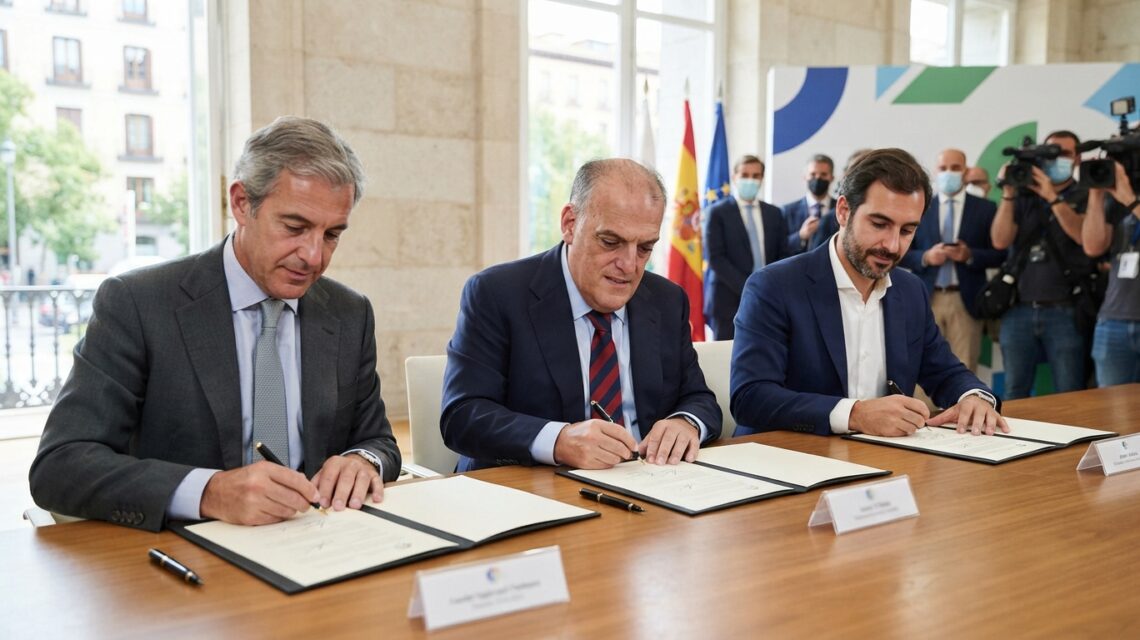
LaLiga’s agreement with CVC became one of the most consequential examples of private capital entering European football.
The arrangement was approved in 2021 and implemented through a commercial holding structure.
CVC acquired approximately 8.2% of LaLiga Group International, the entity associated with the league’s commercial and technological business.
The investment was linked to a 50-year arrangement.
LaLiga’s current transparency disclosures identify €1.994 billion in investment through the Impulso program.
That is more precise than treating the initial €2.1 billion figure reported during negotiations as the final amount invested.
The distinction matters because the deal evolved between its initial announcement and implementation.
Participating clubs receive financing intended to support long-term development projects.
But CVC did not purchase an 8.2% ownership stake in every Spanish football club.
Nor did it acquire outright ownership of the league’s matches.
Its investment was structured around a minority interest in the commercial business and associated economic rights.
Why Real Madrid, Barcelona and Athletic Club rejected the deal
The CVC agreement divided Spanish football.
Real Madrid, Barcelona and Athletic Club opposed the arrangement.
Their objections centered on the duration of the deal and the long-term economic consequences of transferring part of the league’s commercial income.
A 50-year commitment extends across multiple generations of players, executives and club presidents.
The clubs argued that sacrificing future income could be too expensive compared with the immediate financial benefit.
LaLiga defended the arrangement as a way to accelerate investment and improve the league’s competitiveness.
The final structure excluded clubs that declined to participate.
That was a significant difference from an arrangement that automatically imposed identical obligations on every team.
The dispute reflected two competing financial philosophies.
LaLiga prioritized access to capital for infrastructure and commercial development.
The opposing clubs placed greater emphasis on retaining future economic rights.
Neither position can be evaluated solely by comparing the initial investment with the percentage sold.
The ultimate financial outcome depends on how the league’s commercial business performs over the following decades.
Where LaLiga’s CVC money is supposed to go
The Impulso program restricts how participating clubs can use their financing.
LaLiga’s published rules require at least 70% to support growth-related investments.
These can include stadiums, training facilities, digital infrastructure, technology, marketing and international expansion.
Up to 15% can be used for debt-related purposes.
Another maximum of 15% can support player-registration expenditure under the program’s conditions.
The structure was intended to prevent clubs from spending the entire investment immediately on transfer fees and wages.
A new stadium or training complex may generate benefits over many years.
An expensive player contract can expire without creating a comparable lasting asset.
The distinction explains why the program emphasized infrastructure rather than short-term sporting success.
It also means that the amount committed by CVC should not be confused with cash already spent by clubs.
In July 2026, LaLiga executive Jaime Blanco said CVC had completed its payments, but approximately €500 million remained to be distributed to clubs.
Disbursements were tied to approved projects and their readiness for implementation.
That suggests the program was still moving through its investment phase five years after the original agreement.
France sold 13% of its commercial business for €1.5 billion
The French arrangement followed a different model.
In 2022, CVC invested €1.5 billion in LFP Media, the commercial subsidiary of the French professional football league.
The fund acquired a 13% equity stake, leaving the LFP with 87%.
The investment was intended to provide capital to clubs and strengthen the commercial management of French professional football.
The underlying expectation was that improved management and distribution could increase the value of domestic and international broadcasting rights.
But the French television market was already experiencing significant instability.
The collapse of Mediapro’s broadcasting agreement in 2020 had exposed the dangers of relying on ambitious media-rights projections.
The CVC deal offered financial relief and an opportunity to rebuild.
It did not guarantee that broadcasters would pay higher prices for Ligue 1 matches.
That distinction became decisive.
Why Ligue 1’s broadcasting crisis changed the calculation
France’s domestic broadcasting problems intensified in 2025.
DAZN, which had acquired rights to most Ligue 1 matches, entered a dispute with the LFP.
The broadcaster argued that the commercial environment had not developed as expected, while the league challenged DAZN’s failure to meet payment obligations.
According to testimony before the French Senate in May 2026, DAZN had failed to pay approximately €140 million in final installments for the 2024/25 season.
The testimony also described other disputes affecting the league’s broadcasting income.
These included litigation involving Canal+ and disagreements over separate commercial arrangements.
The immediate problem was straightforward.
French clubs depended heavily on money distributed through collective media agreements.
When those payments became uncertain, financial planning became more difficult.
CVC’s investment had provided substantial capital.
But it had not eliminated the league’s dependence on the commercial performance of its broadcasting business.
The new Ligue 1+ streaming service created another test
After the DAZN dispute, the LFP launched its own streaming platform, Ligue 1+, for the 2025/26 season.
The move represented a major change in strategy.
Instead of relying entirely on an external broadcaster, the league sought a more direct relationship with subscribers.
That offered potential advantages.
The LFP could control its product, collect audience information and develop its own distribution strategy.
But operating a streaming service also introduces costs.
Production, technology, customer acquisition, marketing and distribution all require investment.
Subscription revenue is not equivalent to profit.
A 2026 academic analysis of Ligue 1+ highlighted the challenge of converting subscription fees into sustainable income after taxes, distribution costs and other obligations.
The study also identified CVC’s participation in commercial revenue as part of the financial structure.
The broader lesson is that selling equity in a media business does not remove the risks associated with operating that business.
Investors and clubs remain exposed to the value of the underlying product.
France’s November 2026 tender became a decisive moment
On November 3, the LFP opened a new tender for Ligue 1 domestic broadcasting rights covering 2027–2032.
The league offered all nine matches per round as a single package.
Interested companies could bid for the full rights or seek exclusive distribution of Ligue 1+.
Offers were due on December 3, with a result expected on December 4.
The LFP sought financial guarantees and indicated that bids would need to exceed a confidential reserve price.
The tender was brought forward from a later rights cycle after discussions with potential partners.
The outcome was not known as of November 9, 2026.
That uncertainty matters.
A successful tender could provide a more stable revenue foundation.
A disappointing result could leave the league increasingly dependent on its own streaming service.
Either outcome would affect the commercial environment in which CVC holds its 13% interest.
The investment’s long-term success therefore remains unresolved.
RedBird’s AC Milan purchase was a different kind of deal
RedBird Capital Partners followed a separate strategy.
Rather than buying a minority stake in a league’s commercial subsidiary, the firm acquired control of AC Milan in 2022, in a transaction valued at approximately €1.2 billion.
The acquisition involved financing provided by the previous owner, Elliott Management.
That financing arrangement is important because the headline purchase price was not simply an all-cash payment funded entirely by RedBird’s own capital.
In December 2024, Milan announced that RedBird had invested an additional €170 million and reduced the principal of Elliott’s vendor loan to €489 million.
On January 30, 2026, RedBird completed a further refinancing.
The new debt facilities, arranged by Comvest Credit Partners, replaced the acquisition-related financing previously provided by Elliott.
RedBird remained the club’s controlling owner.
Elliott’s representatives left Milan’s board.
The transaction illustrates how private-equity ownership can involve several layers of financing long after the original acquisition.
Why refinancing is not the same as eliminating debt
RedBird described the January 2026 refinancing as a step toward greater financial flexibility.
That may be correct, depending on the terms of the new facilities.
But refinancing debt does not necessarily mean the debt disappears.
It generally means an existing obligation is repaid using new financing, potentially with different lenders, interest rates or repayment schedules.
The distinction matters because a club can improve its financing structure without becoming debt-free.
RedBird’s strategy also involves increasing Milan’s commercial value.
The club and Inter Milan completed the acquisition of San Siro in November 2025, creating a foundation for a proposed new stadium development.
Modern stadium infrastructure can increase matchday, hospitality and sponsorship revenue.
But construction projects also require substantial investment and carry execution risks.
The commercial case depends on completing the development and generating the expected returns.
Silver Lake’s $500 million City Football Group investment began before the pandemic
Silver Lake’s entry into European football predates the CVC deals.
In November 2019, the American technology investment firm agreed to invest $500 million in City Football Group.
The investment represented slightly more than 10% of the group’s post-investment equity.
It valued the business at approximately $4.8 billion.
City Football Group controlled Manchester City and interests in clubs across several countries.
Silver Lake’s investment was primary capital, meaning the money went into the company rather than simply purchasing existing shares from another investor.
The announced purpose included international expansion, technology and infrastructure development.
The transaction also gave Silver Lake representation on the group’s board.
It was therefore a minority investment in a multiclub business, not a purchase of Manchester City itself.
The distinction matters because the group included multiple sporting and commercial assets.
The collapse of 777 Partners exposed the risks of aggressive expansion
Not every investment firm entering football followed a sustainable path.
777 Partners built a portfolio of clubs that included Genoa, Hertha Berlin, Standard Liège and interests in other teams.
It also attempted to acquire Everton.
That proposed takeover failed in 2024 after the company did not satisfy the conditions required to complete the transaction.
As its financial difficulties intensified, 777’s football assets were put up for sale or transferred through restructuring arrangements.
The consequences extended across several countries.
In October 2026, 777 co-founder Josh Wander pleaded guilty in a United States federal court to wire fraud and securities fraud.
The case involved allegations of misrepresenting assets and financial information in connection with borrowing and investment activity.
Wander’s guilty plea was a significant development.
But it would be misleading to treat his conduct as representative of all private-equity investors in football.
The case instead highlights the importance of assessing an investor’s financing, governance and ability to meet contractual commitments.
A club can face serious risks when its ownership structure depends on unstable external funding.
What the major investments actually purchased
| Investor | Football asset | Original transaction | Economic interest |
|---|---|---|---|
| CVC Capital Partners | LaLiga commercial business | €1.994bn invested through Impulso | Approximately 8.2% interest, linked to a 50-year arrangement |
| CVC Capital Partners | LFP Media, France | €1.5bn in 2022 | 13% equity stake |
| RedBird Capital Partners | AC Milan | Approximately €1.2bn acquisition in 2022 | Controlling ownership |
| Silver Lake | City Football Group | $500m in 2019 | Slightly more than 10% at entry |
| 777 Partners | Multiple football clubs | Various transactions beginning in the early 2020s | Club ownership and minority interests, later affected by restructuring |
These figures are not directly comparable.
A 13% stake in a league’s commercial subsidiary is different from control of an individual club.
A primary capital investment differs from a purchase financed partly through vendor debt.
And a 50-year commercial arrangement does not have the same economic characteristics as ordinary club equity.
The legal structure determines who receives revenue, who bears losses and who controls decisions.
The hidden cost of selling future commercial income
The strongest criticism of long-term private-capital agreements concerns the trade-off between present funding and future revenue.
Suppose a commercial business generates €200 million annually.
An investor entitled to 10% of that income would receive €20 million per year before any applicable contractual adjustments.
If revenue later doubles to €400 million, the investor’s 10% share would rise to €40 million.
Over decades, the cumulative value could become substantial.
That does not automatically mean the original deal was unfavorable.
The initial capital may have financed projects that helped revenue grow.
Without the investment, the business might have developed more slowly.
The appropriate comparison is therefore not simply the money received today versus all future payments.
It is the value created by the investment, the cost of alternative financing and the rights surrendered.
For LaLiga, the central question is whether modernization generates enough additional commercial value to justify the long-term participation granted to CVC.
For France, the immediate concern is whether the underlying media business can recover from its broadcasting crisis.
Why private equity does not guarantee better sporting results
Investment funds often promise more professional management.
They may introduce financial planning, data analysis, commercial partnerships and operational expertise.
Those improvements can be valuable.
But they do not guarantee victories.
Football results depend on coaching, recruitment, player performance, injuries and competition.
A club can improve its financial position while experiencing disappointing seasons.
Conversely, a team can achieve sporting success while carrying significant financial risk.
The distinction is particularly important when investors emphasize enterprise valuation.
A club becoming more valuable does not necessarily mean its supporters are receiving a better sporting experience.
Financial success and sporting success can reinforce each other, but they are not interchangeable.
What investors and clubs will be watching next
The immediate test is in France.
The December 2026 television-rights tender will help establish whether Ligue 1 can rebuild predictable broadcasting income.
That outcome will matter to clubs relying on league distributions and to CVC as a minority shareholder in the commercial subsidiary.
In Spain, attention will remain on the projects financed through LaLiga Impulso.
The question is whether stadium improvements, digital development and international expansion produce measurable long-term returns.
For AC Milan, RedBird’s refinancing and stadium project will test whether the ownership group can convert financial restructuring into sustained commercial growth.
City Football Group faces the broader challenge of managing a complex international portfolio while maintaining sporting and financial performance.
The collapse of 777 Partners provides a warning about the consequences of unstable financing.
European football has attracted investment funds because its brands, audiences and media rights can be extraordinarily valuable.
But the deals have also revealed an important distinction.
Capital can buy time, infrastructure and commercial expertise. It cannot guarantee future broadcasting revenue, sporting success or sound management.
+ Siga o Giro no Facebook
+ Siga o Giro no Instagram
Leia Mais: