

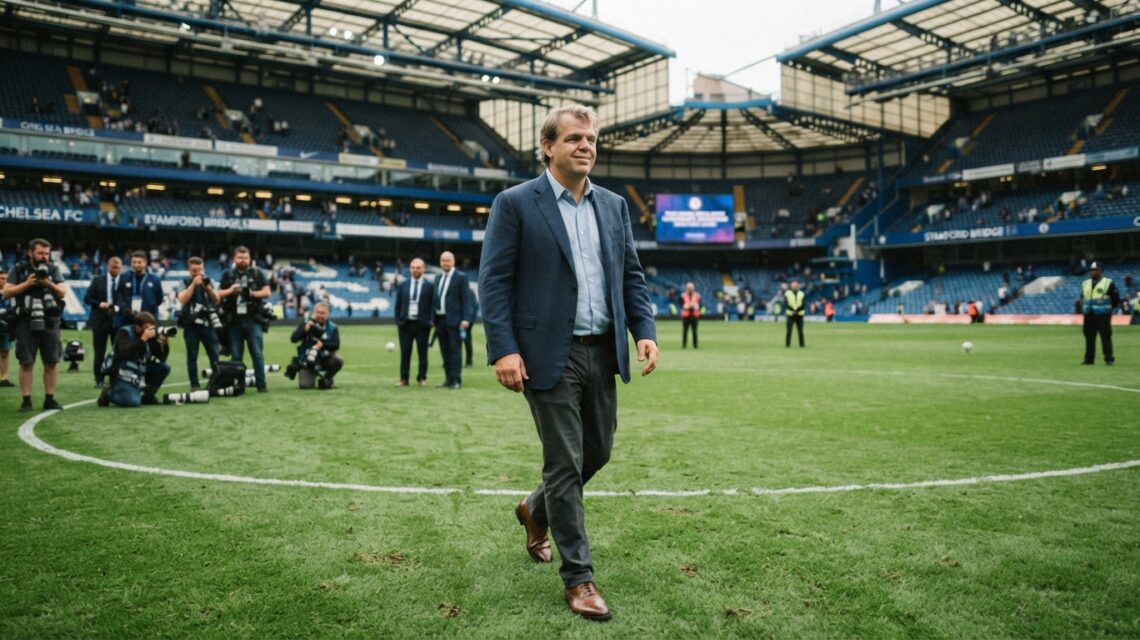
Todd Boehly and Clearlake Capital acquired Chelsea for £2.5 billion and pledged another £1.75 billion in investment. The takeover led to unprecedented transfer spending, two major trophies in 2025 and financial sanctions, while more than £2.6 billion in proceeds remained blocked amid a dispute over aid to Ukraine.
By Marcio Tamer
Updated November 9, 2026
Four years after Chelsea Football Club changed hands in one of the most extraordinary transactions in sporting history, the money from its sale still has not reached the humanitarian causes it was intended to support.
The British government confirmed on October 16, 2026, that more than £2.6 billion in proceeds from Chelsea’s 2022 sale remained frozen, despite a government license issued in December 2025 to enable the transfer.
The money has become the subject of a prolonged dispute involving former owner Roman Abramovich, his company Fordstam and the UK government.
Meanwhile, the club itself has entered a radically different financial era.
Under the ownership of Todd Boehly and Clearlake Capital, Chelsea assembled a playing squad that UEFA valued at £1.52 billion, the most expensive in football history according to its 2026 financial benchmarking report.
The club won the UEFA Conference League and FIFA Club World Cup in 2025, but its spending strategy also attracted regulatory scrutiny.
UEFA imposed a €31 million financial penalty in July 2025, with additional conditional sanctions, and a separate €3 million squad-cost fine in June 2026.
The contrast captures the unusual legacy of the takeover.
Chelsea’s sale was completed in less than three months under government supervision. Its new owners then transformed the club’s transfer strategy.
But the original sale proceeds remained inaccessible, while the new business model faced growing pressure to demonstrate financial sustainability.
Why Chelsea had to be sold in 2022
Roman Abramovich bought Chelsea in 2003 and transformed the club into one of Europe’s most successful teams.
During his ownership, Chelsea won five Premier League titles, two Champions League titles and numerous domestic and international trophies.
His financial backing helped the club compete with the wealthiest teams in Europe.
That model became untenable after Russia launched its full-scale invasion of Ukraine in February 2022.
On March 10, the UK government imposed sanctions on Abramovich, citing his close ties to Russian President Vladimir Putin.
The measures froze his UK assets and prohibited transactions that could provide him with economic benefits.
Chelsea was directly affected because Abramovich owned the club.
The government issued a special operating license allowing Chelsea to continue playing matches and paying essential expenses.
But the restrictions severely limited normal commercial activity.
The club could not freely sell new tickets or merchandise, negotiate new player contracts or conduct transfer business under its usual arrangements.
The sanctions created an urgent need for a change of ownership.
However, Chelsea was not placed into administration, and its insolvency was not formally established.
The immediate threat was the disruption of its ability to operate commercially under sanctions.
How the £4.25 billion takeover was structured
On May 6, 2022, Chelsea announced that a consortium led by Todd Boehly and Clearlake Capital had agreed to acquire the club.
The consortium also included Mark Walter and Hansjörg Wyss.
The headline transaction value was £4.25 billion.
But that figure combined two different financial commitments.
| Component | Amount | Purpose |
|---|---|---|
| Purchase of Chelsea shares | £2.5bn | Acquisition consideration, subject to sanctions restrictions |
| Additional investment commitment | £1.75bn | Future investment in the club and its infrastructure |
| Total announced package | £4.25bn | Purchase price plus investment commitment |
The £2.5 billion was the price attributed to the club’s shares.
The additional £1.75 billion was a commitment by the new owners to invest in Chelsea.
It was not an extra payment to Abramovich.
Chelsea identified Stamford Bridge, the Cobham training facilities, the academy, the women’s team, Kingsmeadow and the Chelsea Foundation as areas that could benefit from the additional investment.
The transaction therefore combined an ownership transfer with a long-term capital commitment.
That distinction is essential when comparing Chelsea’s sale with other football acquisitions.
A £4.25 billion headline package does not mean the previous owner received £4.25 billion.
Why the government had to approve the takeover
The sale required more than an agreement between buyer and seller.
Because Abramovich was under UK sanctions, the transaction needed a special government license.
The Premier League also had to approve the new ownership group under its Owners’ and Directors’ Test.
On May 24, 2022, the Premier League announced that it had approved the proposed takeover.
The UK government subsequently issued the required license.
Chelsea confirmed completion on May 30, 2022.
The entire process had taken less than three months from the sanctions announcement.
The speed was unusual for a transaction involving one of the world’s most valuable football clubs.
The Raine Group, an American investment bank, managed the sale process and evaluated competing bidders.
The successful consortium included investors with experience in American professional sports.
Boehly and Walter were associated with the Los Angeles Dodgers, while Clearlake brought private-equity expertise.
The takeover also introduced a new governance structure.
Chelsea announced that Boehly and Clearlake would share joint control and equal governance rights.
That was different from the previous arrangement under Abramovich, who had been the club’s controlling owner.
Why the £2.5 billion sale proceeds were frozen
The UK government permitted Chelsea to be sold on the condition that Abramovich would not benefit from the transaction.
The proceeds were therefore placed in a frozen UK bank account.
The government also required that any eventual use of the money comply with sanctions law.
The intended destination was humanitarian assistance for victims of Russia’s invasion of Ukraine.
But the transfer did not happen automatically.
The money remained associated with Fordstam, the company through which Abramovich had owned Chelsea.
That created a legal and administrative problem.
The government could authorize a transfer through a sanctions license, but the funds remained subject to restrictions and disputes over how they should be used.
The distinction between a frozen asset and a confiscated asset is important.
Freezing prevents an owner from accessing or transferring property without authorization.
It does not automatically transfer ownership of that property to the government.
That legal reality helps explain why the Chelsea proceeds remained blocked long after the club itself had changed hands.
The frozen money grew beyond £2.6 billion
The original share purchase amount was £2.5 billion.
But the frozen funds accumulated interest.
According to financial records examined by The Guardian in September 2026, the proceeds had generated at least £175 million in interest by June 2024.
The total was likely to have increased further by 2026.
The human-rights organization REDRESS subsequently examined the financial position in greater detail.
It reported that Fordstam had received £2.35 billion of the original £2.5 billion share purchase consideration.
The remaining £150 million had been retained by the buyers until May 2027 to cover potential liabilities relating to Abramovich’s ownership period.
REDRESS also identified transaction fees and interest income affecting the amount held.
These figures help explain why government statements sometimes refer to more than £2.5 billion or more than £2.6 billion.
The amounts describe different aspects of the transaction and its accumulated proceeds.
They should not be treated as interchangeable figures for the original purchase price.
Why the money had still not reached Ukraine in November 2026
On December 17, 2025, the UK government issued a license allowing more than £2.5 billion from the Chelsea sale to be transferred to a new charitable foundation.
The foundation was intended to provide humanitarian assistance to victims of Russia’s invasion of Ukraine.
The government described the license as a clear legal route for releasing the funds.
But the transfer did not follow.
In a parliamentary answer published on October 16, 2026, Foreign Office minister Uma Kumaran confirmed that no transfer had been made.
She said a 90-day period associated with Abramovich’s original undertaking had expired without the money being released.
The government remained prepared to pursue court action if necessary.
The dispute involved the intended scope of humanitarian assistance.
The UK government insisted that the proceeds should benefit victims of the war in Ukraine.
Abramovich’s representatives had argued for a broader charitable approach that could include victims outside Ukraine.
As of November 9, 2026, the money remained frozen.
No public announcement had established that the proceeds had been transferred to the intended foundation.
How Boehly and Clearlake changed Chelsea’s transfer strategy
After completing the takeover, Chelsea’s new owners pursued an aggressive recruitment policy.
The club invested heavily in younger players, often offering contracts lasting seven or eight years.
Major signings included Enzo Fernández, Mykhailo Mudryk, Moisés Caicedo and Cole Palmer.
The strategy was designed to build a squad capable of competing over several seasons.
It also had an accounting dimension.
When a club buys a player’s registration, the transfer fee is generally capitalized and then amortized over the relevant accounting period.
That means the cost is recognized gradually rather than entirely in the year of the transfer.
For example, a hypothetical £80 million transfer amortized over eight years would produce an annual accounting charge of £10 million.
The same fee amortized over five years would produce an annual charge of £16 million.
The difference can materially affect a club’s reported financial performance.
Chelsea’s unusually long contracts therefore attracted attention from regulators and rival clubs.
UEFA closed the long-contract accounting advantage in 2023
In June 2023, UEFA announced a change to its financial regulations.
From July 1, 2023, clubs could amortize the transfer fee of a newly acquired player over a maximum of five years, even if the player’s contract lasted longer.
The change was not applied retrospectively to earlier transfers.
Chelsea’s existing contracts were therefore not automatically rewritten.
But the regulation limited the financial benefit of using exceptionally long contracts for future signings.
The Premier League followed with a comparable rule change in December 2023.
The result was a significant adjustment to transfer accounting across English football.
Clubs could still offer players contracts lasting longer than five years.
They could not automatically spread the transfer fee across the full length of those contracts for regulatory purposes.
This was one of the clearest examples of Chelsea’s transfer strategy prompting a wider response from football authorities.
Chelsea assembled the most expensive squad in football history
The scale of Chelsea’s recruitment became visible in UEFA’s financial benchmarking data.
In February 2026, UEFA reported that Chelsea’s squad had been assembled at a cost of approximately £1.52 billion.
That was the highest figure recorded for a football club.
The amount represented the acquisition cost of the squad, not the club’s annual wage bill.
It also was not equivalent to the club’s annual transfer expenditure.
Those distinctions matter because the financial burden of a squad includes several components.
Transfer fees create amortization charges.
Player contracts create wage obligations.
Agent fees and other costs can increase the total.
A club may spend heavily in one transfer window while recognizing the accounting cost over several years.
But those obligations accumulate.
As Chelsea continued recruiting, its financial model became increasingly dependent on generating sufficient revenue, managing player sales and controlling the cost of its squad.
Why Chelsea reported two different loss figures for 2024/25
Chelsea’s financial results for the year ending June 30, 2025, attracted considerable attention.
UEFA’s benchmarking report identified a £355 million pre-tax loss.
That was described as the largest annual loss recorded by an English football club under UEFA’s reporting framework.
Chelsea’s separately published statutory accounts reported a £262.4 million pre-tax loss.
The two figures were not identical because they were prepared using different reporting bases and adjustments.
The club’s statutory accounts also showed revenue of approximately £490.9 million.
UEFA’s benchmarking figures placed Chelsea’s revenue at approximately £511 million.
The difference illustrates why financial comparisons must identify the source and accounting method.
It would be misleading to combine UEFA’s loss figure with Chelsea’s statutory revenue figure without explaining that they come from different reporting frameworks.
The broader picture was nevertheless clear.
Chelsea had invested heavily in its squad while facing substantial operating and accounting costs.
Why the losses did not automatically mean a Premier League rules breach
Chelsea said it remained compliant with the Premier League’s Profitability and Sustainability Rules for the relevant three-year assessment period.
That statement may appear surprising alongside a statutory loss of more than £260 million.
But the Premier League’s regulatory calculation is not identical to a club’s published pre-tax profit or loss.
Certain expenditures, including eligible investment in infrastructure, youth development and women’s football, can be excluded from the calculation.
The rules also assess financial performance across multiple seasons rather than a single accounting year.
Consequently, a large statutory loss does not automatically establish a breach of the Premier League’s financial regulations.
Compliance must be determined using the applicable regulatory definitions and reporting period.
UEFA operates a separate framework.
A club can therefore satisfy one competition’s financial rules while facing sanctions under another.
Chelsea’s experience demonstrated exactly that distinction.
UEFA fined Chelsea €31 million in 2025
On July 4, 2025, UEFA announced financial sanctions against Chelsea for breaches of its Financial Sustainability Regulations.
The club entered a four-year settlement agreement.
The penalties included €20 million for breaching the football earnings rule and €11 million for exceeding the applicable squad-cost threshold.
That produced a combined immediate financial penalty of €31 million.
Chelsea also faced the possibility of further conditional fines.
Under the settlement, the football earnings component included up to €60 million in additional conditional penalties if specified financial targets were not met.
The club also accepted restrictions on registering new players for UEFA competitions.
Those restrictions were linked to its transfer balance and financial performance.
They did not amount to an automatic prohibition on signing players for domestic competitions.
The sanctions demonstrated that accounting strategies could delay or redistribute costs without eliminating regulatory scrutiny.
Chelsea received another UEFA fine in June 2026
The financial pressure continued into 2026.
On June 30, UEFA announced that Chelsea had exceeded the permanent 70% squad-cost threshold for calendar year 2025.
The governing body imposed a €3 million fine, including €2 million conditional on future compliance.
Chelsea acknowledged the decision and said UEFA had recognized an improving trend in its squad-cost ratio.
The club described the breach as narrow.
The penalty was separate from the 2025 settlement.
It therefore should not be treated as part of the original €31 million fine.
The 2026 decision showed that Chelsea remained under scrutiny even as the club reported progress in reducing its ratio.
The long-term challenge was to bring spending into line with sustainable revenue.
Chelsea also faced sanctions over historical misconduct
Not all of Chelsea’s regulatory problems arose from the new owners’ spending.
In July 2026, the Football Association imposed a £10 million fine and a suspended two-window registration ban following breaches of agent and intermediary regulations.
The case concerned historical misconduct that Chelsea’s new ownership had reported after acquiring the club.
The FA said the club had admitted 74 breaches.
An initial suspended six-point deduction was overturned on appeal and replaced with the suspended registration ban.
The final sanction was therefore not an active points deduction.
Chelsea said the proceedings brought the relevant historical regulatory matters to a close.
The distinction is important.
The misconduct related to the previous ownership period.
The current owners’ role included reporting the issues to the authorities.
It would be inaccurate to present the FA case as evidence that Boehly and Clearlake committed the underlying historical breaches.
The new owners also delivered major trophies
Chelsea’s financial difficulties did not prevent sporting success.
In May 2025, the club won the UEFA Conference League, defeating Real Betis 4-1 in the final.
The victory made Chelsea the first club to win all five major UEFA men’s club competitions.
Two months later, Chelsea won the expanded FIFA Club World Cup in the United States.
The club defeated Paris Saint-Germain 3-0 in the final at MetLife Stadium.
Cole Palmer scored twice, while João Pedro added the third goal.
Those victories provided evidence that the rebuilt squad could compete successfully in major tournaments.
But trophies and financial sustainability are different measures.
A club can win competitions while reporting substantial losses.
Likewise, a profitable club can struggle on the pitch.
The success of Chelsea’s ownership strategy therefore cannot be judged solely by either transfer spending or trophy count.
Both sporting results and financial performance matter.
What the £4.25 billion transaction actually changed
| Issue | Confirmed outcome |
|---|---|
| Original sale agreement | Announced May 6, 2022 |
| Completion date | May 30, 2022 |
| Share purchase price | £2.5bn |
| Additional investment commitment | £1.75bn |
| Total announced package | £4.25bn |
| Controlling owners | Todd Boehly and Clearlake Capital |
| Original proceeds | Frozen under UK sanctions |
| Proceeds status in November 2026 | More than £2.6bn remained blocked |
| Chelsea squad acquisition cost | Approximately £1.52bn, according to UEFA |
| UEFA sanctions in July 2025 | €31m, plus conditional exposure |
| UEFA squad-cost fine in June 2026 | €3m, including €2m conditional |
| FA historical misconduct sanction in July 2026 | £10m and suspended registration ban |
| Major trophies under new ownership | 2025 Conference League and Club World Cup |
The figures describe different financial categories.
The £4.25 billion package was not a single payment.
The £1.52 billion squad cost was not a one-year expense.
The £355 million UEFA-reported loss was not identical to Chelsea’s statutory pre-tax loss.
And the frozen sale proceeds were not funds available for the new owners to spend.
Understanding those distinctions is essential to assessing the transaction.
What remains unresolved in November 2026
Four years after the takeover, Chelsea faces two separate challenges.
The first concerns the original sale proceeds.
The UK government continues to seek the release of the frozen money for humanitarian assistance to victims of Russia’s invasion of Ukraine.
The October 2026 parliamentary response confirmed that the transfer had still not occurred.
The government has said it is prepared to pursue legal action if necessary.
The second challenge concerns Chelsea’s operating model.
The club has assembled an exceptionally expensive squad and achieved major sporting success.
But it has also reported substantial losses and received financial sanctions.
The owners must demonstrate that commercial growth, player trading and cost management can support the scale of their investment.
The original transaction was extraordinary because it combined sanctions, government intervention and a multibillion-pound ownership transfer.
Its longer-term significance may prove even greater.
Chelsea was sold in 2022, but the financial consequences of that sale are still being worked out in 2026.
+ Siga o Giro no Facebook
+ Siga o Giro no Instagram
Leia Mais: