
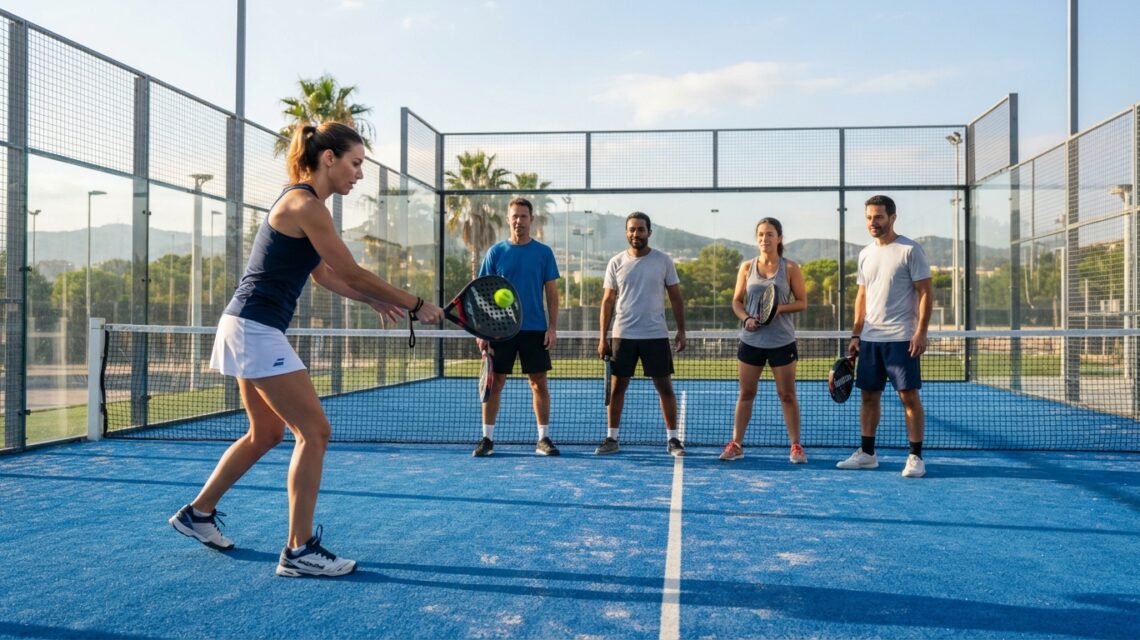
Published coaching prices in Spain and the United Kingdom reveal how much beginners can save with group lessons, while padel’s doubles format gives shared instruction a tactical advantage that one-on-one coaching cannot fully reproduce.
By Marcio Tamer
Updated November 17, 2026
A first-time padel player can pay €50 for an hour of individual instruction at Valencia Padel Center in Spain or join a four-player lesson for just €20 per person. A two-player session costs €30 each, creating a middle ground between personalized coaching and affordable group training.
The difference goes beyond price. Unlike sports where individual technique can be developed almost independently of teammates, padel is fundamentally a doubles game in which positioning, communication and coordinated movement influence nearly every point.
That gives beginner group lessons an advantage that private instruction cannot entirely replicate. Four participants can practice the same attacking and defensive formations they will encounter during recreational matches.
Private coaching, however, offers more opportunities to isolate unfamiliar movements, correct racket technique and learn how to return balls after they rebound from the glass.
For most first-time players, a small beginner group is a reasonable starting point. Individual or semi-private instruction becomes particularly valuable when a specific technical difficulty prevents someone from participating comfortably in rallies.
How much do private and group padel lessons cost?
Published prices from Valencia Padel Center and Ibiza Padel Academy provide a useful comparison of how coaching costs change when more players share a session.
Both Spanish academies advertise individual instruction for €50 an hour, but their pricing structures differ as additional participants join.
| Lesson format | Valencia Padel Center | Ibiza Padel Academy |
|---|---|---|
| Private, one player | €50 | €50 |
| Semi-private, two players | €30 each | €30 each |
| Three-player lesson | €24 each | €21.67 each |
| Four-player lesson | €20 each | €17.50 each |
Published prices are calculated per person for a 60-minute session. Ibiza Padel Academy charges court rental separately. Confirm all inclusions before booking.
At Valencia Padel Center, moving from individual coaching to a four-player lesson reduces the advertised cost per participant by 60%.
The Ibiza example produces an even larger reduction in coaching fees, although players must also account for court rental.
These prices show why beginners should examine the total charge rather than assume that sharing a private lesson automatically divides the original price equally.
A coach who charges €50 for one participant may charge €60 for two or €80 for four. Each player saves money, but the total coaching fee increases.
How much can beginners save over their first month?
A beginner who trains once a week can accumulate four hours of instruction during the first month. Using Valencia Padel Center’s published single-session rates, the differences are substantial.
| First-month training plan | Total cost per player |
|---|---|
| Four private lessons | €200 |
| Four two-player lessons | €120 |
| Four four-player lessons | €80 |
| One private lesson and three four-player lessons | €110 |
| Two private lessons and two four-player lessons | €140 |
These are illustrative calculations using published individual booking rates rather than quotations for discounted lesson packages.
For the same €200 required for four individual lessons, a player could theoretically purchase ten four-player sessions at €20 each. That creates considerably more opportunities to return to the court, although the instructor’s attention will be shared.
The financial advantage becomes particularly relevant for beginners who want to continue training for several months instead of purchasing a short introductory course.
Why padel is different from tennis when choosing lessons
The standard padel format is doubles, with two players on each side of an enclosed court measuring 20 meters long and 10 meters wide.
The International Padel Federation establishes the sport’s official rules, while Britain’s Lawn Tennis Association provides beginner guidance explaining how serving, rebounds and scoring work.
Players serve after bouncing the ball and direct it diagonally into the opposing service box. During rallies, the surrounding walls can remain involved in play after a legal bounce, provided the ball is returned before its second bounce.
Those characteristics fundamentally change the learning process. Beginners must understand not only how to strike the ball but also when to let it pass, where to position themselves relative to their partner and when to move toward the net.
A private lesson can introduce these concepts, but a four-player class allows participants to experience them within a realistic doubles formation.
Why a four-player group is often the best starting point
A beginner group containing four players has a natural advantage: everyone can participate in drills that reproduce the sport’s standard competitive format.
The instructor can organize two pairs, introduce basic point construction and stop play when players make positioning mistakes. Participants learn how their movements affect their partners rather than concentrating exclusively on their own shots.
For example, a beginner may instinctively rush toward the net after hitting a good ball while leaving their partner near the back glass. That creates gaps which opponents can exploit, even when both players have reasonably dependable strokes.
A group coach can demonstrate why attacking and defending positions need coordination. The players can then repeat the situation against actual opponents instead of learning the concept only through explanation.
The social benefit is also significant. Four people attending the same beginner course already have the necessary number of participants for a recreational doubles match.
What private padel lessons teach particularly well
Private coaching is most useful when a player needs concentrated attention on an individual problem.
A beginner who struggles to control the racket face, judge the ball’s trajectory or return a rebound from the back wall may find it difficult to practice effectively while sharing an instructor with several other people.
An individual session gives the coach greater flexibility to simplify exercises and repeat specific situations. The player can begin with gentle feeds, work on foot positioning and gradually progress toward faster or less predictable balls.
That may be particularly helpful for someone who feels uncomfortable entering a group class without understanding the basic strokes.
However, private instruction does not automatically produce faster overall development. Technical improvements still need to transfer into situations involving movement, opponents and a doubles partner.
Why learning to use the back glass can be difficult
One of the most unfamiliar experiences for a first-time padel player is deliberately allowing the ball to travel past them.
In tennis, a player generally tries to intercept an incoming ball before it becomes unreachable. In padel, a sufficiently deep shot may bounce off the court and then rebound from the back glass into a more comfortable hitting position.
The challenge is recognizing which balls should be returned immediately and which are better played after a rebound.
Beginners frequently stand too close to the wall, move toward the ball too early or become trapped between its original trajectory and the rebound.
A private instructor can create repeated wall exercises without the interruptions of a rotating group. Once the player becomes more comfortable, shared lessons can introduce less predictable situations resembling real defensive points.
Learning the wall is not about deliberately using it on every shot. It is about recognizing when the rebound provides additional time or a better contact position.
Do tennis players need private lessons before starting padel?
Not necessarily. Previous racket-sport experience can be an advantage because players may already understand timing, ball contact, anticipation and basic court movement.
However, some familiar techniques and tactical habits do not transfer directly. A tennis player accustomed to large baseline swings may need more compact preparation when returning fast volleys or playing rebounds near the glass.
Experienced tennis players may also attempt to finish points with power when a controlled lob or a well-placed volley would be a better tactical choice.
The continental grip is commonly introduced in beginner padel coaching because it provides a versatile starting position for several strokes, including volleys and serves. It is not the only grip used in padel, and beginners should avoid treating every technical adjustment as an inflexible rule.
A private lesson can help identify which previous habits need modification. A suitable beginner group can accomplish many of the same objectives when the coach understands how to work with players transitioning from other sports.
The distinction is individual rather than automatic. Having played tennis does not mean someone must purchase private padel instruction.
Why squash and pickleball players face different challenges
Squash players may already be familiar with tracking balls around walls, but padel introduces different rebound rules, a net and a partner occupying the same playing area.
Pickleball players may find certain aspects of compact racket preparation and doubles communication familiar. However, using the back glass and managing overhead shots create additional challenges.
None of these backgrounds guarantees immediate proficiency. A beginner’s first session should establish which existing skills are useful and which habits require adjustment.
A coach who evaluates the player’s actual movements before prescribing changes is generally more useful than an instructor who assumes every tennis, squash or pickleball player has the same technical problems.
Why semi-private lessons offer a different balance
A two-player lesson provides more individual attention than a larger group while introducing some of the communication and coordination absent from one-on-one instruction.
At Valencia Padel Center, the €30-per-person rate represents a 40% saving compared with private coaching. Two beginners can train together, alternate technical exercises and practice moving as a pair.
This format can be particularly attractive for couples, friends or relatives who intend to play together regularly.
The instructor can observe how both participants communicate and respond to balls directed toward the middle of the court.
There is still a limitation. Two participants and a coach cannot reproduce every situation found in a standard four-player match without additional players.
For that reason, semi-private instruction works well alongside occasional group sessions or recreational doubles games.
What should a first padel lesson actually cover?
A first-time player’s objective should be to understand the equipment, basic rules and movements necessary to participate safely in a simple rally.
An introductory session can reasonably cover the following areas:
- Basic racket grip and ready position.
- Controlled forehand and backhand strokes.
- Underarm serving and returning.
- Simple back-glass rebounds.
- Basic volley technique.
- Movement and communication with a partner.
- Safe positioning around the walls and other players.
- Use of the racket’s safety wrist strap.
Advanced overhead strokes such as the bandeja or víbora can be introduced later as the player develops appropriate coordination and court awareness.
Attempting to cover every advanced shot during the first hour may leave insufficient time to establish dependable basic movements.
A useful first lesson should give the beginner enough understanding to practice independently and identify what needs improvement next.
Is a six-player group too large for beginners?
Not automatically, but group size deserves attention.
A standard padel court accommodates four active players during a doubles match. If six participants share one court, at least two must rotate out during conventional point play.
That arrangement can work when the instructor organizes short rotations, targeted observation exercises and appropriate rest periods.
However, poorly organized larger classes can leave participants waiting for extended periods, reducing opportunities to hit balls and receive feedback.
A four-player class is often a practical preference because it allows everyone to participate in ordinary doubles exercises simultaneously.
Two-player lessons provide more concentrated attention, while larger groups may offer lower prices or greater availability.
Before booking, ask how many participants share each court, how rotations work and whether the coach separates complete beginners from more experienced players.
Why the advertised hourly price may not include the court
Ibiza Padel Academy explicitly separates coaching fees from court rental. Its advertised €50 individual lesson therefore does not necessarily represent the complete cost of the session.
This distinction is easy to overlook when comparing instructors online. One coach’s advertised rate may include the court, while another’s covers only professional instruction.
Consider an illustrative example in which a coach charges €50 for an individual lesson and the selected court costs €30 an hour. The total becomes €80.
If the same facility charges €70 for four-player coaching and the same €30 court fee applies, the total becomes €100, or €25 per participant.
These hypothetical court charges demonstrate how additional fees can change the comparison. They are not published court rental rates for a specific Ibiza facility.
Beginners should request an all-inclusive price covering instruction, court time, applicable membership charges and any necessary equipment rental.
UK Padel’s £21 introductory class shows another pricing model
The difference between individual and shared instruction is also visible in the United Kingdom.
UK Padel publishes a one-hour private coaching rate of £52 for members and £64 for non-members. Its one-hour Learn to Play activity costs £18 for members and £21 for non-members.
For a non-member, the introductory class costs approximately one-third of an individual lesson. Membership prices introduce another variable that can influence the total cost for someone planning to train regularly.
These are provider-specific examples rather than national averages. The lesson structures and number of participants should also be considered when comparing them with Spanish academy prices.
For a beginner, the important question is how much useful practice the total budget can provide over several weeks.
Do you need to buy a padel racket before your first lesson?
Usually, purchasing a racket before the introductory session is unnecessary if the club offers affordable rental equipment.
Valencia Padel Center, for example, advertises racket rental for €3 per day for visitors attending its programs. Other clubs may include a loan racket in their introductory price or charge separately.
Renting initially allows beginners to become familiar with racket weight, grip size and handling before committing to a purchase.
The essential equipment consideration is safety. Players should properly secure the racket’s wrist strap and wear suitable athletic footwear with grip appropriate for the court surface.
Ask the club whether it supplies rackets and balls, and whether the advertised lesson price covers those items. Expensive equipment is unlikely to be the determining factor in a first lesson.
Can private coaching prevent bad habits?
Individual instruction can identify technical mistakes early and provide exercises designed to address them. However, taking two or three private lessons does not guarantee that a beginner will avoid developing poor habits.
There is no established universal requirement for a specific number of individual sessions before joining a group.
Learning depends on the quality of feedback, practice frequency, previous experience and how effectively players apply corrections during subsequent sessions.
A well-organized beginner group can identify and correct common errors from the outset. An individual lesson becomes especially useful when those errors persist or require more attention than the group format allows.
Instead of purchasing several private sessions automatically, beginners can assess whether they have a specific problem that justifies the additional expense.
How to organize your first four weeks of padel
A combination of individual feedback and doubles practice can offer a useful introduction to the sport.
The following is a suggested training structure, not a mandatory curriculum or a scientifically established optimal schedule.
| Week | Training format | Main objective |
|---|---|---|
| Week 1 | Private or two-player lesson | Grip, serving, controlled strokes and glass rebounds |
| Week 2 | Four-player beginner class | Doubles positioning and communication |
| Week 3 | Group lesson and optional recreational match | Rally consistency and simple tactical choices |
| Week 4 | Group lesson or targeted private session | Address recurring mistakes and review progress |
A budget-conscious player can replace the first individual session with a beginner group class. Someone struggling with a particular stroke might instead make the fourth session private.
The advantage of this flexible structure is that additional coaching responds to actual difficulties rather than assumptions about what every beginner needs.
How can you tell whether your padel lessons are working?
Winning matches is not necessarily the best measure of improvement during the first month. Opponents differ considerably in experience, and early results may not accurately reflect a player’s development.
More useful indicators include whether the player can serve legally and consistently, maintain controlled rallies, return straightforward glass rebounds and move around the court without repeatedly interfering with their partner.
Beginners should also become more comfortable recognizing when to defend from the back of the court and when to advance toward the net.
A coach can use these observations to determine whether additional technical instruction or more doubles practice would be beneficial.
The objective is not to master every stroke immediately. It is to become capable of participating in enjoyable, safe and reasonably coordinated points.
Which lesson format should first-time padel players choose?
A four-player beginner class offers an effective starting environment for adults who want affordable instruction, realistic doubles situations and opportunities to meet future playing partners.
Private coaching is more suitable when a beginner needs concentrated assistance, has difficulty keeping up with group exercises or wants to correct a particular technical problem.
Two-player lessons provide another option for people who prefer personalized feedback while sharing the cost and learning with a familiar partner.
The published Spanish prices demonstrate why the decision matters financially. A beginner can purchase four group sessions for €80 or four private sessions for €200 at Valencia Padel Center’s advertised single-session rates.
Instead of automatically choosing the more expensive option, first-time players should consider what they need to learn. If the main difficulty is controlling the racket, individual feedback may justify the additional cost. If the challenge is learning how to play with a partner, sharing the court is part of the solution.
+ Siga o Giro no Facebook
+ Siga o Giro no Instagram
Leia Mais: