
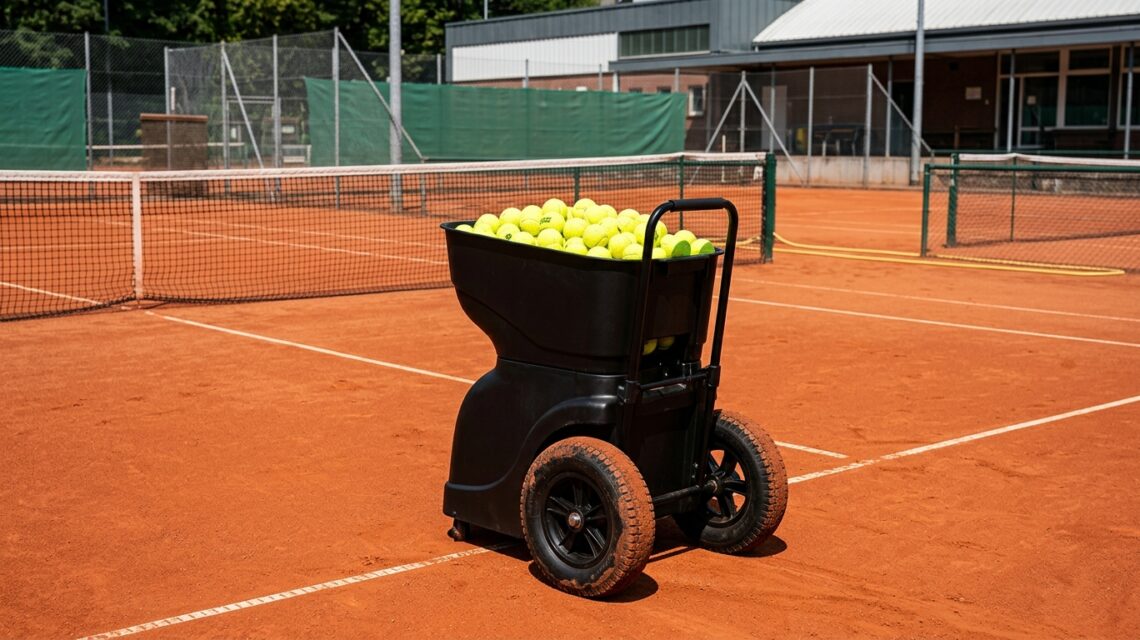
Official specifications from Titan, Sports Tutor, Spinfire, Lobster and Playmate reveal why small tennis clubs should compare commercial warranty terms, feeding capacity and repair support before paying for advanced drills.
By Marcio Tamer
Updated November 16, 2026
A tennis club buying the $2,199 Titan ACE receives a machine capable of holding 150 balls, delivering shots up to 80 mph and creating programmable drills.
But the manufacturer’s warranty contains a detail that could change the purchasing decision.
Titan provides a two-year warranty for personal use but only one year for commercial use by clubs. Batteries and chargers purchased directly from Titan carry a separate three-month warranty.
That distinction matters for a facility planning to rent the machine to members or use it repeatedly during group lessons.
It also challenges a common assumption: an expensive, feature-rich ball machine is not necessarily covered for the same period when used commercially.
Other manufacturers take different approaches.
Sports Tutor advertises three years of parts-and-labor coverage on its Tennis Tutor machines, although the battery warranty is shorter.
Spinfire offers a standard two-year machine warranty, with an optional extension.
The $5,195 Playmate ACE includes a three-year limited parts warranty, which is not equivalent to three years of comprehensive parts-and-labor coverage.
For a small club, these differences may matter more than maximum ball speed or the number of preprogrammed drills.
What do club-ready tennis ball machines actually cost in 2026?
Manufacturer-published prices show that a small club can purchase a capable portable machine for less than $2,500.
Larger commercial machines can cost more than twice that amount.
| Model | Published U.S. price | Ball capacity | Power | Published warranty |
|---|---|---|---|---|
| Sports Tutor Tennis Tutor Plus Player | $2,039 | 150 | Battery | 3 years machine; 1 year battery |
| Sports Tutor Tennis Tutor Plus Player AC/DC | $2,329 | 150 | Battery and AC | 3 years machine; 1 year battery |
| Titan ACE | $2,199 | 150 | Selected battery or AC configuration | 1 year for commercial use |
| Spinfire Pro 2 | From $2,099 | 150 | Battery or AC configurations | 2 years standard |
| Sports Tutor Tennis Tower IO Standard | $3,045 | 225 | AC or optional AC/DC | Confirm configuration and coverage |
| Lobster Phenom | $3,899 | 250 | AC | 2 years |
| Sports Tutor Shotmaker Deluxe | $4,550 | 300 | AC | Confirm written coverage |
| Playmate ACE | $5,195 MSRP | 200 | Confirm selected configuration | 3-year limited parts warranty |
Prices and specifications are based on manufacturer listings reviewed for this article. Options, taxes, shipping, dealer charges and availability can change the final cost.
The comparison reveals that price does not rise in a straight line with hopper capacity.
The Lobster Phenom holds 250 balls and costs $3,899.
The Playmate ACE costs $5,195 at its published MSRP but holds 200 balls.
That does not mean the Lobster is automatically better.
The machines differ in construction, controls, intended use and service arrangements.
It does mean that hopper size alone cannot justify a higher price.
Why commercial warranty coverage should be checked before anything else
A tennis ball machine used by one person for two hours each weekend faces a different workload from a machine rented to members throughout the day.
For clubs, the relevant question is not simply how long the warranty lasts.
It is whether the warranty applies to the intended use.
Titan provides an especially clear example.
Its published warranty policy distinguishes between personal and commercial ownership.
Personal-use machines receive two years of coverage.
Machines purchased for club use receive one year.
The manufacturer also states that its warranty extension is restricted to personal, noncommercial use.
A club cannot assume that buying an optional extension will provide the same protection as a private owner receives.
Spinfire takes a different approach.
Its U.S. distributor advertises a standard two-year parts-and-labor warranty, with an optional five-year extended machine warranty.
However, battery coverage is separate.
The distributor lists six months for sealed lead-acid batteries and two years for lithium batteries.
Sports Tutor advertises three years of parts-and-labor coverage for its Tennis Tutor machines, but the battery is covered for one year.
Playmate’s ACE lists three years of limited parts coverage.
That wording should prompt a follow-up question about labor charges, shipping and exclusions.
A three-year parts warranty is not the same as a three-year parts-and-labor warranty.
Before purchasing, ask the manufacturer or authorized dealer to confirm commercial-use eligibility in writing.
How long does a 150-ball hopper actually last?
Hopper capacity affects how often a coach or player must stop to collect balls.
The calculation is straightforward.
At a feed interval of one ball every 2.5 seconds, the machine launches 24 balls per minute.
A full 150-ball hopper therefore empties in 6 minutes and 15 seconds.
A 225-ball hopper lasts approximately 9 minutes and 23 seconds.
A 300-ball hopper lasts 12 minutes and 30 seconds.
| Hopper capacity | At one ball every 2.5 seconds | At one ball every 5 seconds |
|---|---|---|
| 100 balls | 4 min 10 sec | 8 min 20 sec |
| 150 balls | 6 min 15 sec | 12 min 30 sec |
| 200 balls | 8 min 20 sec | 16 min 40 sec |
| 225 balls | 9 min 23 sec | 18 min 45 sec |
| 250 balls | 10 min 25 sec | 20 min 50 sec |
| 300 balls | 12 min 30 sec | 25 min |
These figures assume continuous feeding with no pauses or interruptions.
Actual sessions include instruction, player rotations, breaks and ball collection.
Still, the difference is meaningful.
At the faster feed rate, moving from 150 to 300 balls doubles the time between hopper refills.
For a coach running repeated drills, that can reduce interruptions.
But a larger hopper does not eliminate the need to collect balls.
It also means more balls must be purchased, stored, transported and maintained.
Is 150 balls enough for a small tennis club?
For many small clubs, yes.
A 150-ball machine can be suitable for private lessons, individual rentals and some group drills.
Sports Tutor’s Tennis Tutor Plus, Spinfire Pro 2 and Titan ACE all use this capacity.
The choice becomes less attractive when a facility runs continuous high-volume feeding sessions.
A club offering cardio tennis or large-group clinics may prefer a 225- or 300-ball machine.
However, the number of players matters as much as the hopper capacity.
A machine serving one player may not need the same feed rate as a machine used for several players rotating through drills.
A coach who pauses frequently to provide feedback may also find 150 balls sufficient.
The most useful buying test is to reproduce a normal club session.
Measure how often the machine needs refilling and how long collection takes.
That reveals whether a larger hopper would genuinely improve operations.
Why AC power may be more valuable than a larger battery
A ball machine that stops because its battery is depleted can disrupt a paid lesson or member rental.
But the solution depends on whether the club has access to electricity near the court.
For facilities with suitable outlets, an AC-powered machine avoids dependence on battery runtime.
Sports Tutor offers AC-powered Tennis Tower and Shotmaker models.
The Lobster Phenom is also AC-powered.
For clubs without convenient outlets, a battery-powered portable unit may be more practical.
The Tennis Tutor Plus Player AC/DC provides both operating options.
Spinfire offers battery and AC configurations, including external battery arrangements.
Titan also allows customers to select different power options.
The important distinction is that not every model includes all power configurations in the base price.
An AC adapter, external battery or charger may be an optional purchase.
Clubs should confirm exactly what comes in the box.
What should clubs know about removable batteries?
A removable battery can simplify charging and replacement.
Instead of moving the entire machine to a power outlet, staff can remove the battery and charge it separately.
Spinfire’s external battery configuration is designed around that convenience.
The manufacturer states that its battery-powered machines can operate for approximately three to eight hours, depending on configuration and use.
Sports Tutor lists typical playing time of four to six hours for its Tennis Tutor machines equipped with a heavy-duty battery.
Those figures are manufacturer estimates.
Actual runtime depends on factors such as feed rate, ball speed, oscillation, battery condition and temperature.
A club should not assume that a machine advertised with six hours of battery life will deliver six uninterrupted hours under its most demanding settings.
There is another consideration.
Replacement batteries have their own purchase costs and warranty conditions.
Before buying, ask whether a spare battery can be purchased, how quickly it can be exchanged and whether the manufacturer supports replacement several years after the initial sale.
Why the Titan ACE’s battery warranty deserves attention
Titan’s published policy provides a useful example of why machine and battery warranties should be evaluated separately.
The Titan ACE carries a one-year warranty for commercial use.
But batteries and chargers purchased directly from Titan have a three-month warranty.
For a club relying on battery operation, that is a significantly shorter period than the machine’s main coverage.
It does not prove that the battery will fail after three months.
A warranty period is not a prediction of product lifespan.
However, it determines how long the manufacturer promises coverage for qualifying defects.
A club using the machine heavily should consider the replacement cost and availability of compatible batteries.
It should also confirm whether the chosen power configuration is appropriate for commercial use.
What is internal oscillation and does a club really need it?
Oscillation allows a ball machine to vary where it delivers shots.
Some machines change direction by moving the entire housing.
Others use internal mechanisms that change the ball’s launch direction while the outer cabinet remains stationary.
Spinfire Pro 2 and Titan ACE both advertise internal oscillation.
That means this feature is no longer limited to expensive commercial machines.
Spinfire explains that internal movement helps disguise shot direction because the player cannot simply watch the entire machine turn.
Titan makes a similar claim for the ACE.
For intermediate and advanced drills, this can create a less predictable practice experience.
However, internal oscillation is not essential for every club.
A beginner working on forehand contact may benefit more from consistent feeds to one location.
A coach teaching volleys may prefer a predictable sequence.
The value of internal oscillation depends on how the machine will be used.
Clubs should also distinguish between internal oscillation and programmable drills.
A machine may have one without offering the full range of the other.
Which machines offer the most useful drills?
Different models emphasize different types of training.
The Sports Tutor Tennis Tutor Plus Player includes a Player Mode that simulates beginner, intermediate and advanced shot patterns.
It automatically changes speed, spin, depth and side-to-side placement.
The Spinfire Pro 2 includes horizontal and vertical oscillation, two-line drills and programmable app-based features.
Titan ACE offers 12 preprogrammed drills and the ability to create custom drills through its app.
The Lobster Phenom includes six preloaded playing-style drills and fully random oscillation.
The Playmate ACE offers electronic direction control for one-, two- or three-line feeding.
Those differences should be matched to the club’s actual instruction.
A facility focused on beginner lessons may use a small number of predictable settings repeatedly.
A competitive junior program may benefit from more varied sequences.
A member rental program may place greater value on controls that can be understood without assistance.
Buying the machine with the most drills is not necessarily the most economical choice.
Why simple controls can matter more than a smartphone app
A machine used by one coach can be configured around that person’s preferences.
A machine rented to dozens of club members faces a different challenge.
Every user must understand how to start, stop and adjust the feed safely.
Sports Tutor emphasizes simple physical controls that do not require an app.
The Spinfire Pro 2 includes a control panel and dedicated remote in addition to its smartphone features.
Titan ACE supports app control, while its dedicated remote is sold separately.
The Playmate ACE includes a two-function remote.
For a club rental program, a physical remote can reduce the need for users to pair phones or install software.
However, an app may be valuable for coaches who want to save custom drills.
The most practical approach is to test the interface with someone who has never used the machine.
If that person cannot start, pause and adjust a basic drill after a brief explanation, staff may spend considerable time providing support.
What does the Playmate ACE offer for $5,195?
Playmate markets the ACE as a machine suitable for rental use.
Its published specifications include a 200-ball capacity, topspin and backspin, electronic height adjustment and one-, two- or three-line direction control.
The machine also includes a user-friendly control panel and a two-function remote.
The manufacturer lists an MSRP of $5,195.
But the ACE has limitations that should be considered before purchase.
Playmate states that the model cannot be upgraded to include the advanced features of its iSMASH or iGENIE machines.
It is also not compatible with iPhone or iPad control.
For a club that wants straightforward rental operation, those limitations may be acceptable.
For a facility expecting to add advanced programming later, they may be significant.
The three-year limited parts warranty also needs to be evaluated alongside labor and service costs.
The higher price should be justified by the machine’s suitability for the club’s intended workload, not by the assumption that it offers every available feature.
Why the Lobster Phenom is a different kind of club machine
The Lobster Phenom is explicitly marketed for heavy club use and frequent transport.
It has a 250-ball hopper, AC power and a published weight of 99 pounds.
Its ball speed ranges from 35 to 80 mph.
The machine includes six preprogrammed drills and fully random oscillation.
It also offers two-line feeding with narrow, medium and wide settings.
At $3,899, the Phenom costs less than the Playmate ACE while holding 50 more balls.
However, it is substantially heavier than portable 150-ball machines.
That weight may be acceptable for a facility with dedicated equipment storage close to the courts.
It may be inconvenient for a club where staff must regularly lift the machine into a vehicle or carry it over steps.
The Phenom also uses AC power rather than an internal battery.
A club without suitable court-side electricity would need to consider a different model or an appropriate power solution.
Lobster provides a two-year warranty.
That is shorter than the three-year machine coverage advertised by Sports Tutor.
When does a 300-ball commercial machine make sense?
Sports Tutor’s Shotmaker line offers larger hopper capacity and a more substantial commercial design.
The manufacturer lists a 300-ball capacity and a maximum speed of 95 mph.
Its published model chart places the Shotmaker Deluxe at $4,550.
The machine weighs approximately 96 pounds.
For a club with a dedicated teaching court and reliable AC power, that may be a reasonable investment.
The larger hopper reduces interruptions during high-volume drills.
The machine’s weight may be less important if it rarely needs to leave the court area.
But for a small facility that moves equipment between courts or stores machines in an upstairs office, portability may outweigh the extra capacity.
The correct purchase depends on the daily workflow.
A 300-ball machine is not automatically better for a three-court club than a lighter 150-ball model.
Why maximum ball speed should not dominate the purchase
Manufacturers often advertise maximum speeds of 80, 85 or 95 mph.
Those figures can be useful for comparing technical capability.
But most club lessons do not require the highest possible setting.
Beginner and intermediate drills frequently emphasize consistency, placement, spin and movement.
A machine that reliably delivers slower balls to the intended location may be more useful than one with a higher top speed but limited control.
The minimum speed and feed interval also deserve attention.
Sports Tutor’s Tennis Tutor machines can deliver balls at intervals as short as approximately 1.5 seconds.
The Titan ACE lists a feed range of one to 10 seconds.
Spinfire Pro 2 lists intervals from two to 15 seconds.
Those settings affect how coaches can design drills.
A slow feed may be suitable for beginners learning technique.
A faster feed can support reaction and footwork exercises.
The ability to control the feed precisely is more important than maximum speed alone.
Are pressureless tennis balls better for machines?
For frequent machine use, pressureless balls are often recommended.
Spinfire’s current operating manual explicitly recommends pressureless balls because they maintain a more consistent bounce over time.
The manufacturer explains that ordinary pressurized balls lose pressure and can produce inconsistent trajectories.
That matters for technical drills.
If one ball lands near the baseline and another falls short because of different internal pressure, the player may receive misleading feedback.
Pressureless balls can reduce that variation.
However, they are not maintenance-free.
Their felt wears, and balls eventually need replacing.
The manufacturer also warns that some balls contain coatings that can affect throwing wheels.
Spinfire recommends using suitable balls from a reputable brand and avoiding unnecessary mixing of different ball types.
Clubs should confirm the machine manufacturer’s ball recommendations before purchasing several cases.
Why clay courts require more maintenance
Clay and other porous court surfaces create additional maintenance demands.
Fine particles can accumulate inside a ball machine and on its throwing wheels.
Spinfire’s 2025 manual specifically recommends cleaning the inside of the throwing wheels monthly when machines are used on clay or similar surfaces.
The manufacturer warns that clay buildup can cause imbalance.
It also advises users to clean the machine’s interior, inspect screws and keep the unit protected from moisture.
Those recommendations are more concrete than assuming that every club needs a particular type of sealed trolley wheel.
Wheel size and construction matter for moving the machine, but clubs should also consider how easily the housing can be cleaned.
A machine used on clay courts should be inspected regularly for dirt buildup.
Wet balls and rain create additional risks.
Spinfire instructs users not to operate the machine in rain or use wet balls.
The manufacturer also advises storing equipment under cover in a dry location.
A protective cover does not necessarily make a ball machine suitable for outdoor storage during heavy rain.
How much can a club earn by renting a ball machine?
A ball machine can generate rental revenue, but the financial return depends on actual demand.
Consider a club that purchases a $2,329 Tennis Tutor Plus Player AC/DC.
If the club charges members $20 per hour, it would need approximately 117 paid rental hours to recover the machine’s purchase price.
At $25 per hour, the figure falls to approximately 94 hours.
At $30 per hour, it falls to approximately 78 hours.
These calculations exclude tennis balls, electricity, maintenance, staff time, taxes and any court fees.
They also assume that every scheduled rental is paid and completed.
The result is therefore a simple purchase-price recovery calculation, not a profit forecast.
| Member rental rate | Hours to recover $2,329 purchase price |
|---|---|
| $20 per hour | 117 hours |
| $25 per hour | 94 hours |
| $30 per hour | 78 hours |
If the machine is rented for five paid hours per week at $25 per hour, the club would collect $125 weekly.
At that rate, recovering the purchase price would take approximately 19 weeks, before operating expenses.
But if demand averages only one paid hour per week, recovery takes much longer.
The club should estimate likely utilization before buying.
Why maintenance and downtime belong in the budget
A machine that is unavailable for repairs cannot support lessons or rentals.
That creates costs beyond the repair invoice.
A coach may need to change a session plan.
A member rental may need to be refunded or rescheduled.
A replacement machine may be required if the club depends heavily on automated feeding.
For this reason, clubs should ask about replacement throwing wheels, feeder motors, circuit boards and batteries.
The availability of those parts can be more important than a long list of advanced features.
Spinfire’s U.S. distributor publishes examples of replacement-part costs, including motors and control boards.
Other manufacturers provide service through their own facilities or dealer networks.
Before purchasing, ask how warranty repairs are handled.
Does the entire machine need to be shipped?
Can a local technician replace the defective part?
Who pays freight?
How long are common replacement parts typically available?
Those answers help estimate the true cost of ownership.
Should a club buy one expensive machine or two smaller ones?
For some facilities, two smaller machines may offer more operational flexibility than one large commercial unit.
Two portable units can support lessons on separate courts.
They also provide a backup if one machine requires maintenance.
However, purchasing two machines increases the number of batteries, chargers and components that must be managed.
It may also require more storage space.
A club with one dedicated teaching court may prefer a larger AC-powered machine.
A facility with several courts and multiple coaches may benefit from portable equipment that can be moved independently.
The decision should be based on scheduling.
If two coaches frequently need a machine at the same time, one expensive unit cannot meet both demands.
If only one coach uses automated feeding, a larger single machine may be sufficient.
What should small clubs check before placing an order?
A purchase checklist should focus on how the machine will operate under real club conditions.
- Commercial warranty: Confirm that the stated coverage applies to clubs and paid rentals.
- Battery coverage: Check the separate warranty, replacement cost and charging time.
- Hopper capacity: Choose 150, 225, 250 or 300 balls based on typical drill duration.
- Power supply: Verify AC access, battery options and whether adapters are included.
- Oscillation: Decide whether internal movement, two-line feeding or custom drills are necessary.
- Controls: Test the physical panel, remote and any required app.
- Portability: Check actual weight, storage dimensions and the route to the courts.
- Court compatibility: Confirm cleaning and maintenance requirements for clay or hard courts.
- Ball compatibility: Use the manufacturer’s recommended training balls.
- Service support: Verify parts availability, repair procedures and freight costs.
- Total budget: Include balls, accessories, shipping, taxes and replacement batteries.
A club should also consider whether the machine will be operated by staff, members or both.
Member rentals place greater importance on straightforward controls and clear operating instructions.
Coach-only machines may justify more advanced programming.
Which tennis ball machine is the best fit for a small club?
For a small club needing portability and flexible power, the Tennis Tutor Plus Player AC/DC offers a practical combination of 150-ball capacity, battery and AC operation, and a three-year machine warranty.
At a published price of $2,329, it is also substantially less expensive than larger commercial models.
For clubs prioritizing internal oscillation and modern programmable drills, Spinfire Pro 2 and Titan ACE deserve consideration.
However, their warranty terms differ, particularly for commercial use.
For facilities running frequent group clinics with court-side electricity, the Lobster Phenom, Tennis Tower IO or Sports Tutor Shotmaker provide larger capacities and more substantial designs.
The Playmate ACE is another option for clubs that value straightforward rental operation, although its $5,195 price and limited parts warranty require careful comparison.
The deciding factor should not be the highest advertised ball speed or the most sophisticated app.
It should be the combination of reliable feeding, appropriate hopper capacity, practical power arrangements and repair support.
For a small tennis club, the most expensive ball machine is not necessarily the one with the highest purchase price.
It may be the one that repeatedly interrupts paid sessions because its power system, warranty or maintenance requirements were poorly matched to the facility.
+ Siga o Giro no Facebook
+ Siga o Giro no Instagram
Leia Mais: