
Choosing between the Saronic Gulf and the Cyclades involves more than island scenery. Departure marinas, Meltemi winds, crew experience and contractual yacht-return deadlines can transform two similarly priced bareboat charters into very different sailing holidays.
By Marcio Tamer
Updated November 19, 2026
Two crews can charter identical sailing yachts from Alimos Marina near Athens for the same seven-day period and experience significantly different holidays. One could complete a 134-nautical-mile circuit through the Saronic Gulf, while the other faces a 208-nautical-mile journey through the Cyclades, including exposed Aegean crossings.
These are actual suggested itineraries published by Greek Isles Yachting. The Cyclades route covers approximately 55% more distance, before accounting for diversions, adverse winds or additional mileage when sailing upwind.
The difference becomes particularly important in July and August, when the seasonal northerly wind known as the Meltemi reaches its greatest intensity and frequency.
For qualified bareboat skippers making their first Mediterranean charter, especially those traveling with children or inexperienced crew, the Saronic Gulf is generally the more forgiving choice. The Cyclades offer spectacular scenery and rewarding sailing, but demand greater flexibility, stronger seamanship and more conservative passage planning.
Saronic Gulf vs. Cyclades sailing conditions
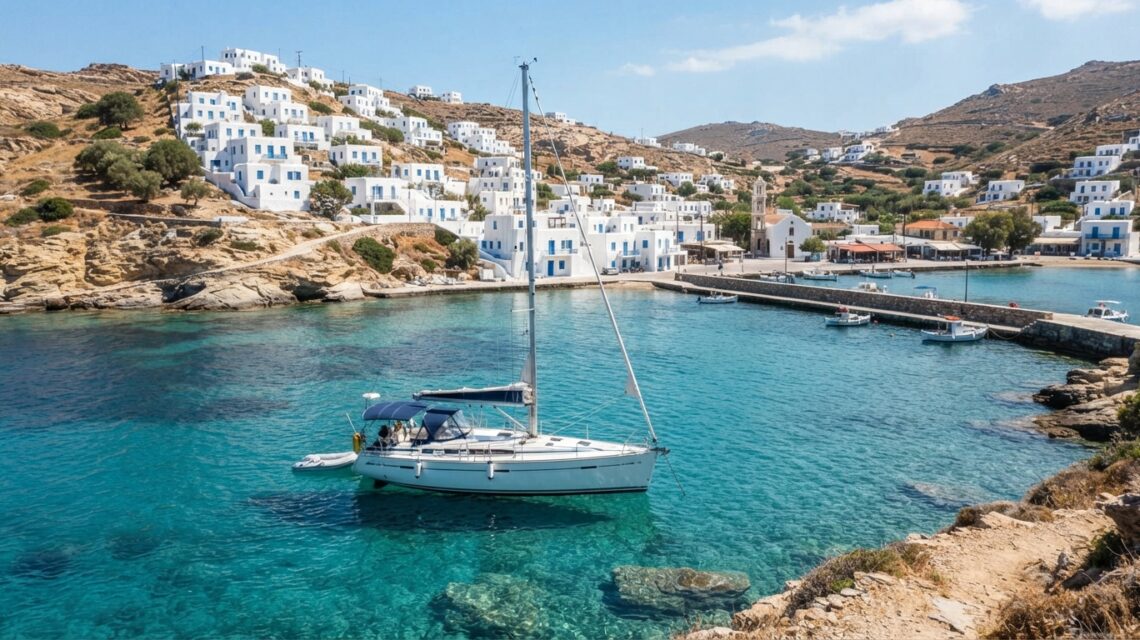
The Saronic Gulf lies between the Attica peninsula and the northeastern coast of the Peloponnese. Its geography provides greater opportunities for relatively sheltered coastal cruising, whereas the Cyclades occupy more exposed waters in the central Aegean.
Both regions offer historic harbors, swimming anchorages and waterfront tavernas. Their differences become apparent when the forecast deteriorates or a crew must reach the charter base by a fixed deadline.
| Feature | Saronic Gulf | Cyclades |
|---|---|---|
| Preferred mainland base | Alimos Marina or Zea Marina | Lavrion |
| Summer wind exposure | Generally more sheltered | Greater exposure to the Meltemi |
| Example seven-day route | 134 NM | 155–208 NM |
| Passage conditions | Coastal sailing and shorter crossings | More frequent exposed crossings |
| Popular islands | Aegina, Poros, Hydra, Spetses | Kea, Kythnos, Syros, Paros, Mykonos |
| Mooring challenges | Crowded town quays and crossed anchors | Strong crosswinds and exposed approaches |
| Best suited to | First-time Mediterranean skippers and families | Experienced, adaptable sailing crews |
| Preferred charter period | Spring through early autumn | May, June and September, subject to forecasts |
The distances represent published sample itineraries rather than regional averages. Neither destination guarantees calm conditions, and even experienced sailors should be prepared to cancel a planned crossing.
Why the Meltemi changes a Cyclades sailing holiday
The Meltemi, also known as the Etesian wind, is a predominantly northerly seasonal wind affecting the Aegean during summer.
Research compiled by the Academy of Athens identifies July and August as the months when these winds occur most frequently and intensely. Offshore conditions can reach Beaufort Force 6 or 7, with stronger episodes and local acceleration between islands, particularly around Paros and Naxos.
| Beaufort force | Wind speed | Description |
|---|---|---|
| Force 4 | 11–16 knots | Moderate breeze |
| Force 5 | 17–21 knots | Fresh breeze |
| Force 6 | 22–27 knots | Strong breeze |
| Force 7 | 28–33 knots | Near gale |
| Force 8 | 34–40 knots | Gale |
For charter crews, the practical difference is not simply faster sailing. Strong winds over exposed water can produce uncomfortable waves, complicate anchoring and increase the workload involved in reefing, steering and harbor maneuvers.
A crew sailing south with the prevailing wind may also encounter substantially more difficult conditions when returning north. This makes an ambitious outbound itinerary particularly risky when the yacht must be returned to its original marina on Friday afternoon.
The Saronic Gulf offers more opportunities to shorten passages or change destinations. However, its exposed stretches can still experience strong winds, gusts and uncomfortable seas during significant weather events.
How choosing Lavrion instead of Alimos can save hours at sea
Charter base selection can materially change a Cyclades itinerary. Alimos is conveniently positioned for the Saronic Gulf, while Lavrion, on the southeastern coast of Attica, provides more direct access to the western Cyclades.
Easy Sailing Greece publishes example passages of approximately 14 nautical miles from Lavrion to Kea and 37 to 40 nautical miles from Alimos to Kea, depending on the route.
At an assumed average speed of six knots, that difference represents roughly four additional hours underway on the outbound journey alone.
Three published weekly itineraries illustrate the wider implications.
| Suggested itinerary | Distance | Theoretical sailing time at 6 knots |
|---|---|---|
| Alimos to Saronic Gulf and return | 134 NM | 22 h 20 min |
| Lavrion to Cyclades and return | 155 NM | 25 h 50 min |
| Alimos to Cyclades and return | 208 NM | 34 h 40 min |
The longest route requires more than 12 additional hours underway compared with the Saronic itinerary. Spread across six sailing days, that amounts to approximately two additional hours per day.
Actual passage times may be longer because of adverse weather, maneuvering and upwind sailing. The Cyclades routes also visit different islands, so their mileage difference cannot be attributed entirely to the departure marina.
For sailors primarily interested in Kea, Kythnos and the western Cyclades, Lavrion is nevertheless a logical starting point.
Why the Saronic Gulf suits families but Hydra still requires planning
A typical Saronic holiday can combine Aegina’s archaeological sites and pistachio-producing countryside with the sheltered waterways around Poros, the historic harbor of Hydra and the elegant coastal architecture of Spetses.
The relatively compact cruising area allows skippers to adjust the itinerary when children become tired, passengers experience seasickness or weather conditions change. A shorter alternative route can still provide several rewarding island stops.
Hydra is an important exception to the region’s reputation for straightforward cruising. Its small, popular harbor can become crowded, and overlapping anchor chains can complicate departures.
Sunsail specifically recommends arriving early and warns about crossed anchors during high season. No particular arrival time guarantees a berth, however, and crews should prepare an alternative destination or suitable anchorage before approaching the harbor.
The same principle applies throughout Greece. A picturesque harbor is not necessarily a safe overnight destination under every wind direction.
How to plan a seven-day Cyclades charter without rushing back
A charter contract covering seven nights does not necessarily provide seven unrestricted sailing days. Greek operator Seafarer Sailing’s 2026 terms, for example, specify Saturday embarkation at 5 p.m., compulsory return by Friday at 5 p.m. and final disembarkation on Saturday morning.
That arrangement leaves six principal sailing days. Completing paperwork, inspecting the yacht and buying provisions can also make departure on the first afternoon impractical.
For an experienced crew departing Lavrion, a flexible itinerary around Kea, Kythnos and nearby western Cyclades islands may be more manageable than attempting to reach Mykonos, Paros and several additional destinations in one week.
Skippers should allow a spare day where possible and stay within a realistic return distance of the base toward the end of the charter. A favorable southbound forecast should never be treated as evidence that the subsequent northbound journey will be equally comfortable.
May, June and September can offer attractive alternatives to peak summer, but strong northerlies remain possible outside July and August. Seasonal recommendations should guide the initial booking decision, while current marine forecasts determine actual departures.
What sailing qualifications do you need to charter in Greece?
A recognized skipper qualification and a second competent adult aboard are common requirements among Greek bareboat charter operators. The precise documentation accepted, however, varies between companies and may depend on approval from the relevant authorities.
The Moorings lists the International Certificate of Competence (ICC), International Proficiency Certificate (IPC) and appropriate NauticEd SLC among its accepted qualifications for Greece. American Sailing graduates using its ASA pathway are instructed to obtain the IPC after completing ASA 104.
Other operators, including Navigare Yachting and Hermes Yachting, explicitly list ASA 104 itself among their accepted qualifications. Published policies also differ regarding RYA Day Skipper certificates, particularly when qualifications contain daylight or geographical restrictions.
Consequently, holding ASA 104 does not universally establish that an IPC is mandatory, nor does it guarantee that a particular operator will accept the certificate alone.
The second competent adult generally does not need a formal skipper qualification, although a sailing résumé or signed declaration may be required.
Submit copies of the actual qualifications before making a non-refundable payment and request written confirmation that they are appropriate for the selected yacht.
Which Greek charter region should your crew choose?
Choose the Saronic Gulf if your crew includes inexperienced sailors, young children or passengers who primarily want swimming, sightseeing and relaxed evenings ashore. Its shorter route options make it easier to balance sailing with time spent exploring islands.
Choose the Cyclades if your crew is comfortable with exposed-water passages, reefing, anchoring and demanding harbor approaches. Starting from Lavrion and limiting the number of islands can make the itinerary more manageable.
Before either charter, confirm the yacht’s anchoring equipment, operating restrictions, return deadline, skipper documentation and weather-information sources. Check Hellenic marine forecasts and the POSEIDON forecasting system throughout the trip.
If the Cyclades are your preferred destination but your crew lacks suitable experience, hiring a professional skipper provides an alternative to abandoning the region entirely.
+ Siga o Giro no Facebook
+ Siga o Giro no Instagram
Leia Mais: